
Product Review - 2004/09
David Adams
E-mail: [email protected]
The GWS A-10 Warthog is a twin ducted-fan, electric-powered, radio-controlled scale model that only weighs 16 ounces. To put this achievement into perspective, the technology available 10 years ago would have made this task impossible to accomplish; five years ago it would have been within the capabilities of a few high-tech wizards.
Today the wizards at GWS are making this technology available to everyone in an inexpensive kit that produces a nice-looking, good-flying airplane. What makes the A-10 kit (and all of GWS's kits) an exceptional value is that the price includes both ducted-fan units (which are ready to run).
GWS A-10 Warthog
Pros:
- Attractive scale model.
- Kit shows impressive engineering.
- Great parts molding with nice surface detail.
- Excellent-quality ducted-fan units included.
- Complete kit; all necessary parts to make the model are included.
- Terrific high- and low-speed flying qualities.
- Good instruction manual.
- Outstanding airplane value for the price.
Cons:
- No pilot figure.
- Fluent English-speaking editor needs to review text in manual.
- Many plastic parts were left over; it's confusing.
- Extremely slow-drying glue.
- Unrealistic wheels.
- Fragile gray paint—but hangar rash tends to give it character.
- No rudder control (stock configuration).
- Push-on wheel retainers don't retain wheels well enough.
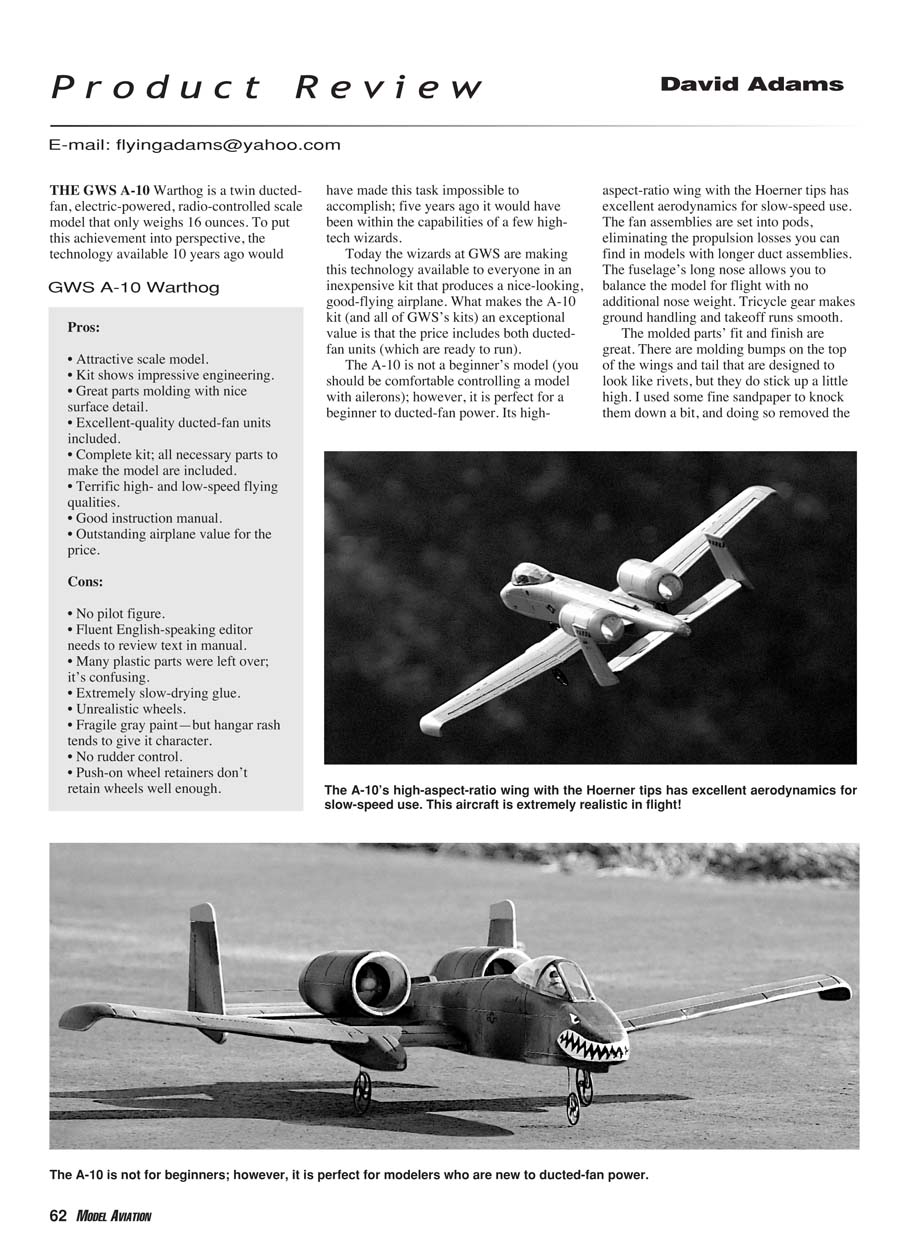
The A-10 is not a beginner's model (you should be comfortable controlling a model with ailerons); however, it is perfect for a beginner to ducted-fan power. Its high-aspect-ratio wing with Hoerner tips has excellent aerodynamics for slow-speed use. The fan assemblies are set into pods, eliminating the propulsion losses you can find in models with longer duct assemblies. The fuselage's long nose allows you to balance the model for flight with no additional nose weight. Tricycle gear makes ground handling and takeoff runs smooth.
The molded parts' fit and finish are great. There are molding bumps on the top of the wings and tail that are designed to look like rivets, but they do stick up a little high. I used some fine sandpaper to knock them down a bit, and doing so removed the gray paint on the bump. The result is a light-colored rivet against the wing's gray skin, which gives the model a pleasant weathered look.
This is actually the second A-10 I have built. I built the first one (the green-camouflage version in the photos) from a preliminary kit with just a couple pages of simple instructions. The fact that I could build it with minimal instructions indicates how smoothly and logically the model goes together. However, I do recommend that the builder read through and thoroughly understand the instructions before building any model. Following the instruction manual carefully should enable you to build the A-10 with no problems. There are no tricky areas that require unusual skills.
Concerns and Modifications
The paint is light, thin, and brittle. I would prefer a paint that stuck better when used on the foam. Molding the model from gray-tinted foam would be a better choice than a painted surface. There is a warning about using tape around the finish, but you must be careful when you use any kind of sticky material around the airplane. The adhesive will pull the paint off easily. This includes the decals. The decals are supplied with the kit; be careful when aligning them, and be sure they are in the proper position before you touch them to the finish.
I don't care for the GWS glue. I used it to attach the two fuselage sides. I squeezed what I thought was a reasonable amount onto each of the mating surfaces. Using the supplied rubber bands to hold the sides together, I set the fuselage aside to dry.
When I looked at the fuselage 30 minutes later, I saw that the glue had oozed out of the joints (I had used too much). I wiped off the excess with a cloth, but I left a small bubble of adhesive in an inconspicuous place to act as an indicator of when the glue might be hardened. A day later it was still not hard.
If you use the GWS glue, be prepared to give it adequate time to dry before stressing the joints. It is good glue; it just takes an incredibly long time to dry, especially in an area that has limited access to the air.
I like to build a little faster than the pace dictated by the GWS glue, so I switched to a foam-friendly cyanoacrylate. It worked fine on the foam and made the building process rapid. It was somewhat surprising when the airplane was finished in just a few hours.
Do double-check the cyanoacrylate you use on a small piece of foam to ensure compatibility, and don't use an excessive amount where it can be trapped in a liquid form; this can eventually dissolve the foam.
It would be nice to have operating rudders since a servo for nose-wheel steering is already installed. I built the gray A-10 exactly according to instructions with fixed rudders. I modified the green-camo A-10 with a bellcrank at the rear of the fuselage and a pushrod to each rudder. It is not too noticeable and was easy to do.
GWS recommends using five-minute epoxy for construction.
Radio Equipment
No radio equipment was provided, so I used my Futaba 8U transmitter. It has a CamPac module allowing 40 models, which is good since I have roughly 30. I have had it for several years, and although I occasionally forget how to program the functions, my fingers remember how to push the right buttons.
To achieve the lightest weight, the recommended flight equipment is:
- GWS R4 receiver
- ICS 100 ESC
- GWS Pico-series servos
- Six-cell 400 mAh 2/3AA battery
I used a GWS R4P in the gray A-10. I have seven of these receivers flying in various airplanes, and their performance has been flawless. But do keep in mind that it is a limited-range, single-conversion receiver and will not have the adjacent-frequency rejection that a double-conversion receiver will have.
The green-camo A-10 has a Hitec 555 double-conversion receiver in it. It adds approximately a half ounce but is good for a crowded flying field. There are double-conversion receivers that weigh less, but I don't have one. I recommend using a double-conversion receiver whenever possible.
I used Hitec HS-55 servos, which I have installed in five of my airplanes. They have worked perfectly. Any lightweight servo would be acceptable.
The ESC I used in the gray A-10 was a 10-amp-capacity unit of unknown manufacture; the label was torn off. The green-camo A-10 used a Great Planes 20-amp ESC. See my notes at the end of the "Flying" section.
Since I had some six-cell, 350 mAh Ni-Cad packs on hand, I used them for power.
Radio used in review: Futaba 8U transmitter, GWS R4P receiver, Hitec HS-55 servos, 10-amp ESC.
Flying
Finally we had a morning with no wind. With two airplanes waiting to be tested, it didn't seem as if that would ever happen. I did a thorough preflight of each airplane and checked control throws and CG locations. I adjusted the CG on each airplane for the middle of the instruction-manual range, using 2-inch nails shoved into the nose foam for weights.
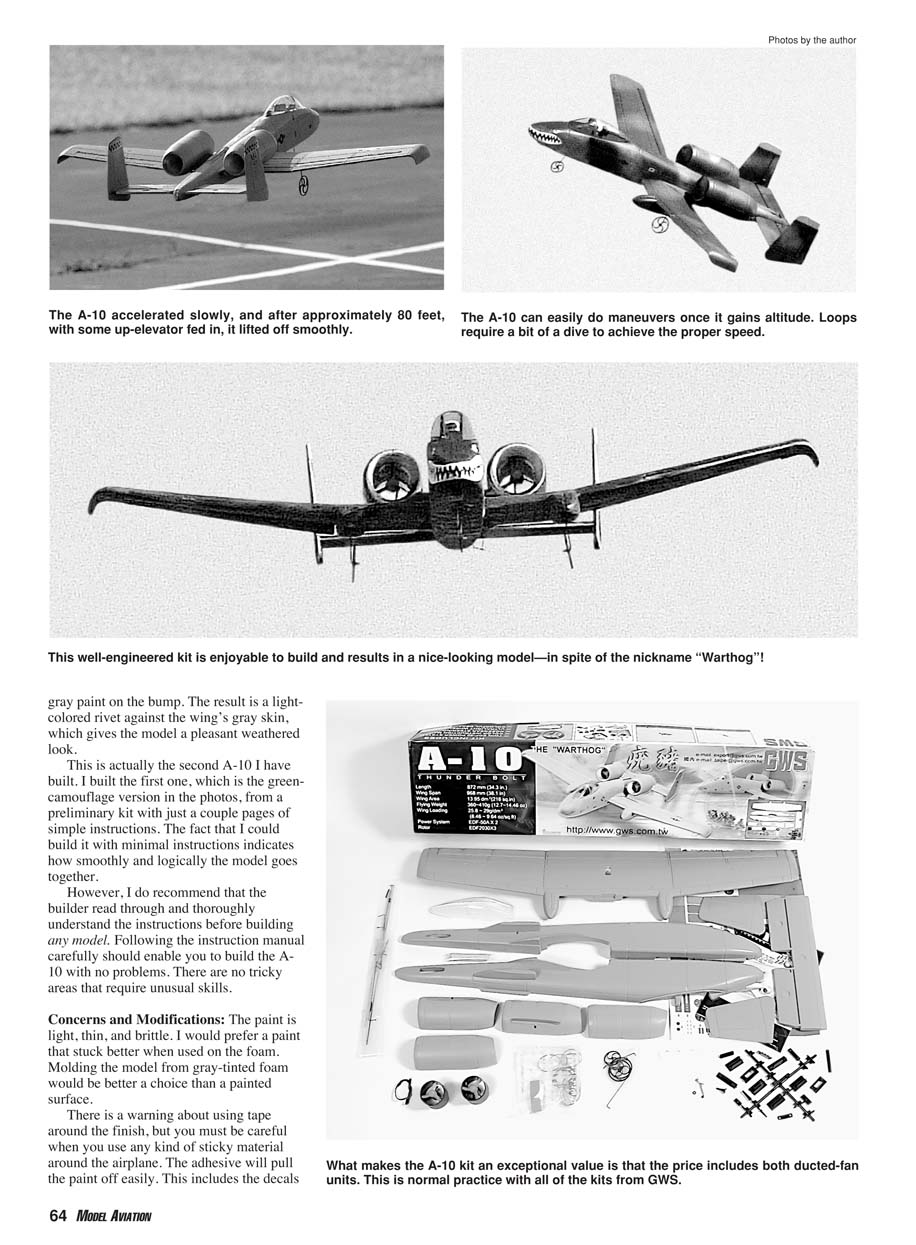
I flew the gray A-10 first because it was built to GWS specifications and was lighter. It accelerated slowly. After roughly 80 feet, I fed in some up-elevator and it lifted off smoothly. The takeoffs are straight and smooth. However, it gained altitude slowly.
Circling over the soybean field at about 3 feet, I made a mental note to myself that the airplane was forgiving in flight and handled the low speed well. A few clicks of up-trim were needed for level flight.
I kept making large circles with a small bank angle and minimal control movements. The total altitude gained after several minutes was approximately 20 feet, and the airplane did not seem capable of doing any maneuvers such as loops or rolls. As the battery voltage dropped off, the airplane started to descend. I lined up the model on the runway and made a nice landing.
The green-camo A-10 was next. It weighs roughly an ounce more than the gray A-10, but its acceleration seemed better and the climb rate was better. The overall height gained was approximately 30 feet, and although the airplane seemed slightly faster and more responsive, I didn't feel confident enough to try maneuvers. Another nice landing followed.
I went to the local hobby store and bought enough batteries for four packs of seven cells. I used AA NiMH cells rated at 700 mAh. On a discharge test these measured more like 550 mAh. They did fit nicely within the plastic battery hatch.
Based on information on Internet discussion groups, I moved the CG to roughly 62 mm from the wing LE; this is slightly aft of the recommended 50–57 mm range, and I was able to remove the nails from each airplane's nose.
The flights with the seven-cell packs were exceptional. The gray A-10's acceleration was good, and liftoff was approximately 50 feet down the runway. Climbout was fine, and I cruised the model around until it had achieved a height of nearly 300 feet in a couple of minutes. Pitch response at the aft CG was good, and the airplane handled nicely. From that height, I performed a series of loops and rolls with the model until it was back at a low altitude, and then I landed it.
The green-camo A-10 was off next. Its performance was noticeably better even though it weighed more than the gray version. The added rudder control allowed coordinated turns, the takeoff is easier to control in a crosswind, and I do think it is worth adding them. I spent most of the time flying this model at low altitude, doing loops and rolls and generally having a ball.
On another flight, one of the wheel keepers came off roughly halfway through the takeoff. The wheel departed the airplane, which kept going straight although it was making some scraping noises. I wouldn't have noticed it except that the wheel ran parallel to the airplane for a few feet before the airplane lifted off. Landing on the strut was smooth, with no problems; it was just noisy.
During this flying session I noticed that a roughly 5 mph wind was not a problem.
I wanted to find out why the green-camo A-10 seemed to fly better. The sound of its motors indicated that they were turning faster than the gray model's. The gray A-10 is lighter and has a 10-amp speed controller with fairly small wires. The green-camo A-10 is an ounce heavier, it has a 20-amp speed controller with larger wires all the way back to the motors, and likely has other small tweaks. Since the tweaks probably don't make it fly better (just meaner), the larger wires may allow less power loss at the motors. Based on this, I suggest using a 15- to 20-amp ESC with large wires all the way back to the motors.
This is a great electric-ducted-fan starter model. The A-10 has excellent flying qualities at all speeds and will delight the builder and the pilot. This is a well-engineered kit that is enjoyable to build and results in a sharp-looking (or as any airplane nicknamed "Warthog" can look) scale model. I highly recommend it and think it is a superior value.
(Editor's note: GWS advises that the A-10 kit with the EDF-50 units is intended for indoor flying. The upgraded kit that includes the EDF-55 units is better suited to aerobatics.)
Specifications:
- Wingspan: 38 inches
- Wing area: 219 square inches
- Length: 34 inches
- Recommended weight: 14.5 ounces
- Review model's weight (ready to fly): 16.3 ounces with battery
- Power supplied in kit: Two GWS EDF-50 ducted-fan units. You must add a six-cell Ni-Cd battery.
- Recommended radio: Four-channel — aileron, elevator, motor, nose-wheel steering
Kit materials:
- Foam (structure)
- Plastic (parts)
Needed to finish model:
- Sharp hobby knife
- Wire-cutting pliers
- Foam-friendly cyanoacrylate
Needed to fly model:
- Transmitter
- Receiver
- Three servos
- ESC
- Motor battery
Manufacturer / distributor:
GWS USA, LLC 3401 Airport Dr. Torrance, CA 90505 (310) 891-3339 Toll free: (866) FLYGWS4 Fax: (310) 891-3313 www.gws.com.tw/
Horizon Hobby 4105 Fieldstone Rd. Champaign, IL 61822 (217) 352-1913 Toll free: (800) 338-4639 Fax: (217) 352-6799
Street price: $79.99
Products used in review:
Futaba 8U Super Series radio system, 20-amp ESC: Great Planes Manufacturing Box 9021 Champaign, IL 61822 (217) 398-8970 www.futaba-rc.com
HS-55 servos, 555 receiver: Hitec RCD USA, Inc. 12115 Paine St. Poway, CA 92064 (858) 748-6948 Fax: (858) 748-1767 www.hitecrcd.com
Transcribed from original scans by AI. Minor OCR errors may remain.

