
Product Review
Frank Mandriota
HobbyZone Sky Surfer
Pros:
- The quality and completeness of the kit.
- The ease of flying.
- Novelty of the flying experience.
Con:
- The tangles of shroud lines.
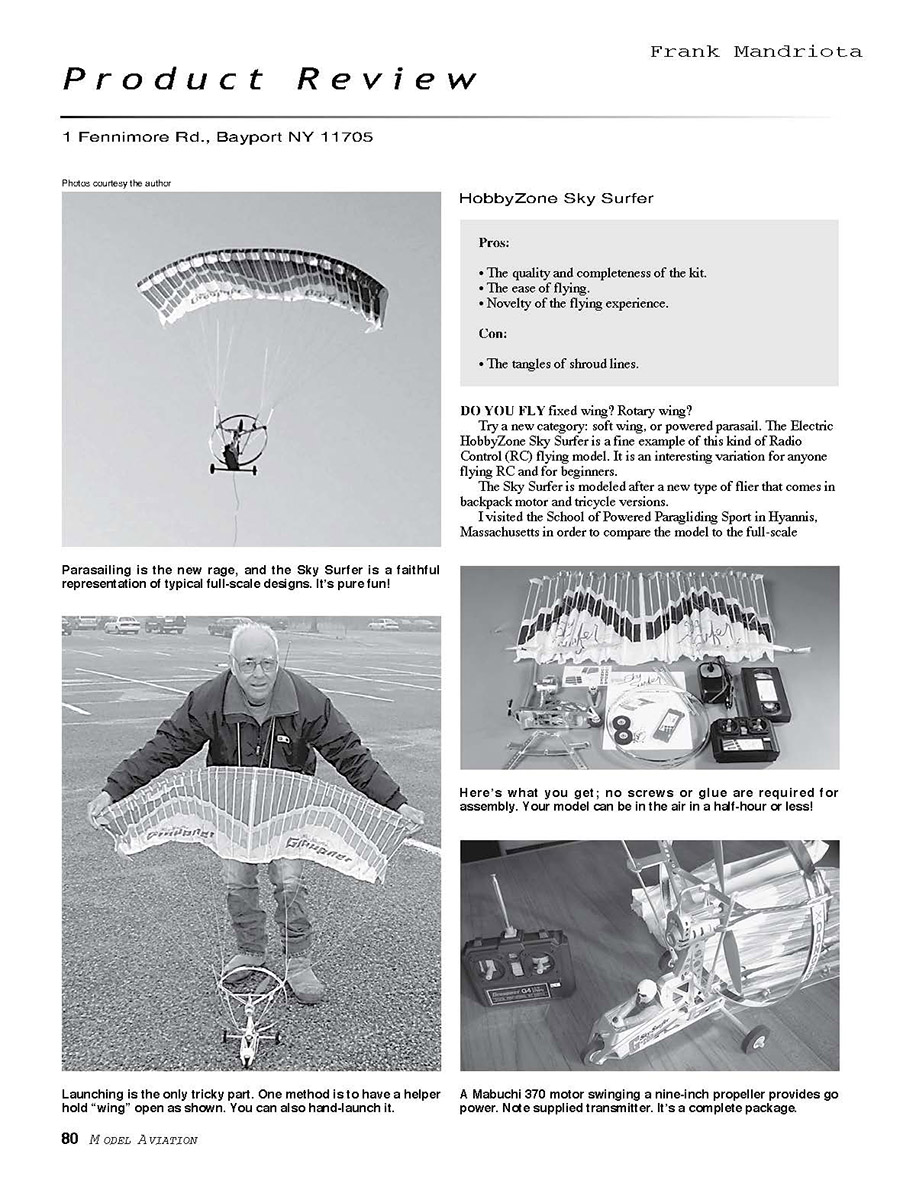
DO YOU FLY fixed wing? Rotary wing? Try a new category: soft wing, or powered parasail. The Electric HobbyZone Sky Surfer is a fine example of this kind of Radio Control (RC) flying model. It is an interesting variation for anyone flying RC and for beginners.
The Sky Surfer is modeled after a new type of flier that comes in backpack motor and tricycle versions.
I visited the School of Powered Paragliding Sport in Hyannis, Massachusetts in order to compare the model to the full-scale version. Powered paragliding has been developing for approximately 20 years and derives from hang gliding and basic paragliding, which are the gravity-powered counterparts.
In the powered full-scale version, two handles are attached to the wing for turning. Pull on the right handle to go right; pull on the left handle to go left—just like a parachute.
Squeeze the throttle handle to speed up the motor, and you go up. Let the motor idle, and you glide down. Somewhere in between produces level flight.
To land, idle, or shut off the motor, glide where you want to land, pull on the brake lines, and the model comes to a smooth landing in just a few steps.
The Sky Surfer is a faithful model of the full-scale version and uses right-left stick controlling a servo to pull the shrouds for turning.
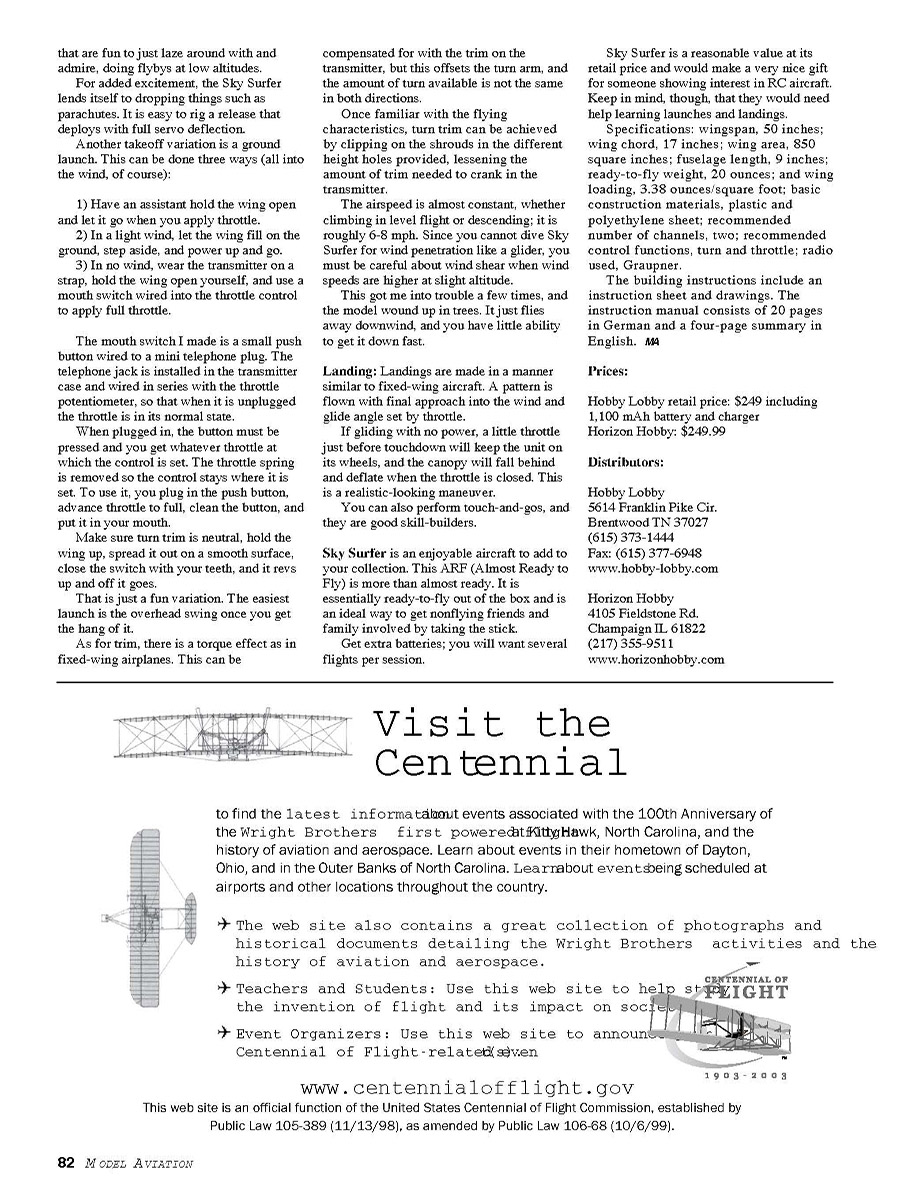
The model is well-packaged in a compact box (5 x 19 x 19 inches), and the parts were easy to identify. This was fortunate, since the bulk of the instructions are in German with an English summary sheet.
Assembly was literally a snap—with no screws and no glue—just push everything into place, and they snap together (and hold together through rough landings)!
Canopy colors vary; there is green-yellow-and-white and red-white-and-blue.
Handling the thin polyethylene-sheet wing and avoiding line tangles is the only departure that takes patience for the person who is new to this kind of model. If you have a charged battery, your model can be in the air in a half-hour or less.
The kit is complete with transmitter, motor, and parasail wing (canopy). Detail and quality is at a high level.
The motor is a Mabuchi 370 with a nine-inch propeller, which is in a protective ring. The outside of the ring is a convenient place to cement the trailing antenna that can tangle with the shrouds. I did that, and I haven’t noticed an effect on range or reliability of reception.
The battery from Hobby Lobby is a seven-cell, 1,100 mAh Ni-Cd, and it fits snugly in the compartment at the bottom of the fuselage. The supplied radio is a lightweight, two-channel, 27 MHz unit that requires six AA alkalines or Ni-Cds.
I use Ni-Cds and wired in a connector that permits charging without removing the cells. There is an Electronic Speed Control integral with the receiver and one servo controlling the shrouds for turning. Plenty of servo-arm movement is available, allowing tight turns.
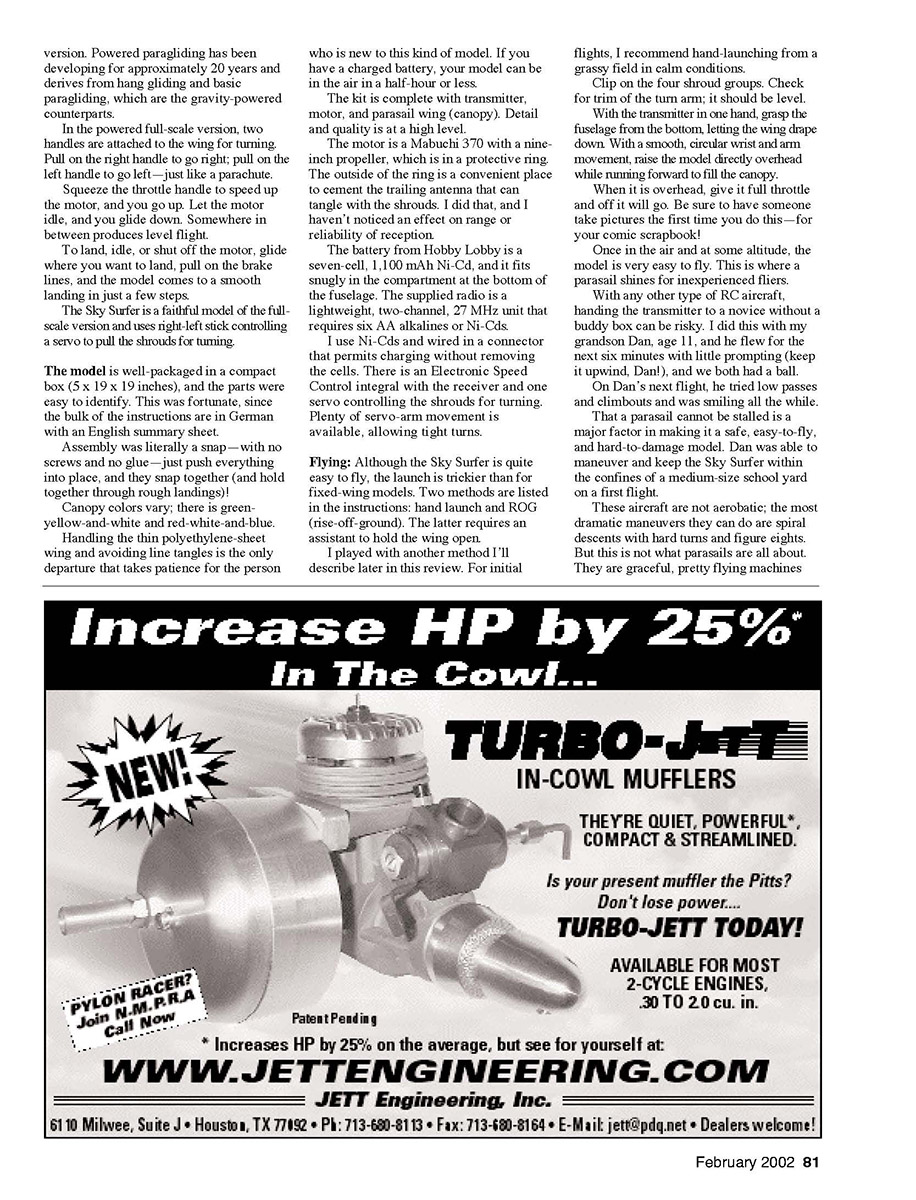
Flying: Although the Sky Surfer is quite easy to fly, the launch is trickier than for fixed-wing models. Two methods are listed in the instructions: hand launch and ROG (rise-off-ground). The latter requires an assistant to hold the wing open.
I played with another method I’ll describe later in this review. For initial flights, I recommend hand-launching from a grassy field in calm conditions.
Clip on the four shroud groups. Check for trim of the turn arm; it should be level.
With the transmitter in one hand, grasp the fuselage from the bottom, letting the wing drape down. With a smooth, circular wrist and arm movement, raise the model directly overhead while running forward to fill the canopy.
When it is overhead, give it full throttle and off it will go. Be sure to have someone take pictures the first time you do this—for your comic scrapbook!
Once in the air and at some altitude, the model is very easy to fly. This is where a parasail shines for inexperienced fliers.
With any other type of RC aircraft, handing the transmitter to a novice without a buddy box can be risky. I did this with my grandson Dan, age 11, and he flew for the next six minutes with little prompting (keep it upwind, Dan!), and we both had a ball.
On Dan’s next flight, he tried low passes and climbs and was smiling all the while.
That a parasail cannot be stalled is a major factor in making it a safe, easy-to-fly, and hard-to-damage model. Dan was able to maneuver and keep the Sky Surfer within the confines of a medium-size school yard on a first flight.
These aircraft are not aerobatic; the most dramatic maneuvers they can do are spiral descents with hard turns and figure eights. But this is not what parasails are all about. They are graceful, pretty flying machines that are fun to just laze around with and admire, doing flybys at low altitudes.
For added excitement, the Sky Surfer lends itself to dropping things such as parachutes. It is easy to rig a release that deploys with full servo deflection.
Another takeoff variation is a ground launch. This can be done three ways (all into the wind, of course):
- Have an assistant hold the wing open and let it go when you apply throttle.
- In a light wind, let the wing fill on the ground, step aside, and power up and go.
- In no wind, wear the transmitter on a strap, hold the wing open yourself, and use a mouth switch wired into the throttle control to apply full throttle.
The mouth switch I made is a small push button wired to a mini telephone plug. The telephone jack is installed in the transmitter case and wired in series with the throttle potentiometer, so that when it is unplugged the throttle is in its normal state.
When plugged in, the button must be pressed and you get whatever throttle at which the control is set. The throttle spring is removed so the control stays where it is set. To use it, you plug in the push button, advance throttle to full, clean the button, and put it in your mouth.
Make sure turn trim is neutral, hold the wing up, spread it out on a smooth surface, close the switch with your teeth, and it revs up and off it goes.
That is just a fun variation. The easiest launch is the overhead swing once you get the hang of it.
As for trim, there is a torque effect as in fixed-wing airplanes. This can be compensated for with the trim on the transmitter, but this offsets the turn arm, and the amount of turn available is not the same in both directions.
Once familiar with the flying characteristics, turn trim can be achieved by clipping on the shrouds in the different height holes provided, lessening the amount of trim needed to crank in the transmitter.
The airspeed is almost constant, whether climbing in level flight or descending; it is roughly 6-8 mph. Since you cannot dive Sky Surfer for wind penetration like a glider, you must be careful about wind shear when wind speeds are higher at slight altitude.
This got me into trouble a few times, and the model wound up in trees. It just flies away downwind, and you have little ability to get it down fast.
Landing: Landings are made in a manner similar to fixed-wing aircraft. A pattern is flown with final approach into the wind and glide angle set by throttle.
If gliding with no power, a little throttle just before touchdown will keep the unit on its wheels, and the canopy will fall behind and deflate when the throttle is closed. This is a realistic-looking maneuver.
You can also perform touch-and-gos, and they are good skill-builders.
Sky Surfer is an enjoyable aircraft to add to your collection. This ARF (Almost Ready to Fly) is more than almost ready. It is essentially ready-to-fly out of the box and is an ideal way to get nonflying friends and family involved by taking the stick.
Get extra batteries; you will want several flights per session.
Sky Surfer is a reasonable value at its retail price and would make a very nice gift for someone showing interest in RC aircraft. Keep in mind, though, that they would need help learning launches and landings.
Specifications: wingspan, 50 inches; wing chord, 17 inches; wing area, 850 square inches; fuselage length, 9 inches; ready-to-fly weight, 20 ounces; and wing loading, 3.38 ounces/square foot; basic construction materials, plastic and polyethylene sheet; recommended number of channels, two; recommended control functions, turn and throttle; radio used, Graupner.
The building instructions include an instruction sheet and drawings. The instruction manual consists of 20 pages in German and a four-page summary in English.
Prices:
Hobby Lobby retail price: $249 including 1,100 mAh battery and charger Horizon Hobby: $249.99
Distributors:
Hobby Lobby 5614 Franklin Pike Cir. Brentwood TN 37027 (615) 373-1444 Fax: (615) 377-6948 www.hobby-lobby.com
Horizon Hobby 4105 Fieldstone Rd. Champaign IL 61822 (217) 355-9511 www.horizonhobby.com
Transcribed from original scans by AI. Minor OCR errors may remain.

