
Product Review
SR Batteries Cutie
Pros:
- Completeness and quality of the kit contents
- Very detailed photo-documented assembly manual
- Structural design
- Precision of the parts
- Flying qualities
Cons:
- None
IN THE 1960s and 1970s, a number of excellent 1/2A glow-engine-powered Radio Control (RC) designs emerged that made great-flying rudder/elevator models. Today, with the availability of very capable electric power systems and disappearing traditional flying sites, many of the earlier 1/2A glow-powered models are being revisited as Electric limited-space flyers.
One that has become a real favorite is the Lee Renaud-designed Q-Tee. The general appeal of the Q-Tee found its way into the heart of Larry Srnickich — the guy behind SR Batteries. With the blessing of the Lee Renaud family, Larry, in turn, took the spirit of the Q-Tee and developed the SR Cutie.
The Cutie is a bit larger than its predecessor, and curves are used where straight lines once were, but you can't mistake what inspired this model.
In addition to the obvious tweaks to the original Q-Tee design and the use of electric power, Larry took full advantage of modern design and kit-manufacturing techniques. The result is a kit that sets a new standard.
I've been building model airplanes of all types for almost 50 years. The SR Cutie was the best kit-building experience I have had, bar none. Let's take a look at this great electric-powered RC model.
Kit Contents
The Cutie is purchased directly via mail order from SR Batteries. Inside the box that arrives on your doorstep is a treasure of neat stuff. The laser-cut-wood and Lexan® parts are nicely sealed in plastic bags. The building plan comes in a very convenient size that fits easily on your building surface.
Upon spreading the kit contents out on your bench, you will notice that all the hardware is name brand. You even get a custom set of Dave Brown Products Lite Flite wheels.
Complementing the quality materials is the most comprehensive assembly manual I have ever seen. It is loaded with quality photographs that take you through all the building steps. The inexperienced builder will really appreciate this guide.
Experienced builders also need to pay attention to the manual because there are a number of departures from common construction practices.
Assembly
From the get-go you get to see some of the innovative design and building techniques used for this model.
You start the Cutie's assembly with the fuselage. The first step is to add balsa doublers to the fuselage sides. Although that's not difficult, keeping the parts aligned can be a challenge sometimes.
The Cutie includes a couple of laser-cut alignment fixtures that make this process a guaranteed perfect fit. That is good, because each stage of fuselage construction is a symphony of perfectly fitting parts in proper alignment that produce a dead straight and square fuselage structure.
The fuselage goes together in no time if you follow the well-documented steps in the assembly manual. The fuselage structure is full of "wow, that's really neat" parts and assembly techniques, including the nose cheeks, the turtledeck structure, and the removable battery hatch.
The latter is made from layers of laser-cut parts. Not only does this greatly reduce the amount of shaping work that has to be done, but the finished hatch ends up fitting the fuselage perfectly.
One other noteworthy feature of the fuselage structure is the wing mount. The Cutie has a parasol-mounted wing. The design and supplied parts for this model's parasol wing mount are brilliant in their execution.
The combination of carbon-fiber tubes for the uprights and precise laser-cut plywood parts results in a very strong, lightweight, dead-true wing mount. This is a signature feature of the kit.
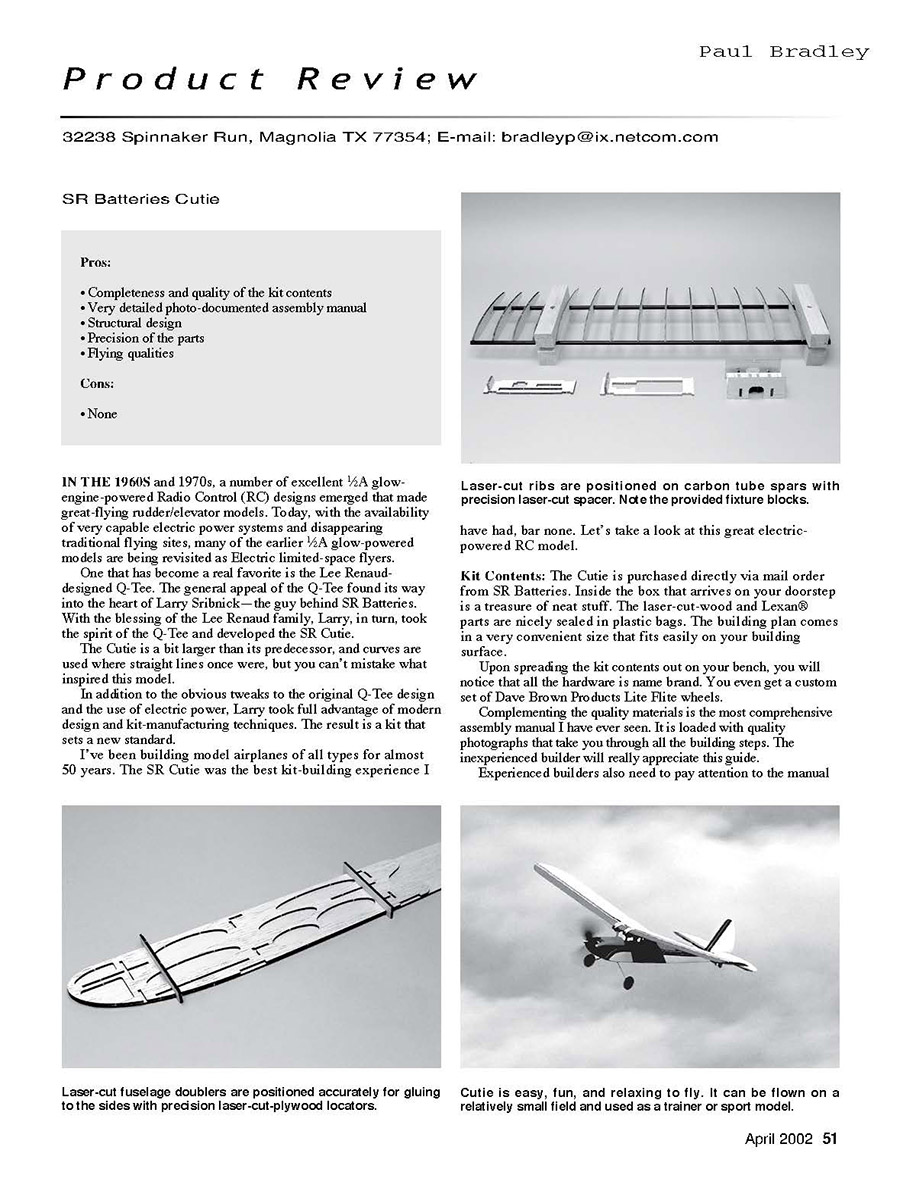
This model's wing structure is also unique. Each wing panel is assembled around two carbon-fiber tubes. They give the wing tremendous strength in bending, and one of the tubes serves as the leading edge.
Laser-cut fixtures and spacers are provided to make sure you end up with a straight wing structure.
As does the fuselage, the wing structure goes together fairly quickly. The assembly steps begin by sliding the ribs onto the two carbon-fiber spars. Very clever use of paper clips and rubber bands keeps the unglued structure together.
Once the ribs are properly spaced, a little bit of thin cyanoacrylate glue (CyA) is used to lock everything in place. At this point, you have the core wing-panel structure completed. Assembly of each panel then progresses through the addition of a laser-cut-sheet trailing edge, tip pieces, and finally the center-section parts.
A perfect fit at the dihedral joint is ensured through the use of supplied angle gauges and laser-cut Lexan® alignment keys. The completed wing structure is very strong and true.
Covering and Finish
The only problem a Cutie builder faces when covering the model is choosing a color scheme. The manual gives very good covering instructions that include laying out the individual pieces on a standard roll of film.
The review Cutie was covered with white UltraCote® that incorporated red-and-blue UltraCote® trim.
Equipment Installation
The recommended power setup for the Cutie is a 7.2-volt Speed 400 mated to a Graupner 2.33:1 gear drive, motivated by a 10-cell 500 mAh battery pack. To make life easy, SR offers a complete power-system package, which was used to power the review model.
The package contains the motor mated to the gear drive, a Jeti 350 Electronic Speed Control (ESC) professionally connected to the motor, a 10-cell SR 500 Max battery pack, Sernos connectors already installed on the battery and ESC, a Graupner prop adapter, a Graupner 9 x 5 SlimProp, and, to finish it all off, a nice Tru-Turn spinner nut.
All you have to do is open the bag and install the components in the model; it doesn't get any easier than this.
The generous space provided by the Cutie fuselage makes installing the radio equipment very easy. The supplied servo mounts are set up to handle miniservos; there are many that will work nicely in this model. SR offers the Maxx Products 50HP ball-bearing servos, which were used in the review model.
Flying
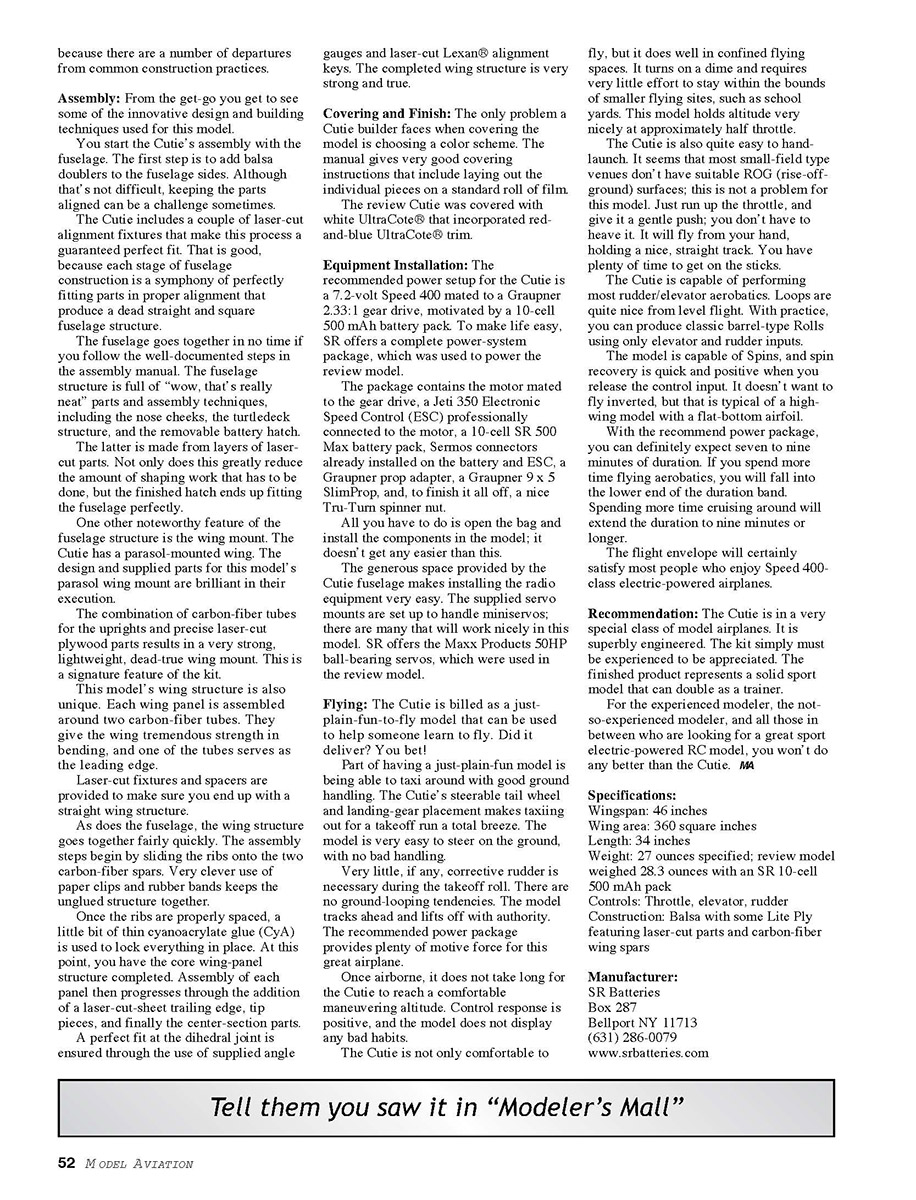
The Cutie is billed as a just-plain-fun-to-fly model that can be used to help someone learn to fly. Did it deliver? You bet!
Part of having a just-plain-fun model is being able to taxi around with good ground handling. The Cutie's steerable tail wheel and landing-gear placement makes taxiing out for a takeoff run a total breeze. The model is very easy to steer on the ground, with no bad handling.
Very little, if any, corrective rudder is necessary during the takeoff roll. There are no ground-looping tendencies. The model tracks ahead and lifts off with authority. The recommended power package provides plenty of motive force for this great airplane.
Once airborne, it does not take long for the Cutie to reach a comfortable maneuvering altitude. Control response is positive, and the model does not display any bad habits.
The Cutie is not only comfortable to fly, but it does well in confined flying spaces. It turns on a dime and requires very little effort to stay within the bounds of smaller flying sites, such as school yards. This model holds altitude very nicely at approximately half throttle.
The Cutie is also quite easy to hand-launch. It seems that most small-field type venues don't have suitable ROG (rise-off-ground) surfaces; this is not a problem for this model. Just run up the throttle, and give it a gentle push; you don't have to heave it. It will fly from your hand, holding a nice, straight track. You have plenty of time to get on the sticks.
The Cutie is capable of performing most rudder/elevator aerobatics. Loops are quite nice from level flight. With practice, you can produce classic barrel-type Rolls using only elevator and rudder inputs.
The model is capable of Spins, and spin recovery is quick and positive when you release the control input. It doesn't want to fly inverted, but that is typical of a high-wing model with a flat-bottom airfoil.
With the recommended power package, you can definitely expect seven to nine minutes of duration. If you spend more time flying aerobatics, you will fall into the lower end of the duration band. Spending more time cruising around will extend the duration to nine minutes or longer.
The flight envelope will certainly satisfy most people who enjoy Speed 400-class electric-powered airplanes.
Recommendation
The Cutie is in a very special class of model airplanes. It is superbly engineered. The kit simply must be experienced to be appreciated. The finished product represents a solid sport model that can double as a trainer.
For the experienced modeler, the not-so-experienced modeler, and all those in between who are looking for a great sport electric-powered RC model, you won't do any better than the Cutie. MA
Specifications
Wingspan: 46 inches Wing area: 360 square inches Length: 34 inches Weight: 27 ounces specified; review model weighed 28.3 ounces with an SR 10-cell 500 mAh pack Controls: Throttle, elevator, rudder Construction: Balsa with some Lite Ply featuring laser-cut parts and carbon-fiber wing spars
Manufacturer: SR Batteries Box 287 Bellport NY 11713 (631) 286-0079 www.srbatteries.com
Transcribed from original scans by AI. Minor OCR errors may remain.

