
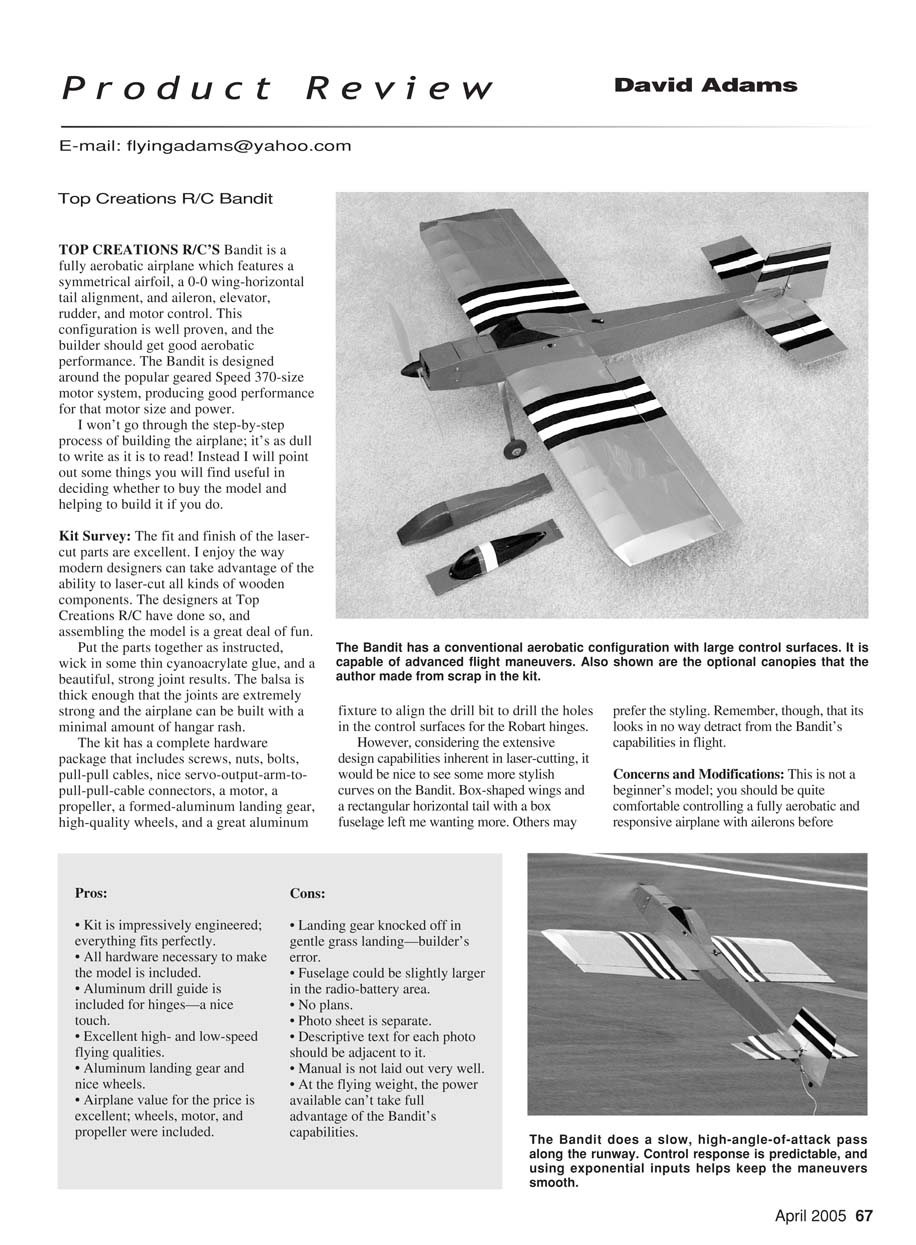
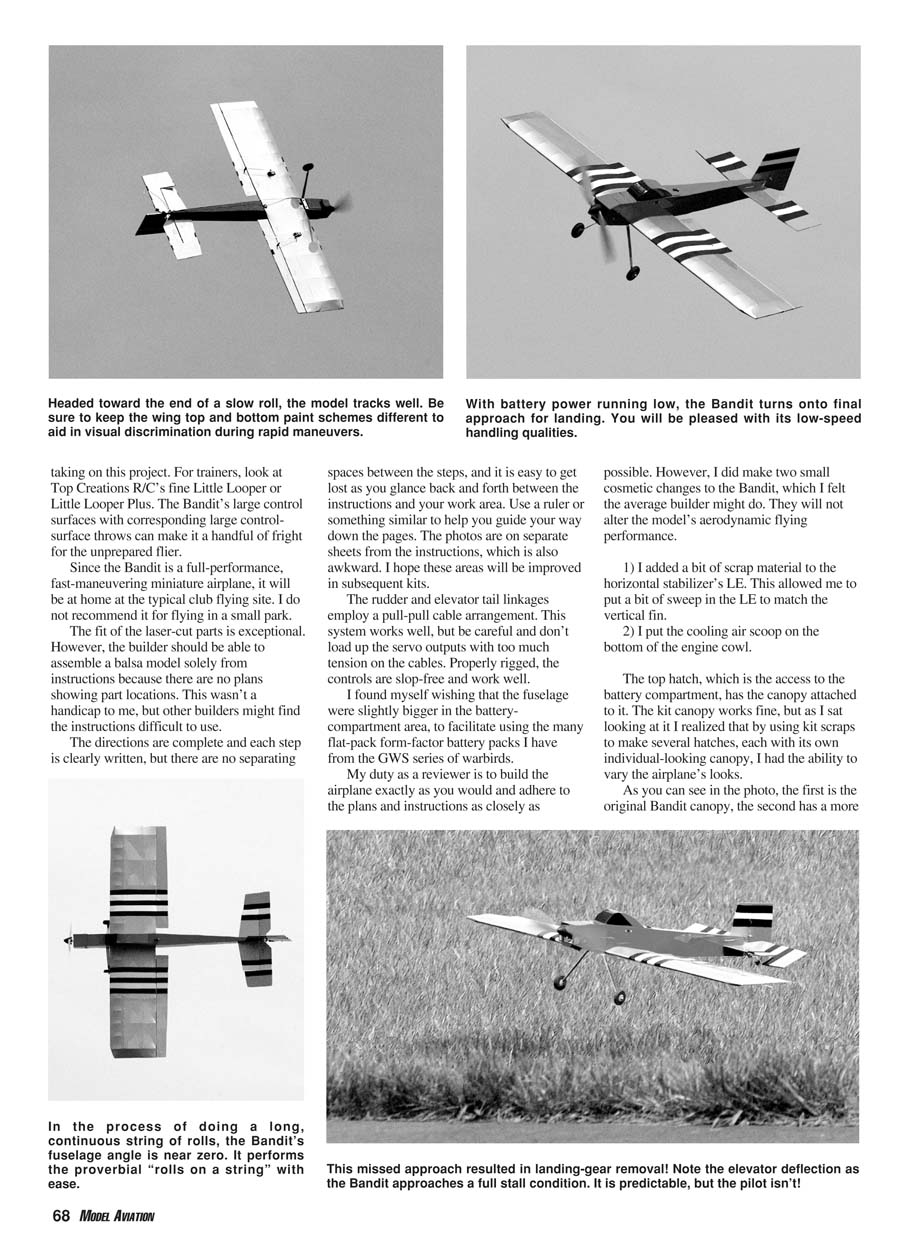
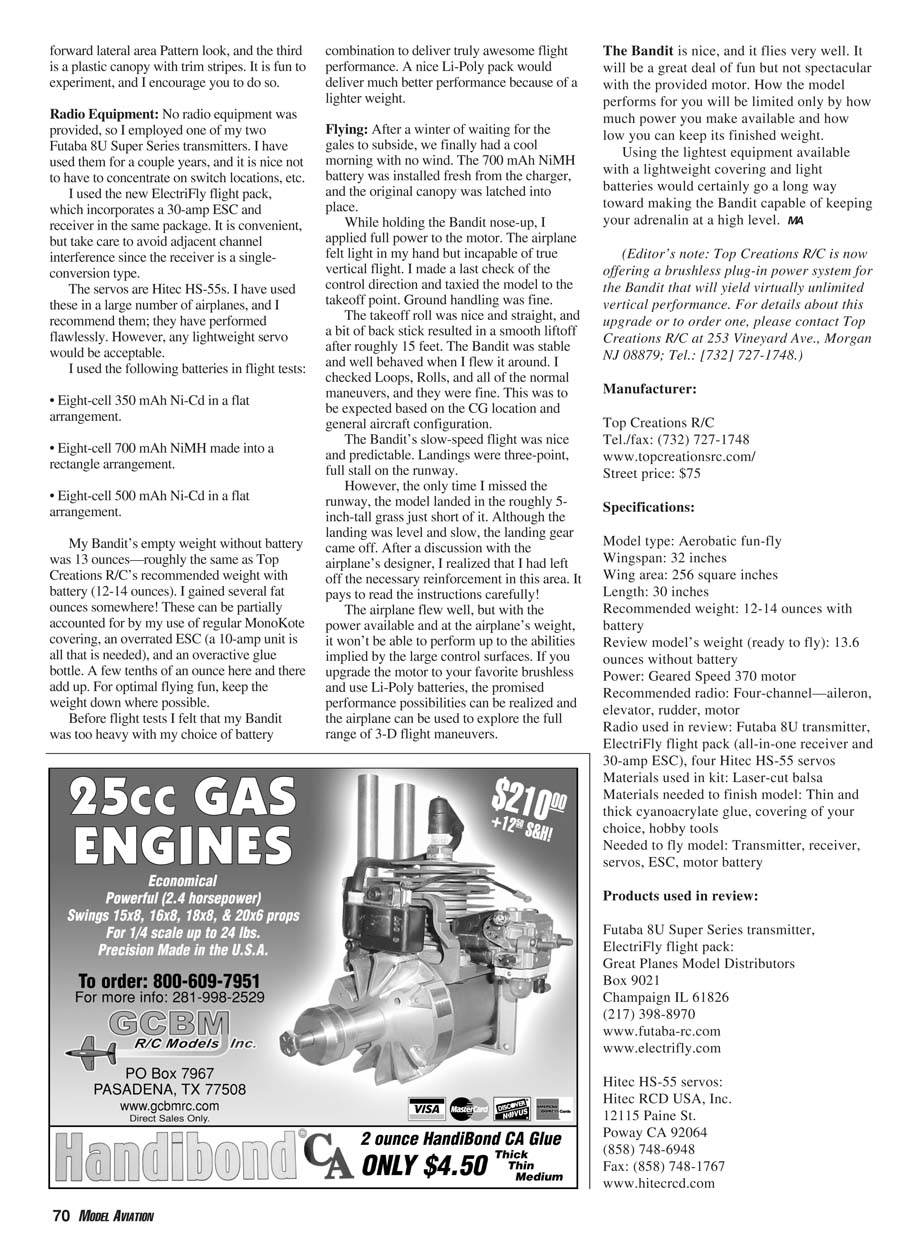
Top Creations R/C Bandit
David Adams E-mail: [email protected]
TOP CREATIONS R/C's Bandit is a fully aerobatic airplane that features a symmetrical airfoil, a 0°-0° wing-to-horizontal-tail alignment, and aileron, elevator, rudder, and motor control. This proven configuration should give the builder good aerobatic performance. The Bandit is designed around the popular geared Speed 370–size motor system, producing respectable performance for that motor size and power.
I won't go through the step-by-step process of building the airplane; it's as dull to write as it is to read. Instead I will point out useful details to help you decide whether to buy the model and to assist in building it if you do.
Kit Survey
The fit and finish of the laser-cut parts are excellent. Modern designers can take full advantage of laser cutting to produce precisely shaped wooden components, and the designers at Top Creations R/C have done so. Assembling the model is a great deal of fun.
Wick in some thin cyanoacrylate glue where indicated, and a beautiful, strong joint results. The balsa is thick enough that the joints are extremely strong, and the airplane can be built with minimal hangar rash.
The kit includes a complete hardware package:
- Screws, nuts, and bolts
- Pull-pull cables and nice servo-output-arm-to-pull-pull-cable connectors
- A motor and propeller
- A formed-aluminum landing gear and high-quality wheels
- An aluminum drill guide to align the drill bit for Robart hinges
That said, considering the design possibilities afforded by laser cutting, it would be nice to see more stylish curves on the Bandit. The box-shaped wings, rectangular horizontal tail, and box fuselage left me wanting a bit more flair. Others may prefer the current styling; the looks do not detract from the Bandit's flight capabilities.
Concerns and Modifications
This is not a beginner's model. You should be comfortable controlling a fully aerobatic, responsive airplane with ailerons before taking on this project. For trainer-type models, consider Top Creations R/C's Little Looper or Little Looper Plus. The Bandit's large control surfaces and corresponding large throws can be a handful for the unprepared pilot. As a full-performance, fast-maneuvering miniature airplane, the Bandit is best suited to a typical club flying site, not a small park.
The laser-cut fit is exceptional. However, the builder must assemble the balsa model solely from the instructions because there are no plans showing part locations. This wasn't a handicap for me, but some builders might find the instructions difficult to follow. The directions are complete and easy to follow, but there are areas that could be improved:
- The manual's layout is not ideal: each step is clearly written, but there are no separating spaces between steps, making it easy to lose your place when glancing back and forth between the instructions and your work area. Use a ruler or similar guide to keep your place.
- The photos are printed on separate sheets from the instructions, which is awkward. Descriptive text for each photo should be adjacent to that photo.
I hope these areas are improved in subsequent kits.
The rudder and elevator use a pull-pull cable arrangement. This system works well, but be careful not to overload the servo outputs with too much tension on the cables. Properly rigged, the controls are slop-free and effective.
I wished the fuselage were slightly larger in the battery compartment area to accommodate flat-pack batteries such as those from the GWS series.
As a reviewer I built the kit following the plans and instructions closely, but I made two small cosmetic changes that many builders might also make. They do not alter aerodynamic performance:
- I added a bit of scrap material to the horizontal stabilizer leading edge to introduce a slight sweep that matches the vertical fin.
- I placed the cooling air scoop on the bottom of the engine cowl.
The top hatch (battery access) has the canopy attached. The kit canopy works fine, but I made several alternative hatches from kit scraps, each with its own canopy style, so I could vary the airplane's appearance. It’s fun to experiment.
Pros:
- Kit is impressively engineered; everything fits perfectly.
- All necessary hardware is included.
- Aluminum drill guide for hinges is a nice touch.
- Excellent high- and low-speed flying qualities.
- Aluminum landing gear and nice wheels.
- Excellent value for the price; wheels, motor, and propeller included.
Cons:
- Landing gear was knocked off in a gentle grass landing—builder error from missing reinforcement.
- Fuselage could be slightly larger in the radio/battery area.
- No full-size plans are included.
- Photo sheet is separate from the instructions.
- Descriptive text for each photo should be adjacent to it.
- Manual layout could be improved.
- At the kit's flying weight with the supplied motor, the available power can't take full advantage of the Bandit's control-surface capabilities.
Radio Equipment
No radio equipment was provided. I used one of my Futaba 8U Super Series transmitters. For power and control I used an ElectriFly flight pack, which integrates a 30-amp ESC and receiver in one package. It is convenient, but be careful about adjacent-channel interference since the receiver is a single-conversion type.
Servos used: Hitec HS-55s. These are lightweight, reliable servos I have used frequently; any similar lightweight servos would be acceptable.
Batteries used in flight tests:
- Eight-cell 350 mAh Ni-Cd (flat arrangement)
- Eight-cell 700 mAh NiMH (rectangular arrangement)
- Eight-cell 500 mAh Ni-Cd (flat arrangement)
My Bandit's empty weight without battery was 13.6 ounces—roughly the same as Top Creations R/C's recommended weight with battery (12–14 ounces). I gained several fat ounces somewhere. Part of that came from my use of regular MonoKote covering, an oversized ESC (a 10-amp unit is sufficient), and an enthusiastic application of glue. Small weight additions add up; keep weight down where possible.
Before flight tests I felt my Bandit was a bit heavy with my chosen battery combination to deliver truly outstanding performance. A Li-Poly pack would provide much better performance because of lighter weight.
Flying
After a long winter we finally had a cool, wind-free morning. I installed a freshly charged 700 mAh NiMH battery and latched the original canopy. Holding the Bandit nose-up, I applied full power. The airplane felt light in my hand but could not sustain true vertical with the supplied motor and batteries. After final control checks I taxied to the takeoff point. Ground handling was fine. The takeoff roll was straight; a bit of back stick produced a smooth liftoff after roughly 15 feet.
In flight the Bandit was stable and well behaved. Loops, rolls, and other normal aerobatic maneuvers were fine, as expected from the CG location and general configuration. Slow-speed flight was predictable. Landings were typically three-point, full-stall on the runway.
On one landing the model fell short of the runway into approximately 5-inch-tall grass. Although the landing was level and slow, the landing gear came off. After consulting the designer I realized I had left off the necessary reinforcement in that area. It pays to read the instructions carefully.
With the provided motor and the airplane's weight, the Bandit will not realize the full potential implied by its large control surfaces. Upgrade to a brushless motor and Li-Poly batteries and you'll unlock much more performance, including strong vertical and 3-D capability.
Overall, the Bandit is a nice flyer and a lot of fun. Its ultimate performance depends on how much power you provide and how light you can keep the finished model. Using the lightest equipment, a lightweight covering, and light batteries will greatly enhance performance and increase the plane's 3-D potential.
(Editor's note: Top Creations R/C is now offering a brushless plug-in power system for the Bandit that will yield virtually unlimited vertical performance. For details or to order, contact Top Creations R/C at 253 Vineyard Ave., Morgan, NJ 08879; Tel.: (732) 727-1748.)
Manufacturer
Top Creations R/C Tel./fax: (732) 727-1748 www.topcreationsrc.com Street price: $75
Specifications
- Model type: Aerobatic fun-fly
- Wingspan: 32 inches
- Wing area: 256 square inches
- Length: 30 inches
- Recommended weight: 12–14 ounces with battery
- Review model's empty weight (without battery): 13.6 ounces
- Power: Geared Speed 370 motor
- Recommended radio: Four-channel—aileron, elevator, rudder, motor
- Radio used in review: Futaba 8U transmitter; ElectriFly flight pack (integrated receiver and 30-amp ESC); four Hitec HS-55 servos
- Materials used in kit: Laser-cut balsa
- Materials needed to finish model: Thin and thick cyanoacrylate glue, covering of your choice, hobby tools
- Needed to fly model: Transmitter, receiver (if not included in pack), servos, ESC, battery, motor
Products used in review
Futaba 8U Super Series transmitter; ElectriFly flight pack: Great Planes Model Distributors Box 9021 Champaign, IL 61826 (217) 398-8970 www.futaba-rc.com www.electrifly.com
Hitec HS-55 servos: Hitec RCD USA, Inc. 12151 Paine St. Poway, CA 92064 (858) 748-6948 Fax: (858) 748-1767 www.hitecrcd.com
Transcribed from original scans by AI. Minor OCR errors may remain.

