



Product Spotlight
QUEST FOR FLIGHT
REVIEWS
Chris Silva provided us this review of Quest for Flight. Here is what he had to say:
In their new book, Quest for Flight: John J. Montgomery and the Dawn of Aviation in the West (University of Oklahoma Press, $29.95 hardcover $14.97 Kindle), authors Craig Harwood and Gary Fogel make a compelling case for John Montgomery’s place in the development of manned flight and the flight sciences.
Harwood and Fogel have pored over Montgomery family records, newspaper articles, and the archives of Santa Clara University [California] to return John Montgomery’s story to our consciousness. You can hardly read about Montgomery’s struggles and successes without imagining boxes of yellowed letters and articles chronicling his flight in the 1880s, and the sights and smells of life on the frontier of aviation.
In 1883, the West was still wild—it would be three years before Geronimo was captured for the last time in a remote canyon of southern Arizona. In Nebraska, William Cody founded Buffalo Bill’s Wild West. And in California, on his family’s farm, John Montgomery began small-scale experiments, which led to carving and bending wood for his first man-carrying glider.
John and his younger brother, James, went out early one morning in March 1884, with the precious glider loaded into a hay wagon, and proved his calculations right. John performed several flights of hundreds of feet while James assisted with foot launching the glider. The mesas of San Diego were at that moment on the ragged edge of human knowledge about flight. John flew and flew that day until a rough landing ended the day’s pioneering achievements.
Nearly 20 years before the first powered flight at Kitty Hawk, an American laid the groundwork for aeronautics. Why was Montgomery’s importance lost with time? It turns out that his part of the story of the invention of manned flight is filled with passion, imagination, camaraderie, showmanship, and even some death and intrigue. It has all of the elements of a classic American inventor’s tale.
As aeromodellers we learn much from our peers. Our passion for our hobby makes us naturally hungry for information. We seek out trivia, brain twisters, physical truths—we read unseen meanings into the bristling of our hair at the movement of air currents, and we diagnose a complex propeller problem from sound alone. What makes us a wonderful community is that we enthusiastically share our learning with others—in meetings, at flying fields, and via online groups. Author Gary Fogel is a classic example of a passionate aeromodeler. Quest for Flight delivers us the joy and pain of invention.
It is difficult to understand why Montgomery isn’t widely recognized. In 1894, he gained recognition through inventor and flying expert Octave Chanute in his book, Progress in Flying Machines. Montgomery was a college professor born to a politically active, connected family. He built a primitive wind tunnel in his family’s barn.
He had the foresight to determine the physics of lift using particle flow over a surface in water or air, experiments which called out to him with their secret of lift over a wing due to circulation. He was a prolific inventor, but was often distracted by new fields of discovery and unusually secretive.
Quest for Flight takes us into John Montgomery’s life and shows us the triumphs and failures of a brilliant, but flawed, man. It’s worth a read, especially if, like Montgomery, you have your own secret projects simmering in your shop, or if you enjoy exchanging what you’ve learned with your flying buddies while waiting for the flying conditions to get just right.
University of Oklahoma Press: 2800 Venture Dr., Norman OK 73069; Tel. (405) 325-2000; website: www.oupress.com
We decided to test that statement as we gave the sticks of the Red Bull helicopter to three novice helicopter pilots, including me.
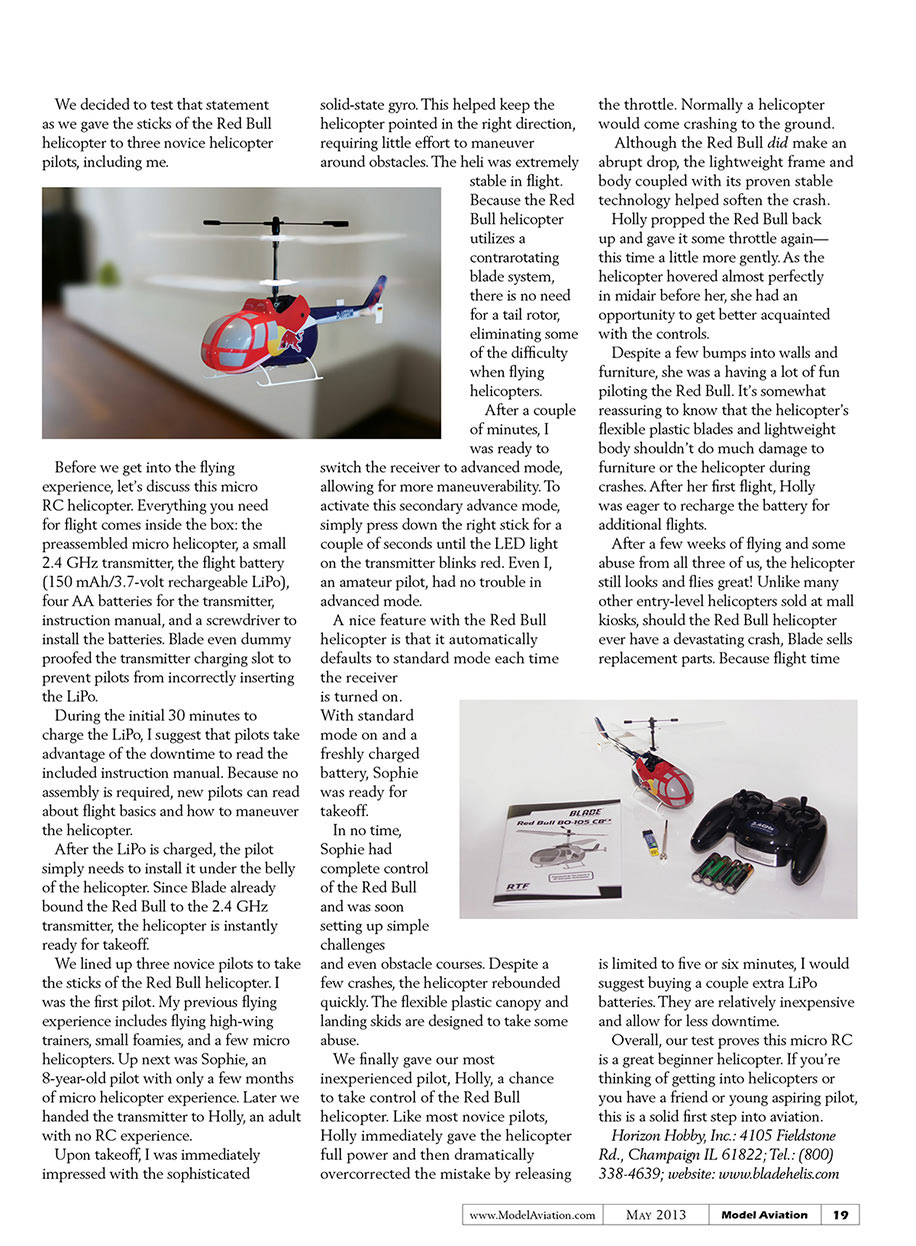
Before we get into the flying experience, let's discuss this micro RC helicopter. Everything you need for flight comes inside the box: the preassembled micro helicopter, a small 2.4 GHz transmitter, the flight battery (150 mAh/3.7-volt rechargeable LiPo), four AA batteries for the transmitter, instruction manual, and a screwdriver to install the batteries. Blade even dummy proofed the transmitter charging slot to prevent pilots from incorrectly inserting the LiPo.
During the initial 30 minutes to charge the LiPo, I suggest that pilots take advantage of the downtime to read the included instruction manual. Because no assembly is required, new pilots can read about flight basics and how to maneuver the helicopter.
After the LiPo is charged, the pilot simply needs to install it under the belly of the helicopter. Since Blade already bound the Red Bull to the 2.4 GHz transmitter, the helicopter is instantly ready for takeoff.
We lined up three novice pilots to take the sticks of the Red Bull helicopter. I was the first pilot. My previous flying experience includes flying high-wing trainers, small foamies, and a few micro helicopters. Up next was Sophie, an 8-year-old pilot with only a few months of micro helicopter experience. Later we handed the transmitter to Holly, an adult with no RC experience.
Upon takeoff, I was immediately impressed with the sophisticated solid-state gyro. This helped keep the helicopter pointed in the right direction, requiring little effort to maneuver around obstacles. The heli was extremely stable in flight. Because the Red Bull helicopter utilizes a contra-rotating blade system, there is no need for a tail rotor, eliminating some of the difficulty when flying helicopters.
After a couple of minutes, I was ready to switch the receiver to advanced mode, allowing for more maneuverability. To activate this secondary advance mode, simply press down the right stick for a couple of seconds until the LED light on the transmitter blinks red. Even I, an amateur pilot, had no trouble in advanced mode.
A nice feature with the Red Bull helicopter is that it automatically defaults to standard mode each time the receiver is turned on.
With standard mode on and a freshly charged battery, Sophie was ready for takeoff.
In no time, Sophie had complete control of the Red Bull and was soon setting up simple challenges and even obstacle courses. Despite a few crashes, the helicopter rebounded quickly. The flexible plastic canopy and landing skids are designed to take some abuse.
We finally gave our most inexperienced pilot, Holly, a chance to take control of the Red Bull helicopter. Like most novice pilots, Holly immediately gave the helicopter full power and then dramatically overcorrected the mistake by releasing the throttle. Normally a helicopter would come crashing to the ground.
Although the Red Bull did make an abrupt drop, the lightweight frame and body coupled with its proven stable technology helped soften the crash. Holly propped the Red Bull back up and gave it some throttle again—this time a little more gently. As the helicopter hovered almost perfectly in midair before her, she had an opportunity to get better acquainted with the controls.
Despite a few bumps into walls and furniture, she was having a lot of fun piloting the Red Bull. It's somewhat reassuring to know that the helicopter's flexible plastic blades and lightweight body shouldn't do much damage to furniture or the helicopter during crashes. After her first flight, Holly was eager to recharge the battery for additional flights.
After a few weeks of flying and some abuse from all three of us, the helicopter still looks and flies great! Unlike many other entry-level helicopters sold at mall kiosks, should the Red Bull helicopter ever have a devastating crash, Blade sells replacement parts. Because flight time is limited to five or six minutes, I would suggest buying a couple extra LiPo batteries. They are relatively inexpensive and allow for less downtime.
Overall, our test proves this micro RC is a great beginner helicopter. If you're thinking of getting into helicopters or you have a friend or young aspiring pilot, this is a solid first step into aviation.
Horizon Hobby, Inc.: 4105 Fieldstone Rd., Champaign IL 61822; Tel.: (800) 338-4639; website: www.bladehelis.com
Product Spotlight
Seacraft V2/SE V2/SE V1 Fuel Pump Systems @ $100-$170 + S&H from Esprit Model, 1240 Clearmont St. NE #12, Palm Bay FL 32905; Tel.: (321) 729-4287; website: www.espritmodel.com.
Esprit Model makes it easy to choose the perfect option to fit your needs by offering three Seacraft Fuel Pump Systems.
The Seacraft Fuel Pump V2 is the most basic. Driven by a hand starter, it has a full metal body, lever for toggling between forward and reverse pumping, and an ergonomic design. Offering both a High Speed version for direct-drive (standard airplane) starters and a Low Speed version for gear-driven (helicopter) starters, the V2 is available in red, blue, or black. It works for glow, nitro, alcohol, synthetic, and mineral oil, and gas or diesel fuel, with a pump rate of roughly 900-1300 ml per minute.
The SE V2 fuel pump features the same full-metal body with the ability to mount it right on a jerry can fuel container. The built-in pump and battery pack attachment allows for quick, easy fueling. The SE V2 comes in a nitro version for nitromethane and glow fuels, and a non-nitro version for gas and diesel fuels and synthetic and mineral oils. Available in red and blue, the pump rate is 1500-1700 ml per minute.
The SE V1 is an all-metal fuel pump complete with a built-in pump and a battery compartment that is safe for LiPo battery handling. Available in red or blue, the sleek design attaches to a jerry can fuel container. The SE V1 is only available for use with smoke oil, synthetic and mineral oil, and gas and diesel fuels. Its pumping rate is 1500-1700 ml per minute. Battery is not included.
Vista Power Q6320AC 320-watt Quad Charger @ $209.95 + S&H from RC Accessory Inc., 3304 Foxridge Cir., Tampa FL 33618; Tel.: (813) 765-0124; website: www.rcaccessory.com.
RC Accessory Inc., a leader in LiPo battery development through its PowerEdge brand, announces the release of its latest Quad 4 Port charger, the Vista Power Q6320AC.
Incorporating four 80-watt, 7-amp chargers into one compact unit with built-in AC power, the Vista Power Q6320AC has a 7-amp maximum charge rate and has built-in 500 mAh balance circuitry. It also has the ability to rapidly and accurately balance-charge LiPo, Li-Ion, and LiFe PO4 (A123) batteries. With full multi-chemistry capability, the Vista Power Q6320AC can also charge Ni-Cd, NiMH, and lead acid batteries.
Each port features a bright display, and ventilation fans keep everything cool. Two JST XH 2S-6S balance boards, a complete charge cable set with various connectors, a DC power cable, and an instruction manual are included with the charger.
Optional balance-connector boards for Thunder Power and Polyquest/Hyperion balance taps are sold separately.
Multiplex Razzor Electric Racer @ $174.99 + S&H from Multiplex USA, 12115 Paine St., Poway CA 92064; Tel.: (858) 748-6948; website: www.multiplexusa.com.
Multiplex introduces its new, compact, electric racer, the Razzor. Built with Elapor foam and carbon-reinforced wings and tail, this lightweight aircraft maintains robust structural strength while flying with incredible precision and maneuverability.
The large fuselage hatch on this 24.4-inch model allows handy access for easy maintenance, and the removable wing makes it easy to transport. With full aerobatic capability, the Razzor also features a high-performance brushless motor and an efficient ESC.
The receiver-ready version includes the brushless motor and ESC, the propeller, flight battery, and servos.
Heli-Max Axe 100 SSL RTF/Tx-R helicopter @ $159.99-$219.99 + S&H from Hobbico, 3002 N. Apollo Dr., Suite 1, Champaign IL 61822; Tel.: (800) 637-7660; website: www.helimax-rc.com.
The new Axe 100 Super Sport Brushless LED (SSL) helicopter from Heli-Max stands out in a crowd! Seven high-intensity LED lights on the top and bottom of the blades and on the tail are color-coded to provide heli orientation and position, day or night. The LEDs are powered by the main battery; no extra battery is required.
Hidden wiring and connectors make it easy to hook up the lightweight, high-capacity 400 mAh LiPo battery and give it a clean look. The beefed-up molded airframe can withstand the stresses of power provided by the brushless outrunner motor and controller.
The individual controller and servos maximize performance and simplify replacement. The extended tailboom is perfect for first-time pilots and experienced pilots looking for a larger coaxial heli that can be flown indoors and outdoors.
Larger than the typical ultramicro and micro helicopters, the Evolve 300 CX features the IFT-exclusive Collision Avoidance Technology (C.A.T.), making it possible to fly indoors in spaces where it would not be comfortable to fly most other micro-class helis.
The Evolve 300 CX is equipped with a coaxial, counter-rotating blade design, digital servos, and two powerful 370 motors coupled to a 3S 11.1-volt LiPo battery. This helicopter is 100% factory assembled, with a factory-finished scale body in a highly visible color scheme.
The helicopter is available as an RTF or Ready-for-Receiver (RFR). Both include a factory-installed C.A.T. module, ultrasonic sensors, an advanced three-in-one control unit, and 7.5-gram digital sub-micro servos. Everything needed to fly the RTF version is included in the box. The RFR version requires a battery, charger, adapter, five-channel transmitter, and six-channel receiver.
O.S. Engine GT15HZ Gasoline/Petrol Helicopter Engine @ $479.99-$629.99 + S&H from Hobbico, 3002 N. Apollo Dr., Suite 1, Champaign IL 61822; Tel.: (800) 637-7660; website: www.osengines.com.
O.S. Engine's GT15HZ gasoline/petrol engine for helicopters is perfect for sport, 3-D, and scale flying, but that's only part of what makes this engine great.
The GT15HZ features a compact size that fits most .90-size helicopters with only minor modifications. The O.S./Walbro-developed pumper carburetor ensures consistent performance, while the IG-05 Ignition Module features a straight plug cap for easy installation. It is compatible with a wide range of voltages and battery chemistries.
With outstanding fuel economy, the O.S. Engine GT15HZ includes a CM-6 spark plug and the IG-056 Ignition Module. It requires regular unleaded gasoline, two-stroke engine oil, and a 4.8- to 8.4-volt ignition battery. This engine is available alone or with a PowerBoost Pipe. The pipe and an optional E-4051 muffler are also available and sold separately.
E-flite L-13 Blanik 4.2-meter Sailplane @ $999.99 + S&H from Horizon Hobby, Inc., 4105 Fieldstone Rd., Champaign IL 61822; Tel.: (800) 338-4639; website: www.e-fliterc.com.
Built for intermediate sailplane pilots, the E-flite 1/4-scale L-13 Blanik 4.2-meter sailplane provides scale accuracy in looks and flight characteristics. This replica of the internationally recognized full-scale sailplane features the authentic Red Bull trim scheme, along with plenty of scale details including a hinged canopy, operational landing flaps, and a spacious cockpit area for easy radio installation.
The fully balsa-sheeted foam-core wings and tail with carbon-fiber joiners, along with the L-13 Blanik's fiberglass fuselage, provide strength and rigidity; covering is long-lasting UltraCote.
Great for sailplane and aerotow pilots as well as slope soars, the L-14 Blanik sailplane includes a high-quality hardware package. Optional electric spoilers are sold separately. A five-plus-channel radio system, six standard high-torque servos and two mini servos, a receiver pack, and a charger for the receiver pack are required.
Transcribed from original scans by AI. Minor OCR errors may remain.

