
product spotlight - 2012/08
SHARK!
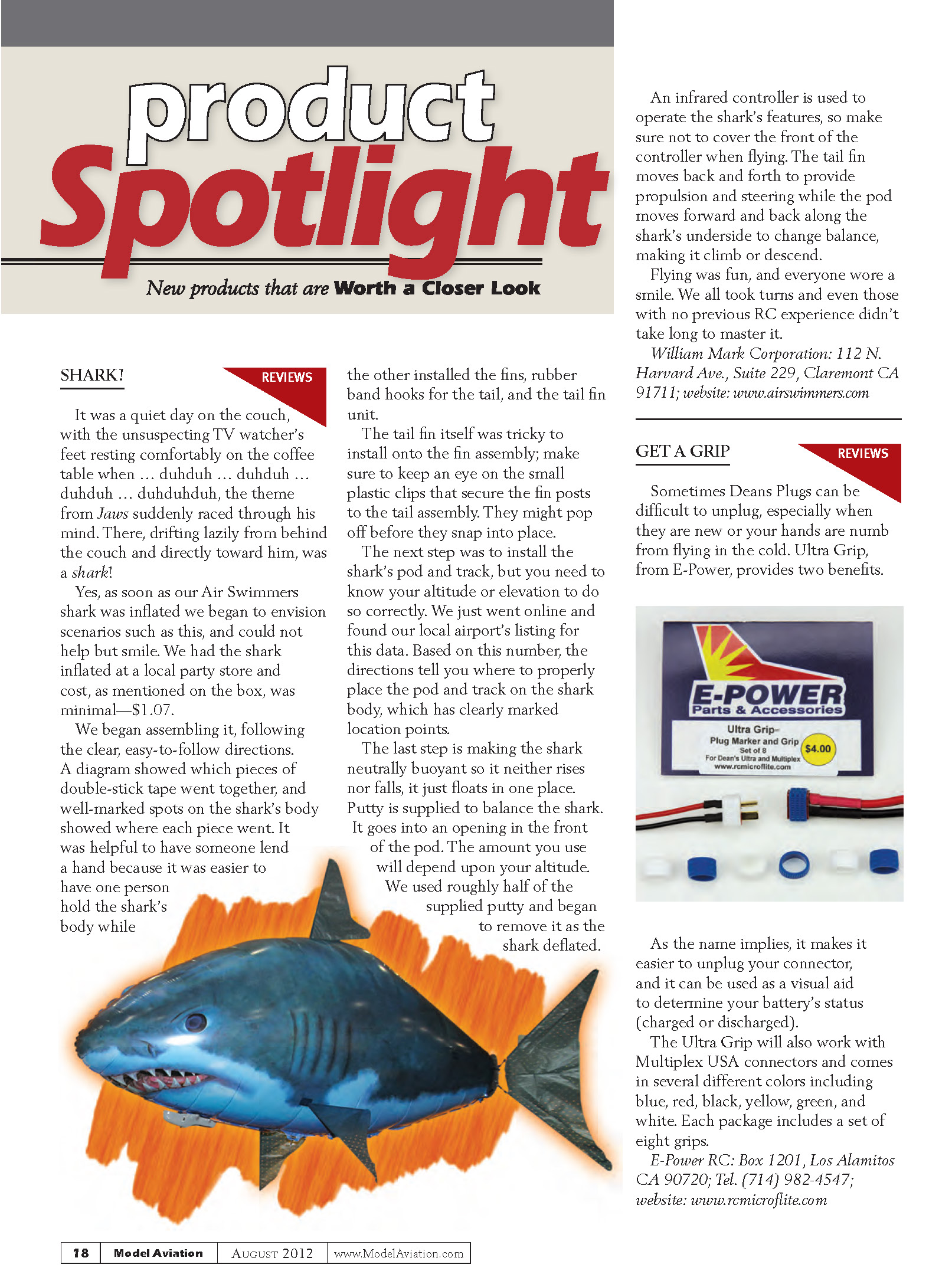
It was a quiet day on the couch, with the unsuspecting TV watcher’s feet resting comfortably on the coffee table when ... duhduh ... duhduh ... duhduh ... duhduhduh, the theme from Jaws suddenly raced through his mind. There, drifting lazily from behind the couch and directly toward him, was a shark!
Yes, as soon as our Air Swimmers shark was inflated we began to envision scenarios such as this, and could not help but smile. We had the shark inflated at a local party store and the cost, as mentioned on the box, was minimal—$1.07.
We began assembling it, following the clear, easy-to-follow directions. A diagram showed which pieces of double-stick tape went together, and well-marked spots on the shark’s body showed where each piece went. It was helpful to have someone lend a hand because it was easier to have one person hold the shark’s body while the other installed the fins, rubber-band hooks for the tail, and the tail fin unit.
The tail fin itself was tricky to install onto the fin assembly; make sure to keep an eye on the small plastic clips that secure the fin posts to the tail assembly. They might pop off before they snap into place.
The next step was to install the shark’s pod and track, but you need to know your altitude or elevation to do so correctly. We just went online and found our local airport’s listing for this data. Based on this number, the directions tell you where to properly place the pod and track on the shark body, which has clearly marked location points.
The last step is making the shark neutrally buoyant so it neither rises nor falls, it just floats in one place. Putty is supplied to balance the shark. It goes into an opening in the front of the pod. The amount you use will depend upon your altitude. We used roughly half of the supplied putty and began to remove it as the shark deflated.
An infrared controller is used to operate the shark’s features, so make sure not to cover the front of the controller when flying. The tail fin moves back and forth to provide propulsion and steering while the pod moves forward and back along the shark’s underside to change balance, making it climb or descend.
Flying was fun, and everyone wore a smile. We all took turns and even those with no previous RC experience didn’t take long to master it.
William Mark Corporation: 112 N. Harvard Ave., Suite 229, Claremont, CA 91711; website: www.airswimmers.com
A NEW LINE OF PROPELLERS
ProTek RC is well known for its solid chargers and full-featured power supplies. ProTek power supplies have fed the hungry chargers each year at the National Electric Fly-In (NEFI) without issue.
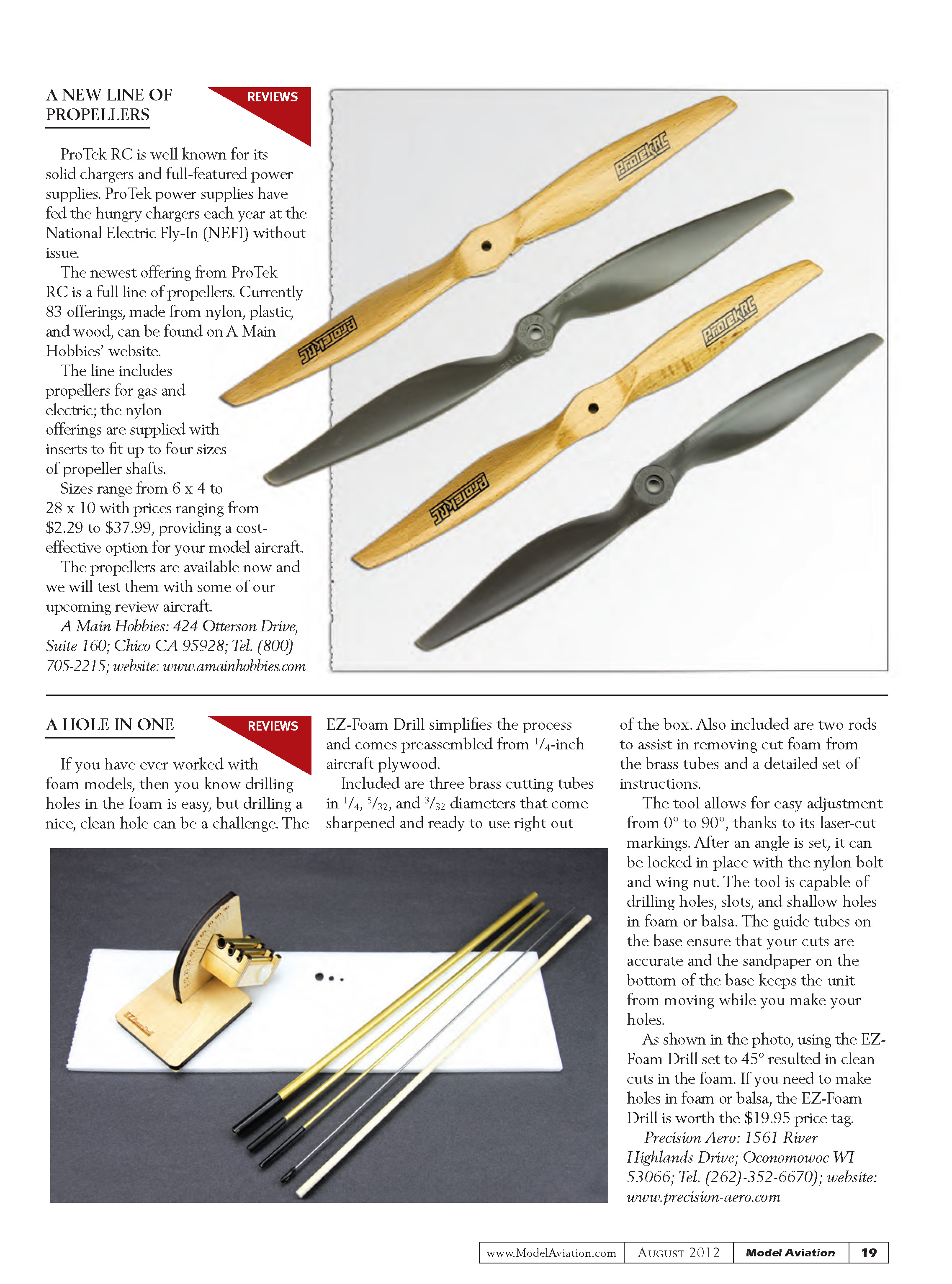
The newest offering from ProTek RC is a full line of propellers. Currently 83 offerings, made from nylon, plastic, and wood, can be found on A Main Hobbies' website.
The line includes propellers for gas and electric; the nylon offerings are supplied with inserts to fit up to four sizes of propeller shafts.
Sizes range from 6 x 4 to 28 x 10 with prices ranging from $2.29 to $37.99, providing a cost-effective option for your model aircraft.
The propellers are available now and we will test them with some of our upcoming review aircraft.
A Main Hobbies: 424 Otterson Drive, Suite 160, Chico, CA 95928; Tel. (800) 705-2215; website: www.amainhobbies.com
A HOLE IN ONE
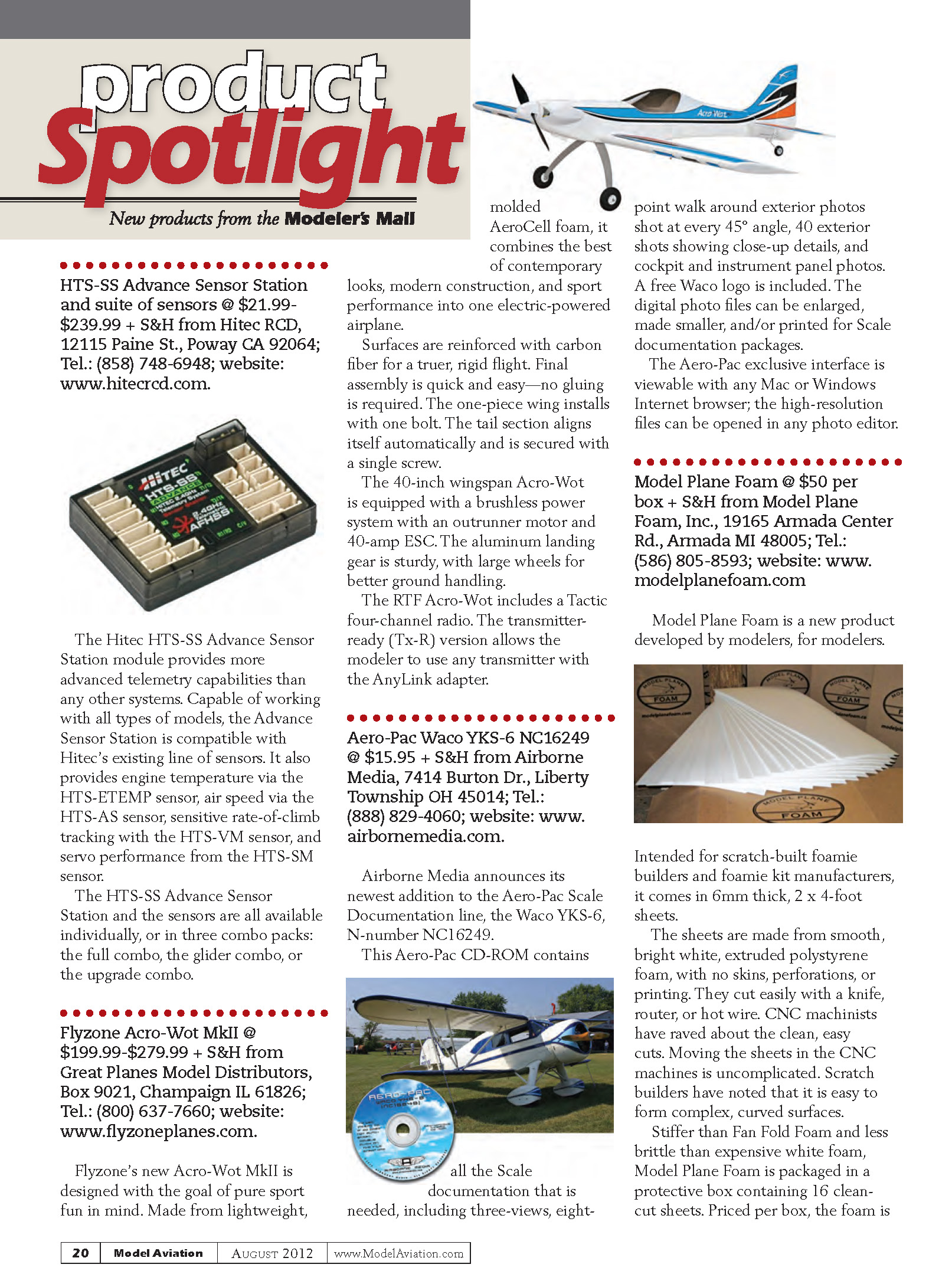
If you have ever worked with foam models, then you know drilling holes in the foam is easy, but drilling a nice, clean hole can be a challenge. The EZ-Foam Drill simplifies the process and comes preassembled from 1/4-inch aircraft plywood.
Included are three brass cutting tubes in 1/4, 5/32, and 3/32 diameters that come sharpened and ready to use right out of the box. Also included are two rods to assist in removing cut foam from the brass tubes and a detailed set of instructions.
The tool allows for easy adjustment from 0° to 90°, thanks to its laser-cut markings. After an angle is set, it can be locked in place with the nylon bolt and wing nut. The tool is capable of drilling holes, slots, and shallow holes in foam or balsa. The guide tubes on the base ensure that your cuts are accurate and the sandpaper on the bottom of the base keeps the unit from moving while you make your holes.
As shown in the photo, using the EZ-Foam Drill set to 45° resulted in clean cuts in the foam. If you need to make holes in foam or balsa, the EZ-Foam Drill is worth the $19.95 price tag.
Precision Aero: 1561 River Highlands Drive, Oconomowoc, WI 53066; Tel. (262) 352-6670; website: www.precision-aero.com
HTS-SS Advance Sensor Station and suite of sensors — $21.99–$239.99 + S&H
From Hitec RCD, 12115 Paine St., Poway, CA 92064; Tel. (858) 748-6948; website: www.hitecrcd.com
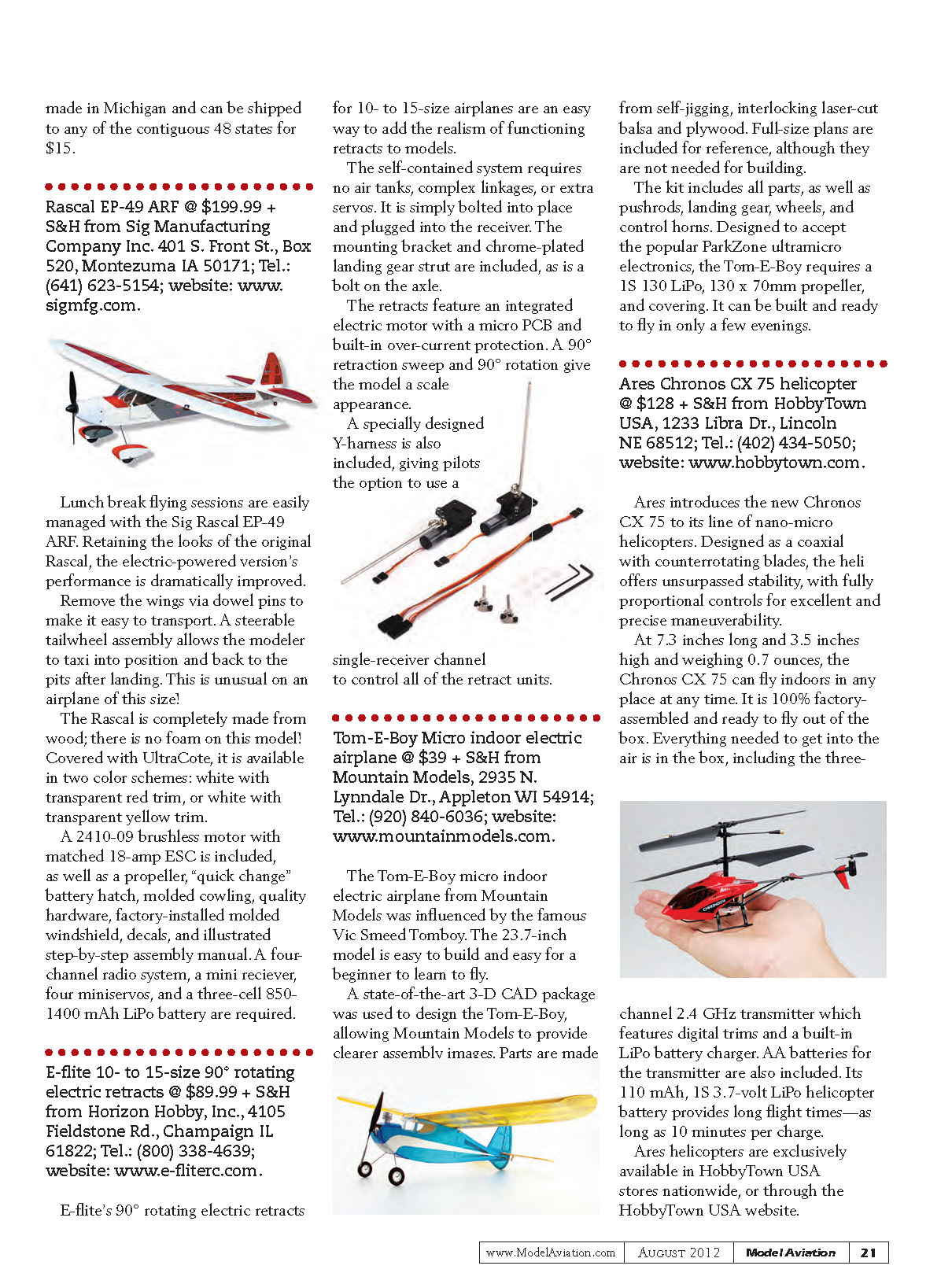
The Hitec HTS-SS Advance Sensor Station module provides more advanced telemetry capabilities than many other systems. Capable of working with all types of models, the Advance Sensor Station is compatible with Hitec’s existing line of sensors. It also provides engine temperature via the HTS-ETEMP sensor, airspeed via the HTS-AS sensor, sensitive rate-of-climb tracking with the HTS-VM sensor, and servo performance from the HTS-SM sensor.
The HTS-SS Advance Sensor Station and the sensors are all available individually, or in three combo packs: the full combo, the glider combo, or the upgrade combo.
Flyzone Acro-Wot MkII — $199.99–$279.99 + S&H
From Great Planes Model Distributors, Box 9021, Champaign, IL 61826; Tel. (800) 637-7660; website: www.flyzoneplanes.com
Flyzone’s new Acro-Wot MkII is designed with the goal of pure sport fun in mind. Made from lightweight, molded AeroCell foam, it combines contemporary looks, modern construction, and sport performance into one electric-powered airplane.
Surfaces are reinforced with carbon fiber for a truer, rigid flight. Final assembly is quick and easy—no gluing is required. The one-piece wing installs with one bolt. The tail section aligns itself automatically and is secured with a single screw.
The 40-inch wingspan Acro-Wot is equipped with a brushless power system with an outrunner motor and 40-amp ESC. The aluminum landing gear is sturdy, with large wheels for better ground handling.
The RTF Acro-Wot includes a Tactic four-channel radio. The transmitter-ready (Tx-R) version allows the modeler to use any transmitter with the AnyLink adapter.
Aero-Pac Waco YKS-6 NC16249 — $15.95 + S&H
From Airborne Media, 7414 Burton Dr., Liberty Township, OH 45014; Tel. (888) 829-4060; website: www.airbornemedia.com
Airborne Media announces its newest addition to the Aero-Pac Scale Documentation line, the Waco YKS-6, N-number NC16249.
This Aero-Pac CD-ROM contains all the scale documentation needed, including three-views, eight-point walk-around exterior photos shot at every 45° angle, 40 exterior shots showing close-up details, and cockpit and instrument panel photos. A free Waco logo is included. The digital photo files can be enlarged, reduced, and/or printed for scale documentation packages.
The Aero-Pac exclusive interface is viewable with any Mac or Windows Internet browser; the high-resolution files can be opened in any photo editor.
Model Plane Foam — $50 per box + S&H
From Model Plane Foam, Inc., 19165 Armada Center Rd., Armada, MI 48005; Tel. (586) 805-8593; website: www.modelplanefoam.com
Model Plane Foam is a new product developed by modelers, for modelers.
Intended for scratch-built foamie builders and foamie kit manufacturers, it comes in 6mm-thick, 2 x 4-foot sheets.
The sheets are made from smooth, bright white, extruded polystyrene foam, with no skins, perforations, or printing. They cut easily with a knife, router, or hot wire. CNC machinists have raved about the clean, easy cuts. Moving the sheets in CNC machines is uncomplicated. Scratch builders have noted that it is easy to form complex, curved surfaces.
Stiffer than Fan Fold Foam and less brittle than expensive white foam, Model Plane Foam is packaged in a protective box containing 16 clean-cut sheets. Priced per box, the foam is made in Michigan and can be shipped to any of the contiguous 48 states for $15.
Rascal EP-49 ARF — $199.99 + S&H
From Sig Manufacturing Company Inc., 401 S. Front St., Box 520, Montezuma, IA 50171; Tel. (641) 623-5154; website: www.sigmfg.com
Lunch-break flying sessions are easily managed with the Sig Rascal EP-49 ARF. Retaining the looks of the original Rascal, the electric-powered version's performance is dramatically improved.
Remove the wings via dowel pins to make it easy to transport. A steerable tailwheel assembly allows the modeler to taxi into position and back to the pits after landing. This is unusual on an airplane of this size!
The Rascal is completely made from wood; there is no foam on this model. Covered with UltraCote, it is available in two color schemes: white with transparent red trim, or white with transparent yellow trim.
A 2410-09 brushless motor with matched 18-amp ESC is included, as well as a propeller, "quick change" battery hatch, molded cowling, quality hardware, factory-installed molded windshield, decals, and an illustrated step-by-step assembly manual. A four-channel radio system, a mini receiver, four miniservos, and a three-cell 850–1400 mAh LiPo battery are required.
E-flite's 90° rotating electric retracts — $89.99 + S&H
From Horizon Hobby, Inc., 4105 Fieldstone Rd., Champaign, IL 61822; Tel. (800) 338-4639; website: www.e-fliterc.com
For 10- to 15-size airplanes, these retracts are an easy way to add the realism of functioning retracts to models.
The self-contained system requires no air tanks, complex linkages, or extra servos. It is simply bolted into place and plugged into the receiver. The mounting bracket and chrome-plated landing gear strut are included, as is a bolt-on axle.
The retracts feature an integrated electric motor with a micro PCB and built-in over-current protection. A 90° retraction sweep and 90° rotation give the model a scale appearance.
A specially designed Y-harness is also included, giving pilots the option to use a single receiver channel to control all of the retract units.
Tom-E-Boy Micro indoor electric airplane — $39 + S&H
From Mountain Models, 2935 N. Lynndale Dr., Appleton, WI 54914; Tel. (920) 840-6036; website: www.mountainmodels.com
The Tom-E-Boy micro indoor electric airplane from Mountain Models was influenced by the famous Vic Smeed Tomboy. The 23.7-inch model is easy to build and easy for a beginner to learn to fly.
A state-of-the-art 3-D CAD package was used to design the Tom-E-Boy, allowing Mountain Models to provide clearer assembly images. Parts are made from self-jigging, interlocking laser-cut balsa and plywood. Full-size plans are included for reference, although they are not needed for building.
The kit includes all parts, as well as pushrods, landing gear, wheels, and control horns. Designed to accept the popular ParkZone ultramicro electronics, the Tom-E-Boy requires a 1S 130 LiPo, a 130 x 70mm propeller, and covering. It can be built and ready to fly in only a few evenings.
Ares Chronos CX 75 helicopter — $128 + S&H
From HobbyTown USA, 1233 Libra Dr., Lincoln, NE 68512; Tel. (402) 434-5050; website: www.hobbytown.com
Ares introduces the new Chronos CX 75 to its line of nano-micro helicopters. Designed as a coaxial with counterrotating blades, the heli offers unsurpassed stability, with fully proportional controls for excellent and precise maneuverability.
At 7.3 inches long and 3.5 inches high and weighing 0.7 ounces, the Chronos CX 75 can fly indoors in any place at any time. It is 100% factory-assembled and ready to fly out of the box. Everything needed to get into the air is in the box, including the three-channel 2.4 GHz transmitter which features digital trims and a built-in LiPo battery charger. AA batteries for the transmitter are also included. Its 110 mAh, 1S 3.7-volt LiPo helicopter battery provides long flight times—as long as 10 minutes per charge.
Ares helicopters are exclusively available in HobbyTown USA stores nationwide, or through the HobbyTown USA website.
Transcribed from original scans by AI. Minor OCR errors may remain.

