
Pylon Racing for Everyone
by Don Stegall
What is Club 40 Pylon Racing?
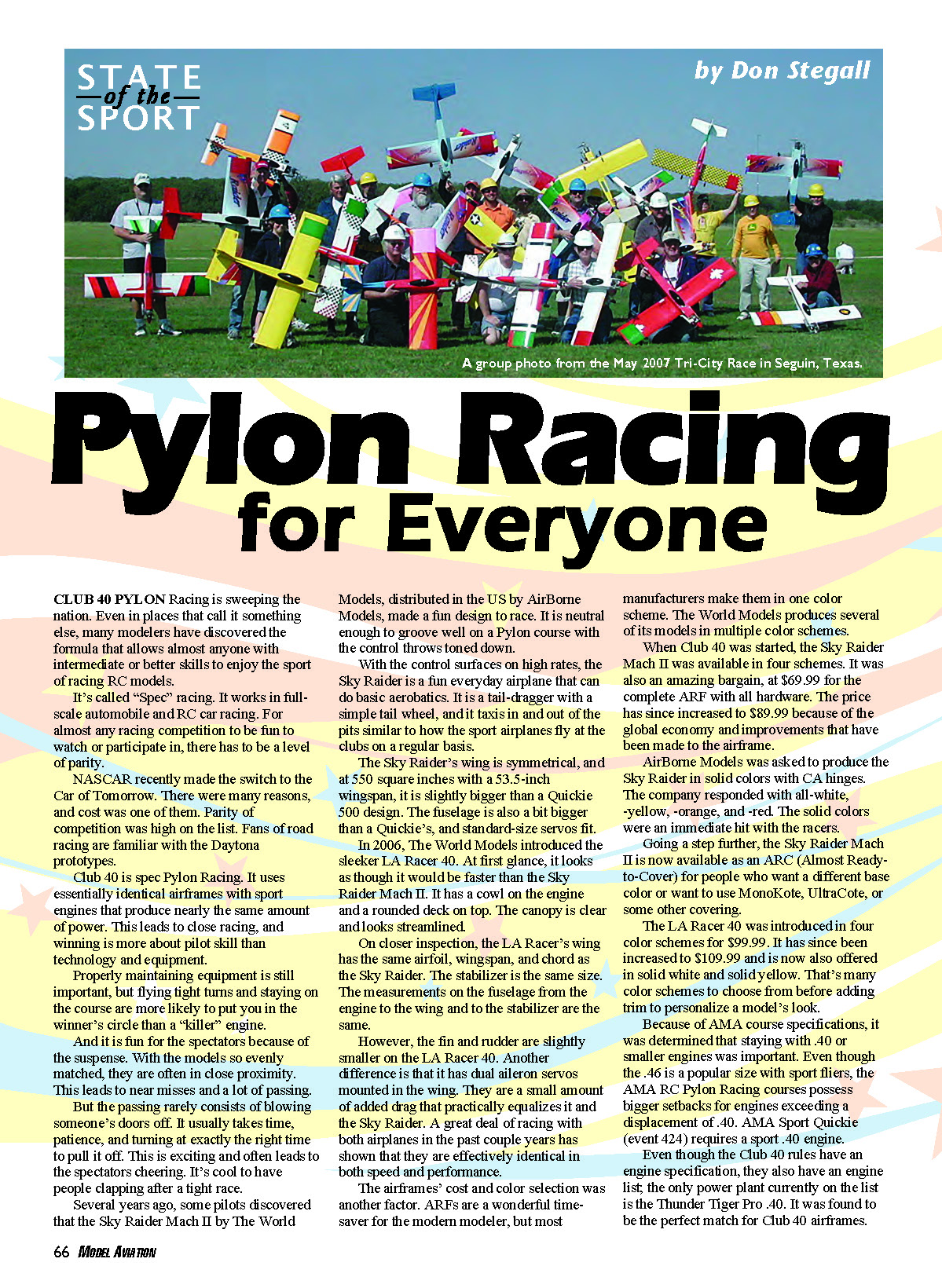
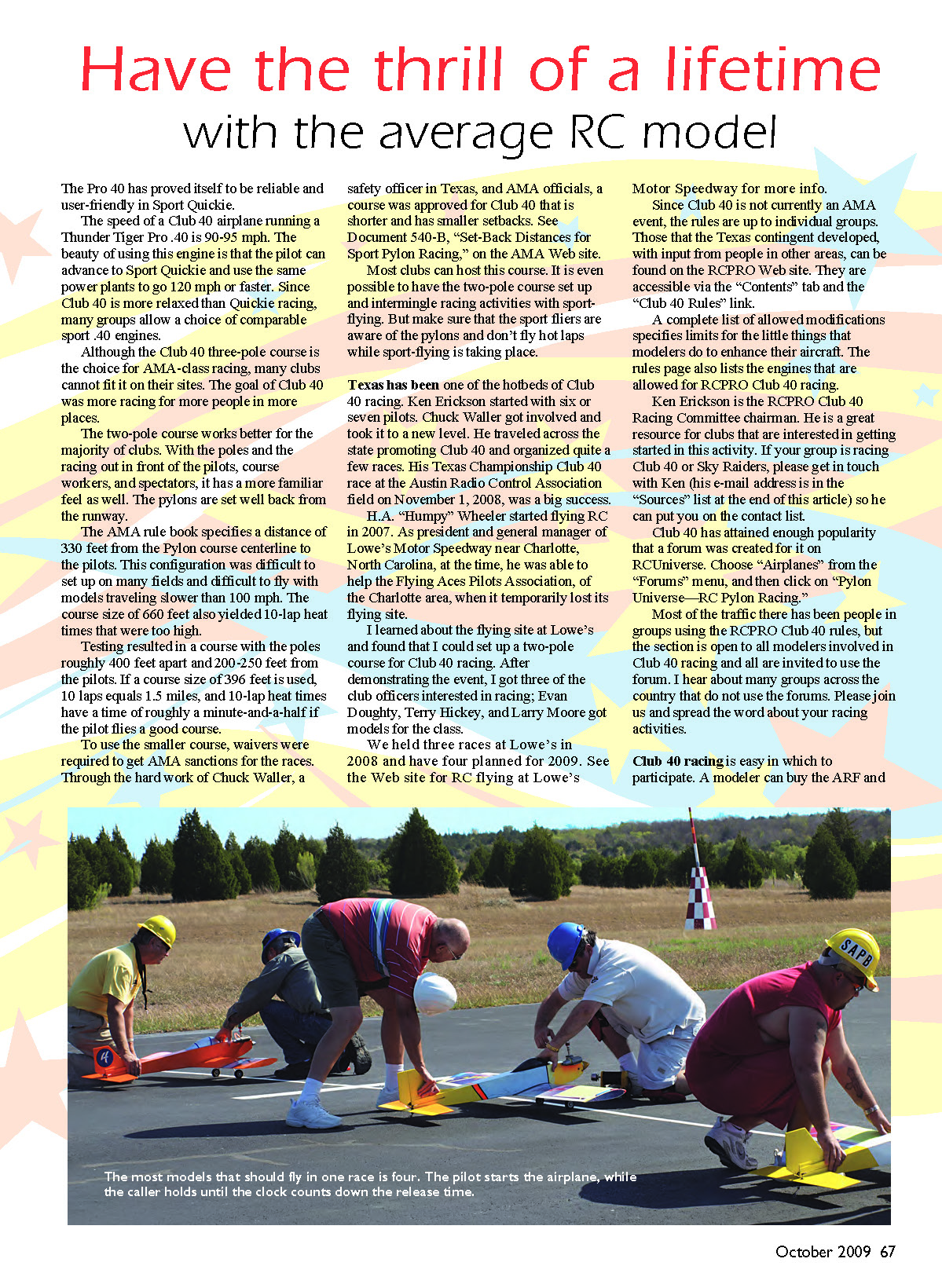
Club 40 Pylon Racing is spec pylon racing for RC models. Spec racing—used in full-scale automobile and RC car racing—creates parity so pilot skill determines results more than technology. Club 40 uses essentially identical airframes and sport .40 engines, leading to close, exciting racing that emphasizes pilot technique, tight turns, and staying on course rather than having the most powerful engine.
Airframes: Sky Raider Mach II and LA Racer 40
Several pilots found that the Sky Raider Mach II (The World Models, distributed in the U.S. by AirBorne Models) made a good pylon racer. Tuned with toned-down control throws it grooves well on a pylon course; on high rates it is a useful everyday sport airplane capable of basic aerobatics. It is a taildragger with a simple tail wheel and taxis like other sport airplanes.
The Sky Raider's wing is symmetrical and has about 550 square inches of area with a 53.5-inch wingspan—slightly larger than a Quickie 500 design. The fuselage is also a bit larger than a Quickie’s and accepts standard-size servos.
In 2006 The World Models introduced the sleeker LA Racer 40. At first glance it appears faster because of a cowl and rounded deck, but the LA Racer uses the same airfoil, wingspan, chord, stabilizer size, and similar fuselage measurements forward and aft. The fin and rudder are slightly smaller and it has dual aileron servos in the wing, which add a small amount of drag and effectively equalize its performance with the Sky Raider. Racing over recent years has shown the two airframes to be essentially identical in speed and performance.
Colors, ARF and ARC options
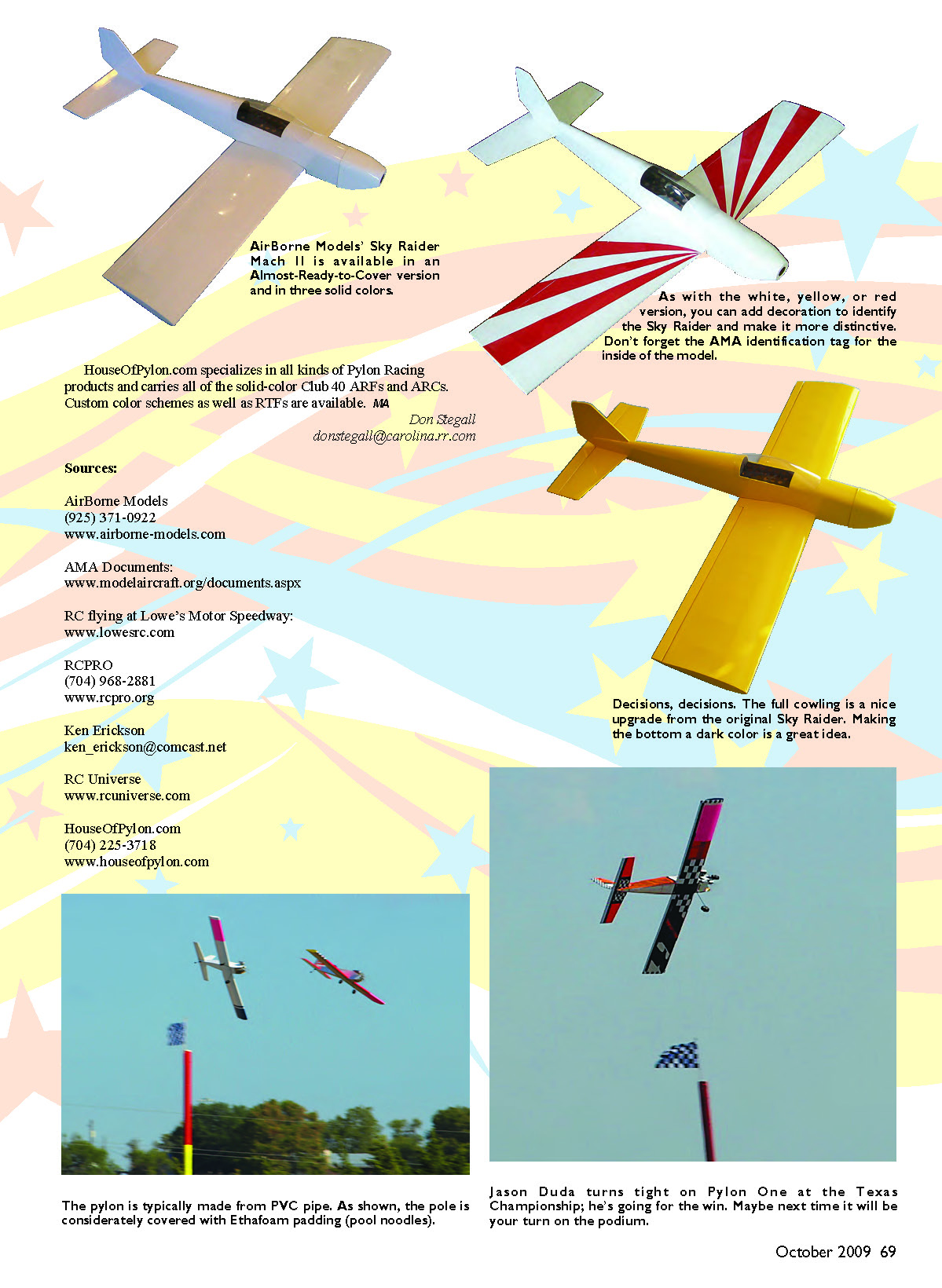
ARFs are time-savers, and The World Models produces several color schemes. When Club 40 began, the Sky Raider Mach II was available in four schemes and sold as a complete ARF for $69.99. The price later rose to $89.99 after global economic changes and airframe improvements. AirBorne Models produced solid-color Sky Raiders with CA hinges—white, yellow, orange, and red—which proved popular with racers. The Sky Raider Mach II is also offered as an ARC (Almost Ready-to-Cover) for modelers who prefer different base colors or want to apply MonoKote, UltraCote, or other coverings.
The LA Racer 40 was introduced in four color schemes at $99.99, later increased to $109.99, and is now offered in solid white and solid yellow as well.
Engines and Performance
Because of AMA course specifications and safety, Club 40 limited engines to .40 or smaller. Although .46 engines are common in sport flying, Club 40 uses a specified engine list; the primary powerplant on that list is the Thunder Tiger Pro .40, found to be a good match for Club 40 airframes. The Pro .40 has proven reliable and user-friendly in Sport Quickie racing, too.
A Club 40 airplane running a Thunder Tiger Pro .40 typically reaches about 90–95 mph. Pilots can use the same powerplant to advance to Sport Quickie racing and reach 120 mph or faster. Since Club 40 is more relaxed than Quickie racing, many groups allow equivalent sport .40 engines.
Course layouts and AMA waivers
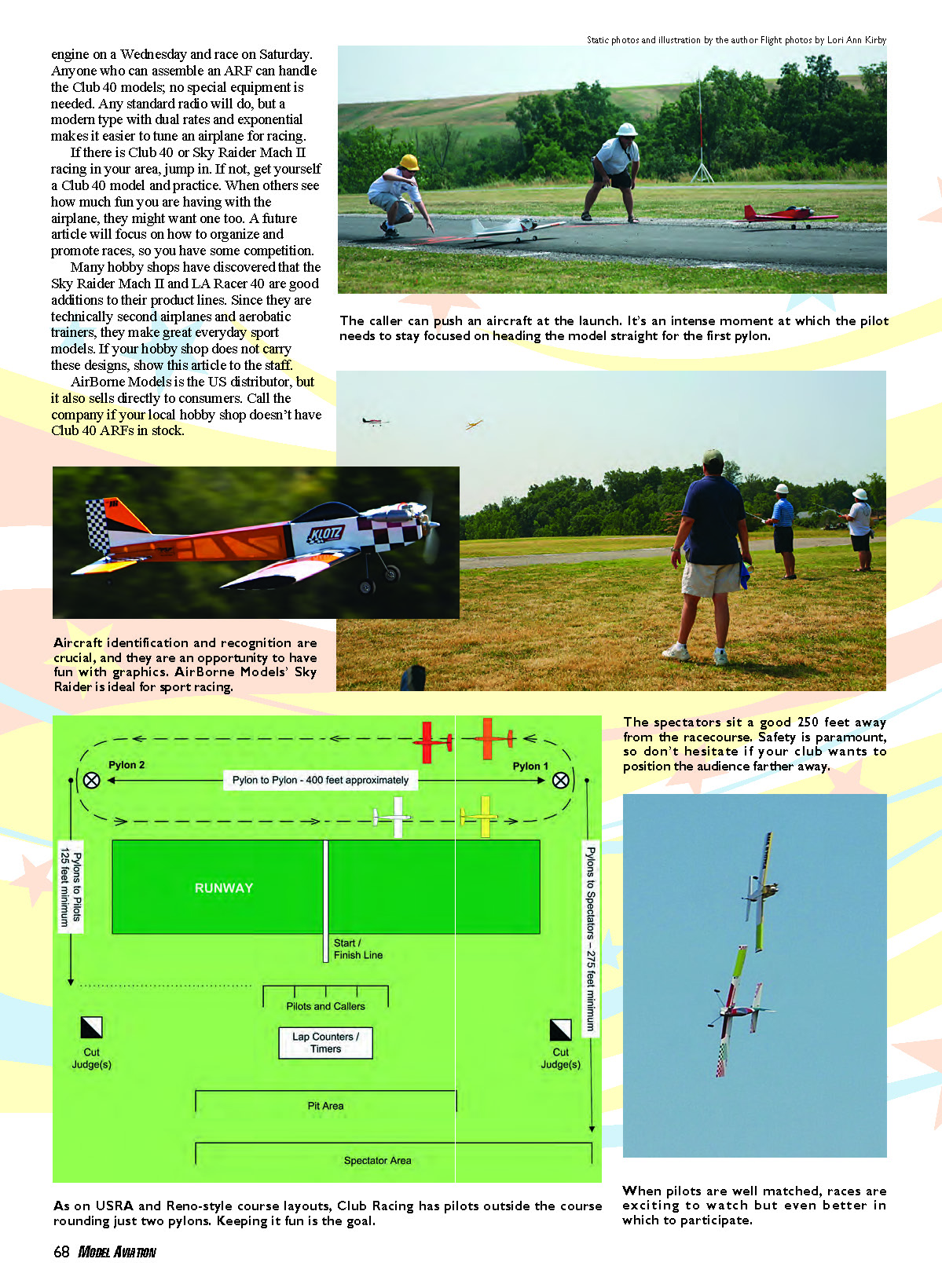
Although the three-pole course is the AMA-class choice, many clubs can’t fit it on their fields. Club 40 aimed to make pylon racing available in more places, so the two-pole course was adopted by many groups. The two-pole layout places the pylons and racing out in front of pilots, course workers, and spectators, with the pylons set well back from the runway.
The AMA rule book originally specified a 330-foot distance from the pylon course centerline to the pilots (660-foot course size), which was hard to fit and produced long 10-lap heat times for models under 100 mph. Testing led to a smaller recommended course: poles roughly 400 feet apart and 200–250 feet from the pilots (a 396-foot course). On a 396-foot course, 10 laps equals 1.5 miles, and a clean pilot's 10-lap heat runs roughly a minute-and-a-half.
Using the smaller course required waivers to obtain AMA sanctions. With the efforts of safety officer Chuck Waller and AMA officials, a shorter course with smaller setbacks was approved for Club 40. See AMA Document 540-B, "Set-Back Distances for Sport Pylon Racing," on the AMA website.
Most clubs can host the smaller course, and it can be set up alongside regular sport flying—provided sport fliers are aware of pylons and avoid flying hot laps during racing.
Growth, events and regional activity
Texas has been a Club 40 hotbed. Ken Erickson started with six or seven pilots, and Chuck Waller promoted Club 40 across the state and organized many races. The Texas Championship Club 40 race at the Austin Radio Control Association field on November 1, 2008, was a big success.
H.A. "Humpy" Wheeler began flying RC in 2007. As president and general manager of Lowe's Motor Speedway at the time, he helped the Flying Aces Pilots Association (Charlotte area) when it temporarily lost its flying site. This led to a two-pole Club 40 setup at Lowe's Motor Speedway. After a demonstration, club officers Evan Doughty, Terry Hickey, and Larry Moore took up racing. Three races were held at Lowe's in 2008, with four planned for 2009. See the Lowe's RC website for details.
Rules, organization and forums
Club 40 is not currently an AMA-only event, so rules may vary by group. The Texas contingent developed rules, with input from others, which are posted on the RCPRO website (see Sources). Those rules include a complete list of allowed modifications and specify the engines permitted for RCPRO Club 40 racing.
Ken Erickson is the RCPRO Club 40 Racing Committee chairman and is a resource for clubs starting the activity. If your group races Club 40 or Sky Raiders, contact Ken so he can add you to the contact list (his e-mail is in the Sources list).
A Club 40 forum exists on RCUniverse: choose "Airplanes" from the "Forums" menu, then "Pylon Universe—RC Pylon Racing." The forum is open to any modelers involved in Club 40 racing.
Getting started
Club 40 is easy to join. A modeler can buy an ARF and engine on a Wednesday and race on Saturday. Any modeler who can assemble an ARF can handle Club 40 models; no special equipment is needed. Any standard radio will work, but a modern radio with dual rates and exponential makes tuning for racing easier.
Many hobby shops have added the Sky Raider Mach II and LA Racer 40 to their lines; they make good second airplanes and aerobatic trainers for everyday sport flying. If your local shop doesn’t carry them, show this article to the staff. AirBorne Models is the U.S. distributor and also sells directly to consumers—call them if your shop doesn't stock Club 40 ARFs.
As with USRA and Reno-style course layouts, Club 40 two-pole racing has pilots outside the course rounding just two pylons. The goal is to keep it fun and accessible.
If there’s Club 40 or Sky Raider Mach II racing in your area, jump in. If not, get a Club 40 model and practice—others may follow when they see how much fun it is. Future articles will discuss organizing and promoting races.
Don Stegall [email protected]
Sources:
- AirBorne Models
(925) 371-0922 www.airborne-models.com
- AMA Documents
www.modelaircraft.org/documents.aspx
- RC flying at Lowe's Motor Speedway
- RCPRO
(704) 968-2881 www.rcpro.org
- Ken Erickson
- RC Universe
- HouseOfPylon.com
(704) 225-3718 www.houseofpylon.com
Transcribed from original scans by AI. Minor OCR errors may remain.

