
Radio Control Aerobatics
A look at the higher-priced Pattern offerings
Eric Henderson <[email protected]>
To encourage people to try precision Aerobatics, or Pattern, there has been a continuing focus in this column on Pattern airplanes that will get you into competition without having to take on a second mortgage or sell your firstborn. Of course, this approach assumed a particular definition of "expensive."
The "traditional" modeler is still out there and will hopefully always exist. This breed of modeler is famous for turning the most unusual and unexpected items into low-cost but highly functional solutions for airplanes. An item such as a sister's empty hairspray can will magically disappear and later be seen transformed into an effective muffler.
However, hobbyists not only come in all shapes and sizes, they also have different hobby budgets and available building time. These people are often called the "buy-and-fly" type; they want to spend as little time in the workshop as is practical.
Two broad types of hobbyists:
- Traditional modelers: enjoy building from scratch, often at low out-of-pocket cost but high time investment.
- Buy-and-fly modelers: willing to pay more for a finished or nearly finished model to minimize workshop time.
The most often-asked question at the field is, "How much does that airplane cost?" The answer, especially when it comes to the high-end ARFs, will get many different reactions. It is common for a precision or Scale Aerobatics model to cost thousands of dollars.
To traditional modelers, this price may come as quite a shock, and it often motivates them to rush to their workshops and build models at a fraction of the stated cost. The hours and hours spent building this "labor of love" have no dollar value to a person with that level of skill and ability.
The buy-and-fly brigade has an entirely different reaction. You will hear such comments as, "Heck! I spend more than that on a new set of golf clubs!" It is, of course, a question of relativity and what sort of personal budget someone sets for his or her sport or hobby.
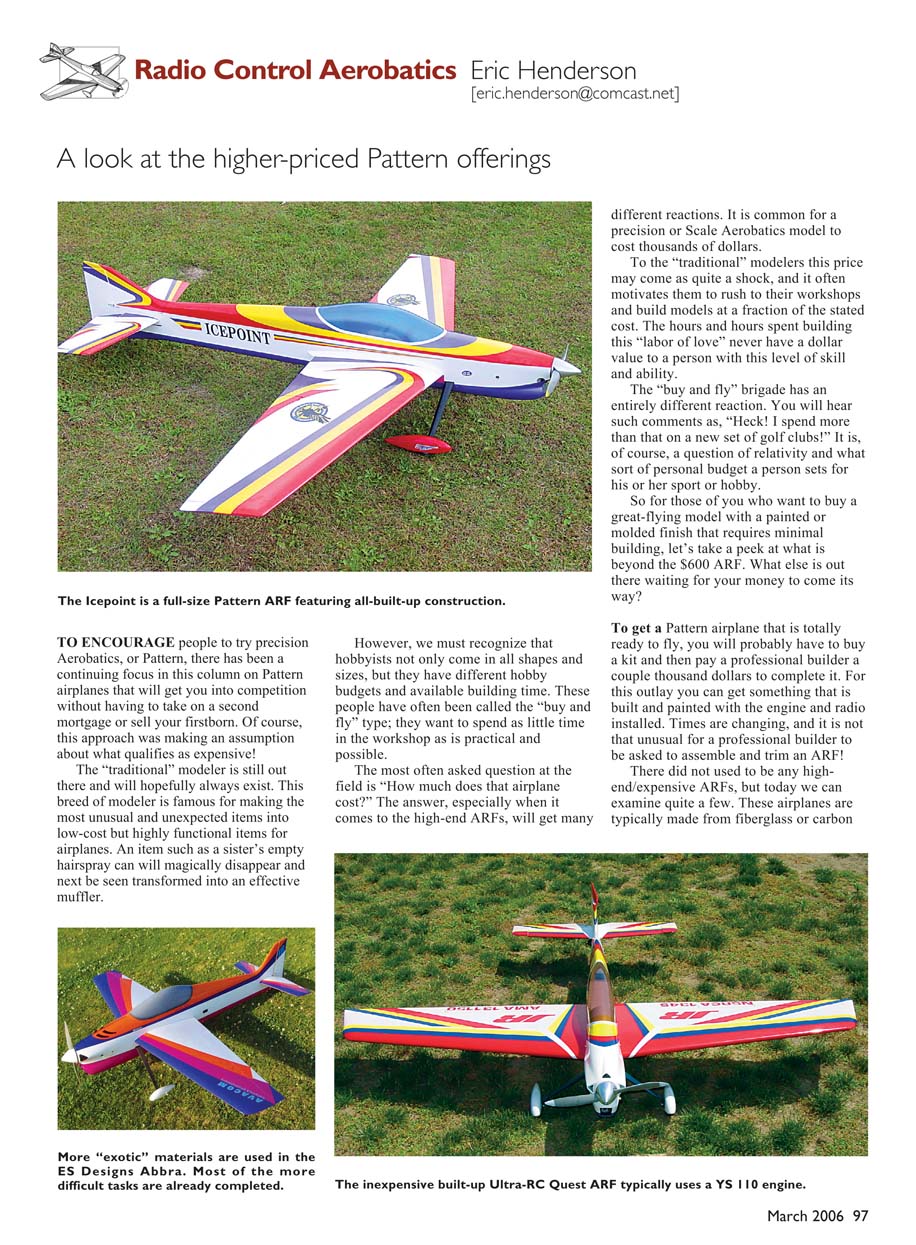
So for those of you who want to buy a great-flying model with a painted or molded finish that requires minimal building, let's take a peek at what is beyond the $600 ARF. What else is out there waiting for your money?
To get a Pattern airplane that is totally ready to fly, you will probably have to buy a kit and then pay a professional builder a couple thousand dollars to complete it. For this outlay you can get something that is built and painted with the engine and radio installed. Times are changing, and it is not unusual for a professional builder to be asked to assemble and trim an ARF.
There did not used to be any high-end, expensive ARFs, but today we can examine quite a few. These airplanes are typically made from fiberglass or carbon fiber, with polyurethane-lined and molded fuselages. We call these "exotic" materials, and they are usually associated with high-tech construction techniques. Another point to consider is that you could find yourself paying not just for a lot of epoxy and carbon fiber, but also for the design that won or placed high in the Nats or the World Championships.
I'll draw an arbitrary line in the sand and look at Pattern ARFs costing less and more than $500. An ARF costing less than $500 can be an excellent flier.
Photo captions / notes:
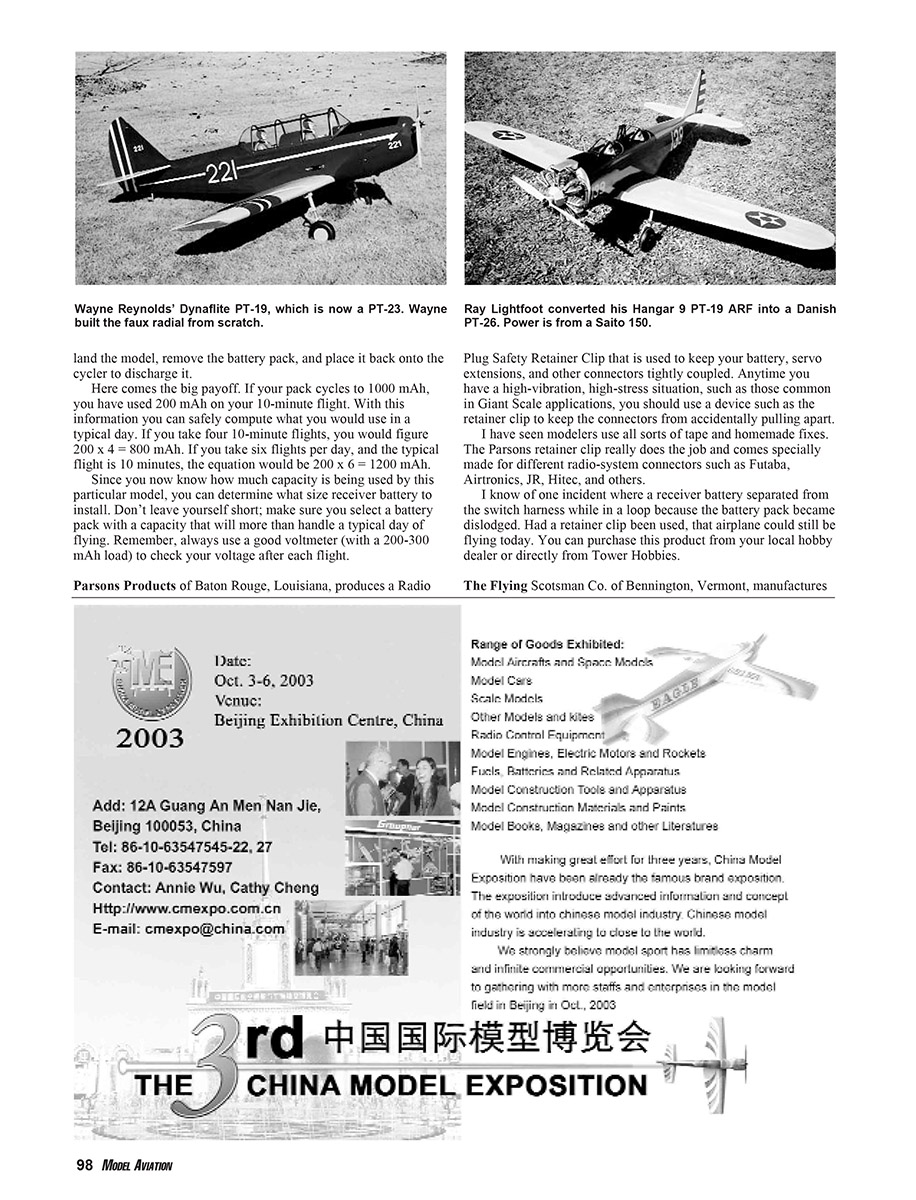
- Wayne Reynolds' Dynaflite PT-19, which is now a PT-23. Wayne built the faux radial from scratch.
- Ray Lightfoot converted his Hangar 9 PT-19 ARF into a Danish PT-26. Power is from a Saito 150.
Note: The provided scanned page does not contain the remainder of the "Radio Control Aerobatics - 2006/03" article. This scanned page is actually the "Radio Control Electrics" column by Bob Kopski with meet announcements and photo captions, and therefore the primary article text and continuation are not available on this page.
Transcribed from original scans by AI. Minor OCR errors may remain.

