
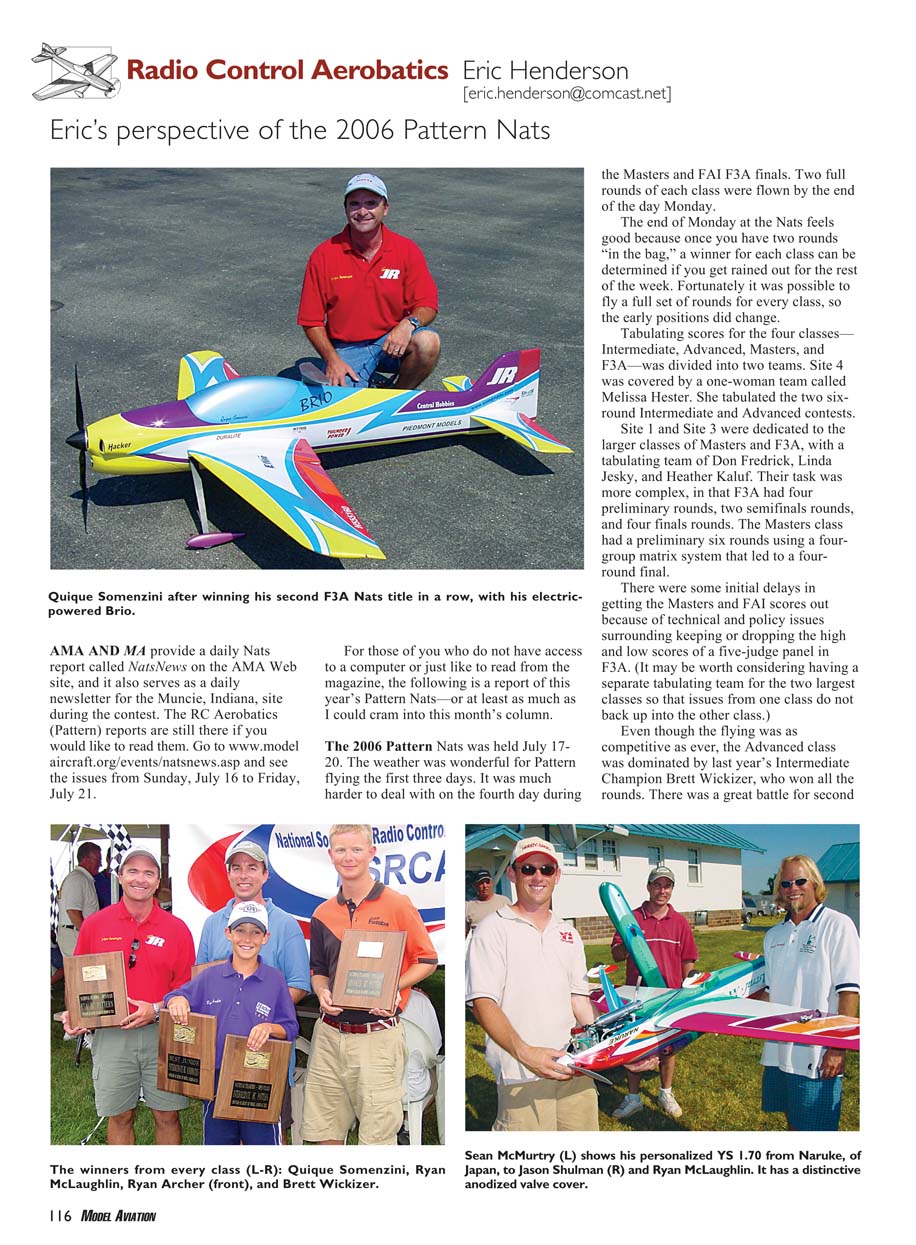
Radio Control Aerobatics
Eric Henderson [[email protected]]
Eric’s perspective of the 2006 Pattern Nats
Overview
AMA and MA provide a daily Nats report called NatsNews on the AMA website; it also serves as a daily newsletter for the Muncie, Indiana, site during the contest. The RC Aerobatics (Pattern) reports are still available; go to www.modelaircraft.org/events/natsnews.asp and see the issues from Sunday, July 16 to Friday, July 21.
For those who do not have access to a computer or just like to read from the magazine, the following is a report of this year’s Pattern Nats—or at least as much as I could cram into this month’s column.
The 2006 Pattern Nats was held July 17–20. The weather was wonderful for Pattern flying the first three days; it was much harder to deal with on the fourth day during the Masters and FAI F3A finals. Two full rounds of each class were flown by the end of Monday.
Having two rounds “in the bag” at the end of Monday feels good because a winner for each class can be determined if you get rained out for the rest of the week. Fortunately, it was possible to fly a full set of rounds for every class, and the early positions did change.
Tabulation and scoring
Tabulating scores for the four classes—Intermediate, Advanced, Masters, and F3A—was divided into two teams.
- Site 4 was covered by a one-woman team, Melissa Hester. She tabulated the two six-round Intermediate and Advanced contests.
- Sites 1 and 3 were dedicated to the larger classes of Masters and F3A, with a tabulating team of Don Fredrick, Linda Jesky, and Heather Kaluf. Their task was more complex: F3A had four preliminary rounds, two semifinal rounds, and four finals rounds. The Masters class had a preliminary six rounds using a four-group matrix system that led to a four-round final.
There were some initial delays in getting the Masters and FAI scores out because of technical and policy issues surrounding keeping or dropping the high and low scores of a five-judge panel in F3A. It may be worth considering having a separate tabulating team for the two largest classes so that issues from one class do not back up into the other.
Class summaries
Advanced
Even though the flying was as competitive as ever, the Advanced class was dominated by last year’s Intermediate Champion Brett Wickizer, who won all the rounds. There was a great battle for second place in Advanced between Mike Hester, Mark Hunt, Keith Black, and Steven Rosenblatt.
Intermediate
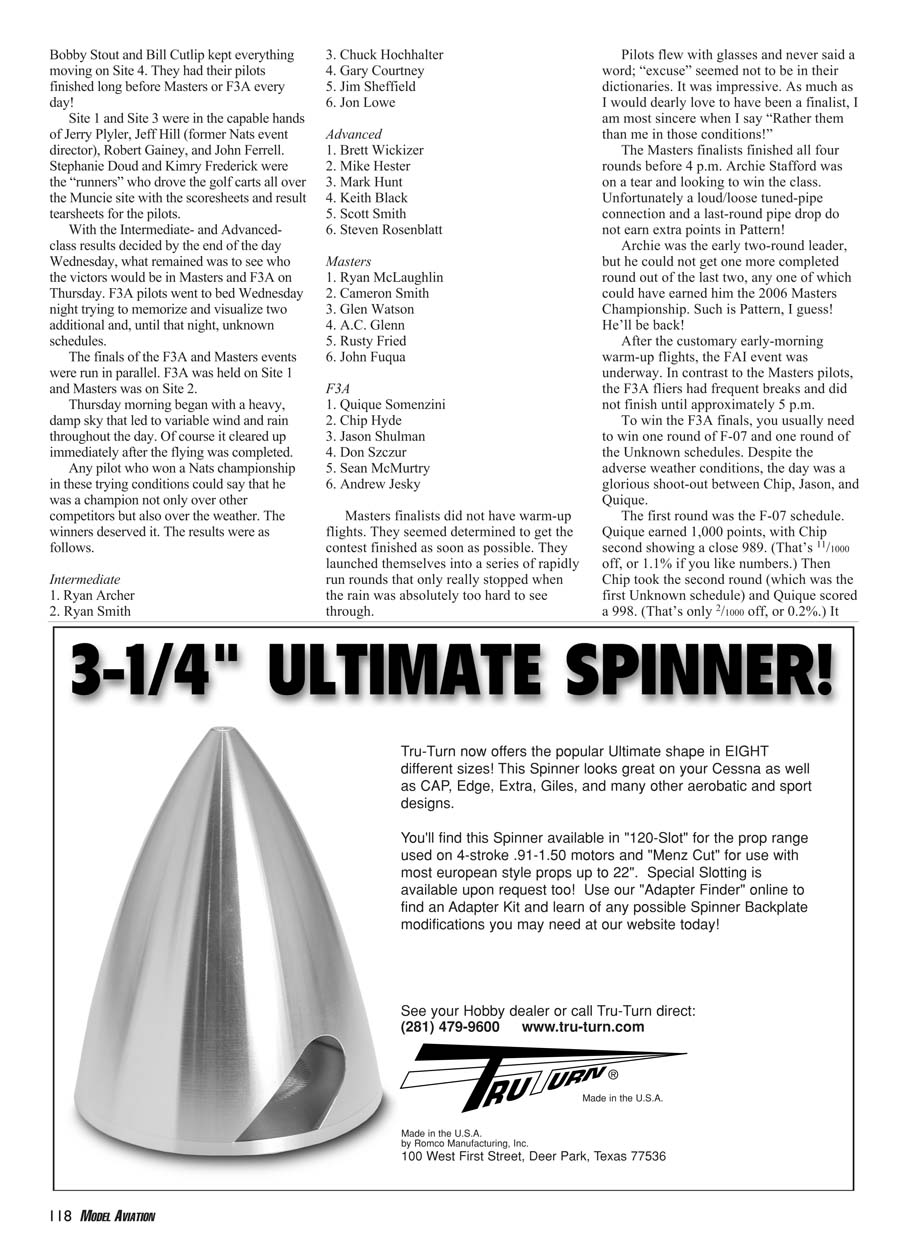
The Intermediate class had an interesting flavor as two Ryans battled it out. Ryan Archer maintained a daily lead over Ryan Smith without ever winning a round; consistency certainly paid off. Ryan Archer was so diminutive that he could hardly lift the heavy wooden trophies. Chip Hyde has been coaching and helping the delightful young Ryan Archer. It was great to see this in the practice sessions, and it conjured up the question of whether we could see Ryan beating Chip one day. The Intermediate contest was exciting to follow, and placings were undecided until the last two rounds were finished Wednesday.
Masters
Wednesday was a big day for the large Masters group. The competition for the top eight spots was strong and visible. The top four positions were basically decided, but Robert “Godfather” Satalino, Craig Buckles, Dale Arnold, and Donald Ramsey still had a shot. Worth mentioning was Jerry Budd, who began well by winning a round; however, his model appeared to have electrical problems that kept him out of the top eight this year.
When the dust settled, the Masters finals qualifying order was:
- Glen Watson
- Rusty Fried
- A.C. Glenn
- Ryan McLaughlin
- Archie Stafford
- John Fuqua
- Jeff Carter
- Cameron Smith
FAI (F3A)
FAI had a four-round preliminary contest held the first two mornings of the contest. All pilots flew in front of the same judges, so they all had equal judge exposure. There was one flightline on two separate sites; FAI pilots had the luxury of flying with only one airplane in the air at a time.
When half the FAI pilots had been judged on both sites, the judge panels swapped sites. This was considered easier than having the pilots move from one site to another with their airplanes and associated support equipment.
After four rounds of the Preliminary schedule (P-07), the best total of three rounds was used to select the 20 semifinalists for Wednesday. The 20 pilots’ totals were also normalized, and that score was used as a carryover to make the two-round Finals schedule (F-07) semifinals a best-of-two-out-of-three-rounds scoring event.
I had campaigned for an FAI semifinals round last year. The FAI pilots voted to support the change, so it finally came to pass this year. It was a privilege and pleasurable to be in the chair for these semifinals.
There were more F3A entrants in 2006 than in the last few years, which put to rest fears that the new format would “scare” pilots away. Some fliers were stretched a bit flying F-07, but they all said they had a blast and expect to come better prepared next year.
One less obvious effect of an F-07 semifinal is that all pilots who make it into the eight-person finals are clearly capable of flying that schedule in rounds one and three of the finals.
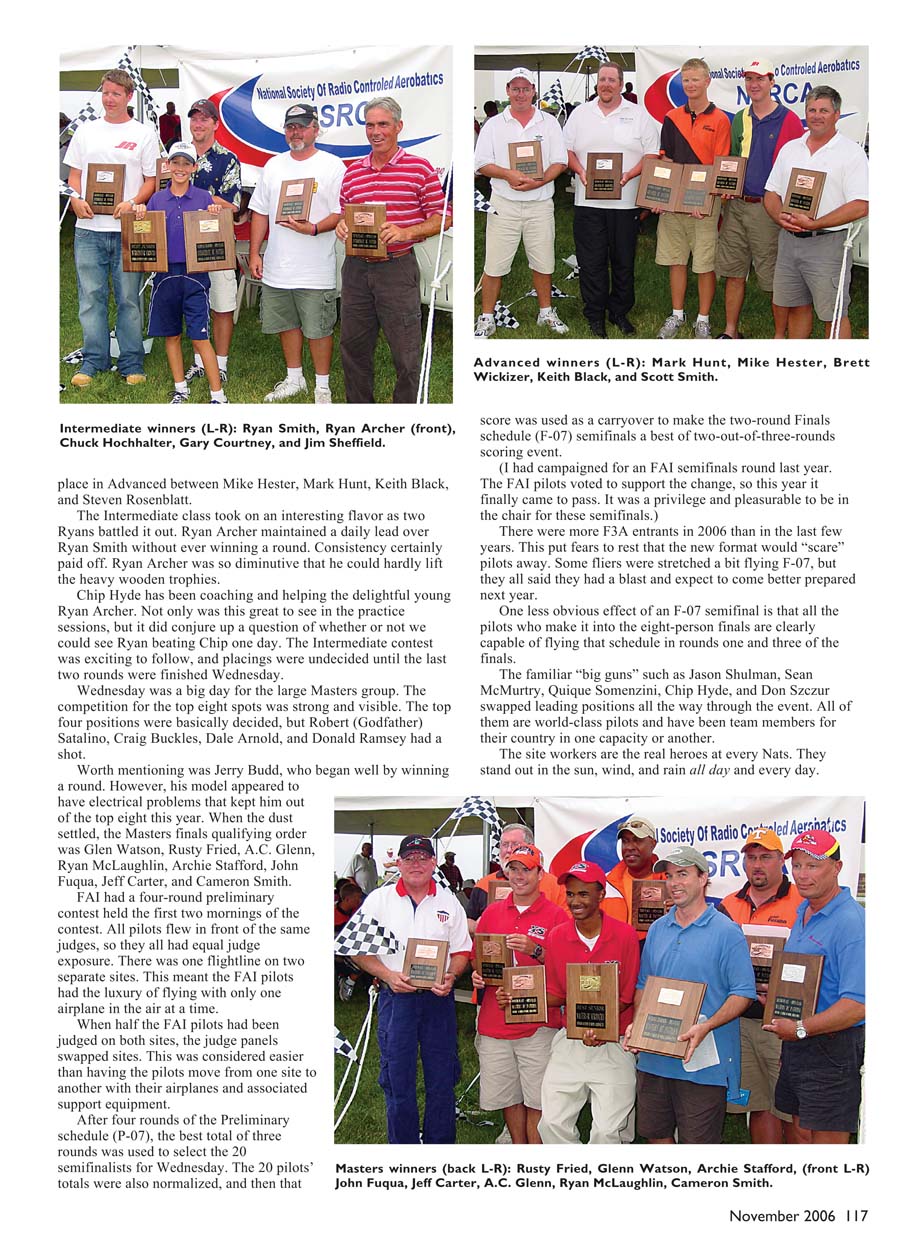
The familiar “big guns” such as Jason Shulman, Sean McMurtry, Quique Somenzini, Chip Hyde, and Don Szczur swapped leading positions all the way through the event. All of them are world-class pilots and have been team members for their country in one capacity or another.
Site workers and support
The site workers are the real heroes at every Nats. They stand out in the sun, wind, and rain all day and every day.
- Site 4: Bobby Stout and Bill Cutlip kept everything moving; they had their pilots finished long before Masters or F3A every day.
- Sites 1 and 3: Jerry Plyler, Jeff Hill (former Nats event director), Robert Gainey, and John Ferrell managed operations capably.
- Runners: Stephanie Doud and Kimmy Frederick drove golf carts around the Muncie site with scoresheets and result tearsheets for the pilots.
With the Intermediate- and Advanced-class results decided by the end of Wednesday, what remained was to see who the victors would be in Masters and F3A on Thursday. F3A pilots went to bed Wednesday night trying to memorize and visualize two additional and, until that night, unknown schedules.
Finals day (Thursday)
The finals of the F3A and Masters events were run in parallel. F3A was held on Site 1 and Masters on Site 2.
Thursday morning began with a heavy, damp sky that led to variable wind and rain throughout the day. Of course it cleared up immediately after the flying was completed.
Any pilot who won a Nats championship in these trying conditions could say that he was a champion not only over other competitors but also over the weather. The winners deserved it.
Masters finals
Masters finalists did not have warm-up flights. They seemed determined to get the contest finished as soon as possible and launched themselves into rapidly run rounds that only really stopped when the rain was too hard to see through. Pilots flew with glasses and never complained; “excuse” seemed not to be in their dictionaries. It was impressive.
The Masters finalists finished all four rounds before 4 p.m. Archie Stafford was on a tear and looking to win the class; unfortunately a loud/loose tuned-pipe connection and a last-round pipe drop do not earn extra points in Pattern. Archie was the early two-round leader, but he could not complete another round in the last two, any one of which could have earned him the 2006 Masters Championship.
FAI finals
After the customary early-morning warm-up flights, the FAI event was underway. In contrast to the Masters pilots, the F3A fliers had frequent breaks and did not finish until approximately 5 p.m.
To win the F3A finals, you usually need to win one round of F-07 and one round of the Unknown schedules. Despite the adverse weather, the day was a glorious shoot-out between Chip, Jason, and Quique.
- Round 1 (F-07): Quique earned 1,000 points, with Chip second at 989 (11/1000 off, or 1.1%).
- Round 2 (Unknown): Chip won and Quique scored 998 (2/1000 off, or 0.2%).
- Round 3 (F-07): Quique won again, preventing Chip from clinching the contest with that round. Chip earned a 910, and Sean McMurtry scored 990.
- Round 4 (Unknown): Jason Shulman (“box-left”) won the last round, locking up third place for Jason and leaving a mathematical door open for Chip. Quique took second in the last round, closing the door for Chip and giving Quique a repeat win.
Quique handles pressure extremely well, with a cool countenance and a disarming smile. You would not know from looking at him that his wife was due to give birth to their second son any day during the Nats. Sebastian Somenzini was born only a few days later, “well under the FAI limit at 7-3/4 pounds.” Quique works and lives with his growing family in the U.S. and is a fine example for all who want to compete in RC flying.
Results
Intermediate
- Ryan Archer
- Ryan Smith
- Chuck Hochhalter
- Gary Courtney
- Jim Sheffield
- Jon Lowe
Advanced
- Brett Wickizer
- Mike Hester
- Mark Hunt
- Keith Black
- Scott Smith
- Steven Rosenblatt
Masters
- Ryan McLaughlin
- Cameron Smith
- Glen Watson
- A.C. Glenn
- Rusty Fried
- John Fuqua
F3A
- Quique Somenzini
- Chip Hyde
- Jason Shulman
- Don Szczur
- Sean McMurtry
- Andrew Jesky
FAI progression summary
End of P-07
- Jason Shulman
- Sean McMurtry
- Quique Somenzini
- Chip Hyde
- Don Szczur
End of Semifinals (F-07)
- Sean McMurtry
- Quique Somenzini
- Jason Shulman
- Don Szczur
- Chip Hyde
Finals Results
- Quique Somenzini
- Chip Hyde
- Jason Shulman
- Don Szczur
- Sean McMurtry
Equipment and power choices
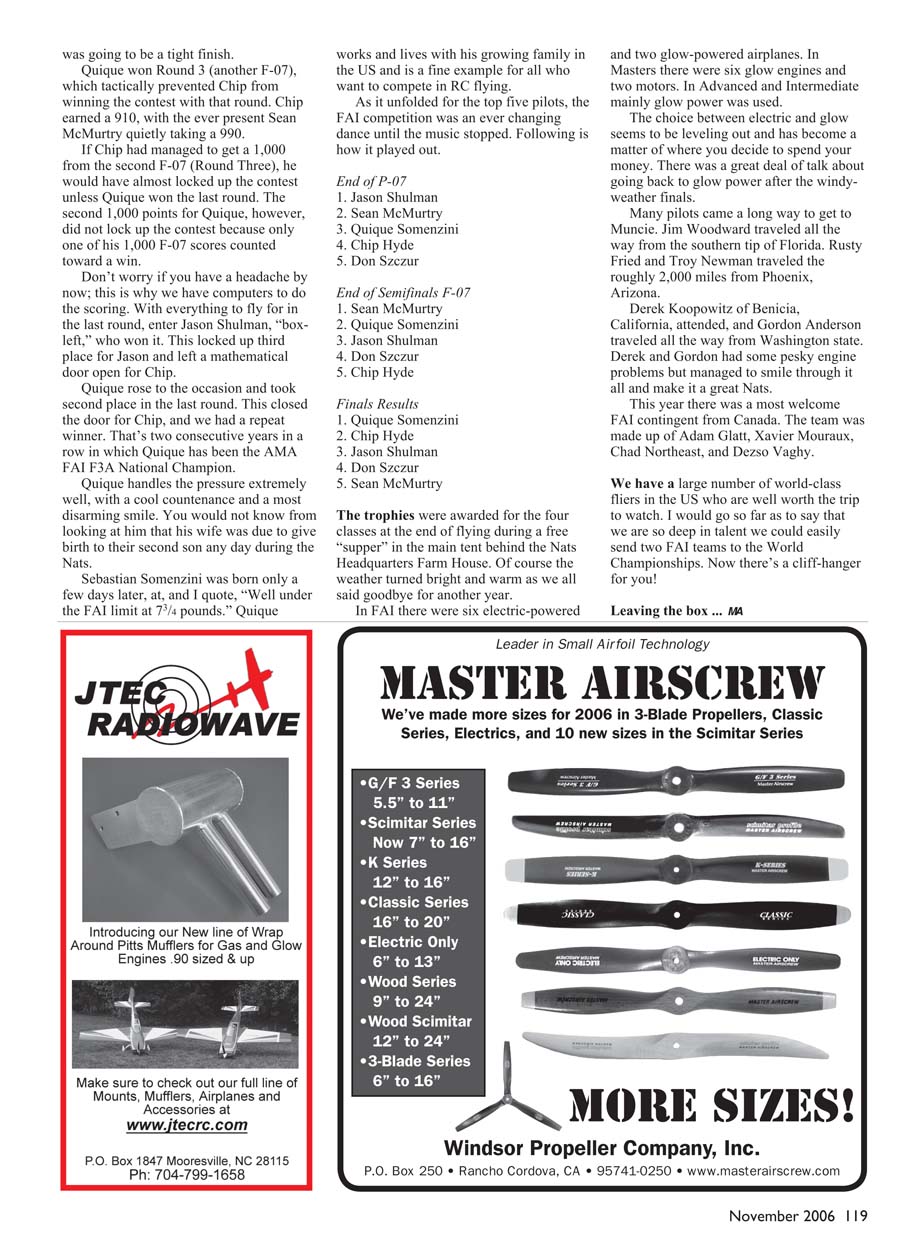
In FAI there were six electric-powered and two glow-powered airplanes. In Masters there were six glow engines and two electric motors. In Advanced and Intermediate, mainly glow power was used.
The choice between electric and glow seems to be leveling out and has become a matter of where you decide to spend your money. There was a great deal of talk about going back to glow power after the windy-weather finals.
Travel and international teams
Many pilots came a long way to get to Muncie.
- Jim Woodward traveled from the southern tip of Florida.
- Rusty Fried and Troy Newman traveled roughly 2,000 miles from Phoenix, Arizona.
- Derek Koopowitz came from Benicia, California.
- Gordon Anderson traveled from Washington state. Derek and Gordon had some pesky engine problems but managed to smile through it all.
This year there was a welcome FAI contingent from Canada: Adam Glatt, Xavier Mouraux, Chad Northeast, and Dezso Vaghy.
We have a large number of world-class fliers in the U.S. who are well worth the trip to watch. I would go so far as to say we are so deep in talent we could easily send two FAI teams to the World Championships. Now there's a cliff-hanger for you!
Leaving the box... MA
Transcribed from original scans by AI. Minor OCR errors may remain.

