
Radio Control Aerobatics
Eric Henderson [[email protected]]
The US's new ambassador for RC Aerobatics
THE CHINESE say that “A journey of a thousand miles begins with a single step.” In the case of the new FAI F3A World Champion—Quique Somenzini—you could say that it began with his first takeoff in 1977! Quique (pronounced “Key-Kay”) flew a long journey to win the individual World Championship back for the US in 2007.
When asked about how he got into RC and competing, Quique said he owed everything to his father, Mario. He was not only supportive, but he also taught Quique how to handle both success and failure like a gentleman. Mario passed away in 2004 while Quique was competing in the Tucson Aerobatic Shootout in Arizona.
Quique has tremendous credentials; he is a winner in many forms of aerobatic flying. He is a four-time US pilot in FAI F3A Aerobatics, and he has been in the top 10 in eight World Championships, earning an impressive three second places.
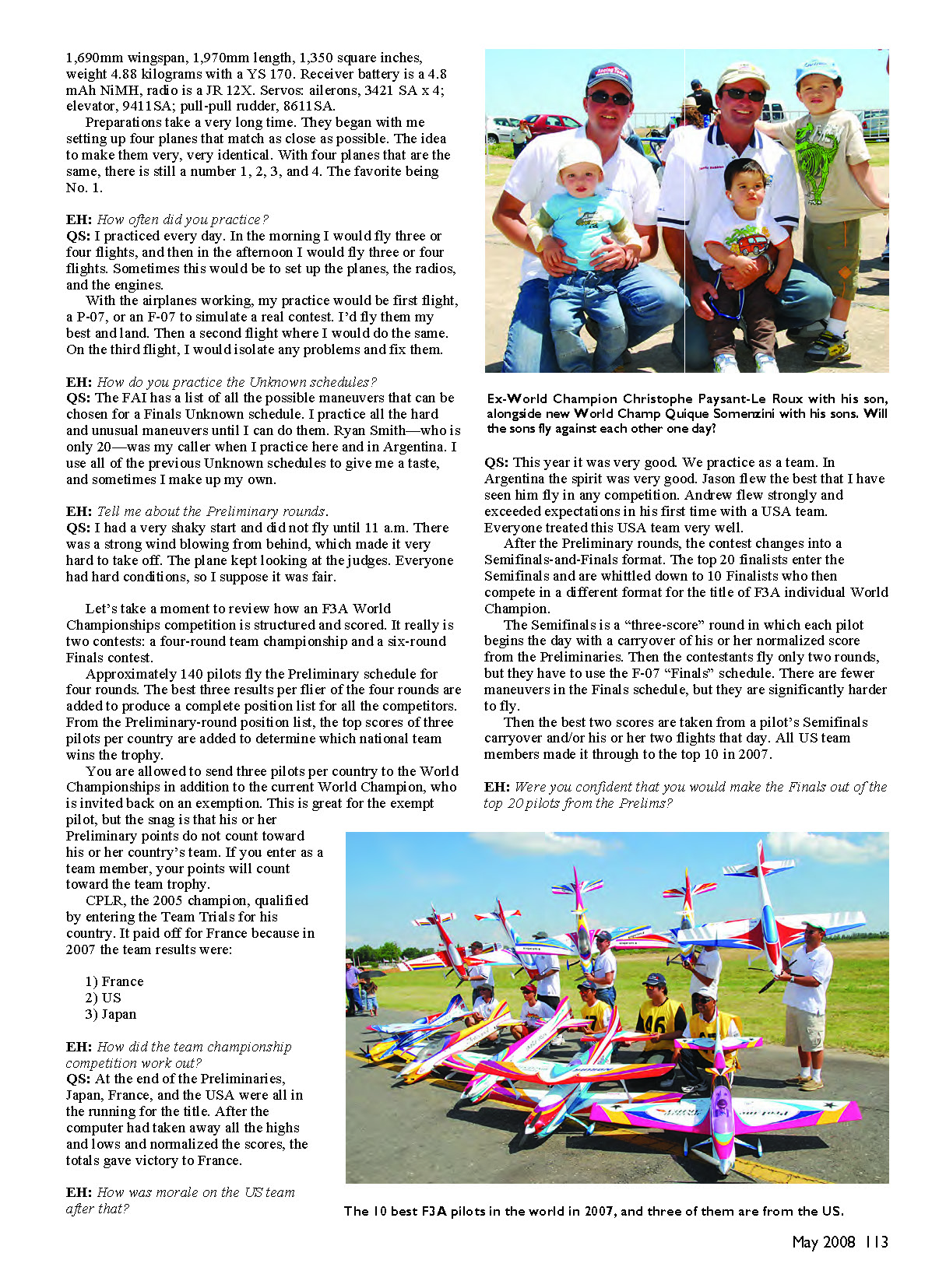
Last year Quique stood on the podium as the individual World Champion. That journey has covered much more than 1,000 miles. He earned that world title every step of the way.
In other categories, Quique is a four-time Tournament of Champions competitor, a three-time Don Lowe Masters competitor and winner, a two-time Tucson Aerobatic Shootout competitor, and a Freestyle Champion and Extreme Flight Championships Champion.
Married in Chile in 2001, and thinking of his family's future, Quique came to live and work in the US. He had been here more than 20 times with his hobby/competition and was drawn—as were so many before him—to the land of opportunity.
Quique has made his home in the US and is raising his American-born children in Ohio. He runs an RC model business with Wayne Ulery and represents JR in testing its products and as a Team JR member.
Once you are a US resident, you qualify to pay US taxes, perform military service, and, in many cases, are eligible to represent the US in a host of sporting events, etc. Almost the only thing you can't do is vote or become the American president. The AMA recognizes US residency as a qualification that makes pilots eligible to be selected for the USA world team(s).
There were two ways Quique could have made it to the 2007 F3A World Championships. He could have taken the relatively easy route of representing Argentina. However, he felt strongly that because his home was in the US, he should take the more difficult and risky path of attempting to qualify through the US Team Trials.
(Christophe Paysant-Le Roux [CPLR]—the multiple and 2005 World Champion—chose to qualify for his country in a similar way. I'll have more about the effect of that parallelism later.)
A dozen or so pilots in the US are more than capable of making it onto the team. In addition, there is the talent of already well-established and repeat team members Chip Hyde, Sean McMurtry, and Jason Shulman.
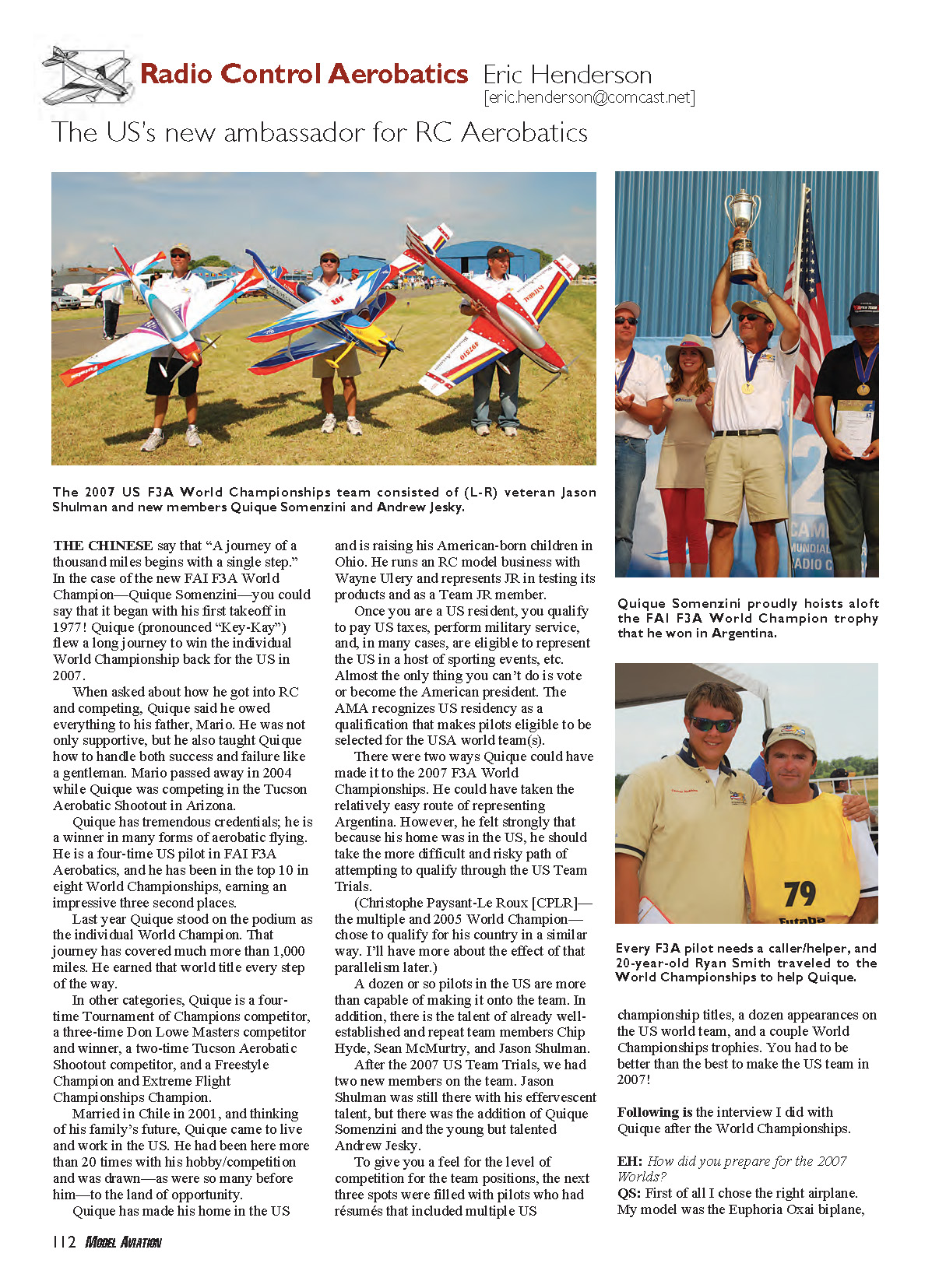
After the 2007 US Team Trials, we had two new members on the team. Jason Shulman was still there with his effervescent talent, but there was the addition of Quique Somenzini and the young but talented Andrew Jesky.
To give you a feel for the level of competition for the team positions, the next three spots were filled with pilots who had résumés that included multiple US championship titles, a dozen appearances on the US world team, and a couple World Championship trophies. You had to be better than the best to make the US team in 2007!
Following is the interview I did with Quique after the World Championships.
EH: How did you prepare for the 2007 Worlds?
QS: First of all I chose the right airplane.
- Wingspan: 1,690 mm
- Length: 1,970 mm
- Wing area: 1,350 square inches
- Weight: 4.88 kilograms (with a YS 170)
- Receiver battery: 4.8 V NiMH
- Radio: JR 12X
- Servos: ailerons, 3421SA × 4; elevator, 9411SA; pull-pull rudder, 8611SA
Preparations take a very long time. They began with me setting up four planes that match as close as possible. The idea was to make them very, very identical. With four planes that are the same, there is still a number 1, 2, 3, and 4. The favorite being No. 1.
EH: How often did you practice?
QS: I practiced every day. In the morning I would fly three or four flights, and then in the afternoon I would fly three or four flights. Sometimes this would be to set up the planes, the radios, and the engines.
With the airplanes working, my practice would be: first flight, a P-07, or an F-07 to simulate a real contest. I'd fly them my best and land. Then a second flight where I would do the same. On the third flight, I would isolate any problems and fix them.
EH: How do you practice the Unknown schedules?
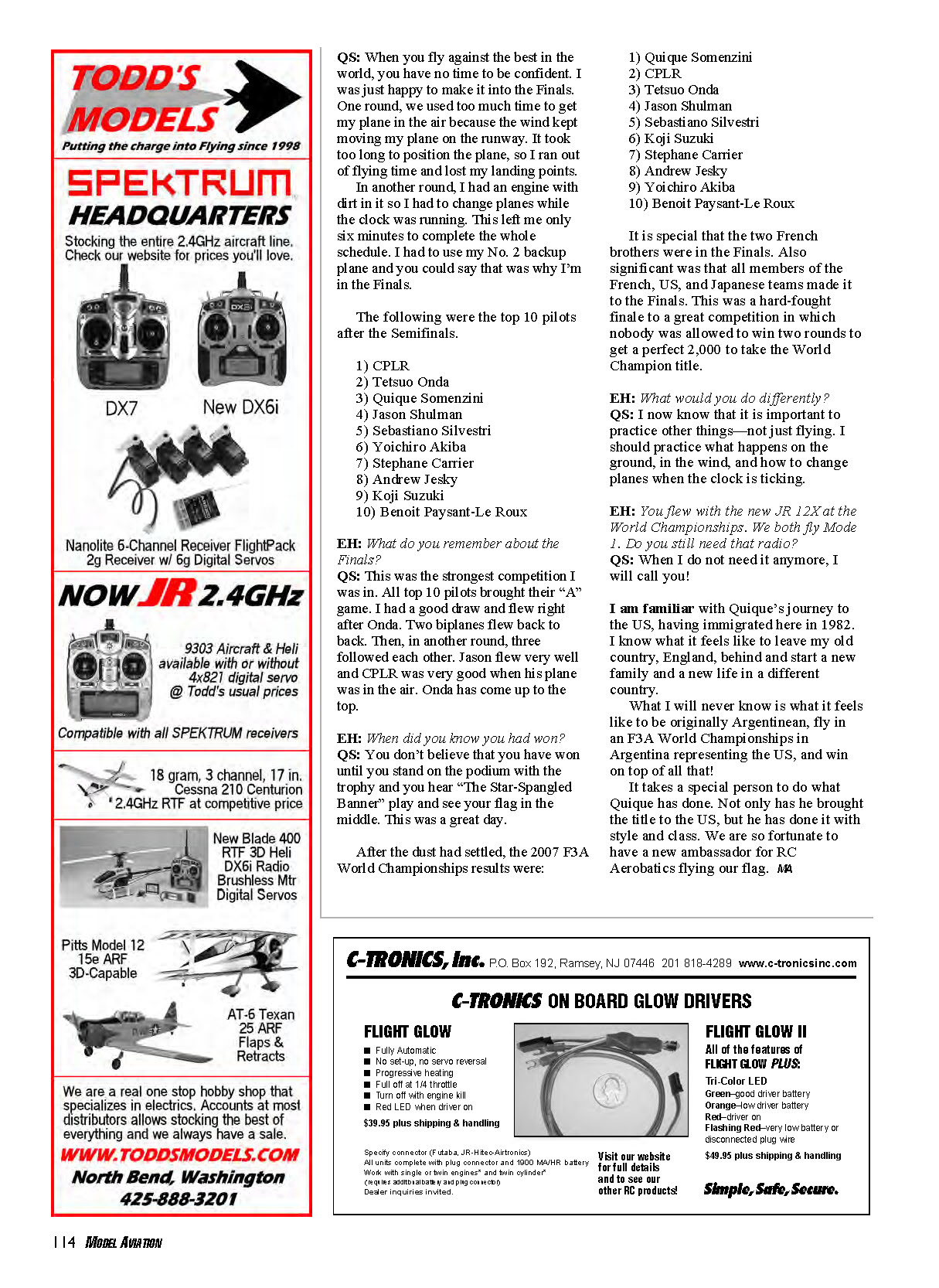
QS: The FAI has a list of all the possible maneuvers that can be chosen for a Finals Unknown schedule. I practice all the hard and unusual maneuvers until I can do them. Ryan Smith—who is only 20—was my caller when I practiced here and in Argentina. I use all of the previous Unknown schedules to give me a taste, and sometimes I make up my own.
EH: Tell me about the Preliminary rounds.
QS: I had a very shaky start and did not fly until 11 a.m. There was a strong wind blowing from behind, which made it very hard to take off. The plane kept looking at the judges. Everyone had hard conditions, so I suppose it was fair.
How the F3A World Championships are structured and scored
Let's take a moment to review how an F3A World Championships competition is structured and scored. It really is two contests: a four-round team championship and a six-round Finals contest.
Approximately 140 pilots fly the Preliminary schedule for four rounds. The best three results per flier of the four rounds are added to produce a complete position list for all the competitors. From the Preliminary-round position list, the top scores of three pilots per country are added to determine which national team wins the trophy.
You are allowed to send three pilots per country to the World Championships in addition to the current World Champion, who is invited back on an exemption. This is great for the exempt pilot, but the snag is that his or her Preliminary points do not count toward his or her country's team. If you enter as a team member, your points will count toward the team trophy.
CPLR, the 2005 champion, qualified by entering the Team Trials for his country. It paid off for France because in 2007 the team results were:
- France
- US
- Japan
EH: How did the team championship competition work out?
QS: At the end of the Preliminaries, Japan, France, and the USA were all in the running for the title. After the computer had taken away all the highs and lows and normalized the scores, the totals gave victory to France.
EH: How was morale on the US team after that?
QS: This year it was very good. We practice as a team. In Argentina the spirit was very good. Jason flew the best that I have seen him fly in any competition. Andrew flew strongly and exceeded expectations in his first time with a USA team. Everyone treated this USA team very well.
After the Preliminary rounds, the contest changes into a Semifinals-and-Finals format. The top 20 finalists enter the Semifinals and are whittled down to 10 Finalists who then compete in a different format for the title of F3A individual World Champion.
The Semifinals is a "three-score" round in which each pilot begins the day with a carryover of his or her normalized score from the Preliminaries. Then the contestants fly only two rounds, but they have to use the F-07 "Finals" schedule. There are fewer maneuvers in the Finals schedule, but they are significantly harder to fly.
Then the best two scores are taken from a pilot's Semifinals carryover and his or her two flights that day. All US team members made it through to the top 10 in 2007.
EH: Were you confident that you would make the Finals out of the top 20 pilots from the Prelims?
QS: When you fly against the best in the world, you have no time to be confident. I was just happy to make it into the Finals. One round, we used too much time to get my plane in the air because the wind kept moving my plane on the runway. It took too long to position the plane, so I ran out of flying time and lost my landing points.
In another round, I had an engine with dirt in it so I had to change planes while the clock was running. This left me only six minutes to complete the whole schedule. I had to use my No. 2 backup plane and you could say that was why I'm in the Finals.
The following were the top 10 pilots after the Semifinals:
- CPLR
- Tetsuo Onda
- Quique Somenzini
- Jason Shulman
- Sebastiano Silvestri
- Yoichiro Akiba
- Stephane Carrier
- Andrew Jesky
- Koji Suzuki
- Benoit Paysant-Le Roux
EH: What do you remember about the Finals?
QS: This was the strongest competition I was in. All top 10 pilots brought their "A" game. I had a good draw and flew right after Onda. Two biplanes flew back to back. Then, in another round, three followed each other. Jason flew very well and CPLR was very good when his plane was in the air. Onda has come up to the top.
EH: When did you know you had won?
QS: You don't believe that you have won until you stand on the podium with the trophy and you hear "The Star-Spangled Banner" play and see your flag in the middle. This was a great day.
After the dust had settled, the 2007 F3A World Championships results were:
- Quique Somenzini
- CPLR
- Tetsuo Onda
- Jason Shulman
- Sebastiano Silvestri
- Koji Suzuki
- Stephane Carrier
- Andrew Jesky
- Yoichiro Akiba
- Benoit Paysant-Le Roux
It is special that the two French brothers were in the Finals. Also significant was that all members of the French, US, and Japanese teams made it to the Finals. This was a hard-fought finale to a great competition in which nobody was allowed to win two rounds to get a perfect 2,000 to take the World Champion title.
EH: What would you do differently?
QS: I now know that it is important to practice other things—not just flying. I should practice what happens on the ground, in the wind, and how to change planes when the clock is ticking.
EH: You flew with the new JR 12X at the World Championships. We both fly Mode 1. Do you still need that radio?
QS: When I do not need it anymore, I will call you!
I am familiar with Quique's journey to the US, having immigrated here in 1982. I know what it feels like to leave my old country, England, behind and start a new family and a new life in a different country.
What I will never know is what it feels like to be originally Argentinean, fly in an F3A World Championships in Argentina representing the US, and win on top of all that!
It takes a special person to do what Quique has done. Not only has he brought the title to the US, but he has done it with style and class. We are so fortunate to have a new ambassador for RC Aerobatics flying our flag.
Transcribed from original scans by AI. Minor OCR errors may remain.

