

Flying senior Pattern in the Hoosier state
Eric Henderson <[email protected]>
The World Models A6 Intruder ARF senior RC Aerobatics (Pattern) model, available through AirBorne Models, is proving to be a popular design judging by the number of sales I see in the hobby store where I work. The Senior Pattern Association (SPA) is also spreading, possibly due in part to the availability of a good SPA ARF.
Hoosier Hospitality Senior Pattern Contest
Randy Schwersenska sent a note about an upcoming SPA event in Indiana: the Hoosier Hospitality Senior Pattern Contest. Details:
- Dates: July 26–27, 2008
- Location: Johnson County Radio Control Flyers’ (JCRCF) Tracee Field, Edinburgh, IN
- Format: Saturday — four rounds; Sunday — two rounds
- Classes:
- Senior Expert (age 60 and older)
- Expert (all ages)
- Sportsman (all ages)
- Novice (all ages)
- Rules:
- General rules require approved airplanes and engines, except Novice.
- Novice models limited to 72 inches wingspan and 15 pounds.
- SPA membership is not required for Novice class.
- Fees and amenities:
- Contest fee: $10
- SPA membership option: $20/year
- JCRCF offers free camping at the field (no hookups)
- County park grounds one mile north offer camping with hookups and running-water restrooms
- Concession stands open Saturday and Sunday
- Hotels available in nearby Franklin and Columbus
For SPA and JCRCF rules or more information, visit the organizations’ websites or contact Randy Schwersenska, event CD. Sounds like a party!
Engines & powerplants
There are a couple of engines that Pattern pilots might find interesting.
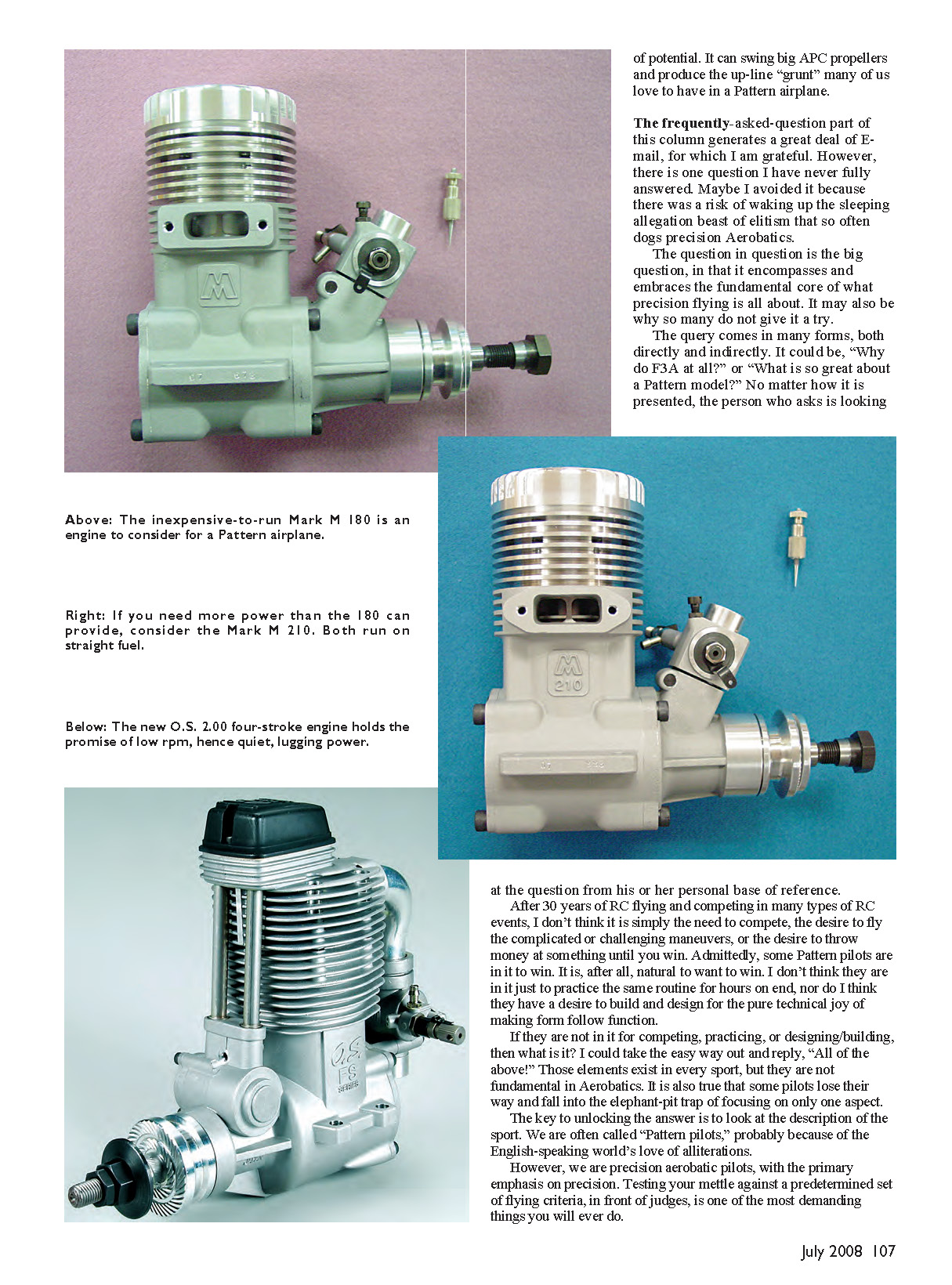
- Mokis are back; they are now called “Marks” and are available from Global Hobby Distributors (Hobby People). Two notable models:
- Mark M 180
- Mark M 210
- I recently featured the Mark M 210 in a review of Hangar 9’s 106-inch Cub. It ran on straight fuel (no nitromethane, often referred to as FAI fuel). The engine started on the first flip right out of the box and ran reliably.
- Mark also makes a remote mixture needle. You can add a second engine servo to modulate the fuel mixture at different throttle settings with a computer mix on your radio, or use an override knob on the transmitter to richen or lean the engine in flight. This is useful for break-in and for dialing the right mixture during long vertical climbs.
- These engines provide strong low-rpm power and need little, if any, tuning. There is also a gas ignition version for those pioneering that option.
Another powerhouse is the O.S. Engines 2.00 four-stroke, which comes in two forms:
- A fuel-injected version (higher price)
- A non-fuel-injected version, now available and with a lot of potential
The non-FI version can swing large APC propellers and produce the up-line “grunt” many of us like in a Pattern airplane.
Why fly precision Aerobatics?
The frequently-asked-question part of this column generates a great deal of email. One question I’ve never fully answered is fundamental: Why do F3A (precision Aerobatics) at all? What is so great about a Pattern model?
People ask from their personal perspective. After 30 years of RC flying and competing in many event types, I don’t think the answer is simply a need to compete, a desire for complicated maneuvers, or spending money to win. Some pilots are in it to win, and it is natural to want that, but that’s not the whole picture.
The key is the word “precision.” We are precision aerobatic pilots, and the primary emphasis is precision. Testing your mettle against a predetermined set of flying criteria in front of judges is one of the most demanding things you will ever do.
This is not like Formula 1 racing, where a driver can be on and off the track and still win. Precision means being held to strict standards on how maneuvers are performed. That standard is either what will make you try precision flying or keep you from taking the first step. Why should a competent RC pilot, comfortable with takeoffs, landings, loops, and rolls, step completely out of their comfort zone to meet these stringent criteria?
There is a plateau in RC flying where pilots think they have fantastic control—until they are invited to “fly by command,” that is, to put the airplane exactly where they are being told to put it. An epiphany often follows: for much of a typical flight, the airplane has been leading the pilot. To fly precisely is to be ahead of the airplane at all times.
Top pilots fly several maneuvers ahead so they can position their models for the best presentation in front of the judges. Flying to a precise pattern will teach far more about flying than casual Sunday cruises. You can become a very good pilot that way, but precision flying helps you achieve greatness.
I often compare precision Aerobatics with figure skating. Both have predetermined maneuvers and standards that must be met. A skater could be a hockey player, but they wouldn’t learn the poise, grace, and presentation of a figure skater. Precision Aerobatics turns you from a good RC pilot into an aerial artist who can “paint” with the accuracy of a draftsman and the poise of a ballerina.
If you choose to fly precision Aerobatics, you will gain superior, lasting skills: a deep understanding of how an airplane works, expertise in trimming and tuning, second-nature engine knowledge, and a high standard for radio and equipment performance. I love the sport and technology of precision Aerobatics and will always try to recruit new blood into this wonderful, challenging part of RC flying. It has helped me in many ways—not least of which is being able to land a multiengine warbird in a strong crosswind and still have all three landing-gear legs attached!
Where is my Evolution?
Short version: I sold my Evolution on the Internet to a buyer who turned out to be ripping off a number of modelers. The model is now in an evidence lockup in North Aurora, Illinois. It will remain there while the seller awaits trial for fraud by Internet deception.
Two lessons learned: listen to friends who live in the area, and call the police if it happens to you. The Internet works for the law as well.
EH
Sources
- Airborne Models — (925) 371-0922 — www.airborne-models.com
- Global Hobby Distributors — (714) 963-0329 — www.globalhobby.com
- JCRCF — www.jcrcf.net
- O.S. Engines — (800) 637-7660 — www.osengines.com
- Randy Schwersenska — (317) 422-5516
- SPA — www.seniorpattern.com
Transcribed from original scans by AI. Minor OCR errors may remain.

