
Radio Control Aerobatics
Eric Henderson [[email protected]]
The innovative YS 170DZ CDI engine
The world of precision aerobatics often gives birth to leading-edge products. There is a never-ending search for aerobatic designs that demand ever more precise control responses, maximum vertical power, and structural strength for the least weight.
I have been lucky enough, in many instances, to own and use some of these latest RC products. They tend to be somewhat high-tech and a bit expensive, so it is not possible to test everything that is out there. Perhaps if the AMA or MA shifted toward being more of a consumer guide, more products could be examined in greater detail.
Product evaluations are not this column’s primary purpose, so we gather insights in other ways—observing events like contests and interviewing competitors and vendors. Some avid supporters of the Pattern world regularly contribute new developments; they are “shadow columnists.” Sometimes they send letters to the column or provide more detailed reports. These people are often sponsored pilots, which is why they get early access to new and creative products or Pattern-specific systems.
One such contributor is Troy Newman, a strong FAI pilot whose career is simmering just below that of current world-team members. He had been flying interesting airplanes, radios, and engines up to and during the 2008 AMA Nats, where he placed in the top eight.
This month I feature the innovative YS 170DZ CDI four-stroke, supercharged engine. The "CDI" designation indicates the engine has a spark-plug ignition system. It is interesting because, even though this is a spark-ignition engine, it runs on methanol (regular glow fuel) rather than gasoline.
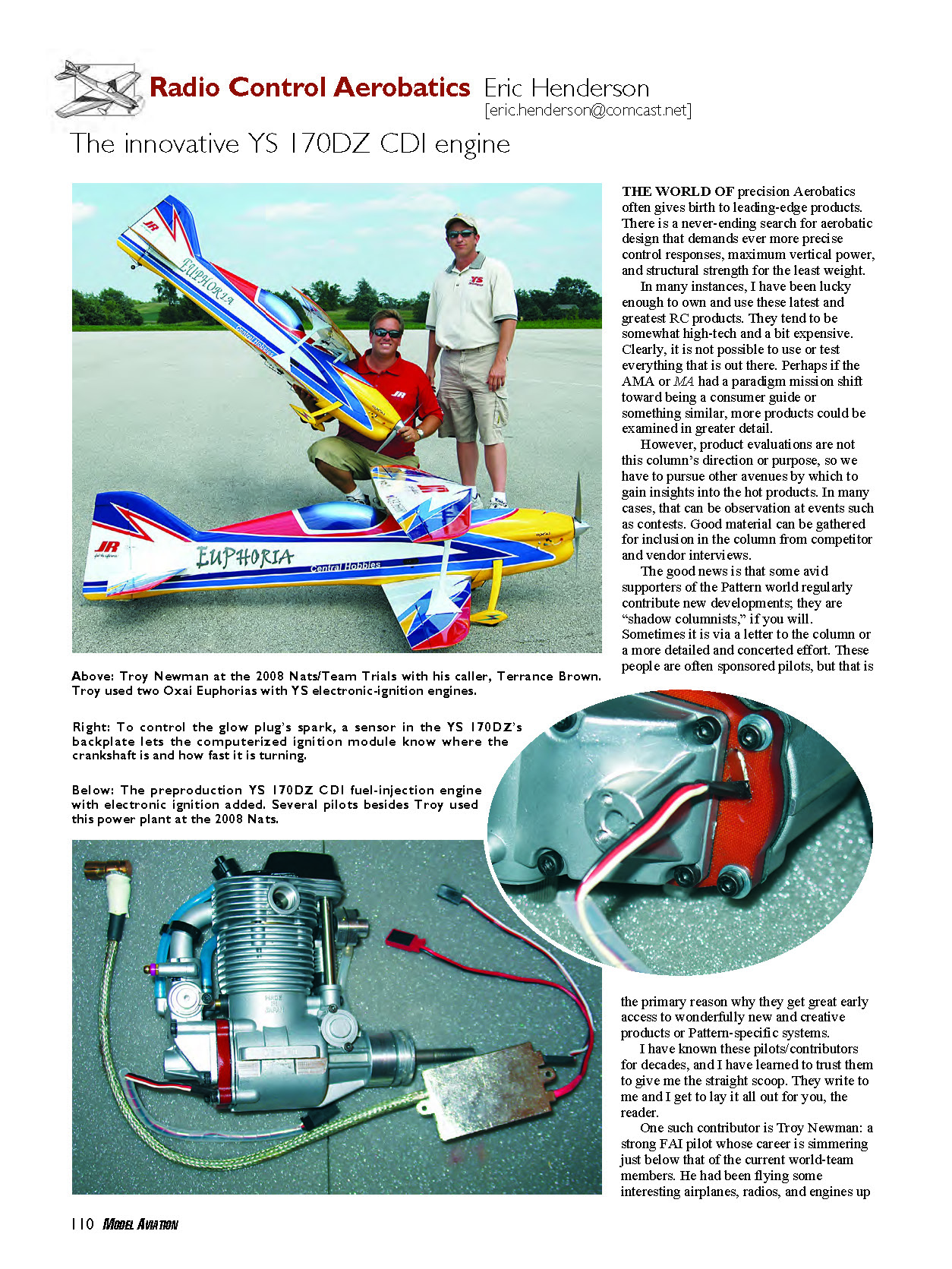
Troy flies an aerobatic biplane called the Euphoria, designed by Quique Somenzini (the current F3A World Champion) and produced by Oxai Models. The large model has significant wing and frontal area and needs a big engine to overcome the drag of two wings and pull it through FAI maneuvers.
Troy is a Team JR member and uses the new JR 12X (native) radio system. The term "native" indicates the radio is dedicated to DSM (Digital Spectrum Modulation) technology and does not have a 72 MHz module option.
Central Hobbies, a well-known supplier focused on Pattern flying, provided special engine hardware and accessories. The company also supplied ball-race clevises and control-connection accessories, so there is no slop in any of his control linkages. His YS engine burns Cool Power fuel from Morgan Fuels and turns a 19 x 11 APC propeller specially designed for the 170DZ CDI.
The YS 170DZ CDI is currently a prototype YS is using to test its new ignition system. The engine was unveiled at the 2008 FAI Team Trials in Muncie, Indiana.
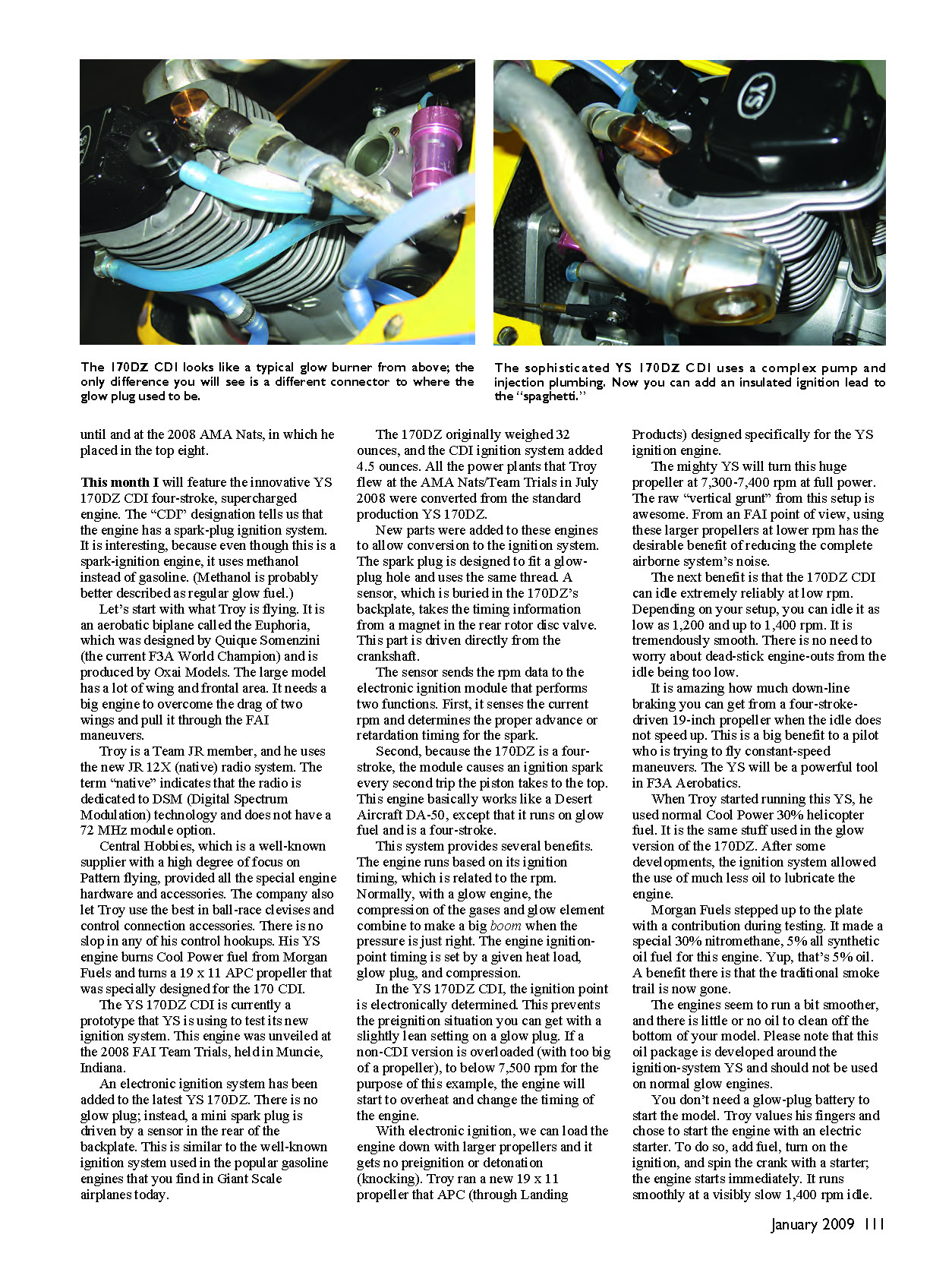
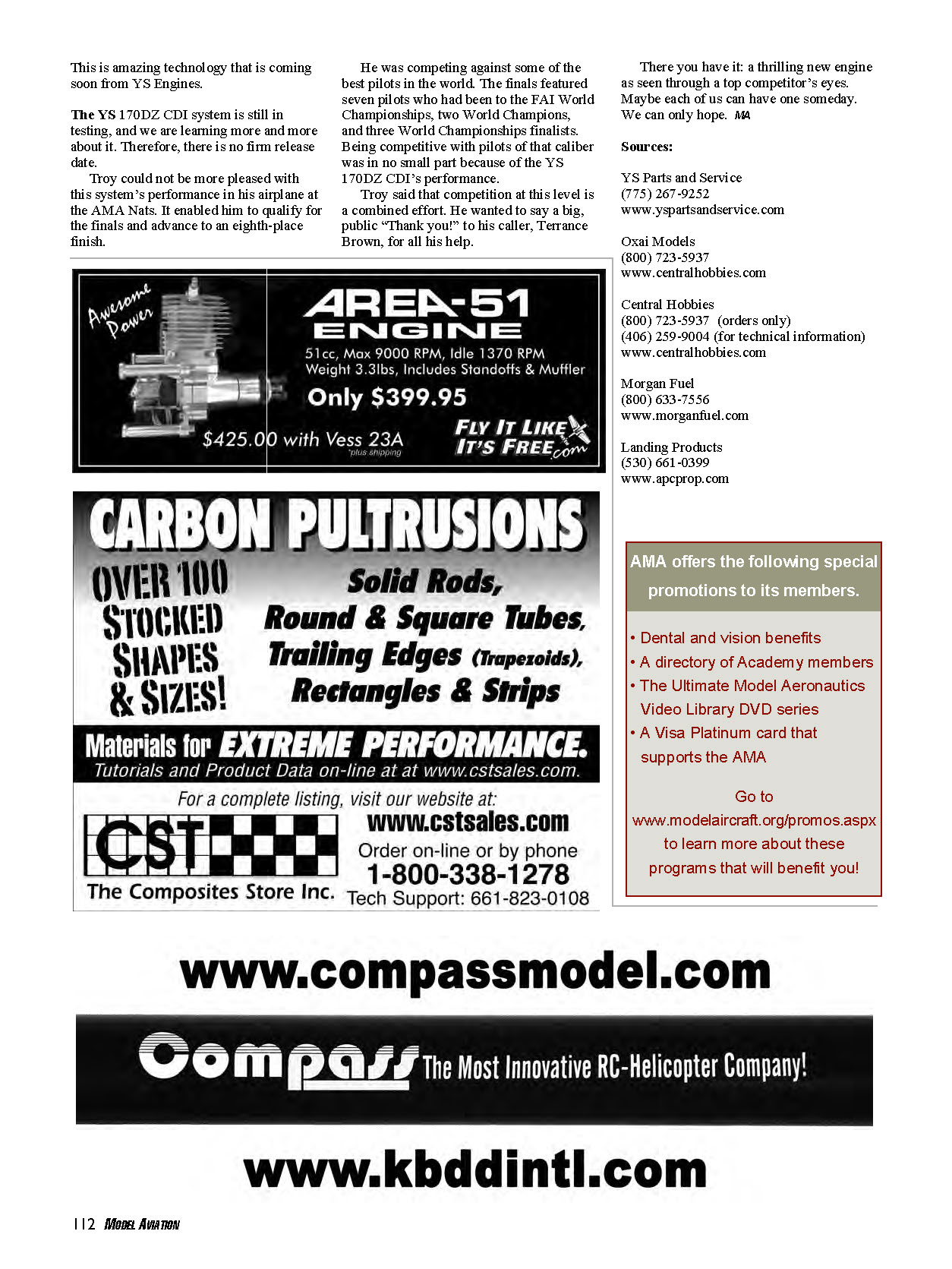
An electronic ignition system has been added to the latest YS 170DZ. There is no glow plug; instead, a mini spark plug is driven by a sensor in the rear of the backplate. This is similar to the ignition systems used in popular gasoline engines found in giant-scale airplanes.
The 170DZ originally weighed 32 oz; the CDI ignition system added 4.5 oz. All the power plants Troy flew at the AMA Nats/Team Trials in July 2008 were converted from the standard production YS 170DZ.
New parts were added to allow conversion to the ignition system. The spark plug is designed to fit the glow-plug hole and uses the same thread. A sensor buried in the 170DZ's backplate takes timing information from a magnet in the rear rotor disc valve, which is driven directly from the crankshaft.
The sensor sends rpm data to the electronic ignition module, which performs two functions:
- It senses current rpm and determines the proper advance or retardation timing for the spark.
- Because the 170DZ is a four-stroke, the module causes an ignition spark every second trip of the piston to top dead center.
Functionally, this engine works like a Desert Aircraft DA-50 except that it runs on glow fuel and is a four-stroke.
This system provides several benefits. Ignition timing is electronically determined and tied to rpm. With a glow engine, ignition timing is governed by compression, glow element heat, and load; a slightly lean setting can cause preignition. With the YS 170DZ CDI, the ignition point is controlled electronically, preventing preignition or detonation even when the engine is loaded with a larger propeller.
Troy ran a new 19 x 11 propeller that APC (through Landing Products) designed specifically for the YS ignition engine. The YS will turn this propeller at about 7,300–7,400 rpm at full power, producing impressive vertical thrust. From an FAI perspective, using larger propellers at lower rpm has the desirable benefit of reducing airborne system noise.
The 170DZ CDI can idle extremely reliably at low rpm—depending on setup, as low as 1,200 to 1,400 rpm—and it is tremendously smooth. There is little worry about dead-stick engine-outs from the idle being too low. A four-stroke-driven 19-inch propeller provides significant down-line braking when the idle does not speed up, which is a big benefit for pilots flying constant-speed maneuvers. The YS will be a powerful tool in F3A aerobatics.
When Troy began running the YS he used standard Cool Power 30% helicopter fuel—the same fuel used in the glow version of the 170DZ. After further development, the ignition system allowed the use of much less oil for lubrication. Morgan Fuels contributed a special test fuel: 30% nitromethane with 5% all-synthetic oil. Yes—5% oil. A benefit of this fuel is that the traditional smoke trail is now gone, the engine runs a bit smoother, and there is little or no oil blowing off the bottom of the model.
Note: that oil package was developed around the ignition-system YS and should not be used in normal glow engines.
You don't need a glow-plug battery to start the model. Troy starts the engine with an electric starter: add fuel, turn on the ignition, and spin the crank with a starter; the engine starts immediately and idles smoothly at about 1,400 rpm.
The YS 170DZ CDI system is still in testing, and a firm release date has not been announced.
Troy was very pleased with the system’s performance at the AMA Nats. It helped him qualify for the finals and finish eighth against some of the best pilots in the world, including seven pilots who had been to the FAI World Championships, two World Champions, and three World Championship finalists. Competition at that level is a combined effort—Troy offered a big public thank-you to his caller, Terrance Brown, for his help.
There you have it: a thrilling new engine as seen through a top competitor’s eyes. Maybe each of us can have one someday.
Sources
- YS Parts and Service — (775) 267-9252 — www.yspartsandservice.com
- Oxai Models — (800) 723-5937 — www.centralhobbies.com
- Central Hobbies — (800) 723-5937 (orders only); (406) 259-9004 (technical) — www.centralhobbies.com
- Morgan Fuel — (800) 633-7556 — www.morganfuel.com
- Landing Products / APC Prop — (530) 661-0399 — www.apcprop.com
Transcribed from original scans by AI. Minor OCR errors may remain.

