

RADIO CONTROL COMBAT
Greg Rose, 1312 NW 196th St., Edmond, OK 73003
For an event as young as RC Combat, the sport already has a few well-defined traditions. One of my favorites is the beginning of the Combat season each spring in Paris, Texas.
The Paris meet—officially called the Lone Star Championships—is hosted by the Paris RC Club and Kelvin McFadden is the CD. Kelvin and his fellow club members do a great job running the event and handling the crowds for what has become one of the premier RC Combat events in the United States.
The meet’s status as a premier event was honored this year by making the Lone Star Championships the official opening competition of the Radio Control Combat Association (RCCA) 2004 National Championship Series.
Premier or not, as with all events, you need a little cooperation from Mother Nature to make all the planning and effort worth the time. Apparently Kelvin assigned the job of weather controller to the right people because they got exactly what they needed: no rain during the two-day meet, but some beforehand to soften the ground.
Although rain before the event is not strictly required, it sure helps. The clay-rich ground at the field has less give than asphalt when it’s dry; the dousing before the contest softened the ground enough to be forgiving of those one-point landings.
During the meet a front went through the area and threatened rain, but its only impact was a few rapid changes in wind direction. The club and Mother Nature had done everything they could to get ready for the event. All that was needed was fliers, and they came in droves.
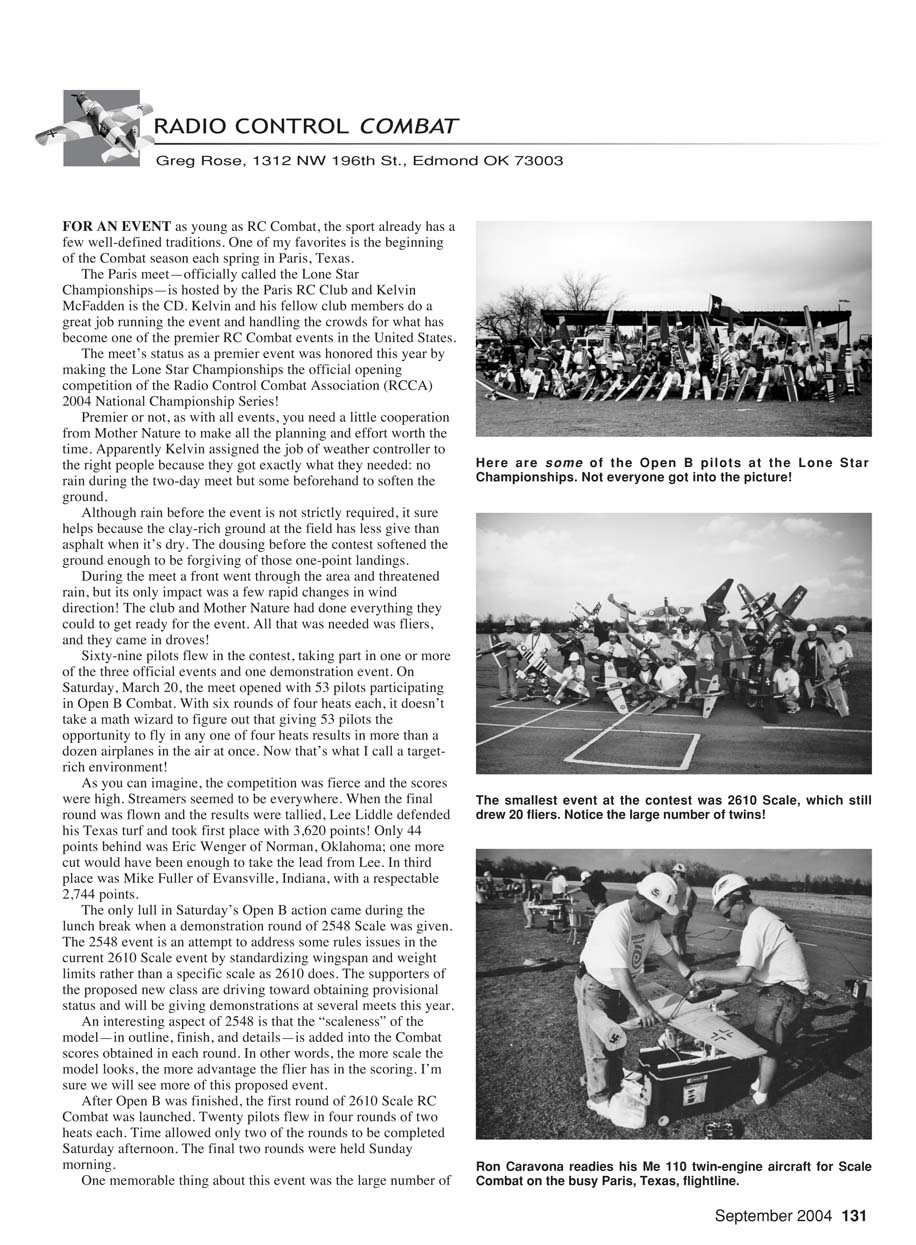
Sixty-nine pilots flew in the contest, taking part in one or more of the three official events and one demonstration event. On Saturday, March 20, the meet opened with 53 pilots participating in Open B Combat. With six rounds of four heats each, it doesn’t take a math wizard to figure out that giving 53 pilots the opportunity to fly in any one of four heats results in more than a dozen airplanes in the air at once. Now that’s what I call a target-rich environment.
Open B Combat
The competition was fierce and the scores were high. Streamers seemed to be everywhere. When the final round was flown and the results tallied, Lee Liddle defended his Texas turf and took first place with 3,620 points. Only 44 points behind was Eric Wenger of Norman, Oklahoma; one more cut would have been enough to take the lead from Lee. In third place was Mike Fuller of Evansville, Indiana, with a respectable 2,744 points.
Top three — Open B Combat:
- 1st: Lee Liddle — 3,620 points
- 2nd: Eric Wenger — 3,576 points
- 3rd: Mike Fuller — 2,744 points
The only lull in Saturday’s Open B action came during the lunch break when a demonstration round of 2548 Scale was given.
2548 Scale demonstration
The 2548 event is an attempt to address some rules issues in the current 2610 Scale event by standardizing wingspan and weight limits rather than a specific scale as 2610 does. Supporters of the proposed new class are driving toward provisional status and will be giving demonstrations at several meets this year.
An interesting aspect of 2548 is that the “scaleness” of the model—in outline, finish, and details—is added into the Combat scores obtained in each round. In other words, the more scale the model looks, the more advantage the flier has in the scoring. I’m sure we will see more of this proposed event.
2610 Scale Combat
After Open B was finished, the first round of 2610 Scale RC Combat was launched. Twenty pilots flew in four rounds of two heats each. Time allowed only two of the rounds to be completed Saturday afternoon; the final two rounds were held Sunday morning.
One memorable thing about this event was the large number of twin-engine designs that flew. Round 1, Heat 1 may have set some sort of record because three of the models flown were twin-engine designs: a MiG-5 flown by Lou Melancon, an Me 110 flown by Ron Caravona, and a P-38 flown by Mark LaBoyteaux. They may not have been the highest scorers, but they definitely won kudos for coolness.
The top scorer in the event was Kirk Adams flying his new Blackburn Firebrand design. In second place—in a finish even tighter than in Open B—was Oklahoma's Don Howard with his new TBD Devastators; Don was only 14 points behind Kirk. Mike Fredricks came down from Wisconsin and took third place with 1,300 points using his well-tested Fulmar design.
Top three — 2610 Scale:
- 1st: Kirk Adams — (score not stated)
- 2nd: Don Howard — 14 points behind first
- 3rd: Mike Fredricks — 1,300 points
Slow Survivable Combat (SSC)
After the Scale portion of the event, a record-setting Slow Survivable Combat (SSC) event began. An incredible 62 pilots flew in six rounds of six heats. Flying that many sorties in one day requires an unbelievable amount of planning and support from the club, and a lot of cooperation from the fliers. Both did a great job keeping the event moving.
Unfortunately, the wind picked up quite a bit for the second day of the meet, which made flying SSC airplanes more difficult. Although speeds were quite different fighting upwind versus running downwind, the pace of the action was still high.
It hardly seems fair to list the top three in an event with 62 fliers. Eleven pilots scored more than 2,000 points each. Getting that many points is a contest-winning performance anywhere but in Paris!
The best of the best in SSC was Eric Wenger with 2,748 points. The two winners from Open B switched places for SSC as Lee Liddle came in with 2,424 points for second place. In third place with 2,324 points was Danny Vaught; Mike Fredricks was only 10 points behind him.
Top three — SSC:
- 1st: Eric Wenger — 2,748 points
- 2nd: Lee Liddle — 2,424 points
- 3rd: Danny Vaught — 2,324 points
SSC has certainly blossomed on the RC Combat scene, and taking the title of the largest event flown at Paris away from Open Class B is noteworthy. For two days of incredible Combat flying, there is nothing like Paris in the springtime.
That's all for now — fly safely, fly Combat, and be sure to check your six!
MA
Transcribed from original scans by AI. Minor OCR errors may remain.

