
Radio Control Combat
Electric-powered Combat is gaining attention
Don Grissom [[email protected]]
We are roughly midway through the year, and it is going well. We have had many new Combat fliers, and others have returned to the activity after many years of being absent. One of the most recent trends in RC Combat is more interest in Slow Survivable Combat (SSC) flown with electric-powered models.
Since I do most of my flying in the South, I have been watching Craig Buttery with his electrics and how they perform. At the last contest in Florida, he won using electric-powered aircraft and earned a nice score. After hearing about Craig’s win, I decided that it would be a good time to learn more.
When you think electrics and Combat, think about Lee Liddle. He designed the Falcon and Cobra Combat models, as well as the 2006 SSC Champion. Lee wrote:
“E-SSC has come a long way in the last four years. The cost of my first power system (motor/electronic speed control/battery) was about $225. The motor was heavy, the ESC could only handle a 4-cell pack (maybe), and the 10C Li-Poly batteries were paper-weights.
“Now things are lighter, more dependable and much less expensive. In fact, the correct power system is now about $90. E-SSC is now not only possible; not only practical, but a viable, economic alternative to internal combustion (IC) powered SSC.
“You must be willing to go on-line for equipment. Buying off-the-shelf items can easily double the cost, but in four years of internet shopping I’ve always received everything that I paid for and 99% of the time I’ve received good, quick service.
“I’m currently using a Turnigy SK outrunner motor (35-30-1100 kV) on a 6S 2200 mAh Li-Poly power pack. The system weighs in at a whopping 3.5 ounces including the mount and propeller adapter. The 1.5-ounce Turnigy 40A Sentry ESC can handle the 6S battery, and since it has a switching BEC I can still use it to power the receiver and servos.
“I’m using a pair of Zippy Flightmax 3S 2200 mAh 20C batteries in series to make up the 6S power pack. The system draws less than 15 amps to spin the 8 x 3 propeller at 17,500 rpm. Since I am only draining the batteries at 6.8C, only about half the capacity is used to fly a heat. This means that I’m not stressing the battery, and I can recharge a pair of batteries in about 30 minutes.
“There are other battery/motor combo options. Some other local pilots are using the SK 35-36-1400 kV motor on a four-cell Li-Poly, or 5S A123 pack at about 23 amps to achieve the same performance. The charge time for the 4S Li-Poly pack is longer because more capacity is spent during each heat.
“With the cost of IC engines and fuel on the rise, and the availability slowly decreasing, electric power is continuing to improve, in both performance and price. We now have six local pilots who have competed in RCCA [RC Combat Association] SSC contests with electric power and two more are making the switch.
“To stay on top of what is happening with E-power in Combat, check out the open forums on the RCCA web site.”
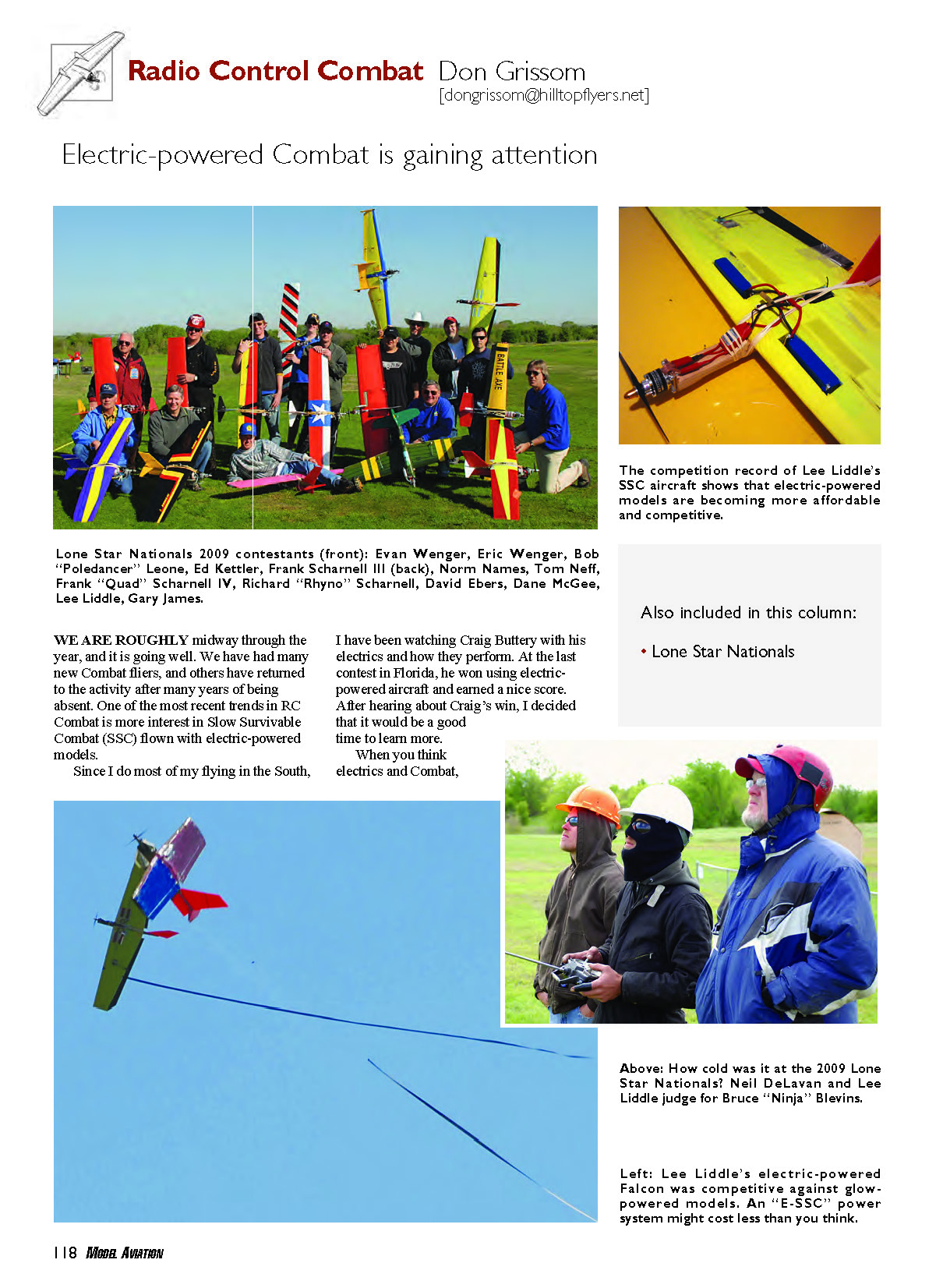
There are many big contests throughout the year. Besides the Nats, a popular event is the Lone Star Nationals. It’s getting bigger every year, and people travel from across the country to compete in Combat in the great state of Texas. Ed Kettler, a former RCCA president, attended the event and sent me some information.
Lone Star Nationals (LSN) — March 27–29, 2009
“The Lone Star Nationals (LSN) was held March 27–29, 2009 at Fort Worth Greater Southwest Aeromodelers’ field, and continued its track record for being one of the premier Combat meets in the country. Twenty-two pilots battled it out over three days and four events, including the first contest with SSC as an AMA Rule Book event.
“This year’s contest had a challenging economic situation as well as highly unpredictable weather: high humidity, rain and wind on Friday; high winds on Saturday; but it concluded with absolutely perfect weather on Sunday.
“Friday’s plan called for Scale 2548 followed by Scale 3696. We had nine pilots flying ‘all-up,’ making for some very exciting flying. Most airplanes lost streamers due to humidity in Round 1, so forestry tape was used mostly for the rest of the event.
“Dane McGee was back in action and didn’t look like he’d lost much after a long AWOL. RCCA’s Bob ‘Long Haul’ Loescher from Ohio fielded his new P-40 which was lighter than previous versions and flew well.
“Tom Neff from Colorado flew a mix of Il-2 and Zero models, while Lee Liddle campaigned electric-powered Skyraiders. There were a couple of spectacular spinner-to-spinner midairs, both involving Dane McGee; the first with Cash Hargett’s Zero, and in the next round with Ed Kettler’s P-51D.
“It rained during lunch, but we were able to start flying again after about an hour. After seven of the eight scheduled rounds, we decided to call the contest due to poor lighting and rapidly rising wind, and to try 3696 later in the contest.
“Tom Neff took first place, followed by Lee Liddle and Ed Kettler.
“Saturday dawned cold and windy; really windy, like 24+ mph with gusts above 30 mph. Club members Bob Leone and Lee Liddle, with CD Ed Kettler, discussed rearranging the field to accommodate the wind, but opted instead to move the pilots a further 30 feet back and to increase the height of the net to allow an extra margin of safety. This worked well, and we had no launch-related incidents.
“Given the adverse conditions, flying was very challenging and the scoring was lower than normal, but the majority of the pilots hung in tenaciously and fought for every available cut. After eight grueling rounds, Evan Wenger solidified his North Texas dominance in SSC. He was followed by Gil Hernandez and Dane McGee.
“After flight operations closed down, a lot of the pilots celebrated their hard-won streamers at a local Mexican restaurant.
“What a difference a day makes; Sunday was clear and calm, at least until the roar of tuned pipes and muffler cans drowned out the morning calm. About half the pilots campaigned Avenger-type aircraft, now supplied by Air Scharnell. Frank III (dad), Frank ‘Quad’ IV, and Richard ‘Rhyno’ drove down from Colorado again and were a great crew to hang out around.
“Also back was Eric Wenger, whose busy schedule only allows the occasional Open-B contest, but the rust quickly disappeared from his thumbs and he flew quite well. Ed Kettler was back in Open-B after five years developing his flying skills in SSC and 2548.
“Ed and Scott Stockwell own Texas Flugwerks who sponsored LSN this year. They produce type 3696, SSC, 2548 and Open-B kits, which they flew throughout the weekend. The flying was awesome in the still air, and after eight rounds, Evan Wenger was in first place, followed by Tom Neff and Lee Liddle.
“We put in four quick rounds of 3696 to finish the contest. Tom Neff had a couple of $50 balsa ARF Spitfires that looked good and flew well, but did not survive the harsh Combat environment. Lester Haury flew a couple of his own-design IAR 80 models, Lee flew his Mustang while Ed Kettler and Dane McGee flew Texas Flugwerks aircraft.
“After the snarl of high-revving, high-speed Open-B, the electrics were a great relief to the ears, but some of the most challenging flying was due to the rising wind and small wing spans. Lee Liddle took first, followed by Lester Haury and Dane McGee.
“Thanks to all of the pilots and volunteers who helped make LSN 2009 a big success. Special thanks to Scott Stockwell, Lee Liddle, Bob Leone, and CD Ed Kettler for running this classic contest.” MA
Sources
- RCCA, (586) 255-8038, www.rccombat.com
- E-SSC power system resource, (800) 607-5803, www.hobbycity.com
- Texas Flugwerks, (469) 734-0377, www.texasflugwerks.com
Transcribed from original scans by AI. Minor OCR errors may remain.

