
Electric Slow Survivable Combat
Don Grissom [[email protected]]
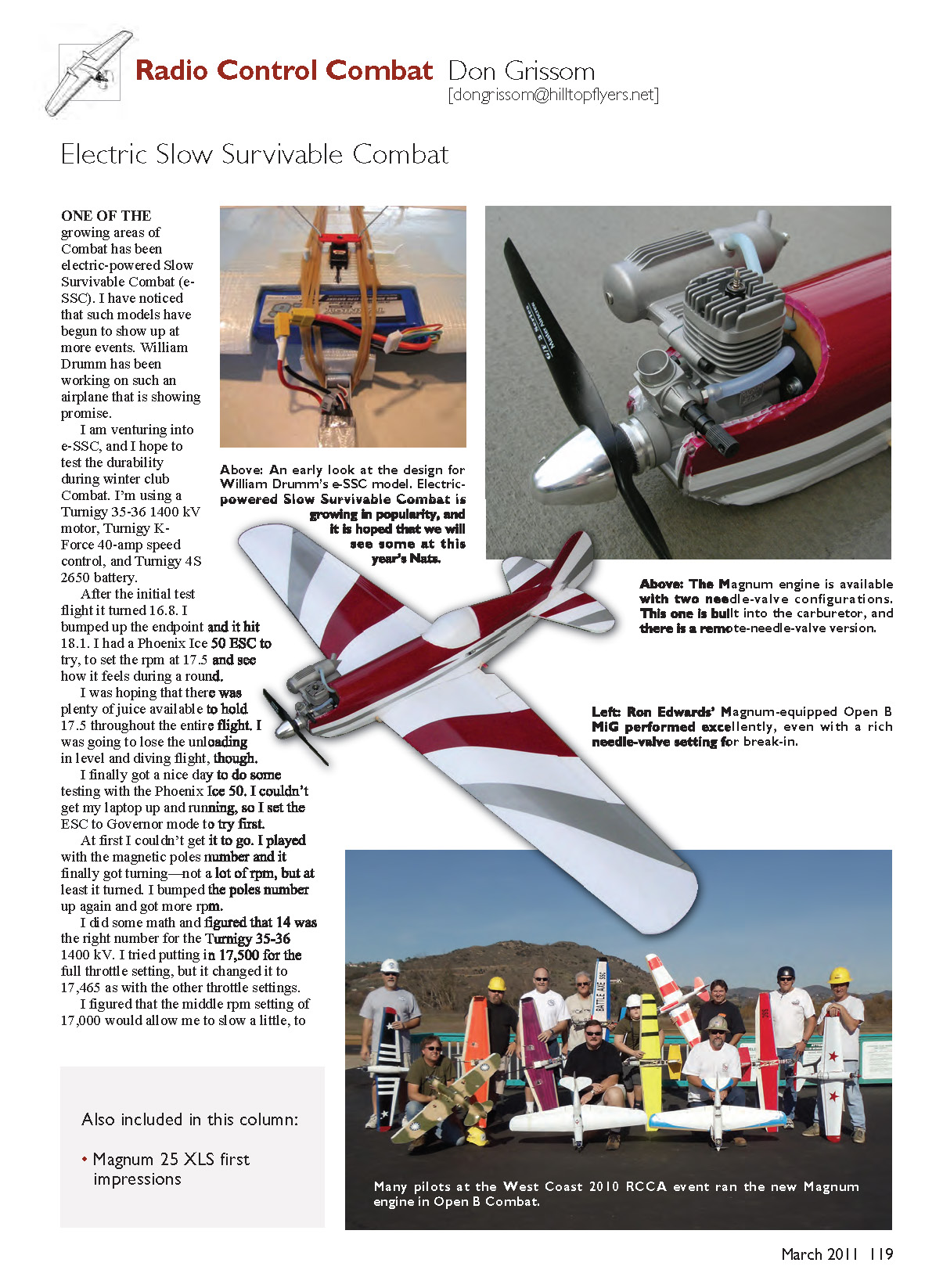
One of the growing areas of Combat has been electric-powered Slow Survivable Combat (e-SSC). I have noticed that such models have begun to show up at more events. William Drumm has been working on an airplane that is showing promise.
I am venturing into e-SSC and hope to test durability during winter club Combat. I’m using a Turnigy 35-36 1400 kV motor, a Turnigy K-Force 40-amp speed control (ESC), and a Turnigy 4S 2650 battery.
After the initial test flight it turned 16,800 rpm. I bumped up the endpoint and it hit 18,100 rpm. I had a Phoenix Ice 50 ESC to try, to set the rpm at 17,500 and see how it feels during a round.
I was hoping there was plenty of juice available to hold 17,500 rpm throughout the entire flight. I was going to lose the unloading in level and diving flight, though.
I finally got a nice day to do some testing with the Phoenix Ice 50. I couldn’t get my laptop up and running, so I set the ESC to Governor mode to try first. At first I couldn’t get it to go. I played with the magnetic poles number and it finally started turning—not a lot of rpm, but at least it turned. I bumped the poles number up again and got more rpm.
I did some math and figured that 14 was the right pole number for the Turnigy 35-36 1400 kV. I tried putting in 17,500 for the full-throttle setting, but it changed it to 17,465 as with the other throttle settings. I figured that the middle rpm setting of 17,000 would allow me to slow a little, to match the speed of a drone, and 14,000 turned out to be just about right when coming in for a landing. I attached the motor before I left for the field and it was at 17,520. The rpm data reads 17,465 for most of the time, with spikes up to 17,570. I definitely liked the way the model flew. It pulled well through loops and turns—much better than my initial test flight.
Now I’ll test setting the ATV (adjustable travel volume) back until the rpm hits 17,500. I’m thinking that Governor mode is going to be better for feel for the entire round. Thanks, William, for the information. I hope to see e-SSC aircraft in the air at the Nats this year.
Magnum 25 XLS — engine update
An issue that came up last year was the discontinuation of the O.S. 25FX engine. The replacement AX was priced higher and was less powerful. Following is an update from Todd Melton, the Southwest District representative of the RC Combat Association, on the new Magnum XLS 25, available from Global Hobby Distributors.
“It has been over a year since the combat community learned that the O.S. 25 FX was being replaced with the AX model 25. I remember all of the concern and discussions regarding the lack of available 25-size engines for 2010 combat.
“It seemed that the new AX engine was designed more for sport flying than Combat. How could we be expected to pay so much for an engine designed to turn 16,000 rpm only to have it broken in a round of combat?
“I was a little discouraged and turned to the Magnum 28 RNV. I thought I’d give it a try after having such good results from the Magnum 15 XLS.
“The announcement of the Magnum 28 RNV being discontinued prompted some of us to contact Magnum in November of 2009. Mike Greenshields (Product Manager for Global Hobby) listened to our concerns and assured us that Magnum would be developing a new engine suitable for our sport.
“Several of us contacted Mike with a laundry list of features we would like to see in a new 25-size engine. Mike assured us we were being listened to.
“You all should know I really have been informing the factory of your comments, etc. I don't know yet exactly what the new engine looks like but I know they are working on it and that they've considered everything you've said.”
And so we waited.
Months went by with only rumors of a possible future release date for the Magnum 25 XLS. Some pilots repaired their older engines. Some bought 25-size engines from any manufacturer that would sell them.
eBay was busy with used O.S. 25 FX sales as all the available engines traded hands from sport pilots to engine-hungry combat pilots. I even bid on a few myself.
In April of 2010 we were lucky enough to get a sneak peek at the factory prototype Magnum 25 XLS. Mike supplied the prototype for a demo at one of our spring combat events. To say the demo was exciting would be an understatement. We watched the prototype turning over 19,000 rpm and pull a combat plane around with ease. The engine was test-flown by several lucky pilots before it was taken away at the end of the day.
Then in June of 2010 came the closeout sales for the Magnum 25 XL. Those engines flew off the shelves and satisfied the mid-season engine requirements for a bunch of us. Could it be that they were preparing to release the new XLS for sale?
Finally the long-anticipated announcement of the new Magnum 25 XLS came near the end of the year. A few guys went and bought the first ones that arrived at the local hobby shops.
Shortly after the release came the Black Friday holiday sales. Every single engine for miles around was snatched up for combat. Some of the new engines were bought for next year's combat, but a few made it into our most recent combat event.
In December we flew the last 2010 RCCA combat event here on the West Coast. The event turned out to be a great proving ground for the new Magnum 25 XLS. It all started with practice and break-ins during the week before combat.
Normally before a combat event the field is dominated by combat pilots making last-minute adjustments, tuning in engines, trimming new planes, and generally preparing for the coming battle. This event was no different.
I happened to be at the field getting my equipment dialed in next to several other pilots. One of my fellow pilots, Ron Edwards, brought out two brand-new Magnum 25s to break in next to me while I was running up my Magnum 15 XLS for the first time.
We fueled, put the glow igniter on, and gave them a start. Both of the brand-new engines ran perfectly right out of the box. We gave the engines the typical combat-style one-tank break-in run and then considered them ready to fly.
Ron launched his new Magnum-equipped Open-B Mig next to my SSC version. Both of the new planes had great power and the engines performed excellently even with a rich needle-valve setting for break-in.
There were two pilots in the combat event who had equipped their planes with the new Magnum engine. Both pilots were running the stock muffler and 9x4 props. Their planes were fast and kept right up with other planes equipped with combat-style mousse can exhaust systems.
I spoke with several of the combat pilots after the event and the general consensus of the new Magnum engine was that it was excellent.
The new Magnums were well accepted and will likely become a popular engine choice for next year's combat planes. Even die-hard pilots loyal to one brand or another promised to give the new Magnums a try.
Sources:
- RC Combat Association — www.rccombat.com
- Global Hobby Distributors — (714) 963-0329 — http://magnum.globalhobby.com
Transcribed from original scans by AI. Minor OCR errors may remain.

