
Radio Control Combat — 2011/09
The contest was a wet one, but fun
I have flown Combat for many years and have used many types of airplanes. Among those I have flown is the Avenger, which is a good airplane. However, at a contest in Florida earlier this year, I had trouble getting the engine to run well. I have used the O.S. .15 LA for many years. These are good engines, but they have developed problems over time.
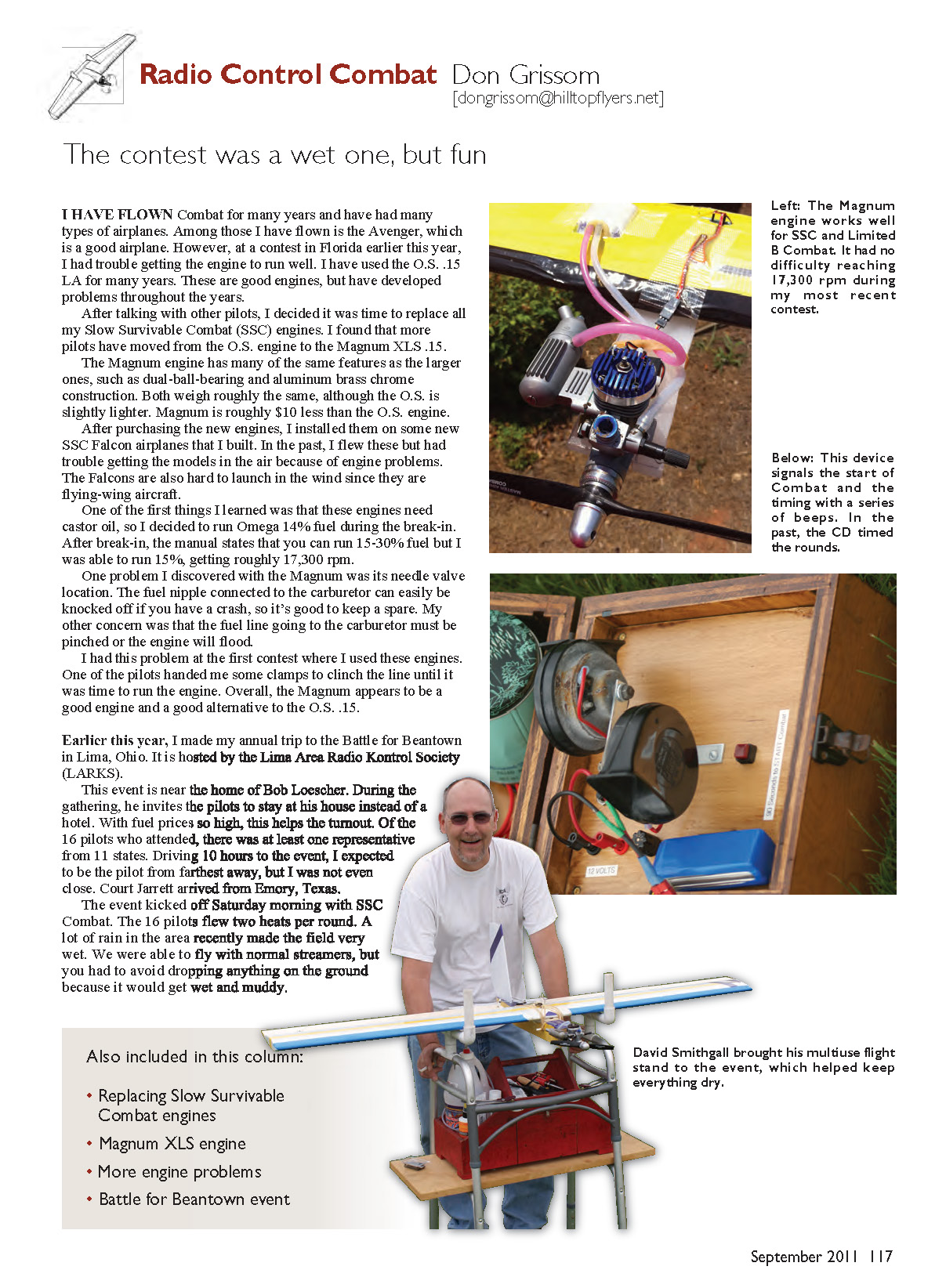
After talking with other pilots, I decided it was time to replace all my Slow Survivable Combat (SSC) engines. I found that more pilots have moved from the O.S. engine to the Magnum XLS .15.
The Magnum engine shares many features with the larger Magnums, such as dual ball bearings and aluminum-brass-chrome construction. Both the Magnum and the O.S. weigh roughly the same, although the O.S. is slightly lighter. The Magnum is roughly $10 less than the O.S. engine.
After purchasing the new engines, I installed them on some new SSC Falcon airplanes that I built. In the past I had trouble getting the Falcons airborne because of engine problems. Falcons are also hard to launch in the wind since they are flying-wing aircraft.
One of the first things I learned was that these engines need castor oil, so I ran Omega 14% fuel during break-in. After break-in, the manual states you can run 15–30% fuel; I was able to run 15%, getting roughly 17,300 rpm.
One problem I discovered with the Magnum was the needle-valve location. The fuel nipple on the carburetor can easily be knocked off in a crash, so it's good to keep a spare. My other concern was that the fuel line going to the carb must be pinched or the engine will flood. I had this problem at the first contest where I used these engines. One of the pilots handed me some clamps to pinch the line until it was time to run the engine. Overall, the Magnum appears to be a good engine and a strong alternative to the O.S. .15.
Battle for Beantown — Lima, Ohio
Earlier this year I made my annual trip to the Battle for Beantown in Lima, Ohio. The event is hosted by the Lima Area Radio Kontrol Society (LARKS).
The contest is near the home of Bob Loescher. During the gathering, he invites pilots to stay at his house instead of a hotel. With fuel prices so high, this helps turnout. Of the 16 pilots who attended, there was at least one representative from 11 states. Driving 10 hours to the event, I expected to be the pilot from farthest away, but I was not even close — Court Jarrett arrived from Emory, Texas.
Contest events and results
The event kicked off Saturday morning with SSC Combat. The 16 pilots flew two heats per round. Recent heavy rain made the field very wet. We were able to fly with normal streamers, but you had to avoid dropping anything on the ground because it would get wet and muddy.
Since this was Bob's contest, we jokingly renamed it "Sponge Bob." I bought some flip-flops because I could not keep my shoes dry. From the beginning, William Drumm III looked strong and ended up with some of the highest-scoring rounds of the day. William was flying an airplane of his own design that was fast and durable. He had been running electrics, but the speed controllers kept burning up, so William switched to gas engines and still had a good contest. Jason Yoder finished second, with Chris Gunter in third.
Later in the day we began Scale .25/.48 Combat. Since Eric and Brian Gilkey could not make it (or were too scared to fly against us), we had only four pilots for Scale. We had planned to fly eight rounds but flew only three on Saturday and another three on Sunday.
Keith and I could not avoid hitting each other and had one of the hardest hits of the meet — engine-on-engine. As for Bob Loescher, all I remember is hearing, "There goes Bob again," when he would fly his aircraft right onto the ground.
The final event of the weekend was Limited B. In recent years this class has become popular because it slows down the airplanes but still allows them to reach higher speeds than SSC.
I had some problems with my Limited B airplanes. After thinking I was going to be out of the event, I decided to fly my SSC airplanes. Even with the engine-size difference I was able to perform better than with my Limited B airplanes.
William Drumm once again won the event, scoring 1,500 points more than second-place finisher Donald Veres. Kelly Bryant took third place.
It was once again a great event and a good example of how to run a contest.
MA
Sources
- O.S. Engines — (217) 398-8970 — www.osengines.com
- Magnum Engines / Global Hobby — (714) 963-0329 — http://magnum.globalhobby.com
- Lima Area Radio Kontrol Society — http://larksclub.homestead.com
- Radio Control Combat Association — www.rcccombat.com
Transcribed from original scans by AI. Minor OCR errors may remain.

