
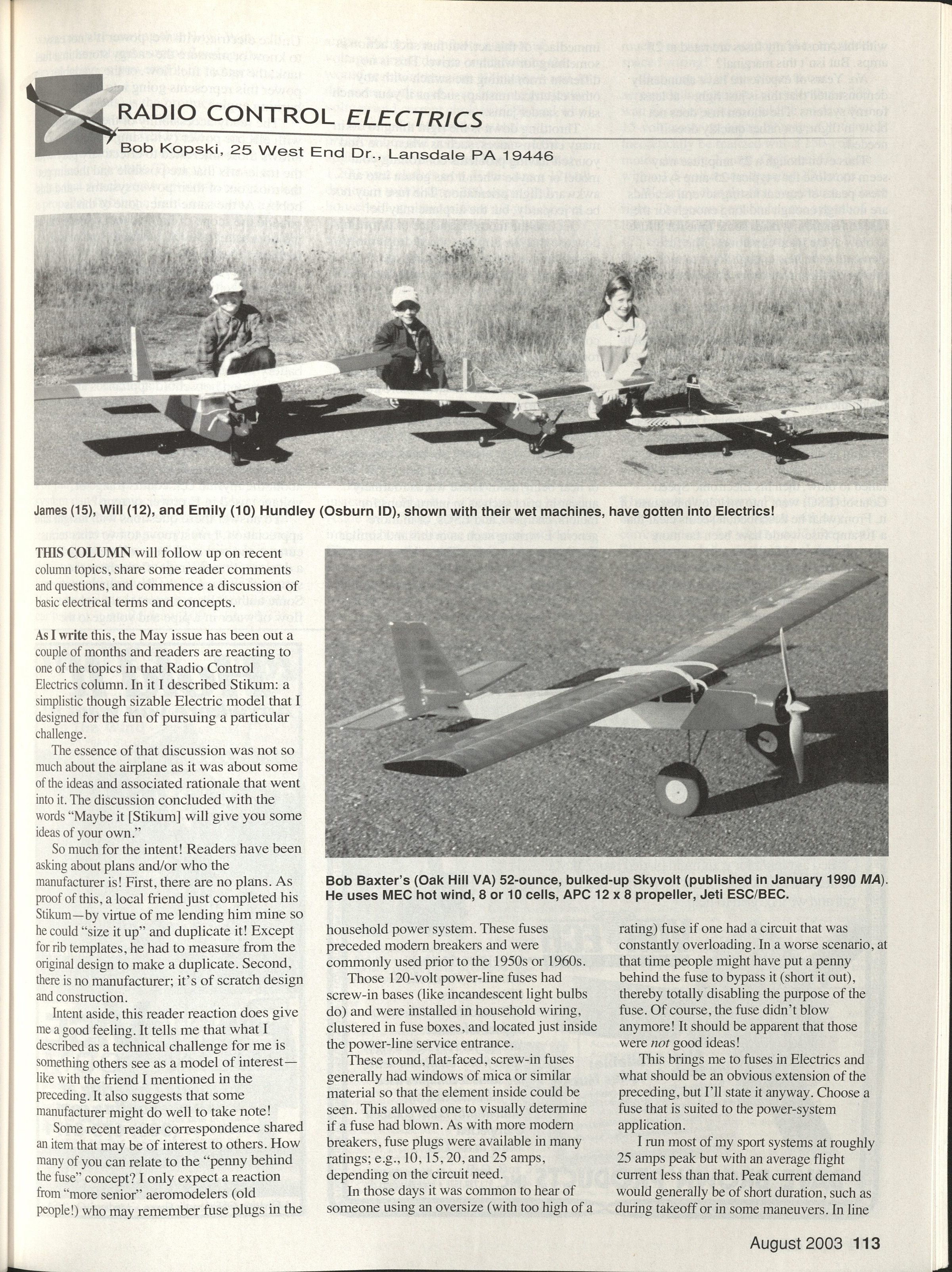
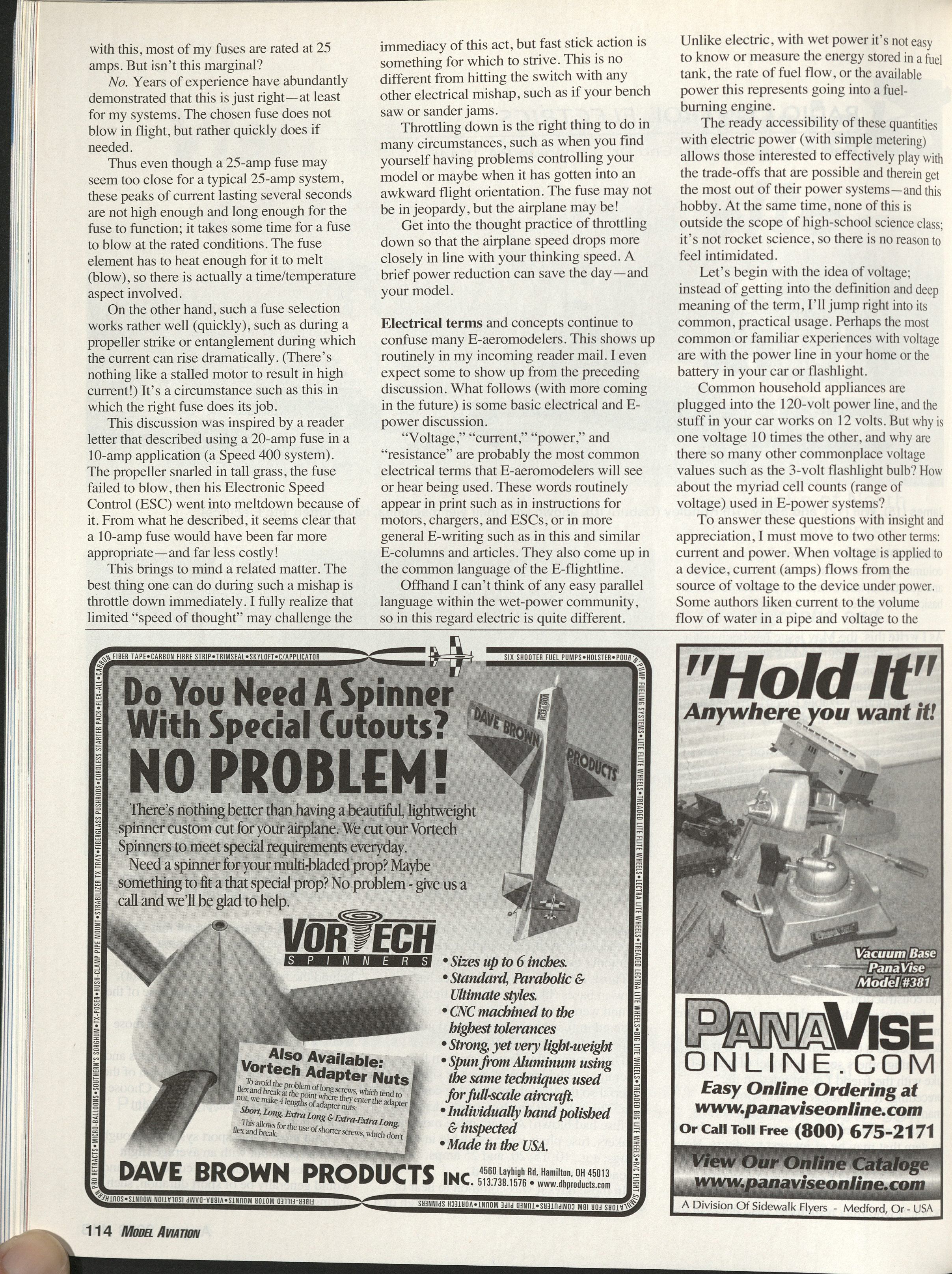
RADIO CONTROL ELECTRICS
Bob Kopski, 25 West End Dr., Lansdale PA 19446
This column will follow up on recent topics, share some reader comments and questions, and begin a discussion of basic electrical terms and concepts.
Reader reaction and Stikum
As I write this, the May issue has been out a couple of months and readers are reacting to one of the topics in that Radio Control Electrics column. In it I described Stikum: a simplistic though sizable electric model that I designed for the fun of pursuing a particular challenge. The essence of that discussion was not so much about the airplane as it was about some of the ideas and associated rationale that went into it. The discussion concluded with the words, "Maybe it [Stikum] will give you some ideas of your own."
Readers have been asking about plans and/or who the manufacturer is. First, there are no plans. As proof of this, a local friend just completed his Stikum—by virtue of my lending him mine so he could "size it up" and duplicate it. Except for rib templates, he had to measure from the original design to make a duplicate. Second, there is no manufacturer; it's a scratch design and construction.
This reaction gives me a good feeling. It tells me that what I described as a technical challenge for me is something others see as a model of interest. It also suggests that some manufacturer might do well to take note.
Penny behind the fuse and fuse selection
Some recent reader correspondence shared an item that may be of interest. How many of you can relate to the "penny behind the fuse" concept? I only expect a reaction from "more senior" aeromodelers who may remember fuse plugs in the household power system. These fuses preceded modern breakers and were commonly used prior to the 1950s or 1960s.
Those 120-volt power-line fuses had screw-in bases (like incandescent light bulbs) and were installed in household wiring, clustered in fuse boxes, and located just inside the power-line service entrance. These round, flat-faced, screw-in fuses generally had windows of mica or similar material so the element inside could be seen. This allowed one to visually determine if a fuse had blown. As with more modern breakers, fuse plugs were available in many ratings; e.g., 10, 15, 20, and 25 amps, depending on the circuit need.
In those days it was common to hear of someone using an oversize fuse if a circuit was constantly overloading. In a worse scenario people might have put a penny behind the fuse to bypass it (short it out), thereby totally disabling the purpose of the fuse. Of course, the fuse didn't blow anymore. Those were not good ideas.
This brings me to fuses in electrics and what should be an obvious extension: choose a fuse that is suited to the power-system application.
I run most of my sport systems at roughly 25 amps peak but with an average flight current less than that. Peak current demand is generally of short duration, such as during takeoff or in some maneuvers. In line with this, most of my fuses are rated at 25 amps. But isn't this marginal?
No. Years of experience have demonstrated that this is just right—at least for my systems. The chosen fuse does not blow in normal flight, but it will blow quickly if needed. Peaks of current lasting several seconds are not high enough and long enough for the fuse to blow at the rated conditions. The fuse element has to heat enough for it to melt, so there is actually a time/temperature aspect involved.
On the other hand, such a fuse selection works well during a propeller strike or entanglement when the current can rise dramatically (a stalled motor can result in very high current). In those circumstances the right fuse does its job.
A reader described using a 20-amp fuse in a 10-amp application (a Speed 400 system). The propeller snarled in tall grass, the fuse failed to blow, and then his electronic speed control (ESC) went into meltdown. From the description, a 10-amp fuse would have been far more appropriate—and far less costly.
Throttle-down practice
The best thing to do during such a mishap is throttle down immediately. I fully realize that limited "speed of thought" may challenge the immediacy of this act, but fast stick action is something for which to strive. This is no different from hitting the switch when a bench saw or sander jams.
Throttling down is the right thing to do in many circumstances, such as when you find yourself having problems controlling your model or when it has gotten into an awkward flight orientation. The fuse may not be in jeopardy, but the airplane may be. Get into the habit of throttling down so that the airplane speed drops more closely in line with your thinking speed. A brief power reduction can save the day—and your model.
Basic electrical terms and concepts
Electrical terms and concepts continue to confuse many electric aeromodelers. This shows up routinely in my incoming mail. What follows is some basic electrical and E-power discussion.
"Voltage," "current," "power," and "resistance" are probably the most common electrical terms that E-aeromodelers will see. These words routinely appear in instructions for motors, chargers, and ESCs, or in general E-writing such as this column. They also come up in the common language at the flightline.
Unlike wet power (internal combustion), with electric power it's easy to know or measure the energy stored in a battery, the rate of current flow, or the available power going into a motor. The ready accessibility of these quantities with electric power (with simple metering) allows you to play with trade-offs and get the most out of your power systems. None of this is outside the scope of high-school science class; it's not rocket science.
Voltage: rather than deep theory, consider practical usage. Familiar examples are the household power line and car battery. Common household appliances are plugged into the 120-volt power line, and stuff in your car works on 12 volts. Why are there so many voltage values and cell counts in E-power systems? To answer that we must consider current and power.
When voltage is applied to a device, current (amps) flows from the source of voltage to the device. Some liken current to the volume flow of water and voltage to the water pressure causing that flow. With voltage present and current flowing, the device receives power.
Power (watts) is the product of voltage and current:
- Power (W) = Voltage (V) × Current (A)
Power is what does the work—turning a propeller, lighting a bulb, or cooling a refrigerator.
Examples:
- A 1,200-watt clothes iron on a 120-volt outlet draws 10 amps (120 V × 10 A = 1,200 W).
- A 40-watt soldering iron on 120 volts draws 40 ÷ 120 = 0.333 amps (333 milliamps).
- For E-flight, a 300-watt power system can fly a much bigger and heavier model than a 30-watt system.
Consider a 100-watt device as an illustration:
- On 120 volts it draws 100 ÷ 120 = 0.833 amps.
- On 12 volts it draws 100 ÷ 12 = 8.33 amps.
There are infinitely many voltage/current combinations that yield the same power. The choice depends on practical considerations.
If the 1,200-watt iron were a 12-volt device, it would draw 100 amps. If all household appliances were 12-volt, wiring and components would be vastly heavier and more massive—not practical.
High-voltage distribution lines are high voltage so currents can be kept reasonable for transmitting large power levels. Local transformers convert distribution voltages to familiar 120 volts for home use. Using kilovolts in-home would be dangerous and impractical: outlets would be widely spaced, insulation needs would be extreme, and household wiring would be much larger.
Bringing this to aeromodelling: a 300-watt E-power system could be realized in different ways:
- 15 volts at 20 amps (practical choice)
- 150 volts at 2 amps (requires many cells—impractical and expensive)
- 1.5 volts at 200 amps (requires very heavy wiring, connectors, ESC, and switches)
Good choices—design trade-offs and practical compromises—of voltage and current levels are needed to achieve the required power for the job.
Closing
That ends this column. Please include a self-addressed, stamped envelope with any correspondence for which you'd like a reply. Everyone who does so gets one. And do make it a point to take a nonbelieving wet-flying friend to an E-meet; I've never seen anyone leave a meet unconvinced!
Happy E-landings, everyone! MA
Transcribed from original scans by AI. Minor OCR errors may remain.

