
RADIO CONTROL ELECTRICS - 2004/09
By Bob Kopski
25 West End Dr., Lansdale PA 19446
This column offers:
- One meet announcement
- An Electric Connection Service (ECS) follow-up
- Two E‑suppliers of interest
- A follow-up on Dump’r and other electronic projects
- Clarification of the April/May noise‑testing discussion
- An answer to an often‑asked battery question
- A gleeful “I told ya so.”
Meet announcement
Don McGillivray (13371 Sylvan Ave., Fort Myers FL 33919; Tel.: (239) 481‑0063) has announced the fifth annual Electric Fly‑In and Gathering of E‑Flyers, scheduled for October 2–3 in Cape Coral, Florida. The meet is sponsored by the Cape Coral R/Sea Hawks. Check the club’s Web site at www.rseahawks.org or contact Don for more information — and be sure to tell him Bob sent you.
ECS follow-up (Rocky Mountain Electric Flyers)
The April column included an ECS request from the then‑forming Rocky Mountain Electric Flyers. The ECS encouraged interested people to visit the Denver sports‑complex flying site, and it worked.
According to club vice president Ron Evans (1262 Elizabeth St. #204, Denver CO 80206), “Several newbies saw the column and came out to join us.” The club has since obtained its AMA charter and has a Web site — www.rmeflyers.org — with directions to the field, photos, and more.
The club plans to form an electric “exhibition team” to visit area (read: gas) flying sites and demonstrate everything electric, from micro/park flyers to hotliners, scale models, and 3‑D aircraft. This is a great idea other E‑groups could copy.
The ECS is a free column service to connect individuals and clubs with nearby E‑enthusiasts. Send me your info and I’ll share it in a future column. As shown here, it works!
Suppliers of interest
A huge number of electric suppliers have appeared over recent years, reflecting the growth of E‑power interest. Two suppliers of particular interest:
- Hal Stewart (8198 Speach Dr., Baldwinsville NY 13027) — Hal offers a plans service focused on smaller airplanes (park, backyard, indoor). His catalog includes Old‑Timer, sport, scale, and other designs, many suited to electric power. The catalog is $1.50.
- Hobby Lobby International — One of the earlier vendors in the electric scene, Hobby Lobby continues to publish an extensive, attractive catalog of E‑products. Catalog 43 is a colorful, broad presentation of many items. You can order a copy for $3 by calling (615) 373‑1444 or visiting www.hobbylobby.com. Be warned: there’s so much appealing E‑stuff it can be hard to choose!
Dump’r and project repairs
Dump’r — a battery discharger featured in the October 2003 MA — remains a reader favorite. It’s a safe, effective device designed for packs of four to 18 Ni‑Cd/NiMH cells. Many readers have built Dump’r, and several have built more than one.
I periodically receive Dump’rs in the mail to troubleshoot. As I wrote in the article, I’ll fix any Dump’r free of charge except postage. Of the roughly 18 Dump’rs I have received, every one had some assembly error; a few had multiple errors. All worked perfectly after a little fix‑up. If you have a problematic Dump’r, send it to me and I’ll help.
The same offer applies to other electronic projects of mine that you’ve built: write first (with an SASE) describing the situation. If I can’t help by letter, I’ll invite you to send the unit. My offer is a free fix except postage.
Fine print: the free repair applies to projects built in accordance with the published article. If you deviated from the published circuit/design, I may not be able to help easily. I’m not referring to cosmetic or mechanical creativity, but to liberties with the electronic circuit. If you’ve modified the circuit or used alternate parts, document accurately and completely how your build deviates from the original; I’ll try to help, but I may not have substitute parts on hand.
I believe this policy of free repair is unique in aeromodeling, and it’s based on confidence with known, proven designs.
Noise‑testing clarification
The April and May columns discussed power‑system‑induced radio “noise” problems and described an in‑shop method to determine if there’s a problem and how severe it might be. Some readers asked for clarification about the test.
The familiar field range test is done by checking distance with the motor off and then again with the motor on at partial power to see if operating power systems reduce range. The in‑shop test attempts to simulate this field walk in a convenient setting.
Review the April, May, and August columns for full details. To expand on the at‑home test: turning the transmitter off during the bench test is not intended to simulate a flyaway, but to give any power‑system noise problems an opportunity to manifest on the bench.
Power‑system noise typically appears under weak signal conditions — at range limits or when the aircraft passes through signal nulls (dropouts). Turning the transmitter off on the bench roughly simulates the latter.
Procedure: with the throttle at a partial power setting, observe servo behavior and motor speed when you turn the transmitter off. Compare that with the same indicators when you turn the transmitter off with the motor not running. You want servo twitches and motor sputters/burps to be the same in both cases. If there is noticeably more reaction when the motor is running, you likely have noise problems.
If you see this, try the recommendations from the April, May, and August columns—especially the recommended choke solutions. There’s an excellent chance of a dramatic improvement.
Battery question (receiver pack cutoff)
Batteries remain a frequent subject, especially receiver packs. A common question: how low can receiver voltage drop and still be safe to fly?
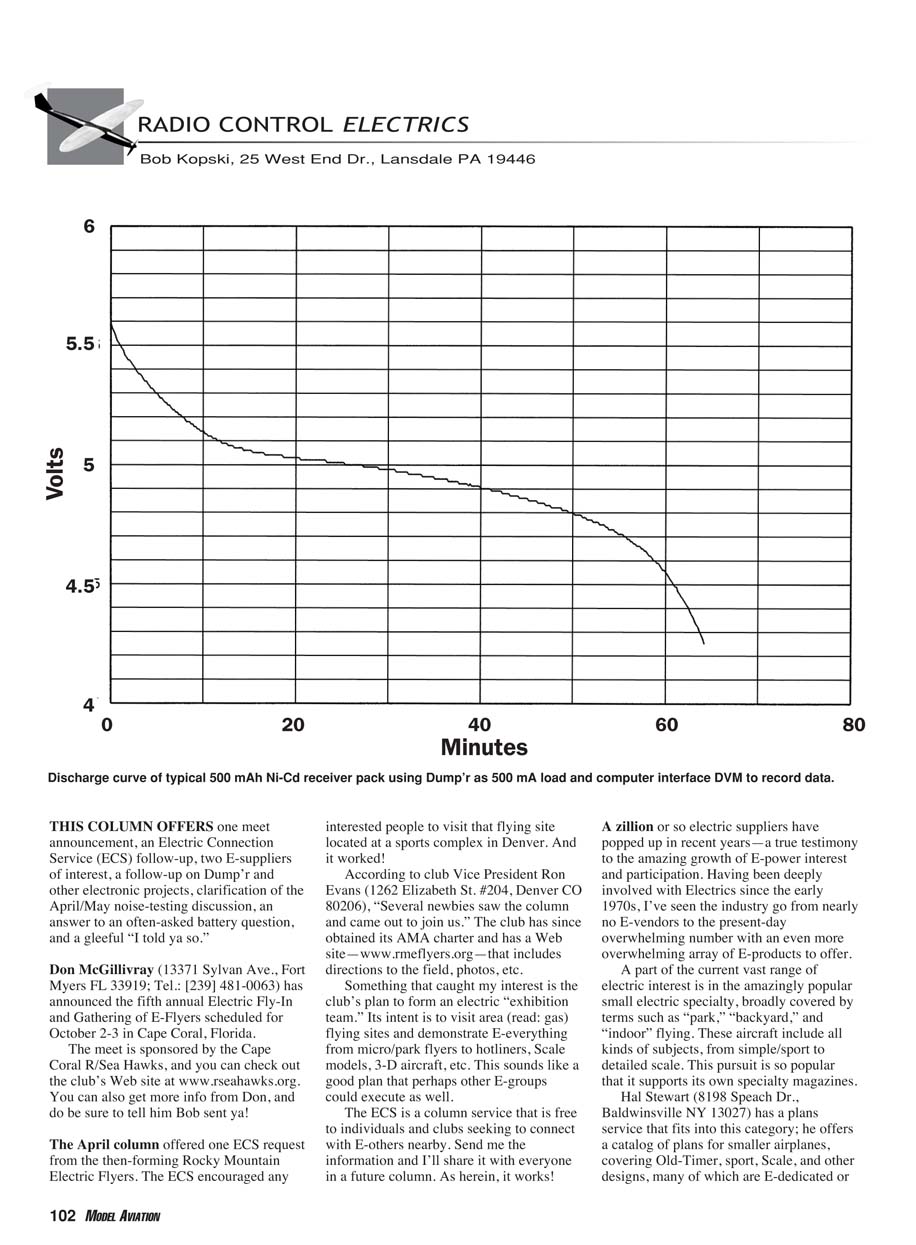
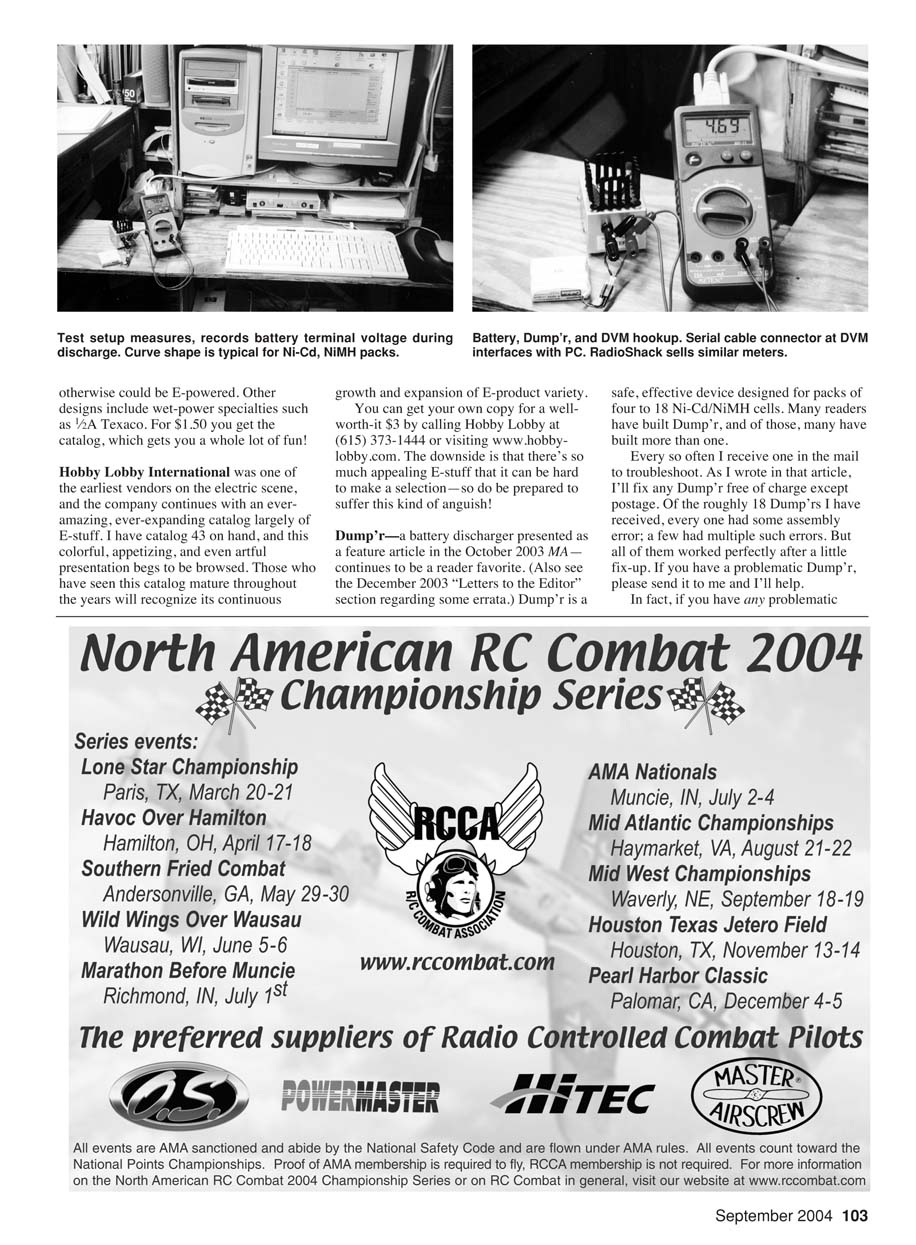
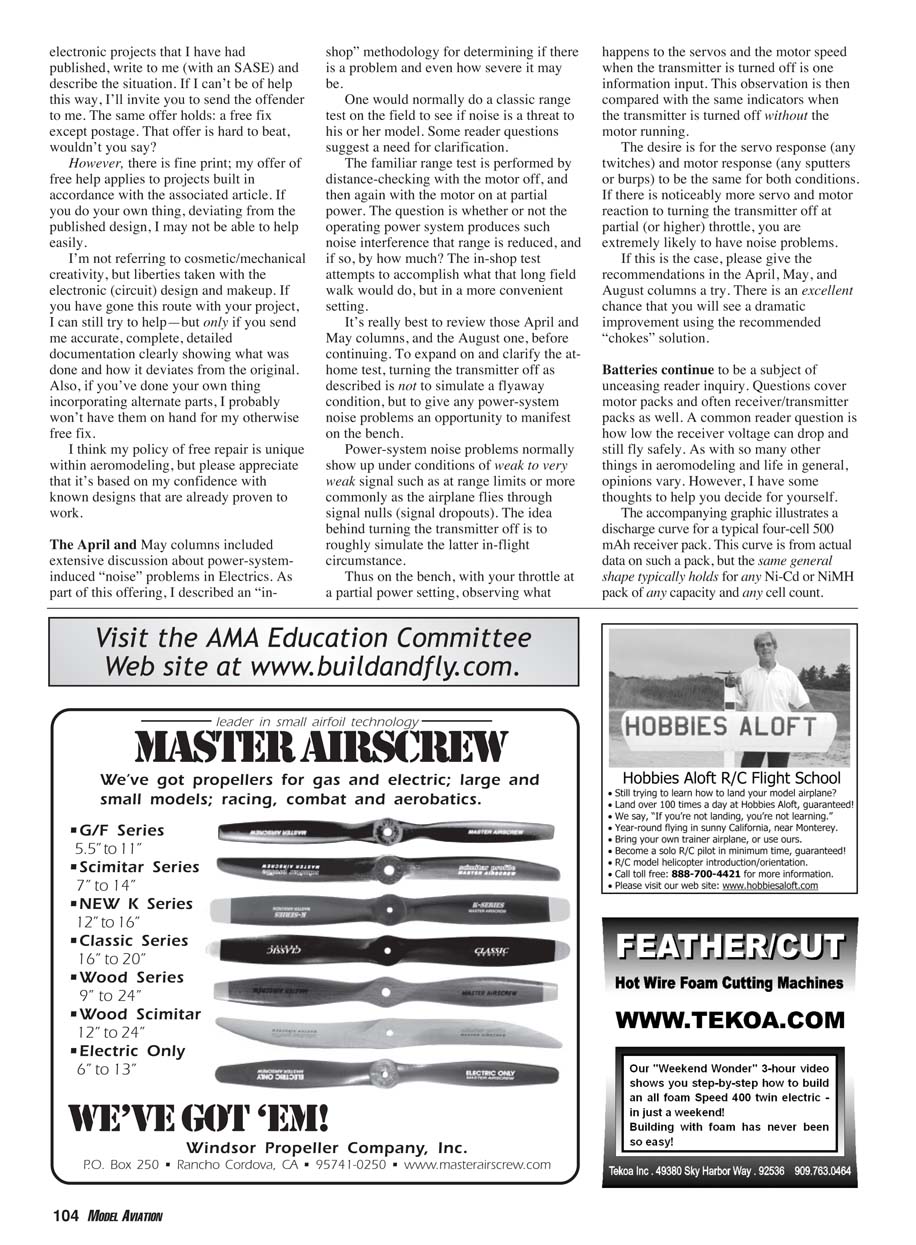
The accompanying graphic in the original article shows a discharge curve for a typical four‑cell 500 mAh receiver pack. The general shape — high terminal voltage after charge, gradually declining during discharge — is typical for Ni‑Cd and NiMH packs of various capacities.
Reported safe cutoff values for receiver packs vary from roughly 4.4 volts to as high as 5.0 volts. Many commercial expanded‑scale voltmeters show a “red” scale starting around 4.8 volts (with variation among brands). My Ace SmartTest uses 4.4 volts as cutoff. Many ESC BECs cut off somewhere under 5.0 volts; 4.5 volts is common. These facts indicate radio gear is generally expected to operate at these levels.
Important: voltage readings only have meaning under load. Dedicated test instruments apply a load current to the pack. If you use an ordinary voltmeter, simulate in‑flight conditions by moving one or more servos during the test.
My choice (when I use receiver packs at all, which is less common now) is roughly 4.5 volts. I would not stop at 5.0 volts — the discharge curve shows half or more of the pack capacity often remains above 5.0 volts. Also, discharging only to 5.0 volts can encourage memory effect in susceptible packs. Use this guidance to make your own decision.
I told ya so
Electric flight’s growth has been enormous, but for me it was expected. I’ve promoted electrics since the early, lean years and always believed electric power would become mainstream. Now E‑power has enormous industry support and participation and competes head‑to‑head with world‑class power performers (see “2003 NEAT Fair” in the March 2004 MA).
If you’ve been saying “Electric doesn’t this, that, and the other,” it’s time to be quiet about that and go fly an electric. And yes — I told ya so!
Please enclose an SASE with any correspondence for which you’d like a reply. Happy E‑landings, everyone! MA
Transcribed from original scans by AI. Minor OCR errors may remain.

