
RADIO CONTROL ELECTRICS
Bob Kopski, 25 West End Dr., Lansdale PA 19446
This column will review an oversight in the July column, detail some experiences with a Sig Rascal ARF, and describe an unlikely and confusing potential source of glitching.
Late News
The 2nd Annual Best Electrics in South Texas meet is scheduled for October 8–10 in New Waverly, Texas. For details:
- Web: www.tri-countybarnstormers.com
- E-mail: [email protected]
- Scott Mrosko: (936) 539-5123
- New Creations R/C: (936) 856-4630
Universal Slow Charger (USC) follow-up
The July column included a photo and brief description of Eric Einarsson’s version of the Universal Slow Charger (USC). The USC was published as a feature article in the September 2000 Model Aviation (MA) issue.
I unintentionally did readers a disservice in July in two ways:
- I failed to mention that you can get copies of the original article from AMA Librarian Rich LaGrange at (765) 287-1256, extension 506. Ask for “Universal Slow Charger,” pages 37–46 of the September 2000 issue. Also obtain the correction information in the October 2000 issue (page 60) and the November 2000 issue (page 7). I am unable to supply these copies.
- The original article included a detailed parts list with suppliers. One key supplier discontinued business about two years ago. To address that, I produced a multipage “USC Update” in October 2002 that covers replacement sources and other necessary information. You can get one by sending me an SASE. To the best of my knowledge, the update, together with the MA references above, will let you build a USC.
Remember my offer to assist anyone who has trouble with this or any of my published projects. If you want to build one, dig out your old MA issues or order the article copies from AMA, send me an SASE for the USC Update, and get going.
Sig Rascal ARF — selection and assembly
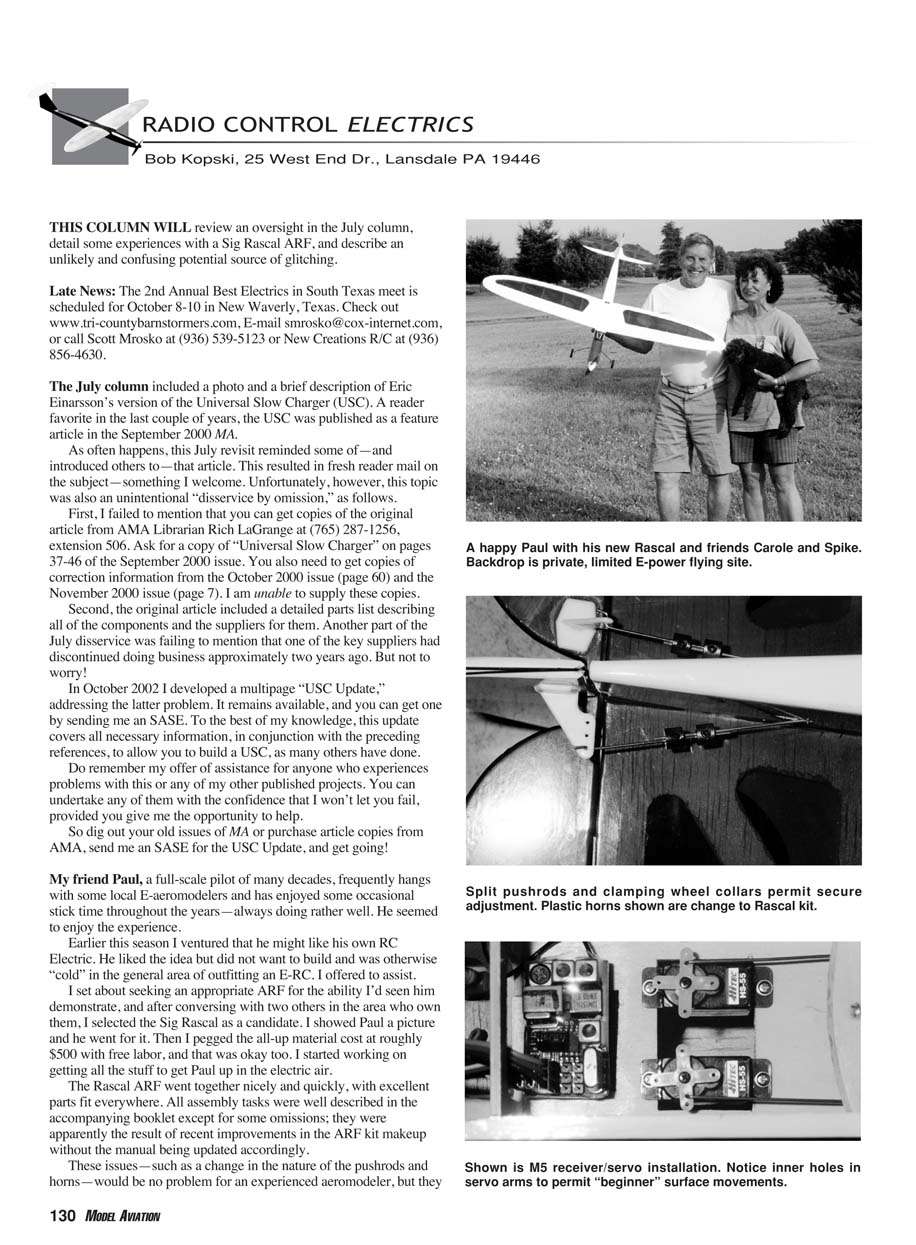
My friend Paul, a full-scale pilot of many decades, often flies electric RC models with other local E-aeromodelers and has done well. Earlier this season I suggested he might like his own RC electric. He liked the idea but didn’t want to build. I offered to assist.
After talking with two local owners, I selected the Sig Rascal ARF. Paul liked the picture and the plan, and the all-up material cost came to roughly $500 (free labor). The Rascal kit went together nicely and quickly; part fit was excellent. The assembly booklet described tasks well except for a few omissions, apparently due to recent kit changes that hadn’t been reflected in the manual. These omissions (for example, changes in pushrods and horns) won’t bother an experienced builder but could be showstoppers for a first-timer. Sig would do well to include a supplemental update sheet with the Rascal manual.
Modifications I made:
- Landing-gear hatch catches: I substituted two flat plastic landing-gear clamp straps for the sheet-metal screws that hold the bottom fuselage battery hatch. The catches swing out for easy battery access; screws would likely get dropped and lost. The clamps are easy to install. Glue a piece of 7/8" balsa inside the fuselage bottom for the pivot screws to bite into. Use the original #2 sheet-metal screws for this.
- Pushrods: The newly supplied 40-mil-diameter solid wires seemed sluggish in the guide tubes. Their slightly textured surface may have caused drag. I substituted K&S .032-inch wire, which slid much better in the guide tubes.
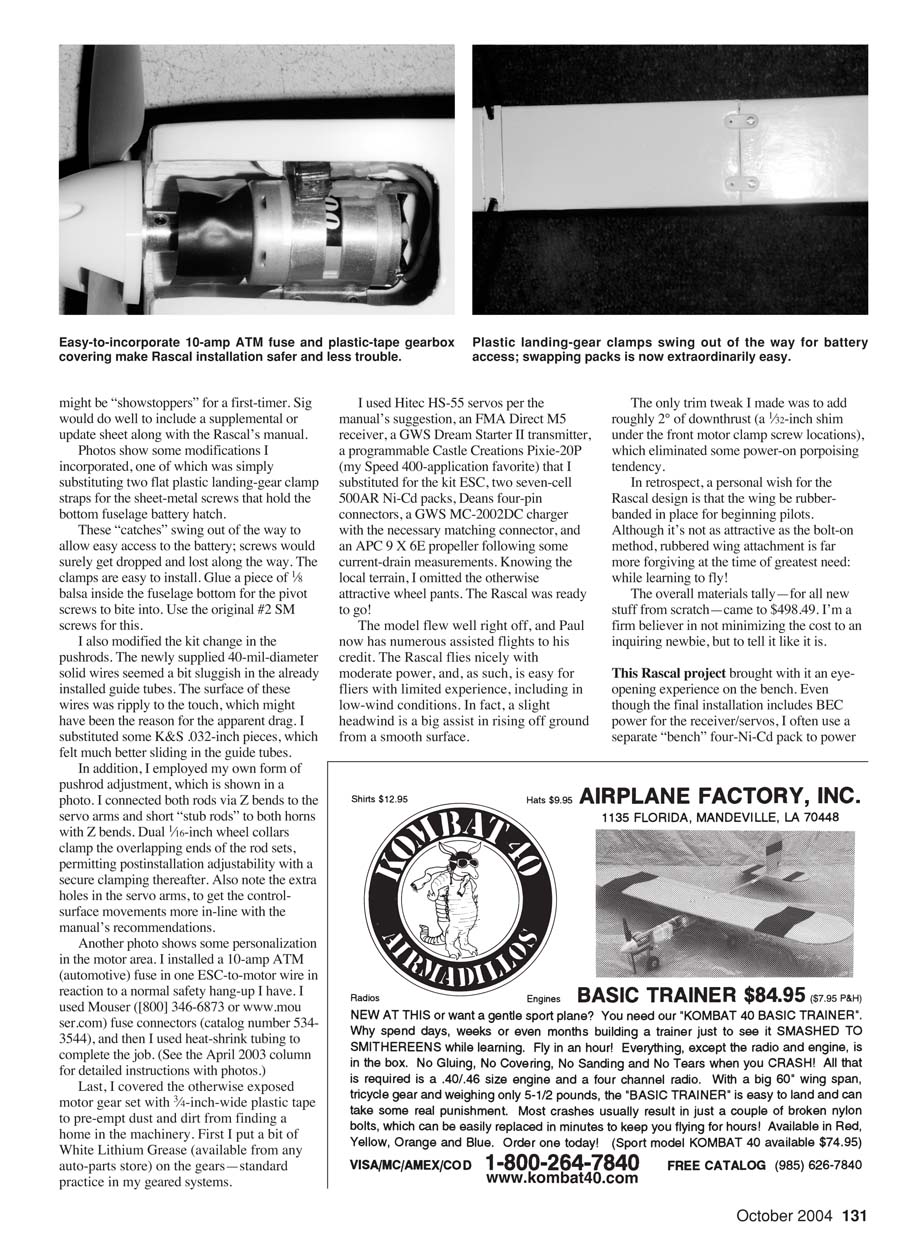
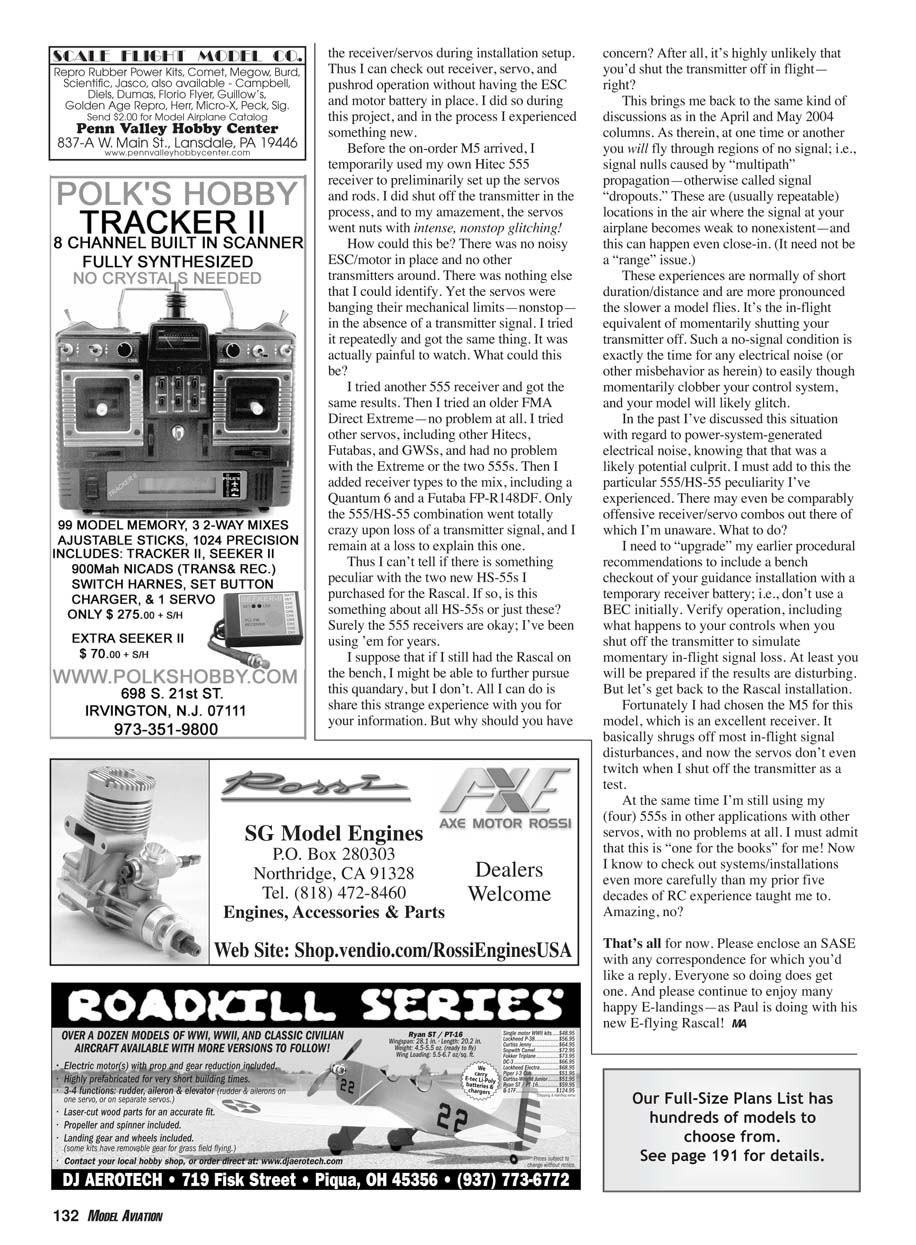
- Pushrod adjustment method: I used Z bends on the servo arms to connect both rods, and short “stub rods” with Z bends to both control horns. Dual 1/16-inch wheel collars clamp the overlapping ends of the rod sets, allowing post-installation adjustability and secure clamping thereafter. I also drilled extra holes in the servo arms to get control-surface movements more in line with the manual’s recommendations.
- Motor area: I installed a 10-amp ATM (automotive) fuse in one ESC-to-motor wire as a safety measure. I used Mouser fuse connectors (catalog number 534-3544) and finished the job with heat-shrink tubing. See my April 2003 column for detailed instructions and photos.
- Gear protection and lubrication: I covered the exposed motor gear set with 3/4-inch-wide plastic tape to keep dust and dirt out. I first applied a bit of white lithium grease on the gears—standard practice for geared systems.
Equipment used
- Servos: Hitec HS-55 (per the manual)
- Receiver: FMA Direct M5
- Transmitter: GWS Dream Starter II
- ESC: Castle Creations Pixie-20P (programmable) substituted for the kit ESC (my Speed 400 favorite)
- Batteries: Two seven-cell 500 mAh Ni-Cd packs
- Connectors: Deans four-pin
- Charger: GWS MC-2002DC with matching connector
- Propeller: APC 9 x 6E (selected after current-draw measurements)
- Notes: I omitted wheel pants because of local terrain
The Rascal was ready to fly.
Flying impressions and final adjustments
The model flew well right off the bench, and Paul now has numerous assisted flights under his belt. The Rascal flies nicely with moderate power and is easy for less experienced pilots in calm or low-wind conditions. A slight headwind helps in takeoff from a smooth surface.
Trim tweak: I added roughly 2° of downthrust (a 1/32-inch shim under the front motor clamp screw locations) to eliminate some power-on porpoising tendency.
Personal preference: For beginning pilots I wish the wing were rubber-banded in place. Although not as attractive as a bolt-on method, a rubbered wing is far more forgiving during the learning phase.
Cost The total materials tally, for all new items from scratch, came to $498.49. I’m a firm believer in telling a newbie the real cost, not minimizing it.
Bench experience — a puzzling glitch
This Rascal project produced an eye-opening bench experience. Even though the final installation includes BEC power for the receiver and servos, I often use a separate “bench” four-cell Ni-Cd pack to power the receiver and servos. That way I can check receiver, servo, and pushrod operation without the ESC and motor battery in place.
During this project, before the ordered M5 arrived, I temporarily used my Hitec 555 receiver to preliminarily set up servos and rods. I shut off the transmitter to test the system, and to my amazement the servos went berserk with intense, nonstop glitching. There was no noisy ESC or motor in place and no other transmitters nearby. The servos were banging their mechanical limits nonstop in the absence of a transmitter signal. I repeated the test and got the same result.
Troubleshooting steps and results:
- Tried another Hitec 555 receiver: same results.
- Tried an older FMA Direct Extreme receiver: no problem at all.
- Tried other servos, including other Hitecs, Futabas, and GWSs: no problem with the Extreme or the two 555s.
- Tried additional receivers (Quantum 6 and Futaba FP-R148DF): no problem.
Conclusion: Only the Hitec 555 receiver combined with HS-55 servos went totally crazy upon loss of transmitter signal. I can’t explain this behavior. It’s unclear whether the issue is peculiar to the two HS-55 servos I purchased, to all HS-55s, or to a particular interaction with the 555 receivers. The 555 receivers themselves have been reliable in my other use over many years.
Why you should care This ties back to earlier columns (April and May 2004). At some point you may encounter regions of no signal—signal nulls caused by multipath propagation, or “dropouts.” These are usually repeatable locations in the air where the received signal becomes weak or nonexistent; they can occur even at relatively close range and are more pronounced the slower a model flies. Momentary in-flight signal loss or electrical noise can clobber your control system and cause a model to glitch.
I had previously discussed power-system-generated electrical noise as a likely culprit. The 555/HS-55 peculiarity adds another possible source of trouble. There may be other receiver/servo combinations with similar issues that I’m unaware of.
Recommendation Upgrade your bench checkout procedure: always power the receiver/servos with a temporary receiver battery (do not rely initially on the BEC). Verify operation and deliberately shut off the transmitter to simulate momentary in-flight signal loss. This way you’ll know whether your installation behaves acceptably under such conditions.
Fortunately, I used the M5 receiver for the Rascal; it handles in-flight signal disturbances well, and the servos do not twitch when I shut off the transmitter. I continue to use my four Hitec 555s in other applications with other servos without problems. This experience taught me to check systems and installations even more carefully than my prior five decades of RC experience recommended.
That’s all for now. Please enclose an SASE with any correspondence for which you’d like a reply; everyone who does so gets one. And please continue to enjoy many happy E-landings—as Paul is doing with his new electric Rascal! /MA
Transcribed from original scans by AI. Minor OCR errors may remain.

