

RADIO CONTROL ELECTRICS - 2004/11
Bob Kopski
25 West End Dr., Lansdale PA 19446
This column includes one meet announcement, new e-catalog info, comments on e-suppliers, an anniversary story, speculation about lithium batteries, some reader input, and a new product.
Club meets
John Jenks of the South Jersey Silent Flyers sent information regarding a series of club-sponsored meets this season. Unfortunately, the info came too late for me to share most of it and barely in time for the RC Electrics meet on October 10. (Ya gotta get the stuff to me early!)
The meet will have plaques for several events, including pylon, limbo, and AULD (All-Up/Last-Down). You can get more details from:
- John Jenks: (856) 983-7024
- Bob Bunting: (856) 786-0798
Directions to the Marlton, New Jersey, field are at: www.sjsf.org
Suppliers and e-catalogs
I buy most of my supplies at a local hobby shop because it’s close and because I believe in supporting my local business community. This often costs me a bit more, but I feel that it’s worth it. However, I also purchase some mail-order E-stuff. One of my favorite mail-order suppliers is New Creations R/C:
- New Creations R/C, Box 496, Willis TX 77378
- Tel.: (936) 856-4630
- Web site: www.newcreations-rc.com
I’ve been buying from this company for years. These knowledgeable people are a pleasure to talk to, and their service is super! Kirk Massey—head aeromodeler at New Creations R/C—tells me he’s updating the catalog, and it should be available by the time you read this. I want one of those!
I’ve had great experiences with other suppliers, large and small. A good experience is the norm. But I’ve learned that there are the other kind as well.
A supplier warning
Paradoxically, I had a bad encounter with a high-profile operation. This supplier presents a glowing image with full-page color print advertising and an inviting web site. But for me, that’s about all this vendor has to offer.
The online ordering process was misleading. “Out of stock” items were not identified (most companies do identify them), but my credit card was quickly charged anyway (most companies don’t do that). I’ve since paid my credit card bill, but I still don’t have the stuff I paid for (weeks waiting), and I’ve not been able to get a believable delivery date. Another goodie was that the customer service e-mail address didn’t work. There’s more bad stuff, but I’ll end this by suggesting that you place your first order with any new-to-you supplier by telephone. It’s easier to know what you’re dealing with, and you can better determine if you want to give your card number out. Caveat emptor.
Revolt! — 10th anniversary
This issue marks the 10th anniversary of my Revolt! construction article being published in MA. The now-obscure design has since accrued a long and unusual flight log.
Revolt! was conceived as a test vehicle for E-stuff. It is otherwise a ho-hum-looking cabin-type design, suggesting “boring” to many. Since it was intended to “carry stuff,” it has large cabin and motor compartments, 600 square inches of high-lift wing section, and is a basically stable design overall. Once trimmed, it is perfectly capable of stable “free flight” performance.
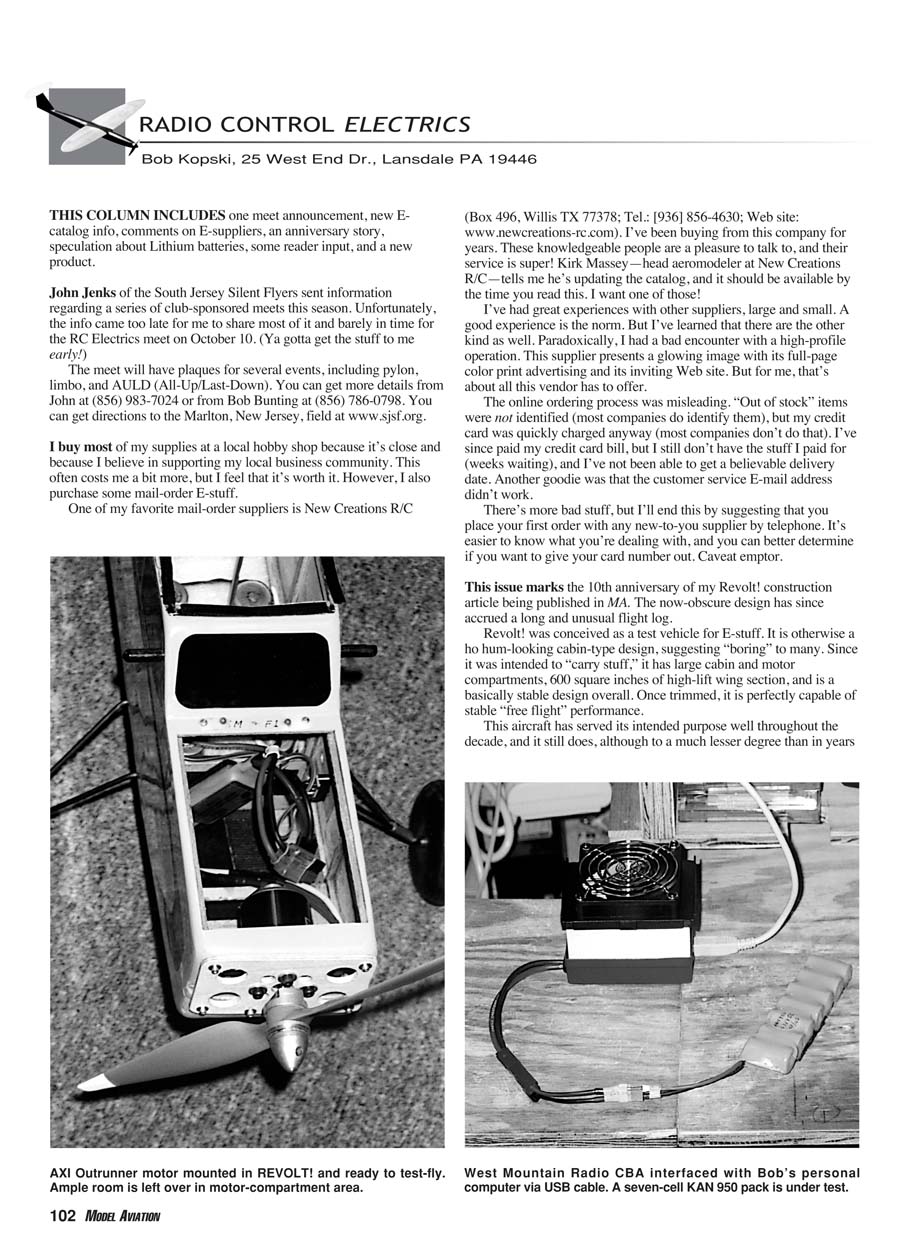
This aircraft has served its intended purpose well throughout the decade, and it still does, although to a much lesser degree than in years past. Still, of the many models in my hangar, it’s the most flown. As a power-system test vehicle, Revolt! has been flown with feeble 600-size direct-drive can motors on seven cells up to geared AstroFlight 40 Cobalts on 21 cells. (Yes, that is all in one airplane!) Other power systems included a wide variety of motors, such as early Keller and Robbe products, “car motor”-based products, nearly all classic AstroFlight products, and contemporary brushless stuff. A photo shows a decade-old Revolt! set up to try an AXI Outrunner motor, which is new as I write this.
Unlike all previous installations, the AXI Outrunner presented a mounting challenge. The other motors—geared or not—were mounted on the accommodating "VEE" block mount system designed into Revolt! However, the AXI cannot be mounted in a VEE block; the motor housing rotates!
I decided to attach a removable 1/8" birch-plywood nose plate to Revolt!, and then fix the AXI front-end bell behind that. If this suggests bad planning to you, please remember that outrunners did not exist when Revolt! was designed!
In addition to serving as a power-system test bed, Revolt! has been pressed into service flight-testing ESCs and radio equipment, has had "glitch-counting" and telemetry equipment installed, and several readers have installed cameras.
Beyond all that, Revolt! has shown its abilities as an unplanned basic trainer for some readers. Through the years I have routinely handed the sticks of this docile craft to youthful and senior bystanders and talked them through the air—knowing that the airplane was forgiving.
Thus this simplistic three-channel E-airplane design has become less of a test resource and much more of a regular companion through the years. I typically take two or three E-airplanes to the field each time I go, and a Revolt! is usually one of them. It's my relaxing "comfort" airplane—it just feels good—with its normally installed 15G/12-cell system.
Out of curiosity and for purposes here, I reviewed my Revolt! flight logs to date (July 2, 2004), beginning with the first on April 10, 1993. The tally: 2,110 flights! How many flights do you have on your favorite model?
Lithium-Polymer (Li-Poly) batteries
I'm sure that by now, nearly all E-aeromodelers are using, or are at least aware of, today's popular battery technology: Lithium-Polymer, more commonly known as "Li-Poly." Li-Poly has hit the market in more of a "flash flood" fashion than past battery products have. It seems as though each month more companies and product labels are added to the already large supplier list. And the warnings and cautions about the use and abuse of Li-Poly continue.
With the product itself, most E-aeromodelers are probably also familiar with the safety do's and don'ts, so I'm not going to belabor the detail here. Rather, with the continuing strong handling cautions mixed with emerging tales of woe, I cannot help but wonder if this product was not introduced prematurely.
Noting that there are no similar cautions and costly losses associated with other lithium-powered consumer applications, such as cell phones, pagers, laptops, etc., why is our E-aeromodeling application so different?
I think the answer lies with the consumer products having built-in protection devices, dedicated (inflexible) chargers, and unique application interfaces that protect the user—from himself or herself. You can't easily use the consumer stuff "wrong."
Our stuff, having essentially no "containment" as in the preceding, does not have protections built in or dedicated interfaces. In effect, safe handling lies totally in our hands, so it is not always in a firm grip. I have a feeling that this will eventually change—out of necessity.
I might imagine a standardized Li-Poly "hobby-use interface," bounding charging and application variables. A possible form of this—perhaps instead of or in addition to electronics built into each pack—would be standardized connectors. I could imagine multipin interfaces with connections to each cell of a pack assembly and a "standard specification" charger interface emerging. I'm sure there must be other options as well. I'm just guessing.
Whatever the case, it's hard to imagine the risks and losses associated with present-day Li-Poly continuing without eventual impact on all aeromodelers, such as increasing insurance premiums. All reader comment on this topic is welcome.
While on the subject of Li-Poly, the opening sentence of the Universal Slow Charger article published in the September 2000 MA reads: "The Universal Slow Charger is a uniquely capable, versatile, flexible charger design that can accommodate all aeromodeling rechargeables I know of, and more."
This was true at the time, but it is no longer true. Do not use the Universal Slow Charger with Li-Poly batteries!
Reader input — switches and brushless systems
Several readers reacted to the August column's discussion about switches and electrics. Surprisingly, one recurring input I received was concerning the use of small arming toggle switches with brushless systems. In that column I described how such switches can be instantly destroyed by the presence of large electrolytic capacitors on the power-input connections of most brushless ESCs.
Several readers independently suggested the same solution to this problem. Although the specifics varied a bit among them, the basic idea was to install a second switch in parallel with the first—except the second would have in series with it a small-value resistor.
The idea is to close this second path first, allowing the ESC input capacitors to safely charge up to battery voltage via the resistor (takes less than a second), and then close the "real" arming switch. This way, the latter is protected from the huge surge of current upon initial closure because it's closing on an already charged capacitor.
I agree that this is a sound approach to the problem, but I'd prefer not to have to mount a second switch. Nor do I like having to remember to sequence the two-switch power-up operation. So I'm still looking for a simpler approach—perhaps an impossible quest. Meanwhile, thanks to those who picked up on the topic and reacted with workable inputs for us all. (I'm now looking at a Revolt! to test this in!)
West Mountain Radio — Computerized Battery Analyzer (CBA)
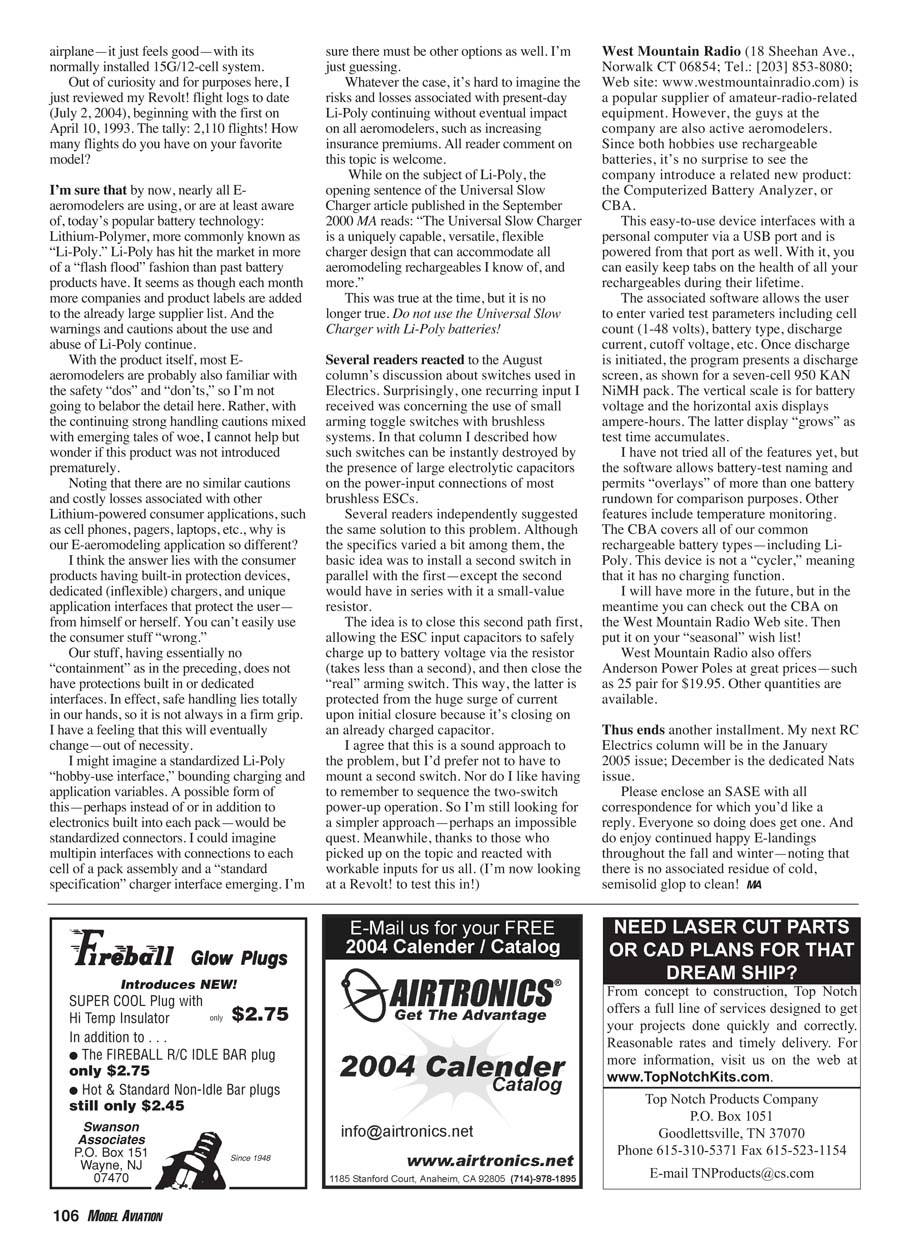
West Mountain Radio is a popular supplier of amateur-radio-related equipment, and the folks there are also active aeromodelers. Since both hobbies use rechargeable batteries, it's no surprise to see the company introduce a related new product: the Computerized Battery Analyzer, or CBA.
Product details:
- West Mountain Radio, 18 Sheehan Ave., Norwalk CT 06854
- Tel.: (203) 853-8080
- Web site: www.westmountainradio.com
This easy-to-use device interfaces with a personal computer via a USB port and is powered from that port as well. With it, you can easily keep tabs on the health of all your rechargeables during their lifetime.
The associated software allows the user to enter varied test parameters including cell count (1–48 volts), battery type, discharge current, cutoff voltage, etc. Once discharge is initiated, the program presents a discharge screen, as shown for a seven-cell 950 KAN NiMH pack. The vertical scale is for battery voltage and the horizontal axis displays ampere-hours. The latter display "grows" as test time accumulates.
I have not tried all of the features yet, but the software allows battery-test naming and permits overlays of more than one battery rundown for comparison purposes. Other features include temperature monitoring. The CBA covers all of our common rechargeable battery types—including Li-Poly. This device is not a "cycler," meaning that it has no charging function.
I will have more in the future, but in the meantime you can check out the CBA on the West Mountain Radio web site. Then put it on your "seasonal" wish list.
West Mountain Radio also offers Anderson Power Poles at great prices—such as 25 pair for $19.95. Other quantities are available.
Closing
Thus ends another installment. My next RC Electrics column will be in the January 2005 issue; December is the dedicated Nats issue.
Please enclose an SASE with all correspondence for which you'd like a reply. Everyone so doing does get one. And do enjoy continued happy E-landings throughout the fall and winter—noting that there is no associated residue of cold, semisolid gloop to clean!
MA
Transcribed from original scans by AI. Minor OCR errors may remain.

