
RADIO CONTROL ELECTRICS - 2005/04
Bob Kopski
25 West End Dr., Lansdale PA 19446
This column includes one meet announcement, shares some reader input, updates an earlier connector story, describes an easy E-airplane upgrade, and suggests improvements to the Miracle ARF.
Meet announcement: Triad Electric Weekend
Randy Covington (3106 YMCA Camp Rd., King NC 27021; Tel.: (336) 983-9126; E-mail: [email protected]) wrote to tell us about the upcoming Triad Electric Weekend scheduled for April 30–May 1, 2005. The event is co-hosted by the Riverside Aeromodelers of King, North Carolina (RAMS), and the Winston-Salem Radio Control Club of Winston-Salem, North Carolina (WSRC). Saturday’s meet will be at the RAMS field in King. Sunday’s events will be at the WSRC field in Advance, North Carolina. That’s one meet, two days, two clubs, and two fields. Contact Randy for details — and tell him Bob sent you.
Reader mail: Li-Poly slow-charger discussion
My average for reader mail has been roughly 200 letters per year for the last 20-plus years, and most of it brings specific questions. As a matter of personal policy, I strive to provide the best answers I can as fast as I can. Other incoming mail shares comments or information, and some just says “Thanks.” And there are always a few letters resulting from misunderstanding column content. The latter is rather small and so far has been the apparent result of modelers not reading carefully. Normally I’d just fix this with correspondence; however, there was a recent, more important instance I want to share.
The December 2004 column included a “wish list” describing some new electric products I’d like to see—for everyone. One item I envisioned was a slow charger for Li-Poly batteries. Several readers reacted, and some clearly misunderstood what I wrote.
That column expressed interest in a Li-Poly charger that would be AC-line powered. This would simplify in-shop charging; there would be no need for a car battery or a robust line-operated 12-volt power supply to feed the usual 12-volt-input Li-Poly charger.
More fundamentally, I suggested that this could be a slow charger because the faster, one-hour Li-Poly charge is often unnecessary with in-shop charging. A slow charger could be smaller, lighter, and less expensive.
I concluded that column topic with the query: “This wish assumes that slow-charging Li-Poly batteries is acceptable. Does anyone out there actually know if that’s true?”
A variety of reader reactions resulted; unfortunately several thought I had proposed charging Li-Polys with the same kind of charger used for transmitters and receivers. I did not — they misread it.
By now everyone should be aware that Li-Polys are to be charged with chargers designed for this chemistry—not with chargers designed for Ni-Cd or NiMH batteries. I was surprised by how many got it wrong.
Some reactions were quite positive: clearly I’m not the only one wanting such a product. One reader described that because his (smaller) charger is incapable of supplying charge at the usual one-hour rate to his larger packs, in effect he is already “slower charging” with no apparent adverse consequence. Another reader disliked having to extend the “sit there and watch it” charging time.
Industry input is that it would be technically okay to slow-charge Li-Polys, provided it’s with a charger designed for Li-Poly chemistry. I’m working on one—for me.
Reader input on any column topic is always welcome, but please read what I actually wrote first. And yes, sometimes I do have an error—and input in such cases is strongly desired, encouraged, and accepted with appreciation.
Connector update: three-pin AstroFlight brushless connector
The January 2005 column shared a home-brew idea involving two Deans connectors: modify a Deans four-pin connector set to yield a three-pin version for smaller brushless-motor/ESC interconnections. The idea was to cut off the fourth or widest-spaced pin, leaving three equally spaced pins intact. The resulting connector pair allows easy motor rotation reversal by simply turning the connector pairing.
When I wrote that, I was unaware AstroFlight was already supplying the item. The smaller connector set is exactly what I described in the January column—ready made. The three-pin connector is AstroFlight part number 520 and is available from the company. The larger classic set is for larger brushless systems; the smaller set is for smaller brushless systems.
Skyvolt upgrade: Li-Poly substitution and outrunner installation
Until last summer I was flying an old Skyvolt (published in the January 1990 MA) with a classic AstroFlight 15 direct-drive motor turning a 9 x 4.5 prop on 10 CP1300 Ni-Cd cells. The airplane's all-up weight was 43.3 ounces, and it flew comfortably for five to seven minutes.
I upgraded the power system in steps:
- Battery swap: I substituted three Li-Poly cells for the 10-cell Ni-Cd pack. Three Li-Polys have essentially the same terminal voltage as a classic 10-cell Ni-Cd/NiMH. I installed a Falcon Batteries 3S1P Predator 2500 pack (from New Creations R/C). Skyvolt’s weight dropped to 36.3 ounces and flight times averaged 15–16 minutes.
- Motor and ESC: I then installed an AXI 2820/10 brushless outrunner motor and a Castle Creations Phoenix-45 brushless ESC. Because outrunners rotate, they cannot be mounted in the AstroFlight 15’s classic “V” block. I made two 1/16-inch plywood rings to fit the Skyvolt’s nose: one inside the fuselage nose and one outside in front. Metric screws passed through the front plywood ring, the balsa front-end former, the inner plywood ring, and threaded into the motor front bell. Tightening the four motor screws clamped the plywood rings against the original balsa fuselage front and securely held the AXI in place. No cutting or gluing was needed.
- Prop selection: Bench runs with an AstroFlight Whattmeter indicated the APC 10 x 5.5E prop as a good starter. This respected the maximum current-drain specification for the Li-Poly and provided plenty of input power.
After motor and ESC installation the Skyvolt weighed 35.3 ounces but was tail-heavy. I added one ounce of stick-on nose weight to balance it. The reborn Skyvolt now exceeds 20 minutes of flight time, with quieter, more efficient performance. The motor/prop combination seems relatively more efficient and accounts for the extra four to five minutes of flight time compared to the previous motor.
Overall, this was a worthy upgrade to an old favorite. Consider converting one of your old favorites into a new favorite.
Miracle ARF: suggested improvements and repair
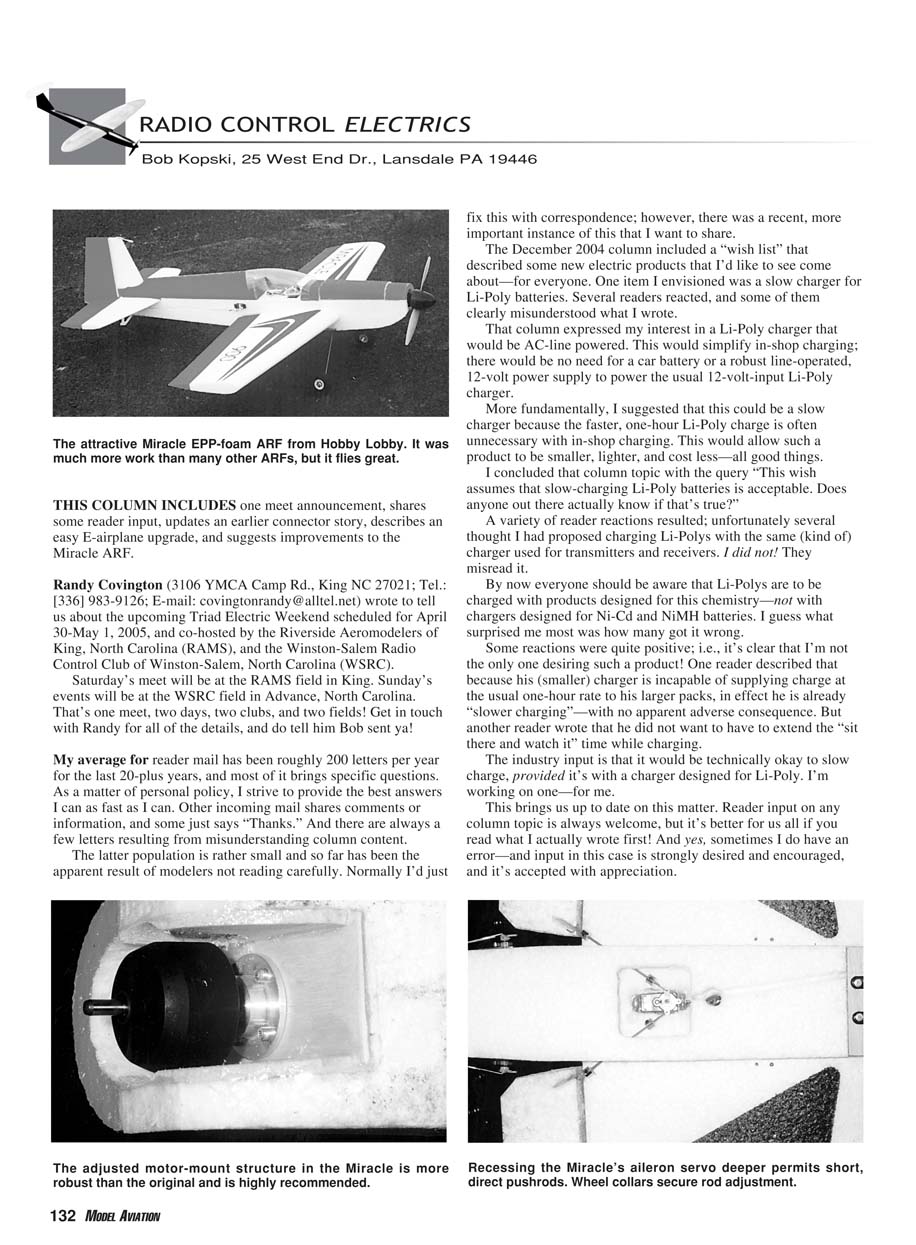
A local E-flier asked me to check out his Hobby Lobby EPP-foam aerobatic Miracle ARF. Several useful modifications followed.
Modifications that improved flying qualities:
- Stiffen the horizontal stabilizer: glue a 1/32-inch plywood strip roughly 1/16 inch wide on the rear stabilizer edge at the hinge line. This requires removing the already-hinged elevator, but the thin strip greatly increases stiffness.
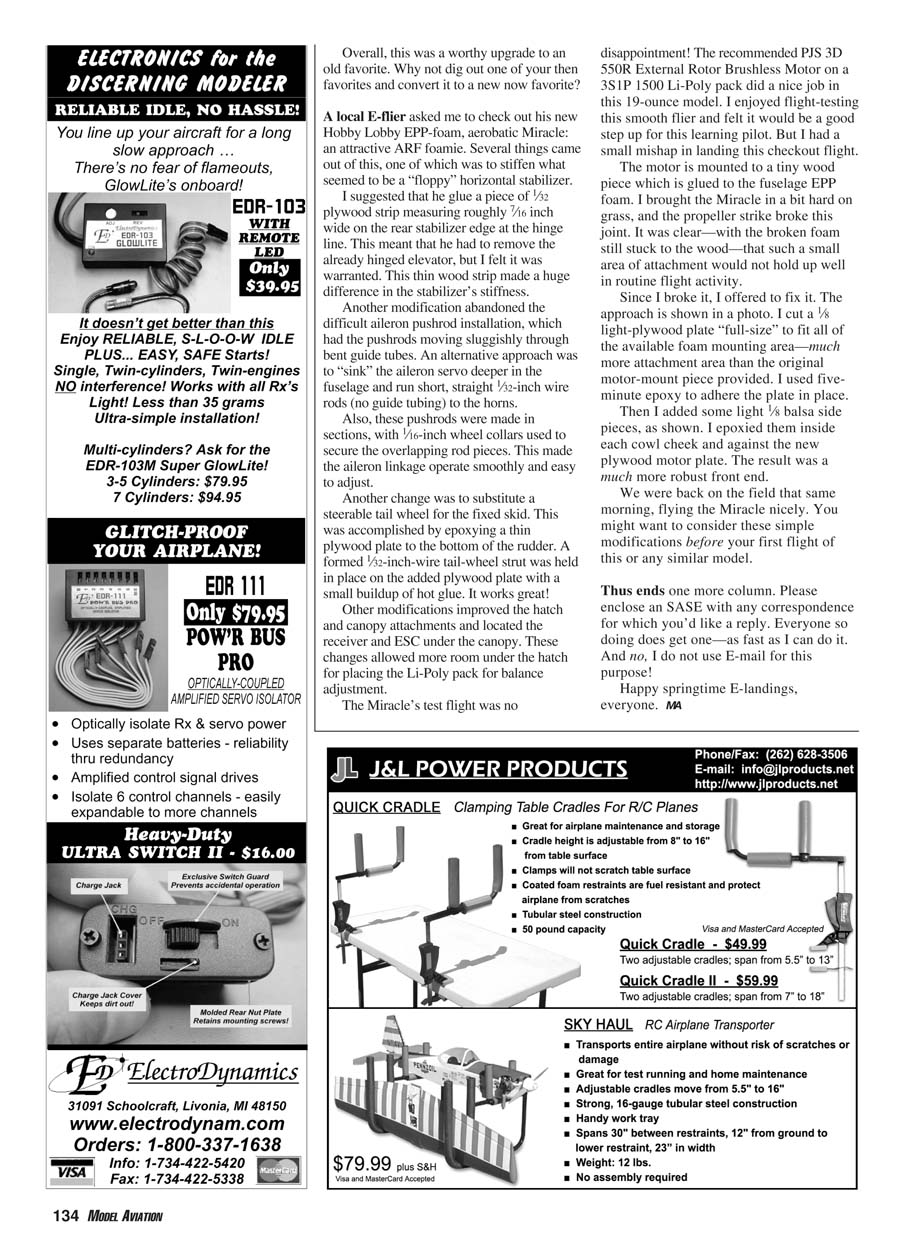
- Simplify the aileron linkage: sink the aileron servo deeper in the fuselage and run short, straight 1/32-inch wire rods (no guide tubing) to the horns. Make the pushrods in sections and secure overlapping pieces with 1/16-inch wheel collars. The result is smooth, easily adjusted operation.
- Replace the fixed skid with a steerable tail wheel: epoxy a thin plywood plate to the bottom of the rudder. Mount a formed 1/32-inch wire tail-wheel strut on the added plate and secure it with a small buildup of hot glue. It works well.
- Hatch and gear placement: improve hatch and canopy attachments and locate the receiver and ESC under the canopy. This provides more room under the hatch for placing the Li-Poly pack for proper balance.
Flight test The recommended PJS 3D 550R external-rotor brushless motor on a 3S1P 1500 Li-Poly pack performed well in this 19-ounce model. The Miracle proved to be a smooth flier and a good step up for the learning pilot. However, I had a small mishap on landing.
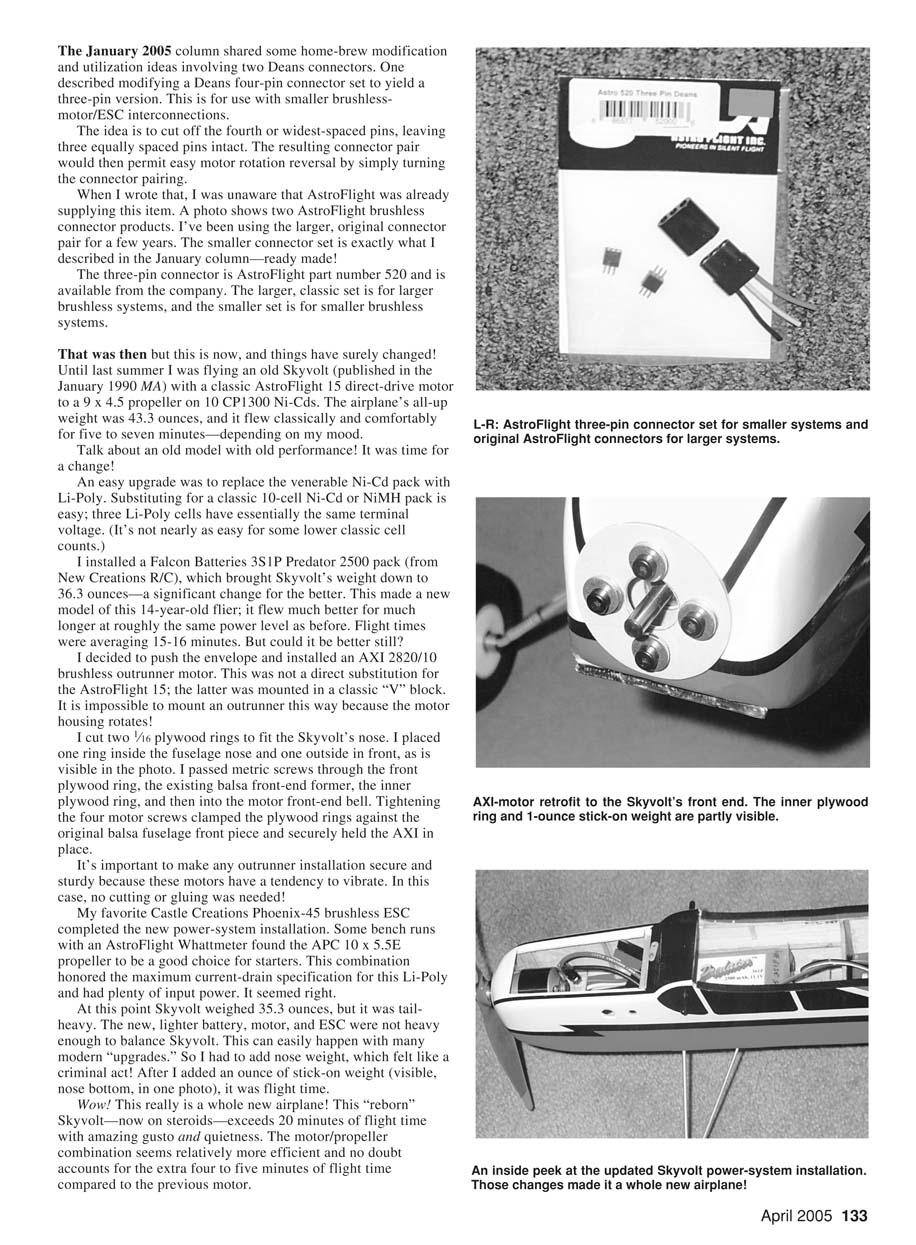
Motor-mount failure and repair The motor is mounted to a tiny wood piece glued to the EPP foam fuselage. On a somewhat hard grass landing the propeller strike broke this joint. The small attachment area was insufficient.
To fix it:
- Cut a full-size 1/8-inch light-plywood plate to cover the entire available foam mounting area—much more attachment area than the original motor-mount piece.
- Epoxy the plate in place with five-minute epoxy.
- Add light 1/8-inch balsa side pieces inside each cowl cheek and epoxied against the new plywood motor plate.
The result is a much more robust front end. We were back on the field that same morning flying the Miracle nicely. Consider these simple modifications before your first flight of this or any similar model.
Closing
Please enclose a stamped, self-addressed envelope (SASE) with any correspondence for which you'd like a reply. Everyone who does so gets one—as fast as I can do it. No, I do not use E-mail for this purpose.
Happy springtime E-landings, everyone.
MA
Transcribed from original scans by AI. Minor OCR errors may remain.

