
RADIO CONTROL ELECTRICS
Bob Kopski, 25 West End Dr., Lansdale PA 19446
THIS COLUMN INCLUDES two meet announcements, describes two neat new products, describes some simple do-it-yourself test accessories, and concludes with a "landing."
Meet announcements
- Loudoun County Aeromodelers Association 6th Annual Electric Fly In
- Contact: Brian Allen, 47036 Berwick Ct., Sterling VA 20165
- Tel.: (703) 430-5849
- E-mail: [email protected]
- When: Saturday, July 23, 2005; registration and flying 9 a.m.–5 p.m.
- Where: Club field in Banshee Reeks Park, Leesburg, Virginia
- Notes: Lunch and a raffle; low-key, fun get-together. Details at www.lcaa.org.
- Cedar Rapids SkyHawks Electric Fun Fly
- Contact: Plenny Bates, 2505 White Eagle Trl. SE, Cedar Rapids IA 52403
- Tel.: (319) 362-2969
- E-mail: [email protected]
- When: August 6–7, 2005
- Where: Field at 3125 C Ave. Extension NE, Cedar Rapids
- Notes: Meet mailer lists local places to stay and eat. Details at www.crskyhawks.org.
Sombra Labs Shadow 1 receiver
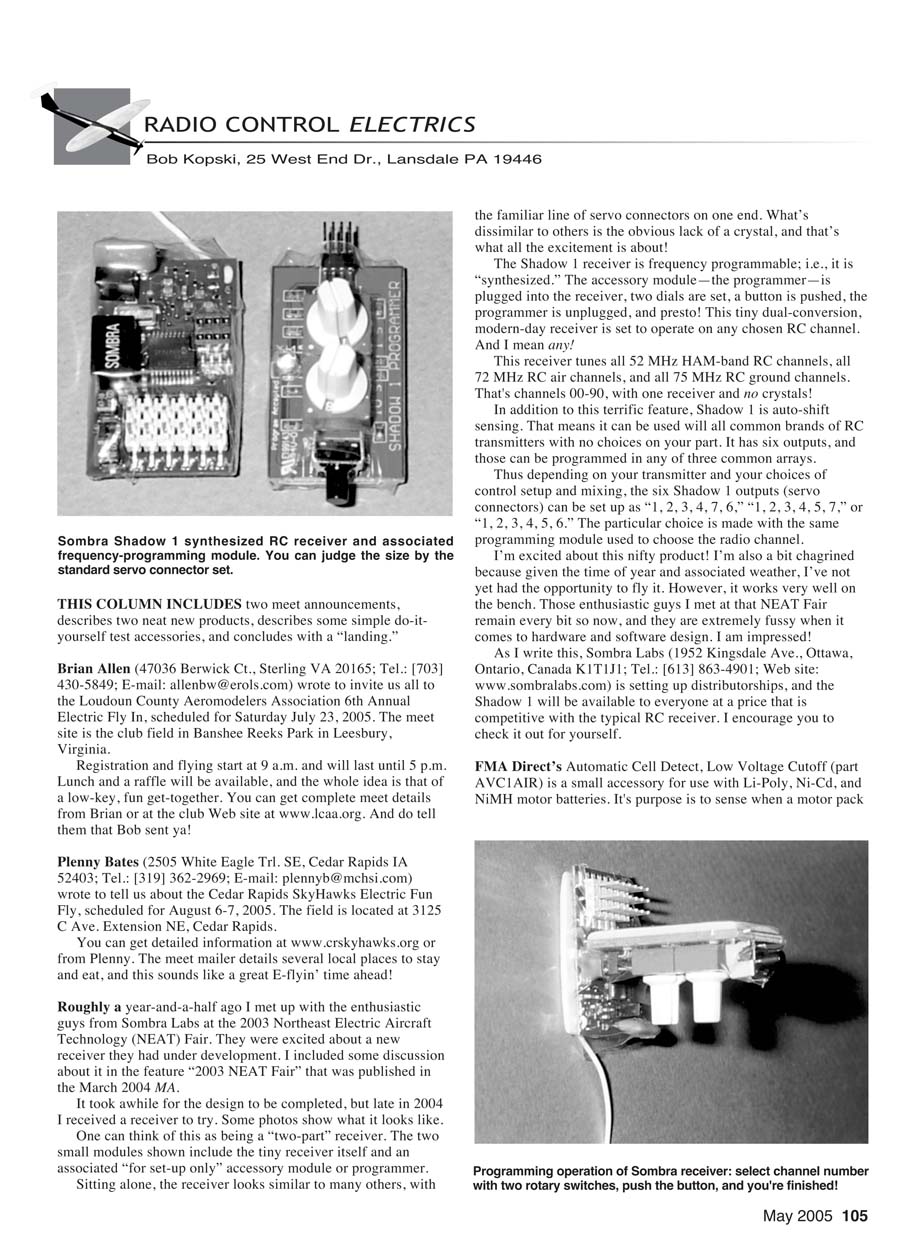
Roughly a year-and-a-half ago I met the enthusiastic guys from Sombra Labs at the 2003 Northeast Electric Aircraft Technology (NEAT) Fair. They were excited about a new receiver under development; I mentioned it in the "2003 NEAT Fair" feature published in the March 2004 MA. The design took some time, but late in 2004 I received a unit to try.
- Design: The Shadow 1 is a two-part system—one tiny receiver module and an accessory programmer used for setup only.
- No crystal: The receiver has no crystal; it is frequency-programmable (synthesized).
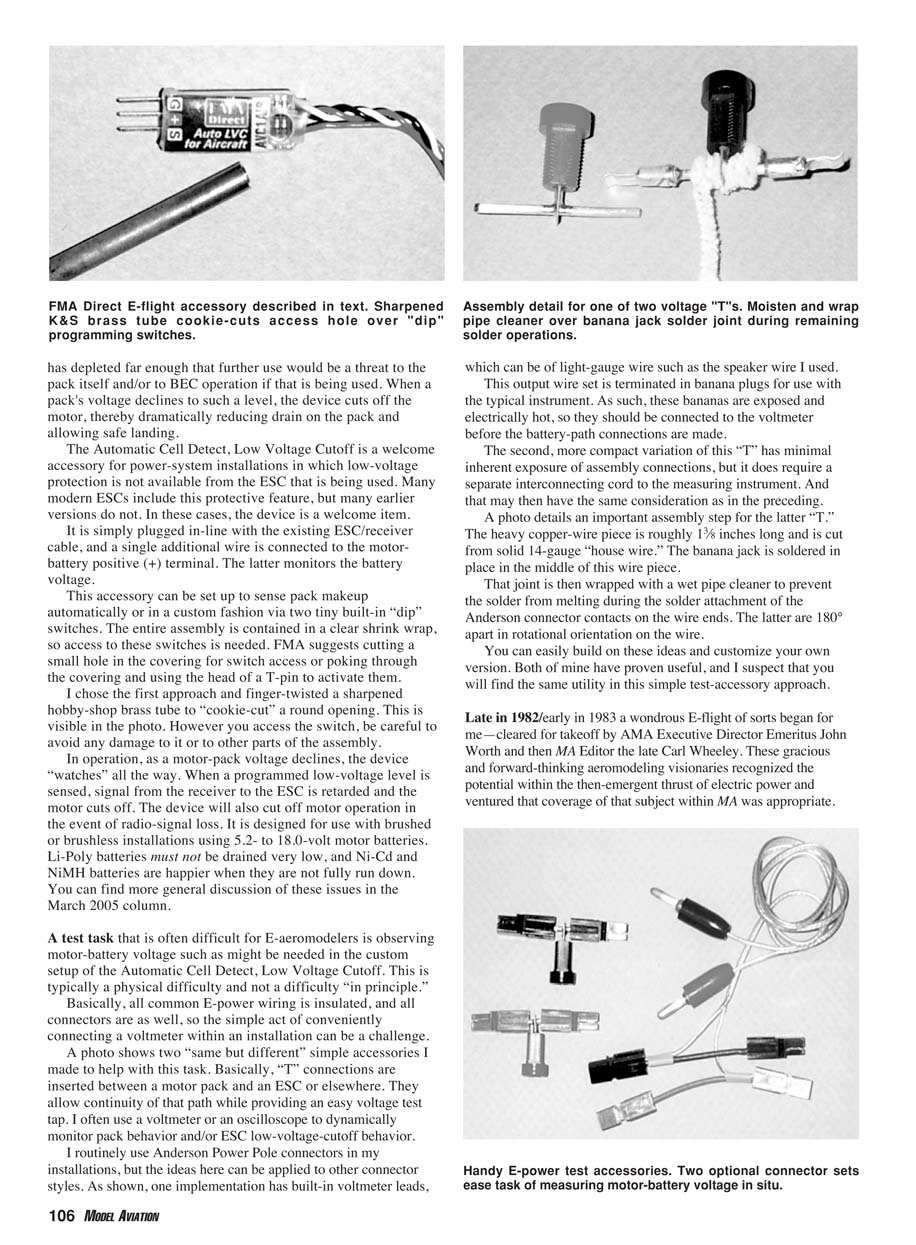
- Programming: Plug the programmer into the receiver, set two dials, push a button, unplug the programmer—then the receiver is set to the chosen RC channel.
- Coverage: Tunes all 52 MHz ham-band RC channels, all 72 MHz RC air channels, and all 75 MHz RC ground channels—channels 00–90 with one receiver and no crystals.
- Compatibility: Auto-shift sensing allows use with common transmitter brands without user adjustments.
- Outputs: Six outputs that can be programmed in any of three common arrays:
- 1, 2, 3, 4, 7, 6
- 1, 2, 3, 4, 5, 7
- 1, 2, 3, 4, 5, 6
The same programming module is used to select the array.
I’m excited about this product. I haven’t flown it yet due to the season, but it works very well on the bench. The Sombra Labs team remains enthusiastic and fussy about hardware and software design—impressive. As of this writing, Sombra Labs is setting up distributors and the Shadow 1 will be available at a price competitive with typical RC receivers.
- Sombra Labs contact: 1952 Kingsdale Ave., Ottawa, Ontario, Canada K1T 1J1
- Tel.: (613) 863-4901
- Web site: www.sombralabs.com
FMA Direct Automatic Cell Detect, Low Voltage Cutoff (AVC1AIR)
FMA Direct’s Automatic Cell Detect, Low Voltage Cutoff (part AVC1AIR) is a small accessory for use with Li-Poly, Ni-Cd, and NiMH motor batteries. Its purpose is to sense when a motor pack is depleted enough that further use would threaten the pack and/or BEC operation; when that level is reached, the device cuts off the motor to dramatically reduce drain and allow a safe landing.
- Use cases: Useful where the ESC does not provide low-voltage protection. Many modern ESCs include low-voltage cutoff, but many older ones do not.
- Installation: Plugged inline with the existing ESC/receiver cable; one additional wire connects to the motor-battery positive (+) terminal to monitor pack voltage.
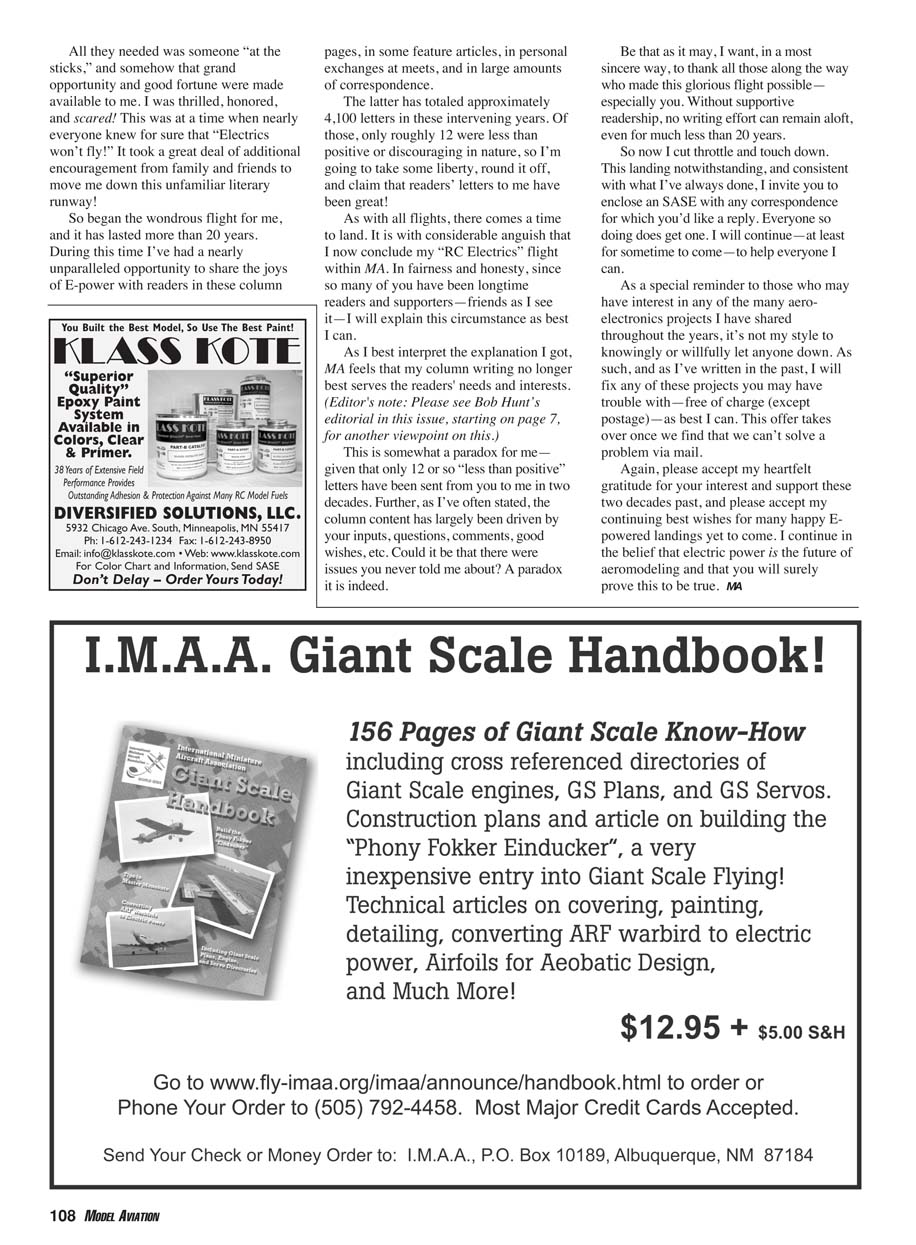
- Setup: The unit can sense pack makeup automatically or be customized via two tiny built-in DIP switches. The assembly is in clear shrink wrap; FMA suggests cutting a small hole for switch access or poking through and using a T-pin to operate them. I cut a small round opening using a sharpened hobby brass tube.
- Operation: As pack voltage declines, the device monitors continuously. When the programmed low-voltage level is reached, the device retards the receiver signal to the ESC and cuts the motor. It will also cut motor operation on radio-signal loss.
- Specs and warnings: Designed for brushed or brushless setups using 5.2–18.0 V motor batteries. Li-Poly batteries must not be drained very low; Ni-Cd and NiMH cells also prefer not to be fully run down. See the March 2005 column for more general discussion.
Simple "T" test accessories for voltage monitoring
Observing motor-battery voltage during installation or while setting custom low-voltage cutoffs can be physically awkward because wiring and connectors are insulated. I made two simple "T" accessories to insert between a motor pack and an ESC (or elsewhere) that maintain continuity while providing an easy voltage test tap. I use these with a voltmeter or oscilloscope to dynamically monitor pack behavior or ESC cutoff behavior.
- Connector style: I routinely use Anderson Power Pole connectors, but the idea can be adapted to other connector styles.
- Version 1: Larger T with built-in voltmeter leads (light-gauge speaker wire) terminated in banana plugs for the instrument. Note: the banana plugs are electrically hot—always connect them to the meter before connecting the battery path.
- Version 2: More compact T with minimal exposed connections; requires a separate interconnecting cord to the measuring instrument (same hot-connection caution applies).
Assembly tip: For the compact T, I used a heavy copper wire piece about 1-3/8 inches long cut from solid 14-gauge house wire. Solder a banana jack in the middle of this wire piece. Wrap that joint with a wet pipe cleaner to keep the solder from melting when you solder Anderson connector contacts to the wire ends; orient the contacts 180° apart on the wire.
You can customize these ideas to fit your own installations. Both of my versions have proven useful.
Landing / brief history
Late in 1982 and early in 1983 a personal E-flight of sorts began for me—cleared for takeoff by AMA Executive Director Emeritus John Worth and then MA Editor the late Carl Wheeley. These gracious and forward-thinking aeromodelling visionaries recognized the potential within the then-emergent thrust of electric power and agreed that coverage of electric flight within MA was appropriate.
Transcribed from original scans by AI. Minor OCR errors may remain.

