
RADIO CONTROL ELECTRICS
Greg Gimlick, [email protected]
CHANGES ABOUND:
Did you open up the magazine and wonder what that strange sound was? It's just me rattling around in the giant footprint left by Bob Kopski. Talk about a daunting position to be in! Bob's 10-part series about electrics years ago got me started, where I learned the basics before attending my first KRC (Keystone Radio Control Club) electric fun-fly in Pennsylvania to see how it all came together. I thought I had landed in the Promised Land — it was so spectacular — yet it doesn't even begin to compare with where we are today. I could go on and on about Bob's contributions to the hobby, but I know it's being done elsewhere and I'm confident that his place in the Model Aviation Hall of Fame is secure.
When I got my first job writing an electric-flight column in 1993, Bob was the first person to call and offer his help and support. What a relief it was to know that someone of his stature would offer a new columnist a resource like that.
Through the years I've heard of others who wrote for magazines say he did the same thing for them. To say I'm humbled to have the opportunity to come behind him and try to hold my own in the electrics-column end of this magazine would be an understatement.
Bit of Background:
I've been in the RC end of the hobby since 1980 but have flown CL and FF models since I was a child. I started "adult life" going to school to become a teacher until I won the draft lottery and changed course. Since I was too afraid to be a "grunt" and they were enticing college guys to become helicopter pilots, that's the course I took.
I went through flight school and did a tour before returning to civilian life to become a teacher. After a short stint at teaching, Uncle Sam recalled me and I never looked back. I spent a wonderful career as a helicopter instructor pilot until I retired.
I love all sorts of airplanes: electric, glow, gas, FF, indoor, giant scale, sport — you name it! Electric models are my first choice because I love their cleanliness, quietness, and longevity. No fuel soaking and vibration damage happens through the course of time. To get a feel for how long some of these models last, look at the history of some of the airplanes in the photos.
I think we're a giant community of modelers who have a lot to offer each other. I suggest that you read every column in the magazine and glean from it the points that will transfer to your particular interest.
Where We've Been:
For a great appreciation of where we've come from, I turned to Keith Shaw. Most of you are probably familiar with Keith; he has designed and built countless unique subjects and flown demonstrations at air shows for longer than he cares to remember. I recently talked with him about Bob's retiring and the electric community in general. You might find his remarks as interesting as I did. They follow.
"We were weird loners rewinding windshield-wiper motors, eggshell-fragile airplanes, dismal Ni-Cds, and exhilaration when your airplane actually gained altitude! Then the pride of being able to loop, albeit with a shallow dive to help.
"Being amazed when you found another 'nut' like yourself, and further amazement when you saw a completely different approach to the problems. Big thrill when simple aerobatics could be flown, of course nowhere near what glow could do. But someday ...
"Cobalt motors and Sanyo Ni-Cds jumping the performance by an order of magnitude overnight. Years upon years of small improvements and trying to convince the public and manufacturers that electric flight just might become at least a small accepted niche market. Brushless motors for all-out performance but at a price to daunt all but the die-hard competitors.
"Although a giant stride backward in technology, the proliferation of cheap, ferrite-powered 'fun' airplanes capable of flying in restricted areas on limited budgets. ARFs, foamies, and small affordable radio equipment to entice the masses. Li-Polys to propel the power-to-weight ratio far past what glow could ever hope to achieve, with airplanes to run circles around the typical glow airplane at the field.
"Look at most magazines; the advertising column inches are almost 50% electric, and the reviews also. The rare construction article is almost always electric.
"A friend in Switzerland told me that at a big Pattern contest there, over a third of the airplanes were electric — seven in the top 10 — and the electrics won the top four places. When electrics win or place at world Scale competitions, the power system is listed with the same matter-of-factness as glow or gas. Where does it go from here?"
Reading Keith’s words brings me a sense of wonderment about the hobby. He and Bob were there at the beginning and brought the rest of us along for the ride, while educating us too.
Where Does It Go From Here?
It just gets better and better. Look at our motor and controller choices compared to even five years ago. Name an application and there’s a setup that will work with it. Name a genre and there’s an electric-powered airplane that can participate in it. I don’t claim that it’s better than the rest, but it’s another way to enjoy the best hobby in the world.
Do I like all of the changes that have come with progress? No, and I don’t think we ever do, but that’s life and progress thrown together. We’ve lost a bit of the sense of community we used to have as electric modelers, but I suspect that the new people coming into electrics wouldn’t even notice because they are learning how the new community feels. Change is never easy, but it’s a necessary part of life.
What’s This Column’s Direction?
At the risk of sounding like a cliché, it’s whatever you want it to be. I’m not an electrical engineer so I don’t design chargers, controllers, and the like, but I know people who are and they have agreed to help me answer the questions that arrive in those fields.
I’m an electric-power modeler who is an instructor at heart, so I like teaching. I like learning and I like seeing what others have done. I enjoy passing on great techniques and ideas from other modelers.
In the 12 years I’ve been writing electric columns, I’ve maintained a theme of "what works" and think it’s still valid today. You don’t have to know the formulas and calculations that go into making an airplane fly; you can be successful by using setups that are similar to those that work well for others.
With the amount of equipment available to us today, there is no way I can possibly buy and try it all, so I depend on readers to fill in the blanks. Don’t be shy.
I’m looking for input. I want your photos and descriptions of airplanes you’ve built and flown. Sometimes a setup looks good on paper and doesn’t work well in the air. That information can be helpful too if presented properly. Let me know what works and what doesn’t if you think it’s good information.
When you send a digital photo, be sure it’s high resolution and think about its composition. Make sure it shows what you’re trying to explain and that there isn’t a tree or an outhouse in the background detracting from the picture.
Give me more detail than you think I’ll want. If you have a setup that is particularly interesting, shoot a close-up of it. Details, details, details — those are what modelers are looking for.
Do not use Photoshop to try to enhance your photo! Let the MA art department work with them.
Covering the Spectrum:
I’ve grabbed some photos from friends that will give you a sense of the changes that have come about over time. The models have flown on cobalt-brushed motors and flew well before they were updated to brushless motors and Li-Poly batteries.
An airplane I’ll show you in a later issue has been retrofitted with the older setup because it just felt better in the air with the old system. If you want to try electrics and are faced with sticker shock, don’t overlook some of the deals available for quality cobalt-brushed motors.
The models shown span the spectrum in size and style:
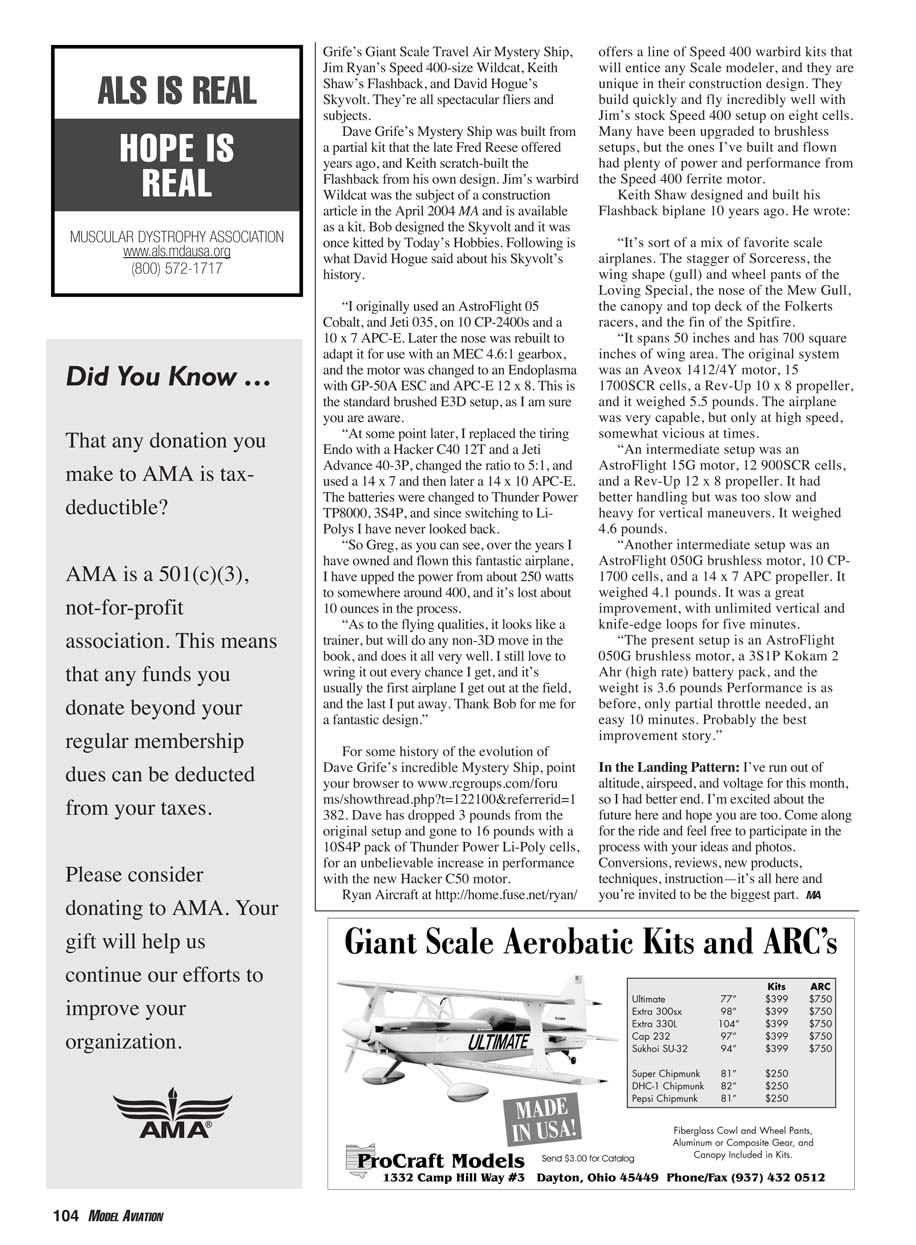
- Dave Grife's Giant Scale Travel Air Mystery Ship
- Jim Ryan's Speed-400-size Wildcat
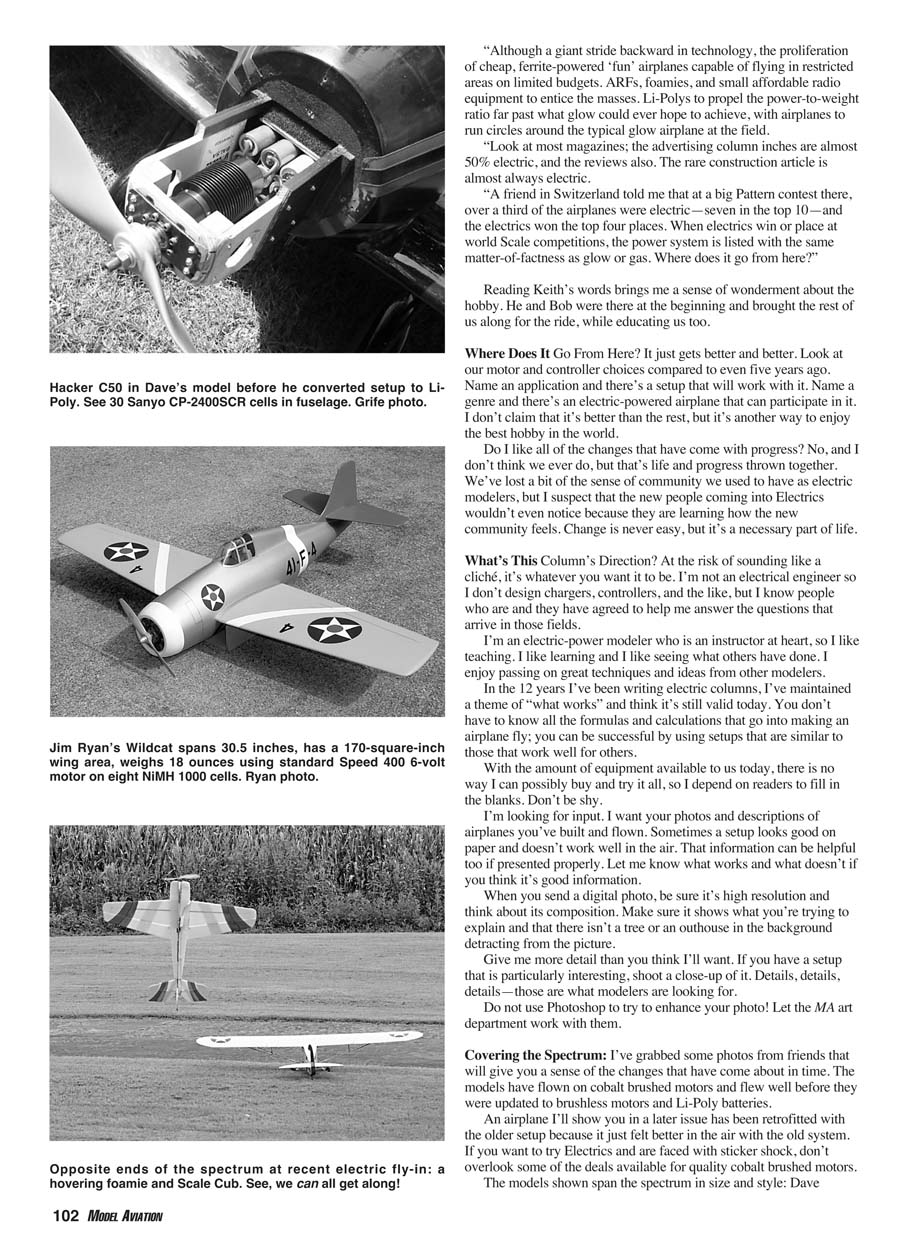
- Keith Shaw's Flashback
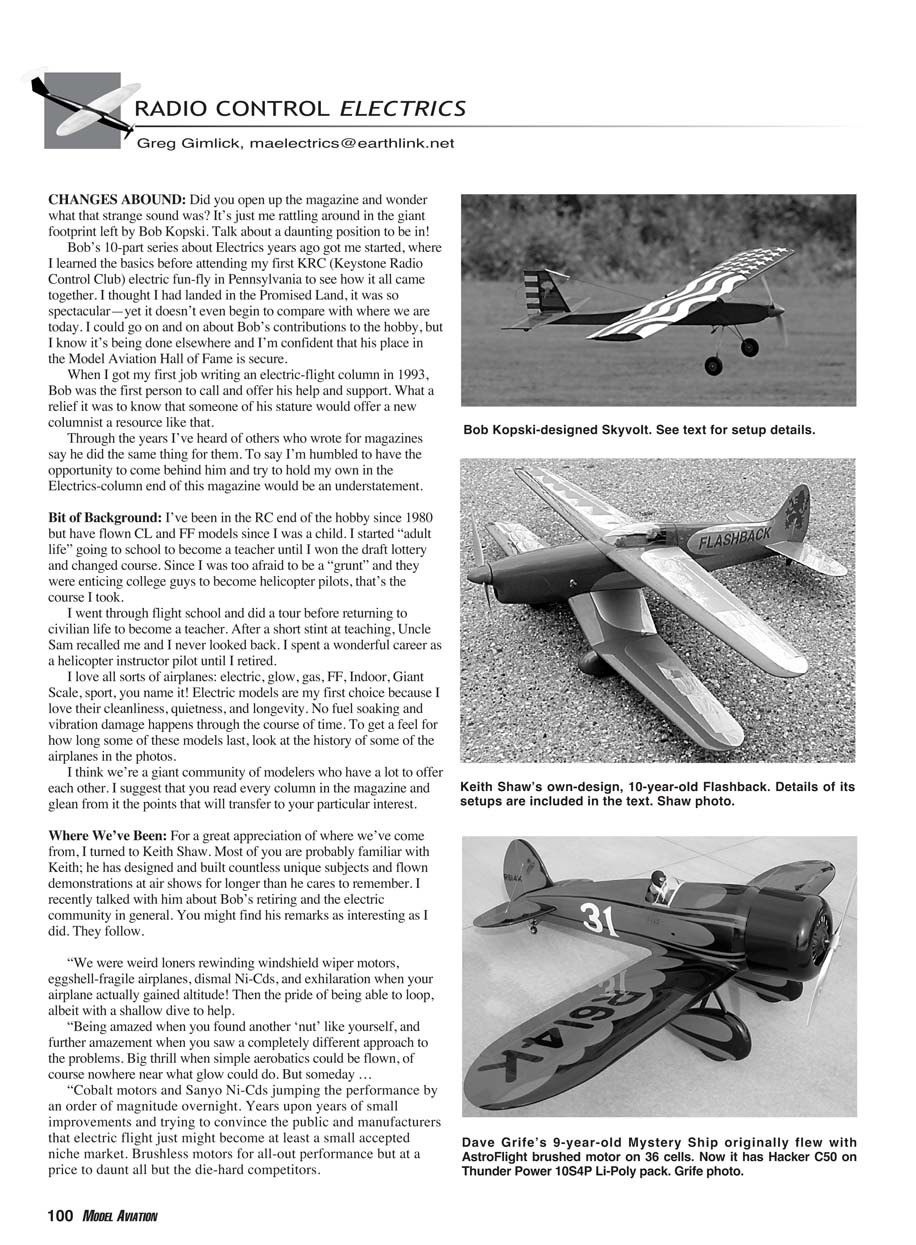
- David Hogue's Skyvolt
They're all spectacular fliers and subjects.
Dave Grife's Mystery Ship was built from a partial kit that the late Fred Reese offered years ago, and Keith scratch-built the Flashback from his own design. Jim's warbird Wildcat was the subject of a construction article in the April 2004 MA and is available as a kit. Bob designed the Skyvolt and it was once kitted by Today's Hobbies. Following is what David Hogue said about his Skyvolt's history.
"I originally used an AstroFlight 05 Cobalt, and Jeti 035, on 10 CP-2400s and a 10 x 7 APC-E. Later the nose was rebuilt to adapt it for use with an MEC 4.6:1 gearbox, and the motor was changed to an Endoplasma with GP-50A ESC and APC-E 12 x 8. This is the standard brushed E3D setup, as I am sure you are aware.
"At some point later, I replaced the tiring Endo with a Hacker C40 12T and a Jeti Advance 40-3P, changed the ratio to 5:1, and used a 14 x 7 and then later a 14 x 10 APC-E. The batteries were changed to Thunder Power TP8000, 3S4P, and since switching to Li-Polys I have never looked back.
"So Greg, as you can see, over the years I have owned and flown this fantastic airplane, I have upped the power from about 250 watts to somewhere around 400, and it's lost about 10 ounces in the process.
"As to the flying qualities, it looks like a trainer, but will do any non-3D move in the book, and does it all very well. I still love to wring it out every chance I get, and it's usually the first airplane I get out at the field, and the last I put away. Thank Bob for me for a fantastic design."
For some history of the evolution of Dave Grife's incredible Mystery Ship, point your browser to www.rcgroups.com/forums/showthread.php?t=122100&referrerid=382. Dave has dropped 3 pounds from the original setup and gone to 16 pounds with a 10S4P pack of Thunder Power Li-Poly cells, for an unbelievable increase in performance with the new Hacker C50 motor. Ryan Aircraft at http://home.fuse.net/ryan/ offers a line of Speed 400 warbird kits that will entice any scale modeler, and they are unique in their construction design. They build quickly and fly incredibly well with Jim's stock Speed 400 setup on eight cells. Many have been upgraded to brushless setups, but the ones I've built and flown had plenty of power and performance from the Speed 400 ferrite motor.
Keith Shaw designed and built his Flashback biplane 10 years ago. He wrote:
"It's sort of a mix of favorite scale airplanes. The stagger of Sorceress, the wing shape (gull) and wheel pants of the Loving Special, the nose of the Mew Gull, the canopy and top deck of the Folkerts racers, and the fin of the Spitfire.
"It spans 50 inches and has 700 square inches of wing area. The original system was an Aveox 1412/4Y motor, 15 1700SCR cells, a Rev-Up 10 x 8 propeller, and it weighed 5.5 pounds. The airplane was very capable, but only at high speed, somewhat vicious at times.
"An intermediate setup was an AstroFlight 15G motor, 12 900SCR cells, and a Rev-Up 12 x 8 propeller. It had better handling but was too slow and heavy for vertical maneuvers. It weighed 4.6 pounds.
"Another intermediate setup was an AstroFlight 050G brushless motor, 10 CP-1700 cells, and a 14 x 7 APC propeller. It weighed 4.1 pounds. It was a great improvement, with unlimited vertical and knife-edge loops for five minutes.
"The present setup is an AstroFlight 050G brushless motor, a 3S1P Kokam 2 Ah (high rate) battery pack, and the weight is 3.6 pounds. Performance is as before, only partial throttle needed, an easy 10 minutes. Probably the best improvement story."
In the Landing Pattern:
I've run out of altitude, airspeed, and voltage for this month, so I had better end. I'm excited about the future here and hope you are too. Come along for the ride and feel free to participate in the process with your ideas and photos. Conversions, reviews, new products, techniques, instruction — it's all here and you're invited to be the biggest part.
MA
Transcribed from original scans by AI. Minor OCR errors may remain.

