
RADIO CONTROL GIANTS
Sal Calvagna 1335 Broadway Ave., Holbrook NY 11741 E-mail: [email protected]
I find it amazing that I am writing the December 2003 Radio Control (RC) Giants column. How could this be possible? Where has this year gone?
The years seem to move along at dizzying speeds lately! If there is anyone out there in modeling land who can give me a few pointers about how to slow things down, I would appreciate it.
Since we are speeding toward the year's end, it's time to start thinking about next year's project and what special modeling items—radio, engine, or kit—you would like for the holidays. A letter to Santa couldn't hurt!
A Modeler's Dream!
In the January 2003 RC Giants column, I wrote a short story about AMA member Jim McGee of Aurora, Colorado. Jim is a superb modeler and enjoys building RC Giants. I first learned about him from his brother Steve McGee of Wellington, Florida. Steve has been a good friend of mine for many years and is an avid modeler himself.
Although I had never met Jim, Steve would tell me about his brother's latest RC projects and what a beautiful job he had done. On several occasions I told Steve to ask Jim to send me a couple of photos of his latest RC Giant and a brief write-up to see if I was able to use them in this column. After more than a year of prodding, I received some photos which I submitted for the January 2003 RC Giants column. Jim had some interesting experiences with modeling and full-scale civil aviation which I related to the readers. The following is a portion of text that appeared in the January issue.
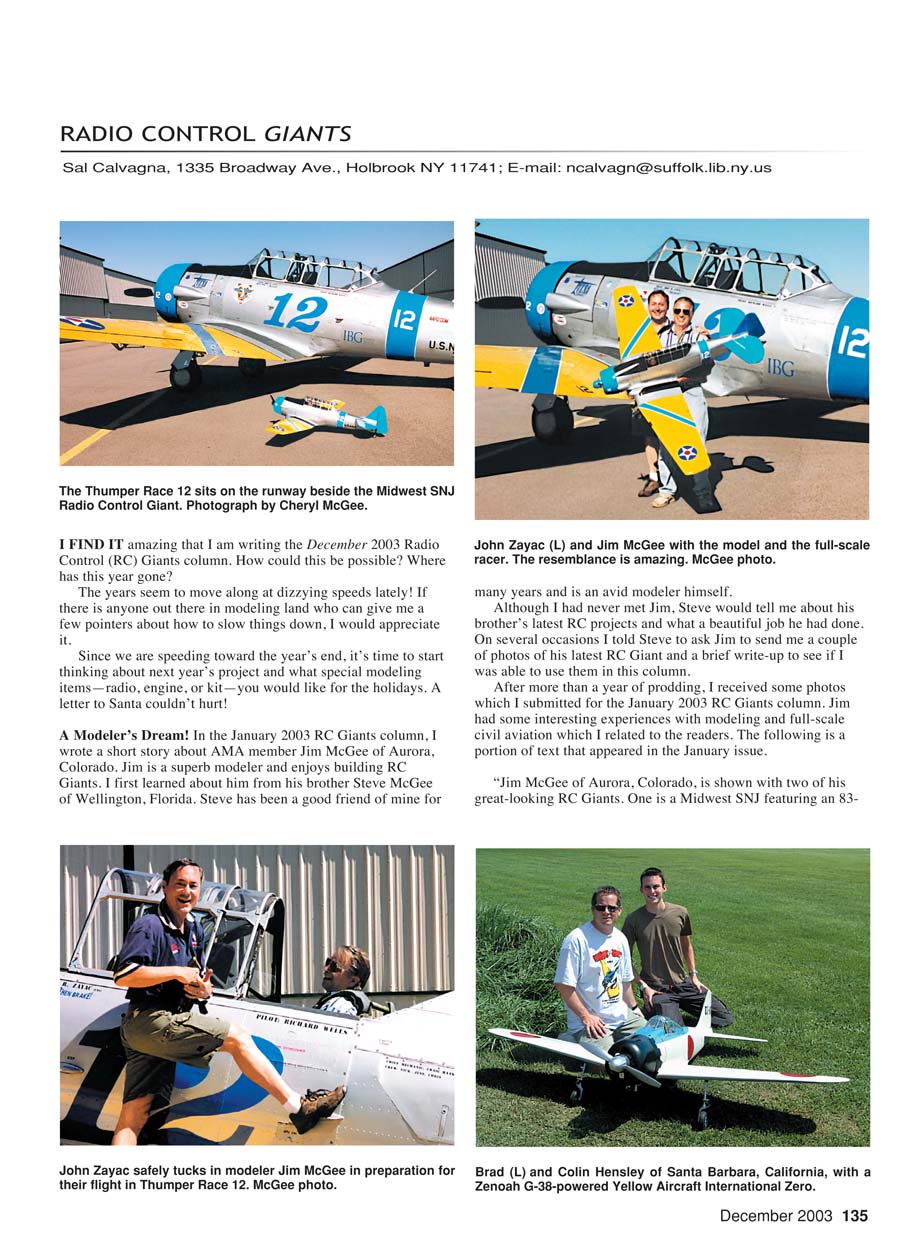
Jim McGee of Aurora, Colorado, is shown with two of his great-looking RC Giants. One is a Midwest SNJ featuring an 83-inch wingspan, powered by an O.S. 1.60, with Robart retracts, and covered in UltraCote. The all-up weight is 12 pounds.
Jim has a great technique using UltraCote to add all those panel lines. He cuts the UltraCote in 3/64-inch strips to imitate the panel lines. He has done an excellent job building and finishing this model, and it has already won three trophies including Pilots' Choice, People's Choice, and first place in Best World War II Aircraft.
The color scheme is that of a full-scale Reno racer that was forced to make an emergency landing on Colorado Boulevard in Highlands Ranch, Colorado, while en route to the Reno National Championship Air Races a few years ago. The aircraft’s radial engine was repaired on-site and remarkably flew out again!
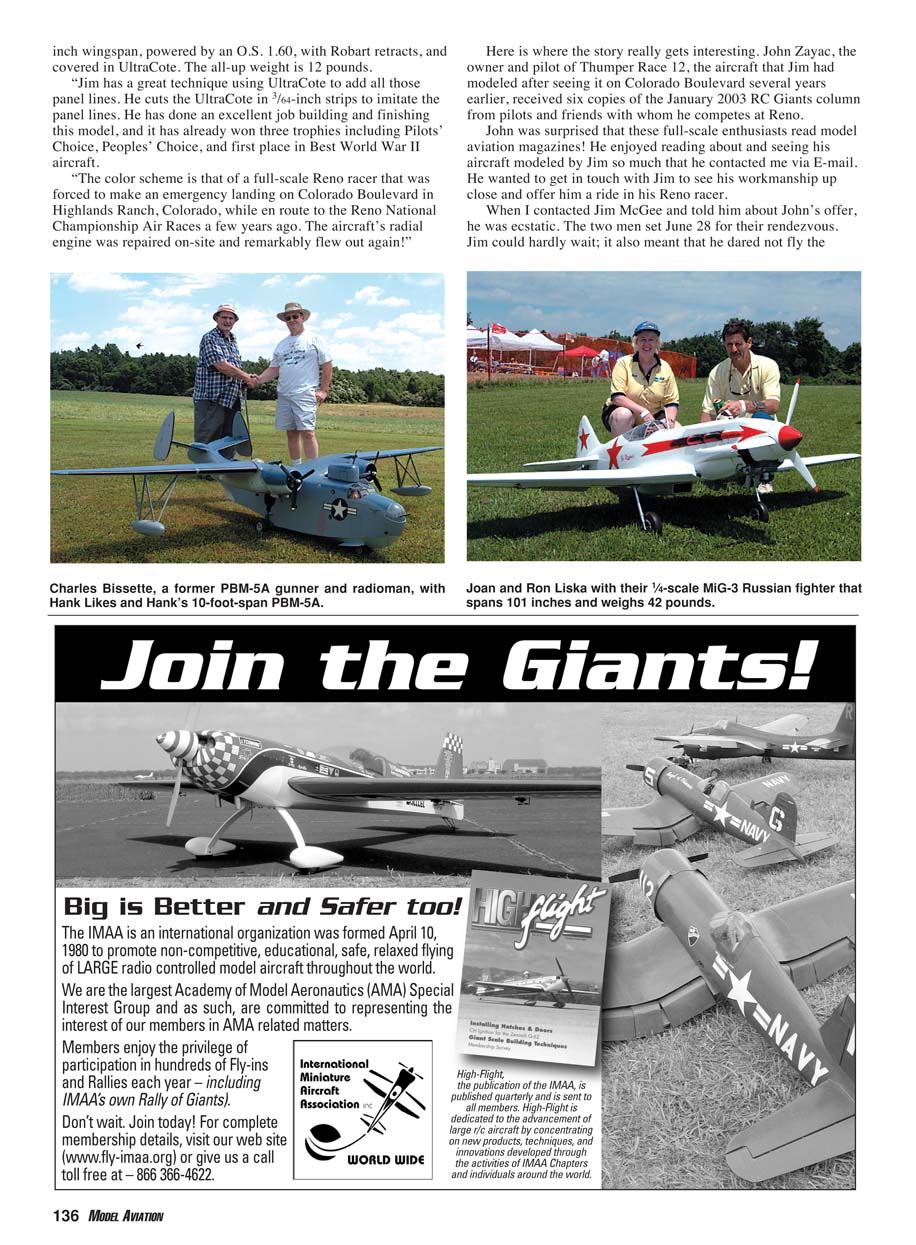
Here is where the story really gets interesting. John Zayac, the owner and pilot of Thumper Race 12, the aircraft that Jim had modeled after seeing it on Colorado Boulevard several years earlier, received six copies of the January 2003 RC Giants column from pilots and friends with whom he competes at Reno. John was surprised that these full-scale enthusiasts read model aviation magazines! He enjoyed reading about and seeing his aircraft modeled by Jim so much that he contacted me via e-mail. He wanted to get in touch with Jim to see his workmanship up close and offer him a ride in his Reno racer.
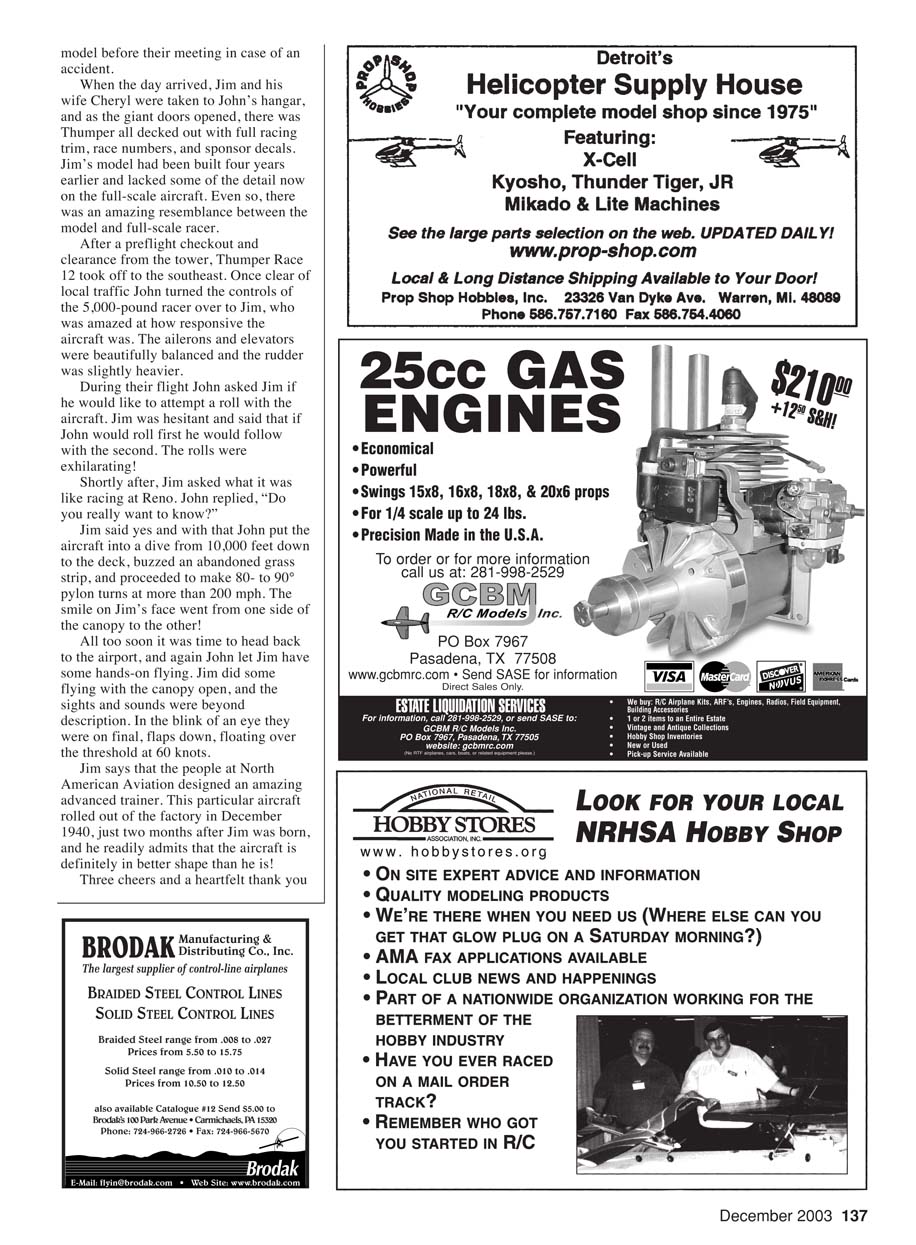
When I contacted Jim McGee and told him about John’s offer, he was ecstatic. The two men set June 28 for their rendezvous. Jim could hardly wait; it also meant that he dared not fly the model before their meeting in case of an accident.
When the day arrived, Jim and his wife Cheryl were taken to John's hangar, and as the giant doors opened, there was Thumper all decked out with full racing trim, race numbers, and sponsor decals. Jim's model had been built four years earlier and lacked some of the detail now on the full-scale aircraft. Even so, there was an amazing resemblance between the model and full-scale racer.
After a preflight checkout and clearance from the tower, Thumper Race 12 took off to the southeast. Once clear of local traffic John turned the controls of the 5,000-pound racer over to Jim, who was amazed at how responsive the aircraft was. The ailerons and elevators were beautifully balanced and the rudder was slightly heavier.
During their flight John asked Jim if he would like to attempt a roll with the aircraft. Jim was hesitant and said that if John would roll first he would follow with the second. The rolls were exhilarating!
Shortly after, Jim asked what it was like racing at Reno. John replied, "Do you really want to know?"
Jim said yes and with that John put the aircraft into a dive from 10,000 feet down to the deck, buzzed an abandoned grass strip, and proceeded to make 80- to 90-degree pylon turns at more than 200 mph. The smile on Jim's face went from one side of the canopy to the other!
All too soon it was time to head back to the airport, and again John let Jim have some hands-on flying. Jim did some flying with the canopy open, and the sights and sounds were beyond description. In the blink of an eye they were on final, flaps down, floating over the threshold at 60 knots.
Jim says that the people at North American Aviation designed an amazing advanced trainer. This particular aircraft rolled out of the factory in December 1940, just two months after Jim was born, and he readily admits that the aircraft is definitely in better shape than he is!
Three cheers and a heartfelt thank you to John Zayac for a day Jim will never forget. You gave the thrill of a lifetime to a fellow modeler.
Scale model building is a love for many of us. The military subjects are steeped in history, and unlike full-scale aircraft, we are able to build and fly airplanes that are no longer found anywhere. So much history; so many aircraft; so little time. You are certainly an inspiration, John. Good luck at the races and thanks again!
The Delaware RC Club hosted a great weekend of flying at Lums Pond State Park July 10–13, 2003, with its 12th annual Warbirds Over Delaware. More than 200 military models—from the earliest string bags of World War I to Desert Storm–era jets—were present.
This year, attendees came from as far as California and Florida. There was even one misguided chap from England who insisted that we were still colonists! The continued success of this event is certainly owed to the stellar performance of all of the Delaware RC Club volunteers. You can visit the club's Web site at www.delawarerc.org/warbirds.htm.
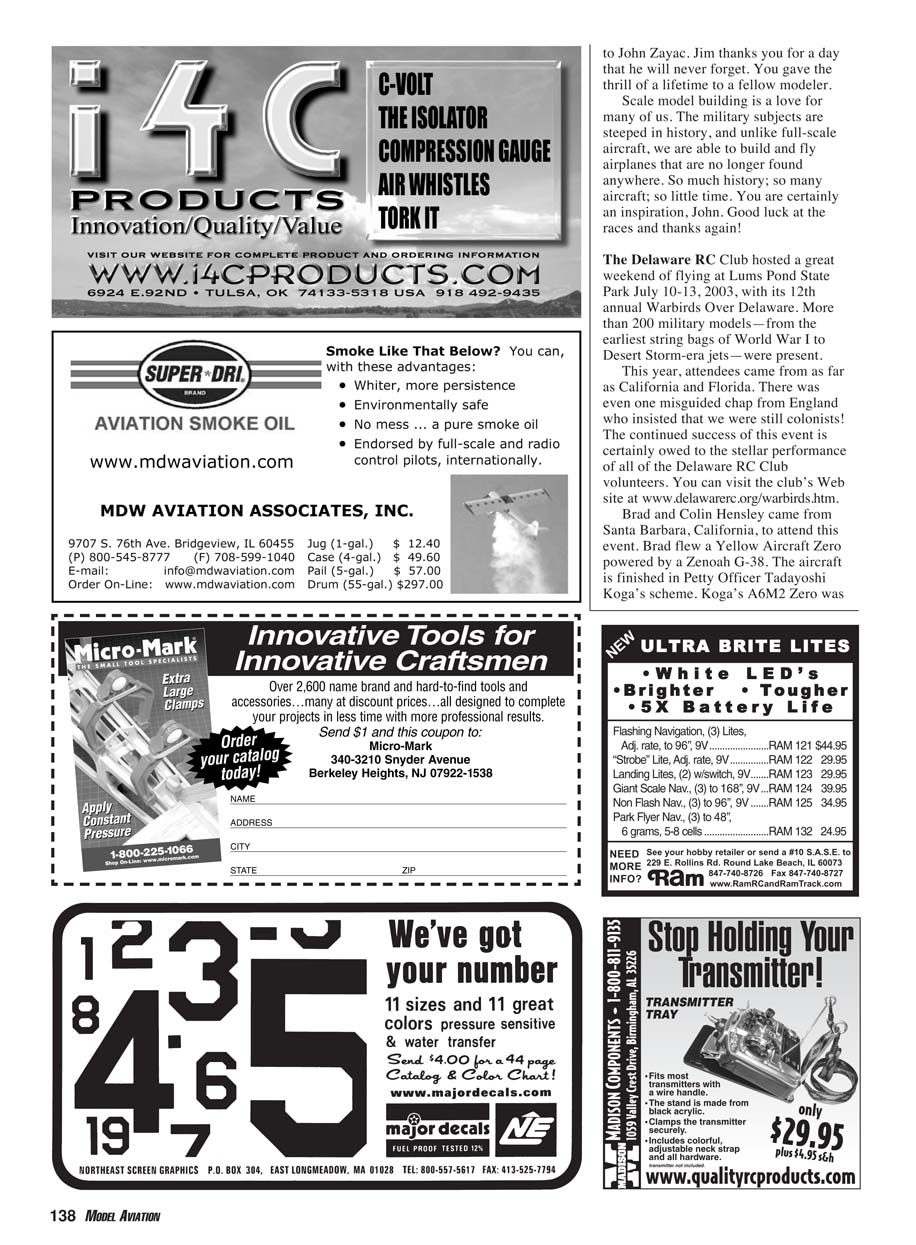
Brad and Colin Hensley came from Santa Barbara, California, to attend this event. Brad flew a Yellow Aircraft Zero powered by a Zenoah G-38. The aircraft is finished in Petty Officer Tadayoshi Koga's scheme. Koga's A6M2 Zero was the first airplane flown and tested by U.S. pilots who dispelled the myth of the great Zero.
On June 3, 1942, Petty Officer Koga attempted an emergency landing on the bleak marshes of Akutan Island in the Aleutians after he found that he was losing fuel from bullet holes. The airplane flipped over on its back during the landing and Koga's neck was broken. Five weeks later an American Naval scouting party found the Japanese fighter upside-down in the marsh, the dead pilot still hanging in his straps.
Koga's A6M2 was only slightly damaged, and it was packed up and shipped to the United States. This was one of the greatest finds of the Pacific War since it enabled American intelligence to make a detailed study of the Zero, which was still running wild throughout the Pacific.
Koga's Zero was repaired, flown, and went through an exhaustive series of tests to gain information about its strengths and weaknesses. The tests revealed the fighter's faults and finally shattered the aura of myth that had surrounded it.
That's all for this month. Remember, now is the time to start planning for next year's RC Giant project. Keep sending in those photos—even if it is a work in progress.
Take care and fly safely.
Sal Calvagna
Transcribed from original scans by AI. Minor OCR errors may remain.

