
RADIO CONTROL GIANTS
Sal Calvagna 1335 Broadway Ave., Holbrook NY 11741 E-mail: [email protected]
WELCOME to the June RC Giants column. This month you will read about two great products designed for larger models. In addition, three of our fellow AMA members who enjoy building and flying RC Giants will be featured.
I planned to write the final report on the finishing touches and test flight of the Kangke (SuperKraft) Rearwin Speedster ARF for this column. Because of the extreme winter weather that has plagued the Northeast this past month, I have not been able to test-fly the model. (My June column is actually written in late January and submitted to Model Aviation in early February.)
The aircraft is ready to go, and if weather permits, keep an eye out for the Rearwin in an upcoming column.
Solo Adjustable-Pitch Propellers
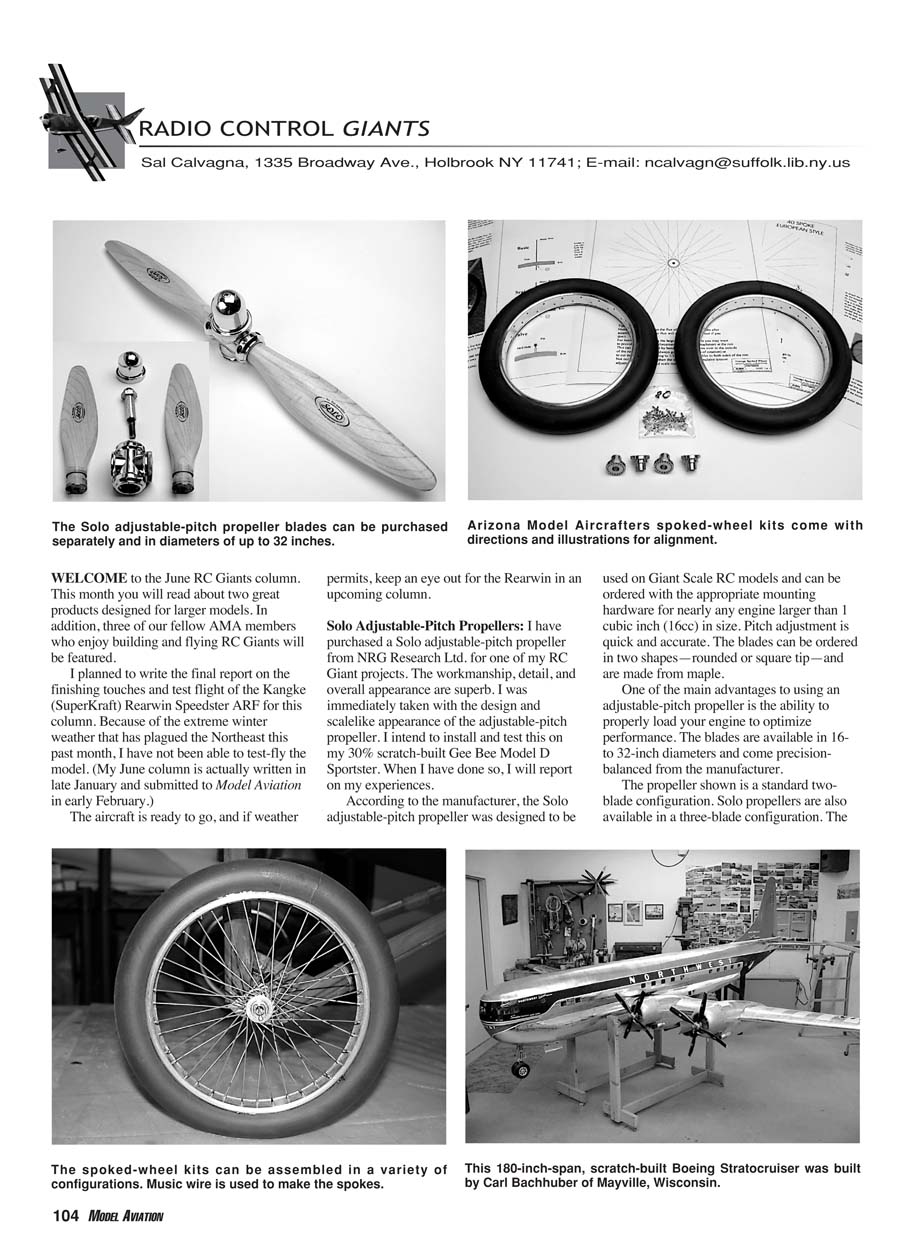
I have purchased a Solo adjustable-pitch propeller from NRG Research Ltd. for one of my RC Giant projects. The workmanship, detail, and overall appearance are superb. I was immediately taken with the design and scale-like appearance of the adjustable-pitch propeller. I intend to install and test this on my 30% scratch-built Gee Bee Model D Sportster. When I have done so, I will report on my experiences.
According to the manufacturer, the Solo adjustable-pitch propeller was designed to be used on Giant Scale RC models and can be ordered with the appropriate mounting hardware for nearly any engine larger than 1 cubic inch (16 cc) in size. Pitch adjustment is quick and accurate. The blades can be ordered in two shapes—rounded or square tip—and are made from maple. One of the main advantages to using an adjustable-pitch propeller is the ability to properly load your engine to optimize performance. The blades are available in 16- to 32-inch diameters and come precision-balanced from the manufacturer.
The propeller shown is a standard two-blade configuration. The two-blade assembly ranges in price from $105 for the 16-inch-diameter blade to $137 for the 32-inch-diameter one. The three-blade assembly costs between $138.50 and $186.50. For more information regarding the Solo adjustable-pitch propeller, write directly to the manufacturer at NRG Research Ltd., 7490 L & A Rd., Vernon, BC, Canada V1B 3S4, or call the company at (250) 549-7134. You can visit the Solo Web site at www.soloprops.com.
Spoked Wheels — Arizona Model Aircrafters
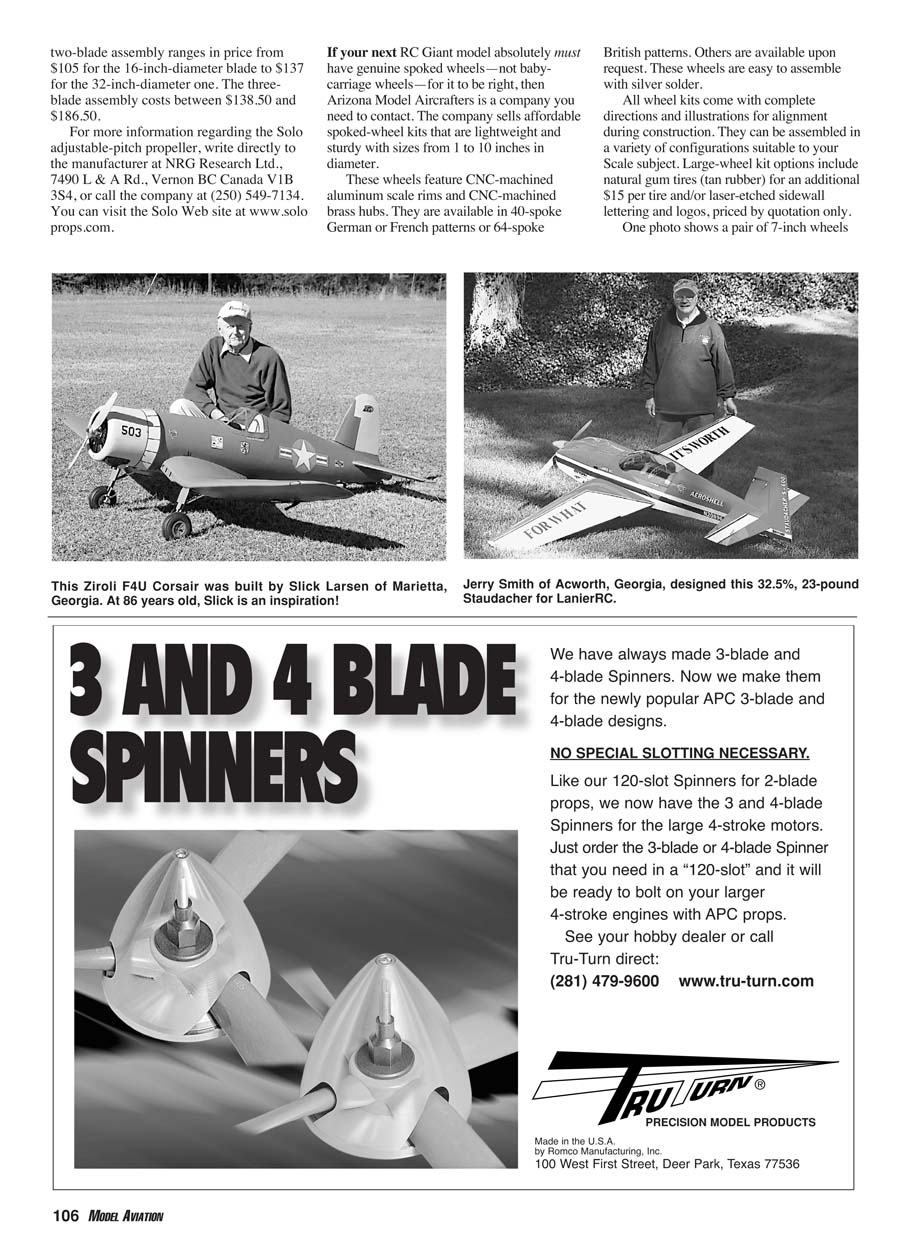
If your next RC Giant model absolutely must have genuine spoked wheels—not baby-carriage wheels—for it to be right, then Arizona Model Aircrafters is a company you need to contact. The company sells affordable spoked-wheel kits that are lightweight and sturdy, with sizes from 1 to 10 inches in diameter. These wheels feature CNC-machined aluminum scale rims and CNC-machined brass hubs. They are available in 40-spoke German or French patterns or 64-spoke British patterns. Other patterns are available upon request.
These wheels are easy to assemble with silver solder. All wheel kits come with complete directions and illustrations for alignment during construction. They can be assembled in a variety of configurations suitable to your scale subject.
Large-wheel kit options include:
- Natural gum tires (tan rubber) for an additional $15 per tire.
- Laser-etched sidewall lettering and logos, priced by quotation.
The kits arrive unassembled. All that is needed to complete the wheel is the appropriate size of music wire used to make the spokes and some silver solder. The completed spoked wheels are not difficult to assemble and require only a couple hours of soldering.
For more information about the Arizona Model Aircrafters wheel kits or other products, contact the company at (480) 348-3733; visit the Web site at www.arizonamodels.com; or write to Airpark Plaza, 14715 N. 78th Way Unit 600, Scottsdale, AZ 85260.
Giant Boeing Stratocruiser
Carl Bachhuber of Mayville, Wisconsin, has done it again with his latest super Giant model. This time Carl has built a 180-inch-wingspan version of a Boeing Model 377 Stratocruiser.
The aircraft is 140 inches long and is powered by four Zenoah G-26 engines. It has scratch-built retracts, Robart brakes, and huge Fowler flaps. Construction is standard, utilizing balsa, light plywood, epoxy, and cloth covering. After sanding and priming, Carl used a polyester Mylar tape burnished to simulate aluminum panels. Carl drew the plans using the ModelCad program. The airplane weighs 81 pounds.
AMA regulations limit RC models to 55 pounds, but a special waiver for flight demonstrations by aircraft that weigh as much as 100 pounds can be obtained. These aircraft receive close inspection and must be signed off on in order to be flown at AMA events.
For more information about Carl’s other fantastic RC Giants, visit his Web site at www.carlb-rcplanes.com.
Slick Corsair
Slick Larsen of Marietta, Georgia, is shown with his Ziroli F4U Corsair. The model is powered by a Zenoah G-62 gas engine and weighs 26 pounds.
Slick is one of the oldest practicing RC Giant modelers in the United States. At age 86, he builds and flies his own models with the passion of people decades younger.
What drives Slick is the need for something to keep him busy. He owns more than 50 Giant Scale models that he keeps in his basement, including the first one he ever built. Slick has become a fan of the Nick Ziroli Giant Scale designs. He owns five of Nick’s designs and is working on a Grumman Hellcat.
Slick has his own special way of building. A trip to the lumber company nets him a plank of hardwood which he saws into sticks for stringers and longerons. All of the airplanes with round fuselages are built on a stick (crutch). A long stick is supported on both ends, and the fuselage bulkheads are temporarily glued and spaced properly along the stick. Then stringers are added to support the bulkheads and add shape.
The completed fuselage is planked using white glue. Once framed and sheeted, the bulkhead supports are cut loose and the stick is removed. Slick calls this method “building on a stick.”
All of Slick’s airplanes are covered with lightweight Ceconite that is adhered to the airframe with Balsarite. When the covering is shrunk, a coat of dope mixed with talcum powder is applied to fill the weave in the cloth. He uses several coats of colored dope to finish the model.
Thanks for being an inspiration for all Giant Scale modelers, Slick!
Jerry Smith and the 32.5% Staudacher
Jerry Smith of Acworth, Georgia, is shown with his 32.5% Staudacher that he designed for LanierRC. The Staudacher is a built-up, laser-cut kit powered by a Zenoah GT-80. It weighs 23 pounds.
Jerry has designed many airplanes for LanierRC during the last 14 years. One of his most popular designs is the Stinger series that has sold thousands. Many of his designs are also available as ARFs.
In addition to his model designs, Jerry has been photographing and writing about models for many years. His kit reviews, event coverages, and cover photographs have graced the pages of hobby magazines for many years. Jerry also authors the “For What It’s Worth” column in R/C Modeler magazine.
Jerry proudly notes that he has been involved with model airplanes since he was 10 years old, has been flying RC since 1956, and confesses that modeling remains his passion. It is a pleasure to see Jerry on the flying line. Keep up the good work!
I have surpassed my allotted word count, so it’s time to end. Stay well and please don’t fly alone. It’s always better if you bring a friend to share the experience.
See you next month. MA
Transcribed from original scans by AI. Minor OCR errors may remain.

