
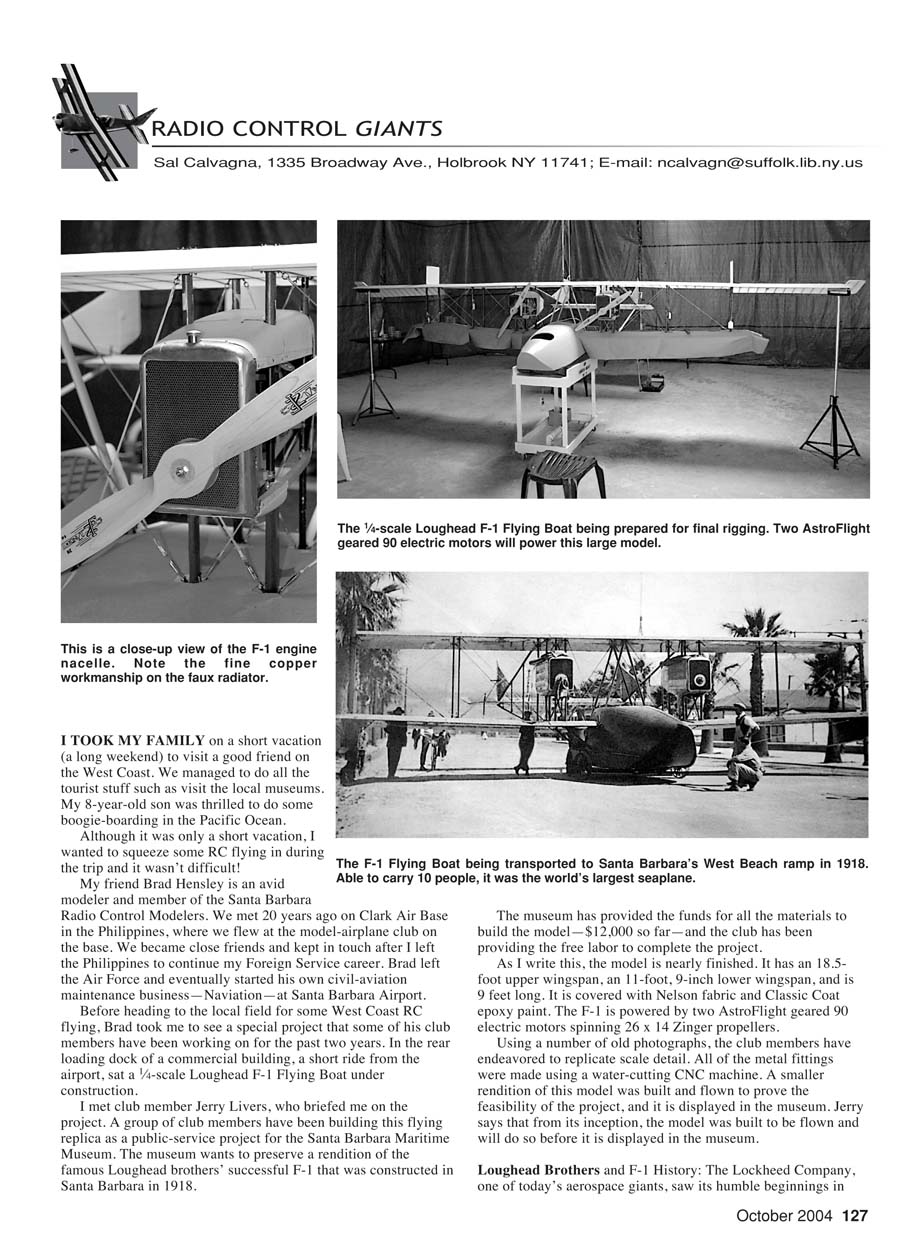
RADIO CONTROL GIANTS
Sal Calvagna, 1335 Broadway Ave., Holbrook NY 11741; E-mail: [email protected]
Trip and field visit
I took my family on a short vacation (a long weekend) to visit a good friend on the West Coast. We managed to do all the tourist stuff, such as visit the local museums. My 8-year-old son was thrilled to do some boogie-boarding in the Pacific Ocean.
Although it was only a short vacation, I wanted to squeeze some RC flying in during the trip, and it wasn’t difficult.
My friend Brad Hensley is an avid modeler and member of the Santa Barbara Radio Control Modelers. We met 20 years ago on Clark Air Base in the Philippines, where we flew at the model-airplane club on the base. We became close friends and kept in touch after I left the Philippines to continue my Foreign Service career. Brad left the Air Force and eventually started his own civil-aviation maintenance business—Naviation—at Santa Barbara Airport.
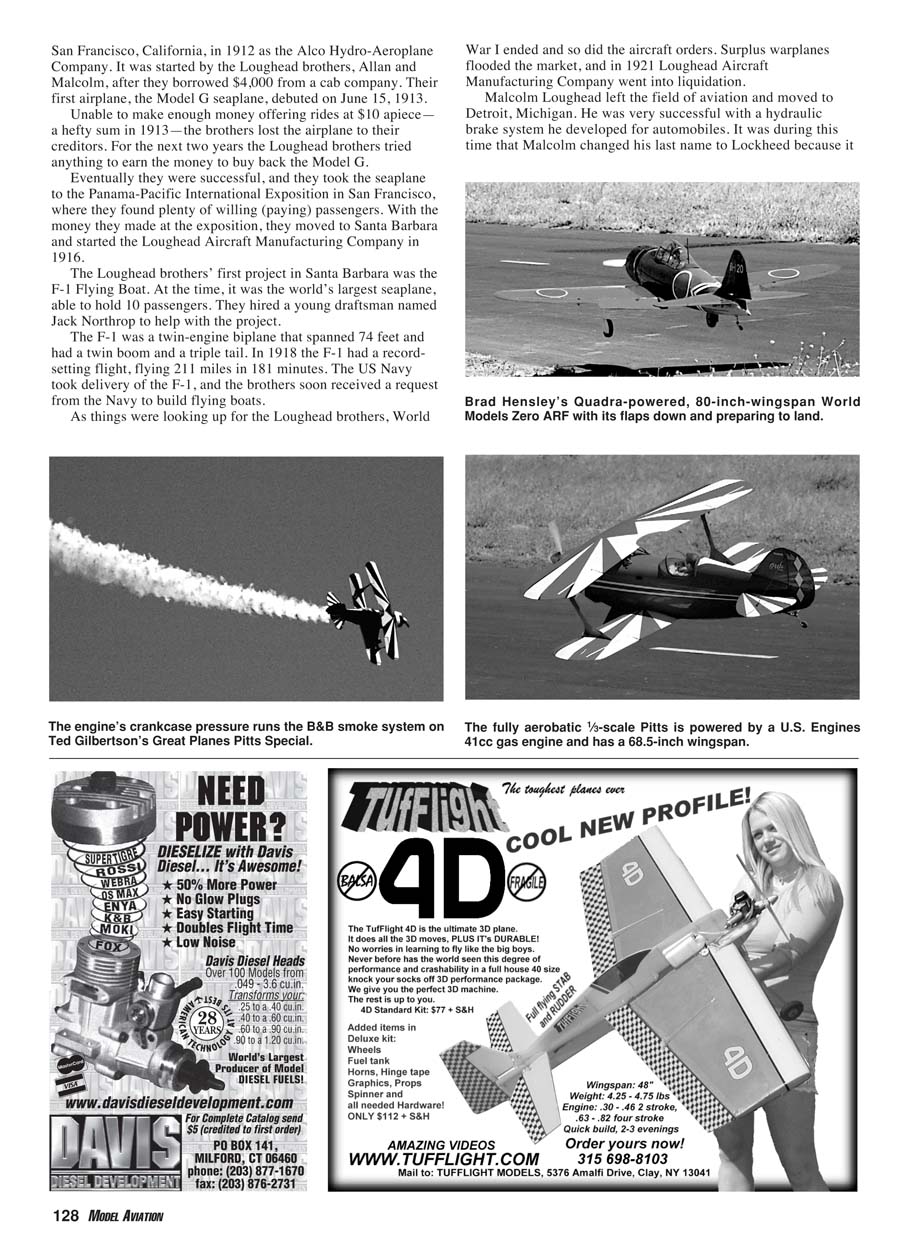
Before heading to the local field for some West Coast RC flying, Brad took me to see a special project that some of his club members have been working on for the past two years. In the rear loading dock of a commercial building, a short ride from the airport, sat a 1/4-scale Loughead F-1 Flying Boat under construction.
F-1 replica project
I met club member Jerry Livers, who briefed me on the project. A group of club members have been building this flying replica as a public-service project for the Santa Barbara Maritime Museum. The museum wants to preserve a rendition of the famous Loughead brothers’ successful F-1 that was constructed in Santa Barbara in 1918.
The museum has provided the funds for all the materials to build the model—$12,000 so far—and the club has been providing the free labor to complete the project.
As I write this, the model is nearly finished. Using a number of old photographs, the club members have endeavored to replicate scale detail. All of the metal fittings were made using a water-cutting CNC machine. A smaller rendition of this model was built and flown to prove the feasibility of the project, and it is displayed in the museum. Jerry says that from its inception, the model was built to be flown and will do so before it is displayed in the museum.
F-1 replica specifications
- Scale: 1/4-scale Loughead F-1 Flying Boat
- Length: 9 feet
- Upper wingspan: 18.5 feet
- Lower wingspan: 11 feet 9 inches
- Covering/finish: Nelson fabric and Classic Coat epoxy paint
- Power: two AstroFlight geared 90 electric motors
- Propellers: 26 x 14 Zinger propellers
Loughead brothers and F-1 history
The Lockheed Company, one of today’s aerospace giants, saw its humble beginnings in San Francisco in 1912 as the Alco Hydro-Aeroplane Company. It was started by the Loughead brothers, Allan and Malcolm, after they borrowed $4,000 from a cab company. Their first airplane, the Model G seaplane, debuted on June 15, 1913. Unable to make enough money offering rides at $10 apiece—a hefty sum in 1913—the brothers lost the airplane to their creditors.
For the next two years the Loughead brothers tried anything to earn the money to buy back the Model G. Eventually they were successful, and they took the seaplane to the Panama-Pacific International Exposition in San Francisco, where they found plenty of willing (paying) passengers. With the money they made at the exposition, they moved to Santa Barbara and started the Loughead Aircraft Manufacturing Company in 1916.
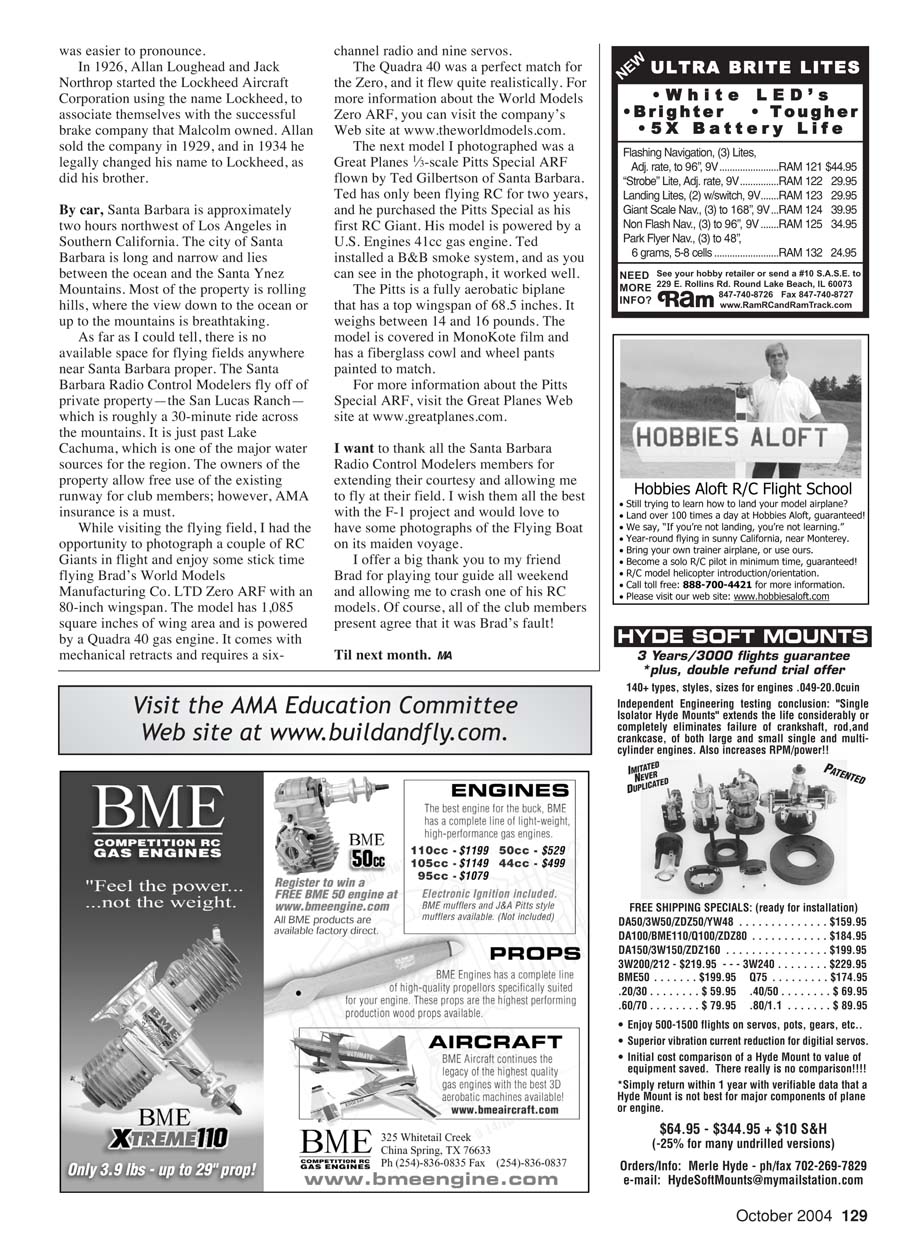
The Loughead brothers' first project in Santa Barbara was the F-1 Flying Boat. At the time, it was the world's largest seaplane, able to hold 10 passengers. They hired a young draftsman named Jack Northrop to help with the project.
The F-1 was a twin-engine biplane that spanned 74 feet and had a twin boom and a triple tail. In 1918 the F-1 had a record-setting flight, flying 211 miles in 181 minutes. The US Navy took delivery of the F-1, and the brothers soon received a request from the Navy to build flying boats.
As things were looking up for the Loughead brothers, World War I ended and so did the aircraft orders. Surplus warplanes flooded the market, and in 1921 Loughead Aircraft Manufacturing Company went into liquidation.
Malcolm Loughead left the field of aviation and moved to Detroit, Michigan. He was very successful with a hydraulic brake system he developed for automobiles. It was during this time that Malcolm changed his last name to Lockheed because it was easier to pronounce.
In 1926, Allan Loughead and Jack Northrop started the Lockheed Aircraft Corporation using the name Lockheed, to associate themselves with the successful brake company that Malcolm owned. Allan sold the company in 1929, and in 1934 he legally changed his name to Lockheed, as did his brother.
Santa Barbara and the flying field
By car, Santa Barbara is approximately two hours northwest of Los Angeles in Southern California. The city is long and narrow and lies between the ocean and the Santa Ynez Mountains. Most of the property is rolling hills, where the view down to the ocean or up to the mountains is breathtaking.
As far as I could tell, there is no available space for flying fields anywhere near Santa Barbara proper. The Santa Barbara Radio Control Modelers fly off private property—the San Lucas Ranch—which is roughly a 30-minute ride across the mountains. It is just past Lake Cachuma, one of the major water sources for the region. The owners of the property allow free use of the existing runway for club members; however, AMA insurance is a must.
RC Giants at the field
While visiting the flying field, I had the opportunity to photograph a couple of RC Giants in flight and enjoy some stick time flying Brad's World Models Manufacturing Co. LTD Zero ARF with an 80-inch wingspan. The model has 1,085 square inches of wing area and is powered by a Quadra 40 gas engine. It comes with mechanical retracts and requires a six-channel radio and nine servos.
The Quadra 40 was a perfect match for the Zero, and it flew quite realistically. For more information about the World Models Zero ARF, visit the company's website at www.theworldmodels.com.
The next model I photographed was a Great Planes 1/3-scale Pitts Special ARF flown by Ted Gilbertson of Santa Barbara. Ted has only been flying RC for two years, and he purchased the Pitts Special as his first RC Giant. His model is powered by a U.S. Engines 41cc gas engine. Ted installed a B&B smoke system, and as you can see in the photograph, it worked well.
The Pitts is a fully aerobatic biplane that has a top wingspan of 68.5 inches and weighs between 14 and 16 pounds. The model is covered in MonoKote film and has a fiberglass cowl and wheel pants painted to match.
For more information about the Pitts Special ARF, visit the Great Planes website at www.greatplanes.com.
Thanks
I want to thank all the Santa Barbara Radio Control Modelers members for extending their courtesy and allowing me to fly at their field. I wish them all the best with the F-1 project and would love to have some photographs of the Flying Boat on its maiden voyage.
I offer a big thank you to my friend Brad for playing tour guide all weekend and allowing me to crash one of his RC models. Of course, all of the club members present agree that it was Brad's fault!
’Til next month. MA
Transcribed from original scans by AI. Minor OCR errors may remain.

