
RADIO CONTROL GIANTS
Sal Calvagna 1335 Broadway Ave., Holbrook, NY 11741 E-mail: [email protected]
On May 8, 2004, the Prince George's Radio Control (PGRC) club held its 12th annual International Miniature Aircraft Association (IMAA) Giant Scale event. Since I had planned to be in the area visiting relatives, I made it a point to attend.
The PGRC field is located in Bowie, Maryland, roughly midway between Baltimore and Washington, D.C. The field has a 40- x 400-foot paved runway and a 100- x 800-foot grass strip.
According to those with whom I spoke, cool temperatures and gusty winds resulted in lower-than-usual attendance this year. My estimate put the number of models at approximately 30, but even so there were a number of great-looking airplanes. Despite the weather, a hearty few took to the air to please those present. Following is a sampling of some of the neat models in attendance.
Setzler Air Camper
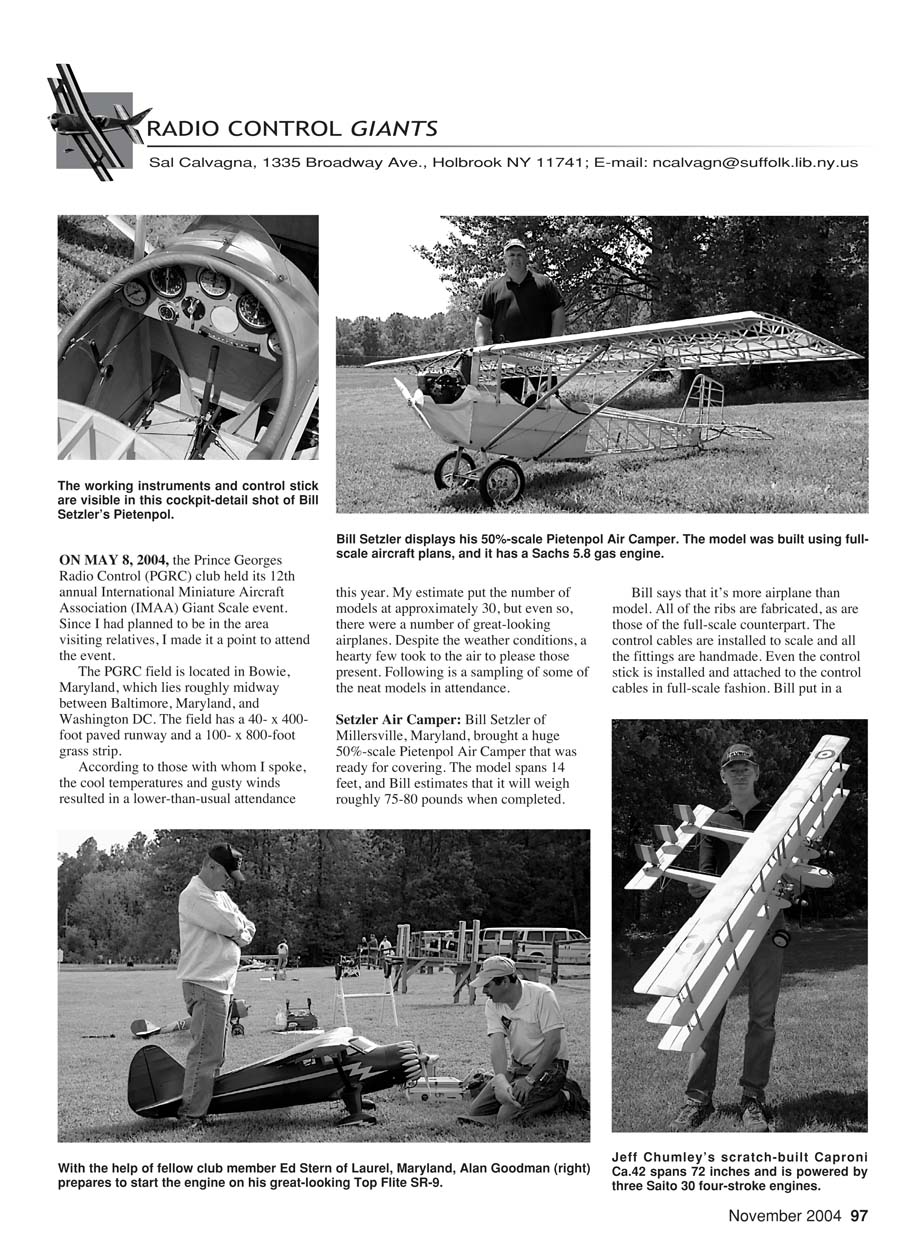
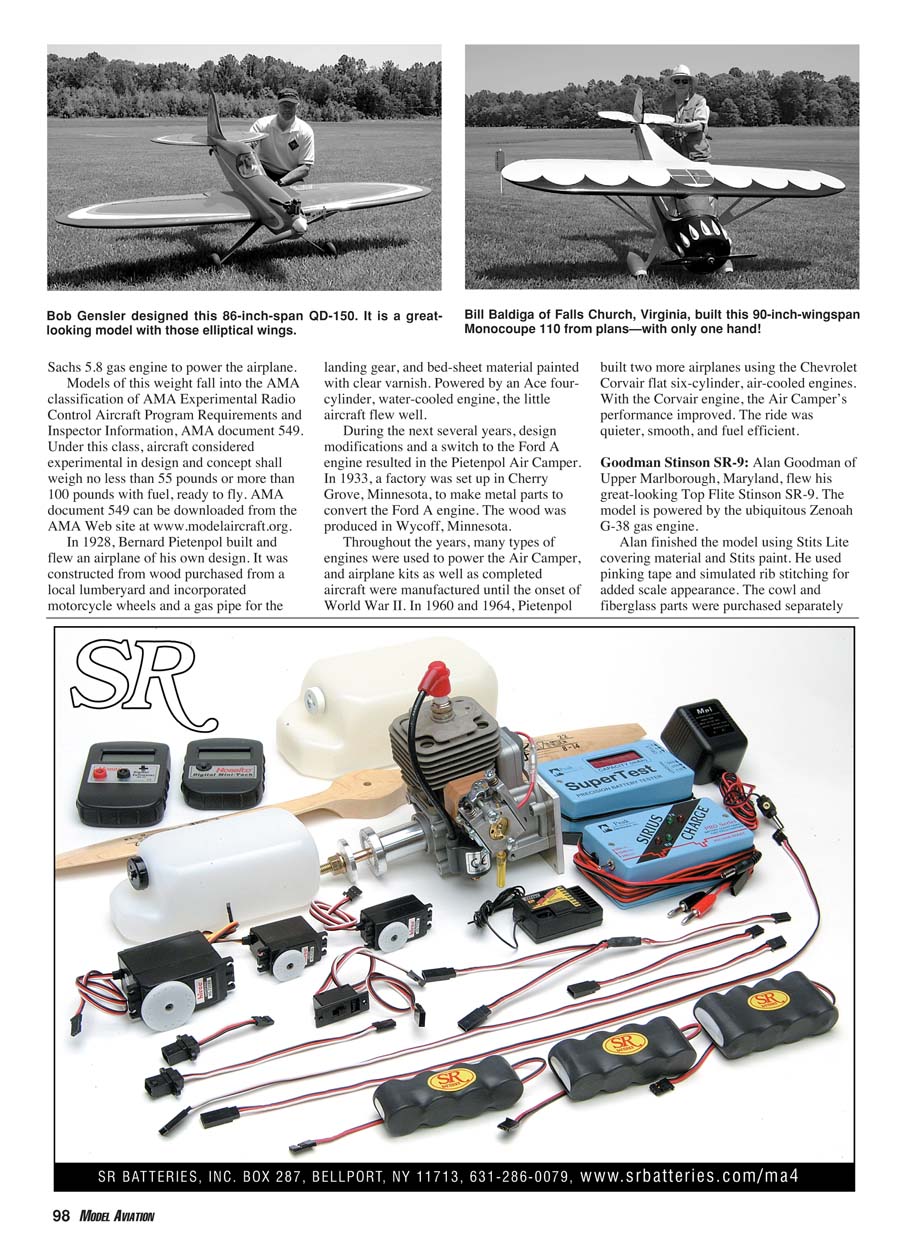
Bill Setzler of Millersville, Maryland, brought a huge 50%-scale Pietenpol Air Camper that was ready for covering. The model spans 14 feet, and Bill estimates it will weigh roughly 75–80 pounds when completed. Bill says that it's more airplane than model. All of the ribs are fabricated, as are those of the full-scale counterpart. The control cables are installed to scale and all the fittings are handmade. Even the control stick is installed and attached to the control cables in full-scale fashion. Bill installed a Sachs 5.8 gas engine to power the airplane.
Models of this weight fall into the AMA classification of AMA Experimental Radio Control Aircraft Program Requirements and Inspector Information, AMA document 549. Under this class, aircraft considered experimental in design and concept shall weigh no less than 55 pounds or more than 100 pounds with fuel, ready to fly. AMA document 549 can be downloaded from the AMA web site at www.modelaircraft.org.
In 1928, Bernard Pietenpol built and flew an airplane of his own design constructed from wood purchased at a local lumberyard and incorporating motorcycle wheels and a gas pipe for the landing gear, and bed-sheet material painted with clear varnish. Powered by an Ace four-cylinder, water-cooled engine, the little aircraft flew well. Over the next several years, design modifications and a switch to the Ford A engine resulted in the Pietenpol Air Camper. In 1933, a factory was set up in Cherry Grove, Minnesota, to make metal parts to convert the Ford A engine. The wood was produced in Wycoff, Minnesota. Throughout the years, many types of engines were used to power the Air Camper, and airplane kits as well as completed aircraft were manufactured until the onset of World War II. In 1960 and 1964, Pietenpol built two more airplanes using the Chevrolet Corvair flat six-cylinder, air-cooled engines. With the Corvair engine, the Air Camper's performance improved: the ride was quieter, smoother, and more fuel efficient.
Goodman Stinson SR-9
Alan Goodman of Upper Marlboro, Maryland, flew his great-looking Top Flite Stinson SR-9. The model is powered by the ubiquitous Zenoah G-38 gas engine. Alan finished the model using Stits Lite covering material and Stits paint. He used pinking tape and simulated rib stitching for added scale appearance. The cowl and fiberglass parts were purchased from Stan's Fiber Tech. The paint scheme was copied from an SR-9 based at Albany, New York. The model flew well and had power to spare with the G-38.
In 1911, Edward "Eddie" Stinson used his life savings of $500 for flight instruction at the Wright brothers' Dayton, Ohio, flight school. He founded the Stinson Aircraft Company in Dayton in 1920 and moved operations to Detroit, Michigan, in 1925.
During the next three decades, more than 13,000 aircraft would carry the Stinson name; however, Eddie Stinson did not live to enjoy the full success of his company. He died on January 26, 1932, in an airplane crash. He had accrued 16,000 hours of flight time, which was more than any other pilot had acquired at that time.
Between 1933 and 1941, the Stinson Aircraft Company delivered 1,327 Reliants—ranging from the SR-1 through the SR-10—with each variation building upon its predecessor with upgraded engines and design refinements. They were rugged aircraft, powered by radial engines, that carried three or four passengers at nearly 165 mph. Pilots liked the airplane's durability, safety, and stability. Passengers appreciated the comfortable ride. The Reliant's high price precluded widespread private ownership, but corporations and commuter airlines eagerly purchased it because of its speed, amenities, and styling. The Reliant was one of the last tail-draggers built.
Chumley Caproni Ca.42
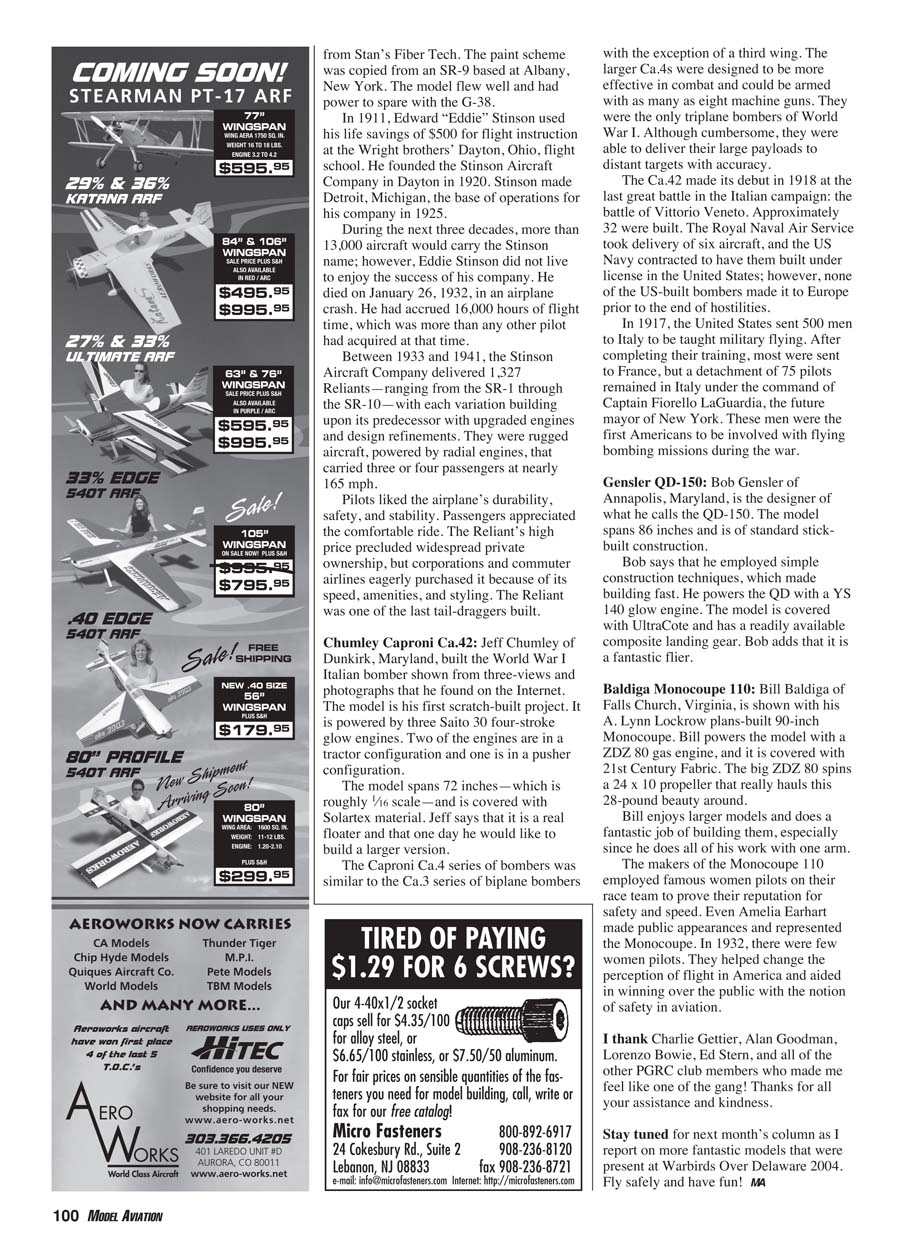
Jeff Chumley of Dunkirk, Maryland, built the World War I Italian bomber from three-views and photographs he found on the Internet. The model is his first scratch-built project. It is powered by three Saito 30 four-stroke glow engines—two in tractor configuration and one in pusher configuration.
The model spans 72 inches, roughly 1/6 scale, and is covered with Solartex material. Jeff says it is a real floater and that one day he would like to build a larger version.
The Caproni Ca.4 series of bombers was similar to the Ca.3 series of biplane bombers except for a third wing. The larger Ca.4s were designed to be more effective in combat and could be armed with as many as eight machine guns. They were the only triplane bombers of World War I. Although cumbersome, they were able to deliver large payloads to distant targets with accuracy.
The Ca.42 made its debut in 1918 at the Battle of Vittorio Veneto. Approximately 32 were built. The Royal Naval Air Service took delivery of six aircraft, and the US Navy contracted to have them built under license in the United States; however, none of the US-built bombers made it to Europe prior to the end of hostilities.
In 1917, the United States sent 500 men to Italy to be taught military flying. After completing their training, most were sent to France, but a detachment of 75 pilots remained in Italy under the command of Captain Fiorello LaGuardia, the future mayor of New York. These men were the first Americans to be involved with flying bombing missions during the war.
Gensler QD-150
Bob Gensler of Annapolis, Maryland, is the designer of what he calls the QD-150. The model spans 86 inches and is of standard stick-built construction. Bob says he employed simple construction techniques, which made building fast. He powers the QD with a YS 140 glow engine. The model is covered with UltraCote and has a readily available composite landing gear. Bob adds that it is a fantastic flier.
Baldiga Monocoupe 110
Bill Baldiga of Falls Church, Virginia, is shown with his A. Lynn Lockrow plans-built 90-inch Monocoupe. Bill powers the model with a ZDZ 80 gas engine, and it is covered with 21st Century Fabric. The big ZDZ 80 spins a 24 x 10 propeller that really hauls this 28-pound beauty around.
Bill enjoys larger models and does a fantastic job of building them, especially since he does all of his work with one arm.
The makers of the Monocoupe 110 employed famous women pilots on their race team to prove the airplane's reputation for safety and speed. Even Amelia Earhart made publicity appearances and represented the Monocoupe. In 1932, there were few women pilots; they helped change the perception of flight in America and aided in winning over the public with the notion of safety in aviation.
I thank Charlie Gettier, Alan Goodman, Lorenzo Bowie, Ed Stern, and all of the other PGRC club members who made me feel like one of the gang. Thanks for all your assistance and kindness.
Stay tuned for next month's column as I report on more fantastic models that were present at Warbirds Over Delaware 2004. Fly safely and have fun!
Transcribed from original scans by AI. Minor OCR errors may remain.

