


RADIO CONTROL GIANTS
Sal Calvagna 1335 Broadway Ave., Holbrook, NY 11741 E-mail: [email protected]
Gender and the Hobby
It is no secret that the hobby/sport of aeromodeling is dominated by males. Even fewer females are involved with Giant Scale. Why? Could the answer involve nature or nurture?
I believe it starts at birth. Generally, boys are encouraged to associate with toy airplanes, army men, action figures, and other so-called masculine stuff at a young age. Girls receive dolls, tea sets, and costume jewelry—things that are labeled feminine. Somewhere in history people considered model airplanes “masculine” and that message stuck.
Role models such as aerobatics pilot Patty Wagstaff may have an effect on women’s interest in RC; there is even a popular ARF modeled after her Extra 300S. If more women were attracted to aeromodeling, just think how different the numbers could be: more AMA members, better-stocked hobby stores, and a better chance of securing more flying fields. When women band together to accomplish something, it is usually done—I’d love to have organizations like NOW on our side when trying to get local government to provide new flying fields!
Although few in number, there are some great women RC Giant modelers. Below are highlights of several builders and their models.
Wendy Chubb — Balsa USA Taube
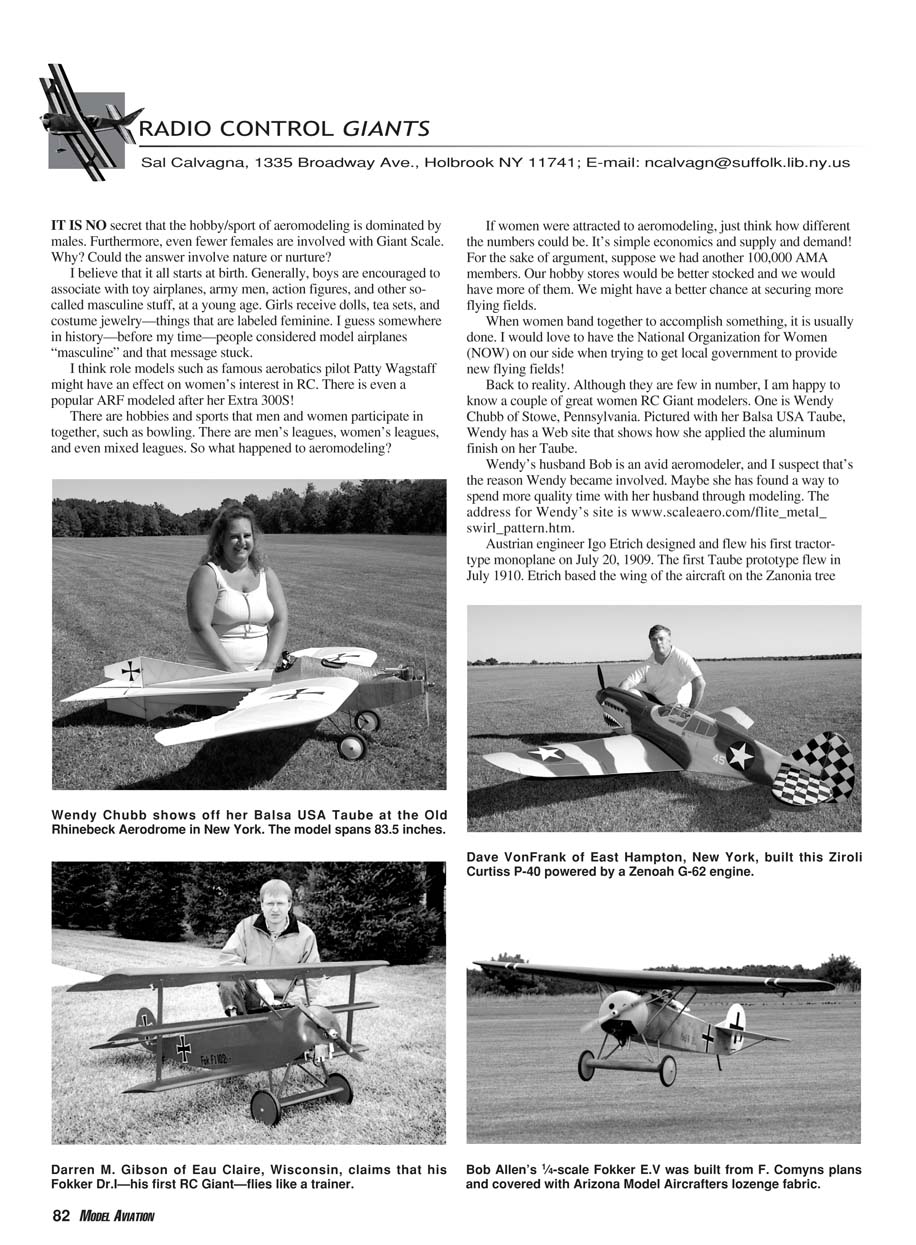
Wendy Chubb of Stowe, Pennsylvania, is pictured with her Balsa USA Taube. She has a website that documents how she applied the aluminum finish on her Taube: www.scaleaero.com/flite_metal_swirl_pattern.htm.
Wendy’s husband Bob is an avid aeromodeler, and I suspect that’s the reason Wendy became involved—perhaps a way to spend more quality time with her husband through modeling. Wendy did a great job building and documenting the aluminizing process; her how-to site should help other modelers.
Taube — History and Specifications
- Designer: Austrian engineer Igo Etrich
- First tractor-type monoplane flown: July 20, 1909
- First Taube prototype flight: July 1910
- Wing inspiration: Zanonia tree
- Wingspan: 46 ft 8 in
- Length: 32 ft 4 in
- Takeoff weight: 1,750 lb
- Engine: 100–120 hp Mercedes water-cooled, six-cylinder inline
The Taube was used for sporting purposes early on and later for observation and training by Germany and Austro-Hungary during World War I. It was the first airplane to drop bombs during the war. Although roughly four years old at the beginning of World War I, the Taube was a stable aircraft with noteworthy performance. By spring 1915 it was of little front-line use and was relegated to training. Ironically, the name "Taube" means dove—the universal symbol of peace in 1914.
Darren M. Gibson — Fokker Dr.I
Darren M. Gibson of Eau Claire, Wisconsin, chose the popular—albeit difficult—Fokker Dr.I as his first foray into Giant Scale. Built from a Balsa USA kit, the Dr.I is powered by a Zenoah G-26 gas engine and covered with Solartex covering material. It is painted in the colors of the notorious Baron von Richthofen.
Radio and systems:
- Futaba radio system
- Hitec standard and high-torque servos
- B&B smoke system
- MGA pilot figure
The Dr.I is one of the most recognizable World War I fighters. Extremely maneuverable and able to climb well, it was not very fast for a late-war fighter. In the hands of an experienced pilot the Dr.I was deadly, but its slower speed made it difficult to disengage once engaged in a dogfight. The wings were fully cantilevered; the prototype did not have outer struts, but pilots were uncomfortable without them, so struts were added to production types.
Darren says the Dr.I model flies like a big trainer. Congratulations on your inaugural RC Giant! What's next?
Bob Allen — Fokker E.V (1/4-scale)
Bob Allen of Poughkeepsie, New York, flew his 1/4-scale Fokker E.V at a local Scale Masters Qualifier. He built the model from F. Comyns plans purchased from Bob Holman Plans.
Specifications and construction:
- Engine: Quadra Q-35
- Covering: Lozenge fabric (purchased from Arizona Model Aircrafters)
- Wing: Fully sheeted and fiberglassed
- Paint: Chevron Perfect Paint
- Systems: B&B smoke system
Bob reports the model is easy to fly and land. The aircraft clearly resembles the Fokker D.VIII (the "Flying Razor"), but the first designation of this late-war fighter was the Fokker E.V—so named because it was Fokker's fifth monoplane to enter military service. Early production suffered wing failures due to poor workmanship, leading to further testing and recertification; newly constructed wings were fitted and the improved models were redesignated D.VIII.
World War I ended before the D.VIII could prove itself in combat, though Lieutenant Emil Rolff of Jasta 6 scored an aerial victory in an E.V in August 1918 and was killed days later when his wing failed in flight. Today, modelers worldwide attest to the design’s appeal at local fields and events. Nice job, Bob!
Dave VonFrank — Ziroli Curtiss P-40
Dave VonFrank of East Hampton, New York, is shown with his Ziroli Curtiss P-40. The model was built and flown for many seasons by his friend Mike Gross before Mike made Dave a deal he couldn't refuse. Dave gave the model a face-lift: he repaired and repainted the wing with acrylic lacquer paint, repaired and repainted the cowl, and installed a new Zenoah G-62 gas engine for power while leaving the original paint scheme intact.
Well known for his "low-as-you-can-go" passes, Dave reports the model is a solid and stable performer.
P-40 history:
- Developed from the Curtiss P-36
- America’s foremost fighter in service when World War II began
- Served throughout the war: Pearl Harbor, the Philippines, China (Flying Tigers), and North Africa
- Strengths: faster in a dive, superior firepower, and could absorb greater battle damage
- More than 14,000 P-40s produced (all variants), making it the third most numerous US fighter of the war
Al Arnal — 40% Extra 300S
Al Arnal, a member (secretary and treasurer) of the Black Sheep Squadron of northeastern Pennsylvania, flies a 40% Extra 300S.
Specifications:
- Engine: 3W-150 twin gas, 18.5 hp
- Propeller: 32 x 12
- Radio: Futaba 9ZAP
- Servos: 15 JR 8411 digital servos
Al spent 50 hours airbrushing his Extra in a patriotic scheme—the results are astounding.
Final Notes
That’s all for this month. Spring hasn't sprung yet, so keep working on those unfinished RC Giants. Get them done for the 2005 flying season. Good luck!
MA
Transcribed from original scans by AI. Minor OCR errors may remain.

