
Radio Control Giants - 2006/11
Sal Calvagna [[email protected]]
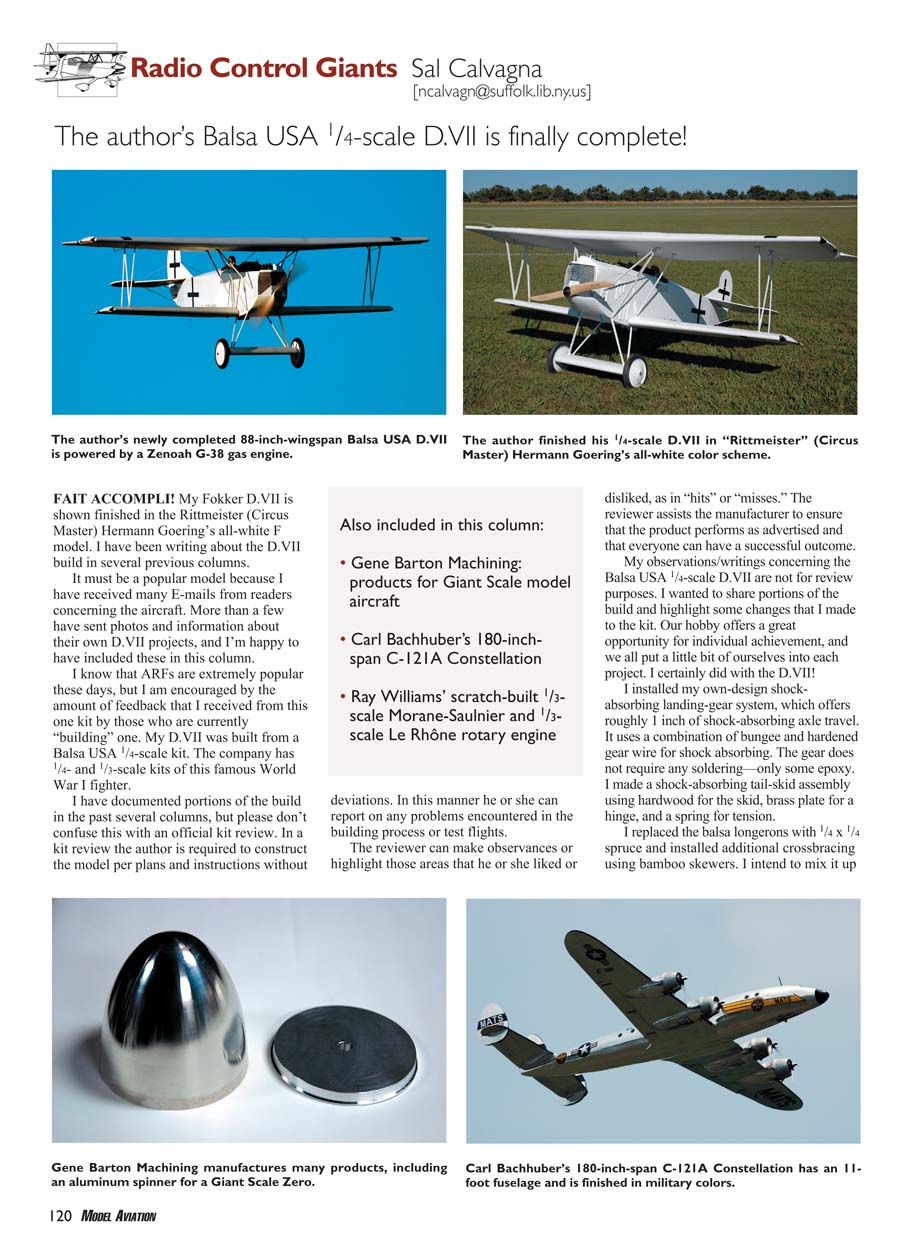
FAIT ACCOMPLI! My Fokker D.VII is shown finished in Rittmeister (Circus Master) Hermann Goering's all-white F model. I have been writing about the D.VII build in several previous columns. It must be a popular model because I have received many e-mails from readers concerning the aircraft. More than a few have sent photos and information about their own D.VII projects, and I'm happy to have included these in this column. I know that ARFs are extremely popular these days, but I am encouraged by the amount of feedback that I received from this one kit by those who are currently "building" one.
My D.VII was built from a Balsa USA 1/4-scale kit. The company has 1/4- and 1/3-scale kits of this famous World War I fighter. I have documented portions of the build in past columns, but please don't confuse this with an official kit review. In a kit review the author is required to construct the model per plans and instructions without deviations. In this manner he or she can report on any problems encountered in the building process or test flights. The reviewer can make observations or highlight those areas that he or she liked or disliked, as in "hits" or "misses." The reviewer assists the manufacturer to ensure that the product performs as advertised and that everyone can have a successful outcome.
My observations/writings concerning the Balsa USA 1/4-scale D.VII are not for review purposes. I wanted to share portions of the build and highlight some changes that I made to the kit. Our hobby offers a great opportunity for individual achievement, and we all put a little bit of ourselves into each project. I certainly did with the D.VII!
I installed my own-design shock-absorbing landing-gear system, which offers roughly 1 inch of shock-absorbing axle travel. It uses a combination of bungee and hardened gear wire for shock absorbing. The gear does not require any soldering—only some epoxy. I made a shock-absorbing tail-skid assembly using hardwood for the skid, a brass plate for a hinge, and a spring for tension.
I replaced the balsa longerons with 1/4 x 1/4 spruce and installed additional crossbracing using bamboo skewers. I intend to mix it up in mock dogfighting and wanted a strong fuselage. Any changes made to the rear of the model will have an adverse effect on balance, so I installed a Zenoah G-38 engine instead of the recommended G-26 for power. Since my model had a slightly bland color scheme, I spruced up the dummy engine with detail. Because most World War I or early aircraft generally use only four channels (rudder, elevator, aileron, and throttle), I added a Bennett smoke system and a bomb drop to enhance the fun factor in the air.
I had fun building the Balsa USA D.VII, and now I'm going to fly it every chance I get! I wonder what my next project will be.
Also included in this column:
- Gene Barton Machining: products for Giant Scale model aircraft
- Carl Bachhuber's 180-inch-span C-121A Constellation
- Ray Williams' scratch-built 1/3-scale Morane-Saulnier and 1/3-scale Le Rhone rotary engine
Gene Barton Machining
If you're looking for quality machined landing gear, spinners, or accessories, check out Gene Barton's website and give him a call. When it came time to purchase a spinner for my Ziroli Zero, I found it difficult to find a company that offered the correct shape of aluminum spinner. Many companies offer aluminum spinners, but I found only two that had what I wanted. Gene Barton Machining was one.
Gene has products ranging from folding wing mechanisms to flightline totes, and he offers custom machining services at a reasonable rate. You can visit his website at www.genebarton.com or call him at (573) 964-6718. I found Gene helpful and customer friendly.
Bachhuber Constellation
Carl Bachhuber of Mayville, Wisconsin, has done it again. His newest Giant is the C-121A Lockheed Constellation finished in military colors. Carl brought this model and his DC-6 to Warbirds Over Delaware 2006 and the crowd loved them.
Carl started the Constellation in July 2005 and finished it the following January. The model spans 180 inches and is powered by four Fuji BT-32 gas engines. The fuselage is more than 11 feet long, which presented a problem because his trailer could not accommodate it. He decided to split the fuselage to get it in.
The C-121A is stable in flight and slightly faster than his DC-6. Carl experienced some teething problems with vibration and on one flight lost an engine complete with the nacelle. The problem was solved by installing new propellers from a different manufacturer; however, anyone who knows a little about the full-scale Constellation's history will find Carl's loss of an engine during flight appropriate for scale realism.
The Lockheed Constellation, "Queen of the Sky," had a long and colorful history. The military versions—C-69 and C-121A—first flew during World War II. The last version was used during the Vietnam conflict. The Constellation had a fully pressurized cabin, was less noisy because of sound-deadening material and because its engines were installed well outboard on its massive 123-foot wing, and sported creature comforts such as reclining seats.
The aircraft was easy to distinguish, with its triple-tail design and graceful dolphin-shaped fuselage. It was the first airliner to fly nonstop from coast to coast; however, all was not well with the design largely because of the Wright R-3350 Cyclone engines that powered it.
There were numerous incidents involving the R-3350 engines. At one point the Constellation was dubbed "the world's best trimmer." In fact, a Constellation actually did fly as a trimotor.
On June 18, 1946, Pan Am's NC88858 had an engine fire while climbing out over the Atlantic Ocean on its way to London. The fire in the number-four engine became uncontrollable and eventually burned through the engine mount, causing the entire engine assembly to drop into the Atlantic. The airplane managed to return for an emergency landing without injuries or further damage.
The mechanics determined that the aircraft would require factory repair, which meant transporting it all the way to California. They removed the jagged pieces of metal from the hole left by engine number four and faired it over with sheet metal. The Constellation was then flown more than 2,000 miles back to the Lockheed factory with three engines!
In 1967 a military RC-121 Constellation was the first Airborne Warning and Control aircraft credited with vectoring an Air Force fighter to intercept and shoot down a MiG above Vietnam. In all, 856 Constellations were built between 1943 and 1958. In the end, it was the jet engine and the new jet passenger liners that sealed its fate.
For more photos of this model and many others that Carl has completed, visit his website at www.carlb-rceplanes.com.
Ray Williams' Morane
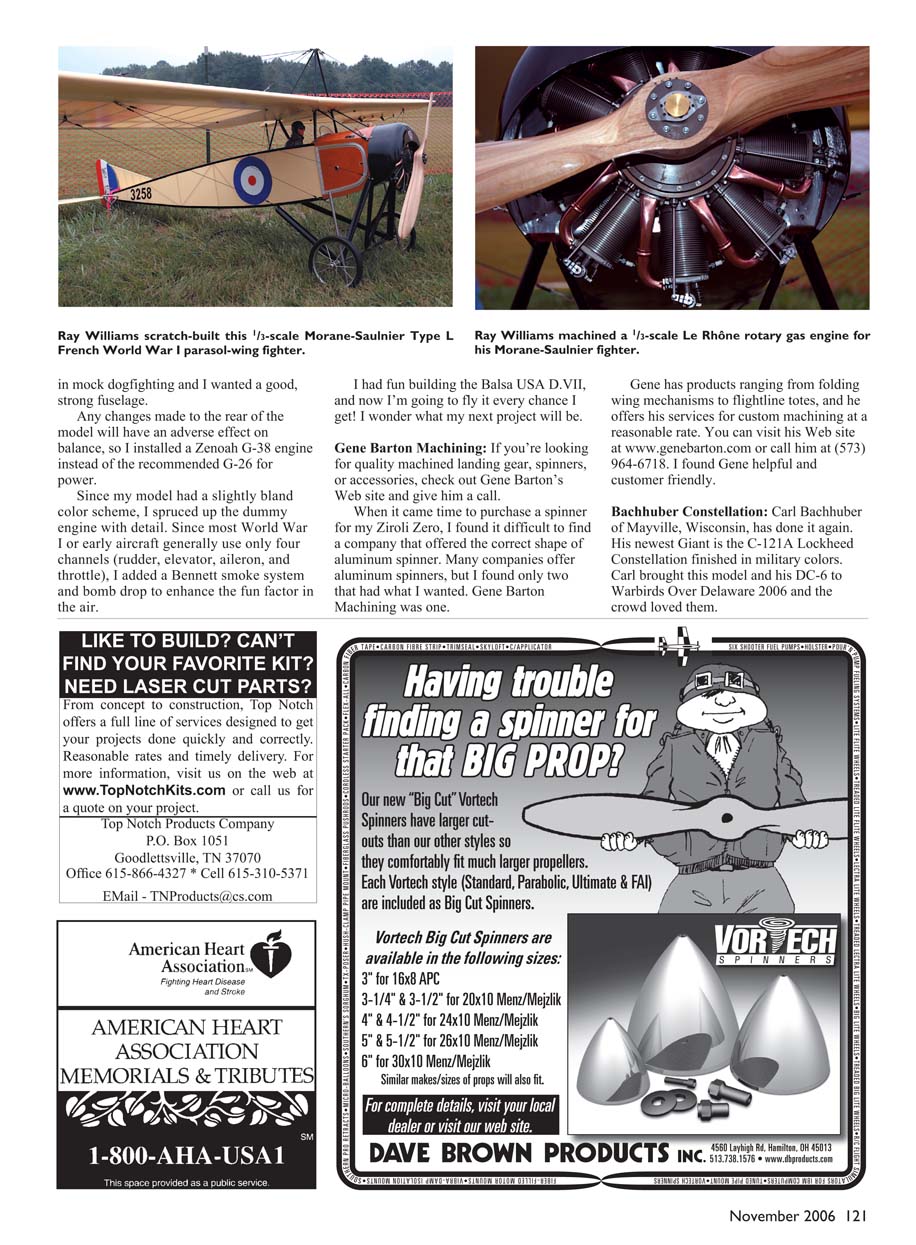
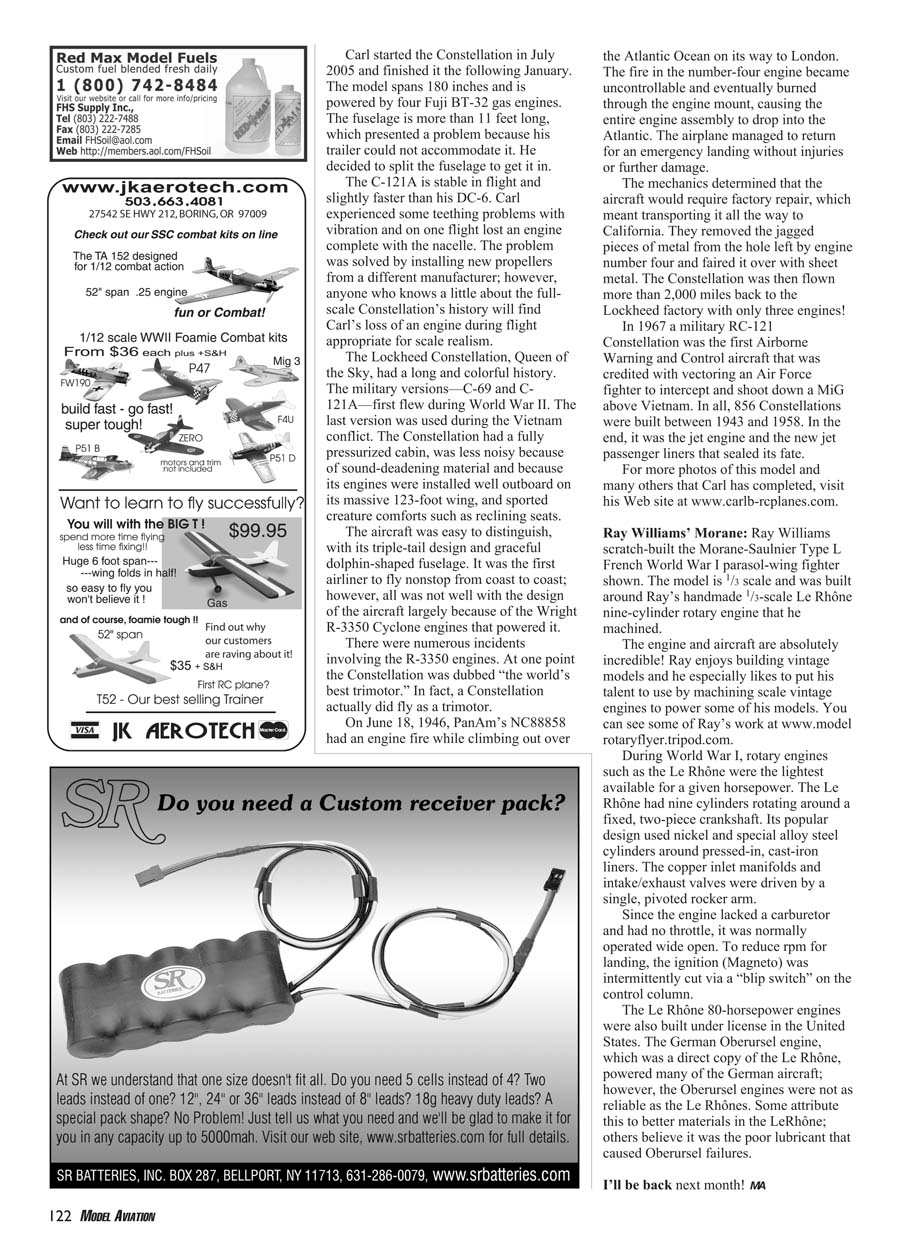
Ray Williams scratch-built the Morane-Saulnier Type L French World War I parasol-wing fighter shown. The model is 1/3 scale and was built around Ray's handmade 1/3-scale Le Rhone nine-cylinder rotary engine that he machined.
The engine and aircraft are absolutely incredible! Ray enjoys building vintage models and he especially likes to put his talents to use by machining scale vintage engines to power some of his models. You can see some of Ray's work at www.modelrotaryflyer.tripod.com.
During World War I, rotary engines such as the Le Rhone were the lightest available for a given horsepower. The Le Rhone had nine cylinders rotating around a fixed, two-piece crankshaft. Its popular design used nickel and special alloy steel cylinders around pressed-in, cast-iron liners. The copper inlet manifolds and intake/exhaust valves were driven by a single, pivoted rocker arm.
Since the engine lacked a carburetor and had no throttle, it was normally operated wide open. To reduce rpm for landing, the ignition (magneto) was intermittently cut via a "blip switch" on the control column.
The Le Rhone 80-horsepower engines were also built under license in the United States. The German Oberursel engine, which was a direct copy of the Le Rhone, powered many of the German aircraft; however, the Oberursel engines were not as reliable as the Le Rhones. Some attribute this to better materials in the Le Rhone; others believe it was the poor lubricant that caused Oberursel failures.
I'll be back next month! MA
Transcribed from original scans by AI. Minor OCR errors may remain.

