
Radio Control Giants
Sal Calvagna [[email protected]]
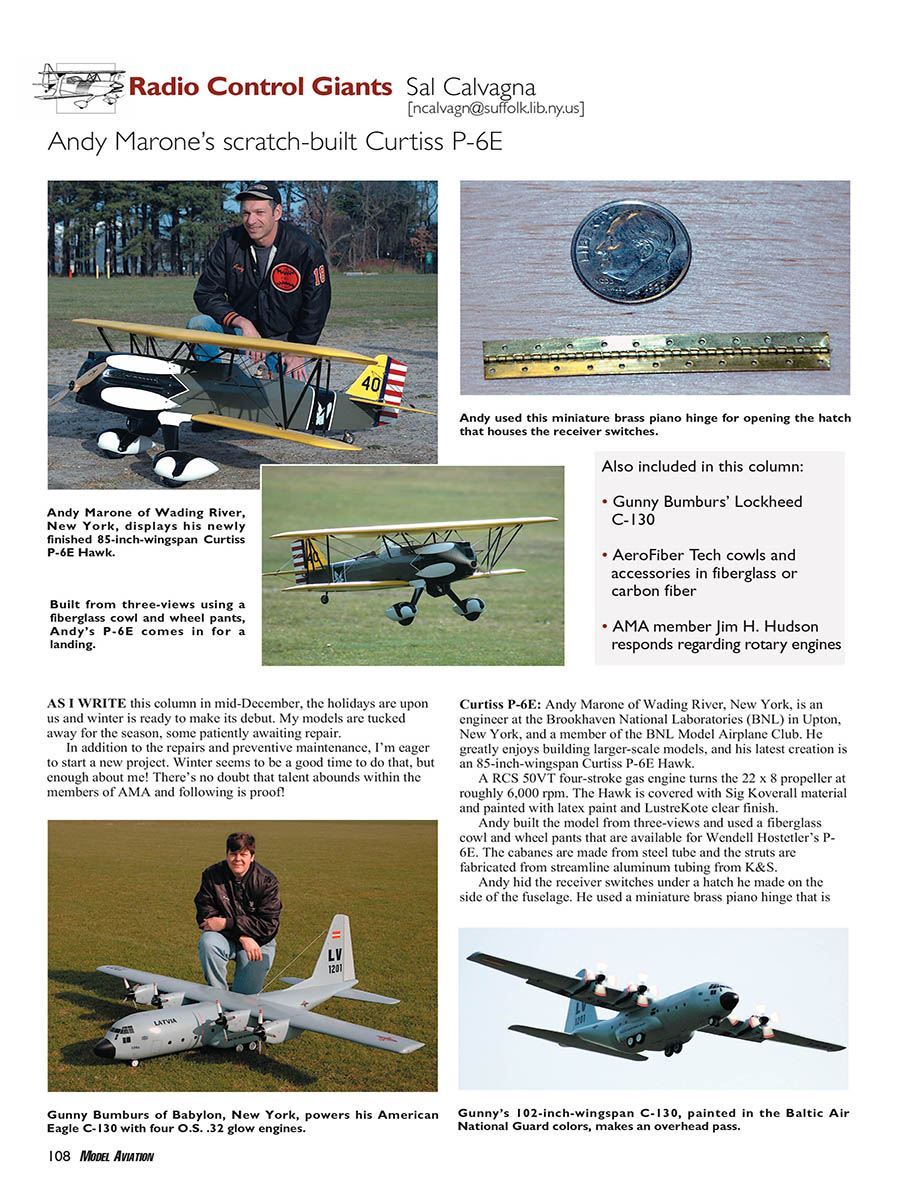
Andy Marone’s scratch-built Curtiss P-6E
As I write this column in mid-December, the holidays are upon us and winter is ready to make its debut. My models are tucked away for the season, some patiently awaiting repair. In addition to the repairs and preventive maintenance, I'm eager to start a new project. Winter seems to be a good time to do that, but enough about me! There's no doubt that talent abounds within the members of AMA and following is proof.
Curtiss P-6E: Andy Marone of Wading River, New York, is an engineer at the Brookhaven National Laboratories (BNL) in Upton, New York, and a member of the BNL Model Airplane Club. He greatly enjoys building larger-scale models, and his latest creation is an 85-inch-wingspan Curtiss P-6E Hawk.
An RCS 50VT four-stroke gas engine turns the 22 x 8 propeller at roughly 6,000 rpm. The Hawk is covered with Sig Koverall material and painted with latex paint and LustreKote clear finish.
Andy built the model from three-views and used a fiberglass cowl and wheel pants that are available for Wendell Hostetler's P-6E. The cabanes are made from steel tube and the struts are fabricated from streamline aluminum tubing from K&S.
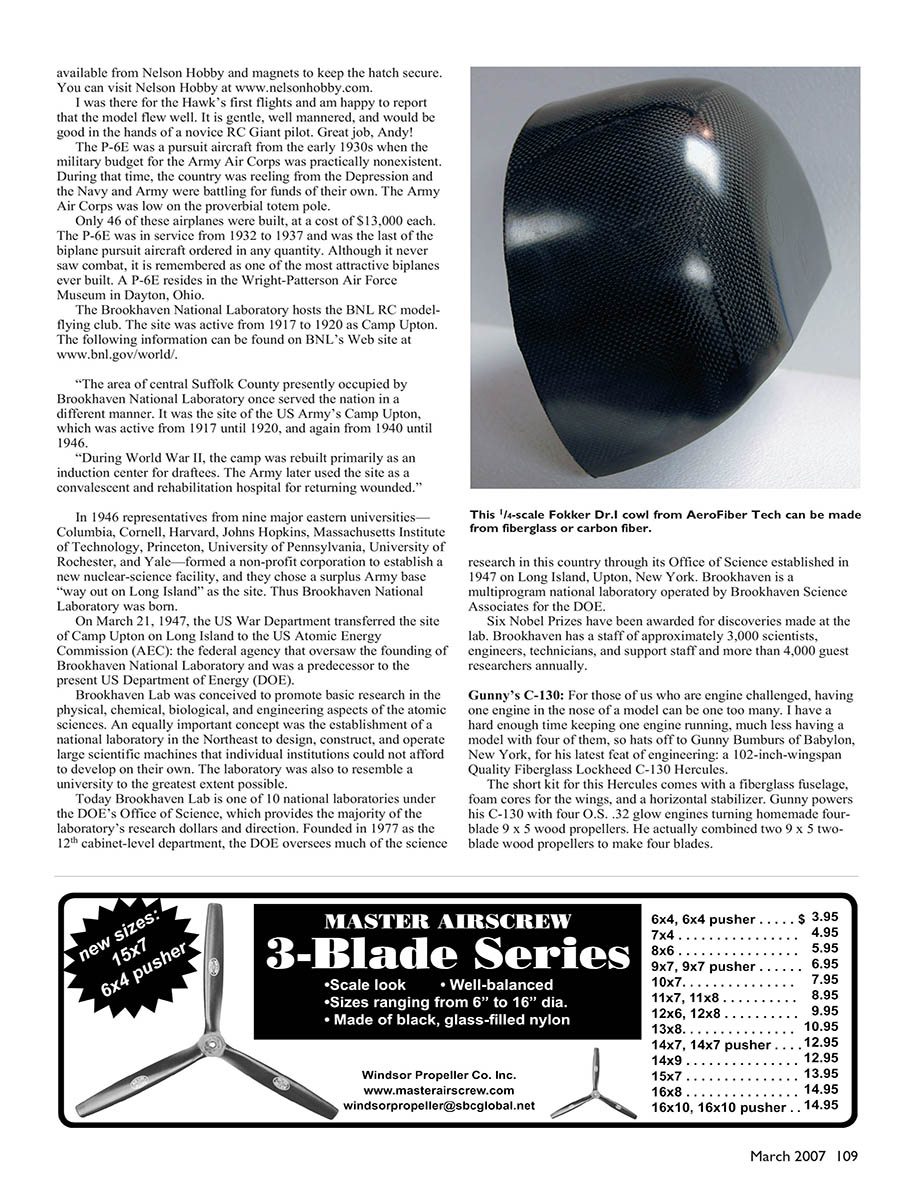
Andy hid the receiver switches under a hatch he made on the side of the fuselage. He used a miniature brass piano hinge that is available from Nelson Hobby and magnets to keep the hatch secure. You can visit Nelson Hobby at www.nelsonhobby.com.
I was there for the Hawk’s first flights and am happy to report that the model flew well. It is gentle, well mannered, and would be good in the hands of a novice RC Giant pilot. Great job, Andy!
The P-6E was a pursuit aircraft from the early 1930s when the military budget for the Army Air Corps was practically nonexistent. During that time, the country was reeling from the Depression and the Navy and Army were battling for funds of their own. The Army Air Corps was low on the proverbial totem pole.
Only 46 of these airplanes were built, at a cost of $13,000 each. The P-6E was in service from 1932 to 1937 and was the last of the biplane pursuit aircraft ordered in any quantity. Although it never saw combat, it is remembered as one of the most attractive biplanes ever built. A P-6E resides in the National Museum of the US Air Force at Wright-Patterson Air Force Base in Dayton, Ohio.
Brookhaven National Laboratory
The Brookhaven National Laboratory hosts the BNL RC model-flying club. The site was active from 1917 to 1920 as Camp Upton. The following information can be found on BNL’s web site at www.bnl.gov/world/:
“The area of central Suffolk County presently occupied by Brookhaven National Laboratory once served the nation in a different manner. It was the site of the US Army’s Camp Upton, which was active from 1917 until 1920, and again from 1940 until 1946.
“During World War II, the camp was rebuilt primarily as an induction center for draftees. The Army later used the site as a convalescent and rehabilitation hospital for returning wounded.”
In 1946 representatives from nine major eastern universities formed a non-profit corporation to establish a new nuclear-science facility. The universities were:
- Columbia
- Cornell
- Harvard
- Johns Hopkins
- Massachusetts Institute of Technology
- Princeton
- University of Pennsylvania
- University of Rochester
- Yale
They chose a surplus Army base “way out on Long Island” as the site. On March 21, 1947, the US War Department transferred the site of Camp Upton on Long Island to the US Atomic Energy Commission (AEC), the federal agency that oversaw the founding of Brookhaven National Laboratory and was a predecessor to the present US Department of Energy (DOE).
Brookhaven Lab was conceived to promote basic research in the physical, chemical, biological, and engineering aspects of the atomic sciences. An equally important concept was the establishment of a national laboratory in the Northeast to design, construct, and operate large scientific machines that individual institutions could not afford to develop on their own. The laboratory was also to resemble a university to the greatest extent possible.
Today Brookhaven Lab is one of 10 national laboratories under the DOE’s Office of Science, which provides the majority of the laboratory’s research dollars and direction. Brookhaven is a multiprogram national laboratory operated by Brookhaven Science Associates for the DOE. Six Nobel Prizes have been awarded for discoveries made at the lab. Brookhaven has a staff of approximately 3,000 scientists, engineers, technicians, and support staff and more than 4,000 guest researchers annually.
Gunny’s C-130
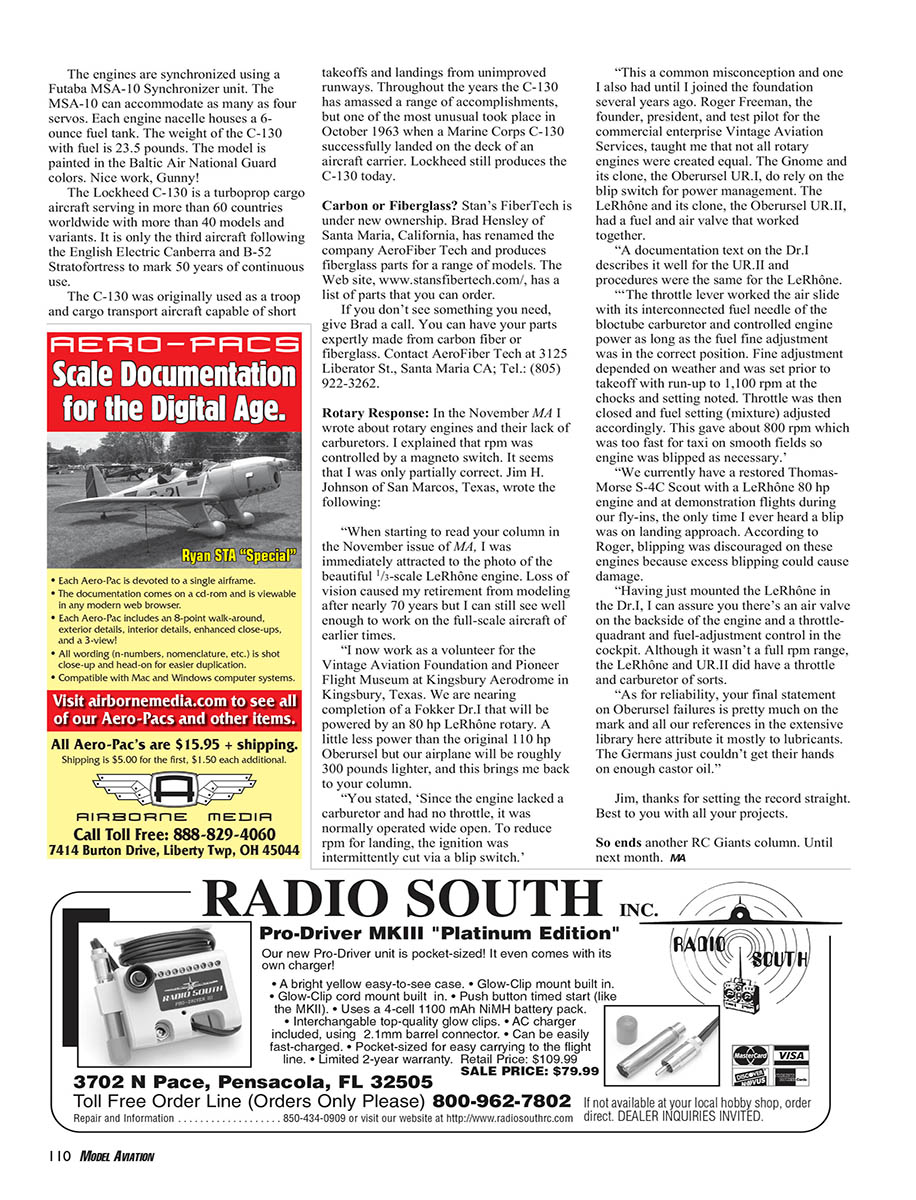
For those of us who are engine challenged, having one engine in the nose of a model can be one too many. I have a hard enough time keeping one engine running, much less having a model with four of them, so hats off to Gunny Bumburs of Babylon, New York, for his latest feat of engineering: a 102-inch-wingspan Quality Fiberglass Lockheed C-130 Hercules.
The short kit for this Hercules comes with a fiberglass fuselage, foam cores for the wings, and a horizontal stabilizer. Gunny powers his C-130 with four O.S. .32 glow engines turning homemade four-blade 9 x 5 wood propellers. He actually combined two 9 x 5 two-blade wood propellers to make four blades.
The engines are synchronized using a Futaba MSA-10 synchronizer unit. The MSA-10 can accommodate as many as four servos. Each engine nacelle houses a 6-ounce fuel tank. The weight of the C-130 with fuel is 23.5 pounds. The model is painted in the Baltic Air National Guard colors. Nice work, Gunny!
The Lockheed C-130 is a turboprop cargo aircraft serving in more than 60 countries worldwide with more than 40 models and variants. It is only the third aircraft following the English Electric Canberra and the B-52 Stratofortress to mark 50 years of continuous use.
The C-130 was originally used as a troop and cargo transport aircraft capable of short takeoffs and landings from unimproved runways. Throughout the years the C-130 has amassed a range of accomplishments, but one of the most unusual took place in October 1963 when a Marine Corps C-130 successfully landed on the deck of an aircraft carrier. Lockheed still produces the C-130 today.
Carbon or Fiberglass?
Stan’s FiberTech is under new ownership. Brad Hensley of Santa Maria, California, has renamed the company AeroFiber Tech and produces fiberglass parts for a range of models. The web site, www.stansfibertech.com, has a list of parts that you can order.
If you don’t see something you need, give Brad a call. You can have your parts expertly made from carbon fiber or fiberglass. Contact AeroFiber Tech at 3125 Liberator St., Santa Maria, CA; Tel.: (805) 922-3262.
Rotary Response
In the November MA I wrote about rotary engines and their lack of carburetors. I explained that rpm was controlled by a magneto switch. It seems that I was only partially correct. Jim H. Johnson of San Marcos, Texas, wrote the following:
"When starting to read your column in the November issue of MA, I was immediately attracted to the photo of the beautiful 1/3-scale LeRhône engine. Loss of vision caused my retirement from modeling nearly 10 years ago but I can still see well enough to work on the full-scale aircraft of earlier times.
"I now work as a volunteer for the Vintage Aviation Foundation and Pioneer Flight Museum at Kingsbury Aerodrome in Kingsbury, Texas. We are nearing completion of a Fokker Dr.I that will be powered by an 80 hp LeRhône rotary. A little less power than the original 110 hp Oberursel but our replica will be roughly 300 pounds lighter, and this brings me back to your column.
"You stated, 'Since the engine lacked a carburetor and had no throttle, it was normally operated wide open. To reduce rpm for landing, the ignition was intermittently cut via a blip switch.'
"This is a common misconception and one I also had until I joined the foundation several years ago. Roger Freeman, the founder, president, and test pilot for the commercial enterprise Vintage Aviation Services, taught me that not all rotary engines were created equal. The Gnome and its clone, the Oberursel UR.I, do rely on the blip switch for power management. The LeRhône and its clone, the Oberursel UR.II, had a fuel and air valve that worked together.
"A documentation text on the Dr.I describes it well for the UR.II and procedures were the same for the LeRhône.
"The throttle lever worked the air slide with its interconnected fuel needle of the carburetor and controlled engine power as long as the fuel mixture adjustment was in the correct position. Fine adjustment depended on weather and was set prior to takeoff with run-up to 1,100 rpm at the chocks and setting noted. Throttle was then closed and fuel setting (mixture) adjusted accordingly. This gave about 800 rpm which was too fast for taxi on smooth fields so engine was blipped as necessary.
"Actually we have restored a Thomas-Morse S-4C Scout with a LeRhône 80 hp engine and at demonstration flights during our fly-ins, the only time I heard blip was on landing approach. According to Roger, blipping was discouraged on these engines because excess blipping could cause breakage.
"Having just mounted the LeRhône in the Dr.I, I can assure you there's an air valve on the backside of the engine and a throttle quadrant and fuel-adjustment control in the cockpit. Although it wasn't a full rpm range, the LeRhône and UR.II did have a throttle and carburetor of sorts.
"As for reliability, my final statement on Oberursel failures is pretty much on the mark and our references in the extensive library here attribute it mostly to lubricants. The Germans just couldn't get their hands on enough castor oil."
Jim, thanks for setting the record straight.
So ends another RC Giants column. Until next month. MA
Transcribed from original scans by AI. Minor OCR errors may remain.

