
Radio Control Giants
Sal Calvagna [[email protected]]
Futaba six-channel FASST 2.4 GHz spread spectrum radio system
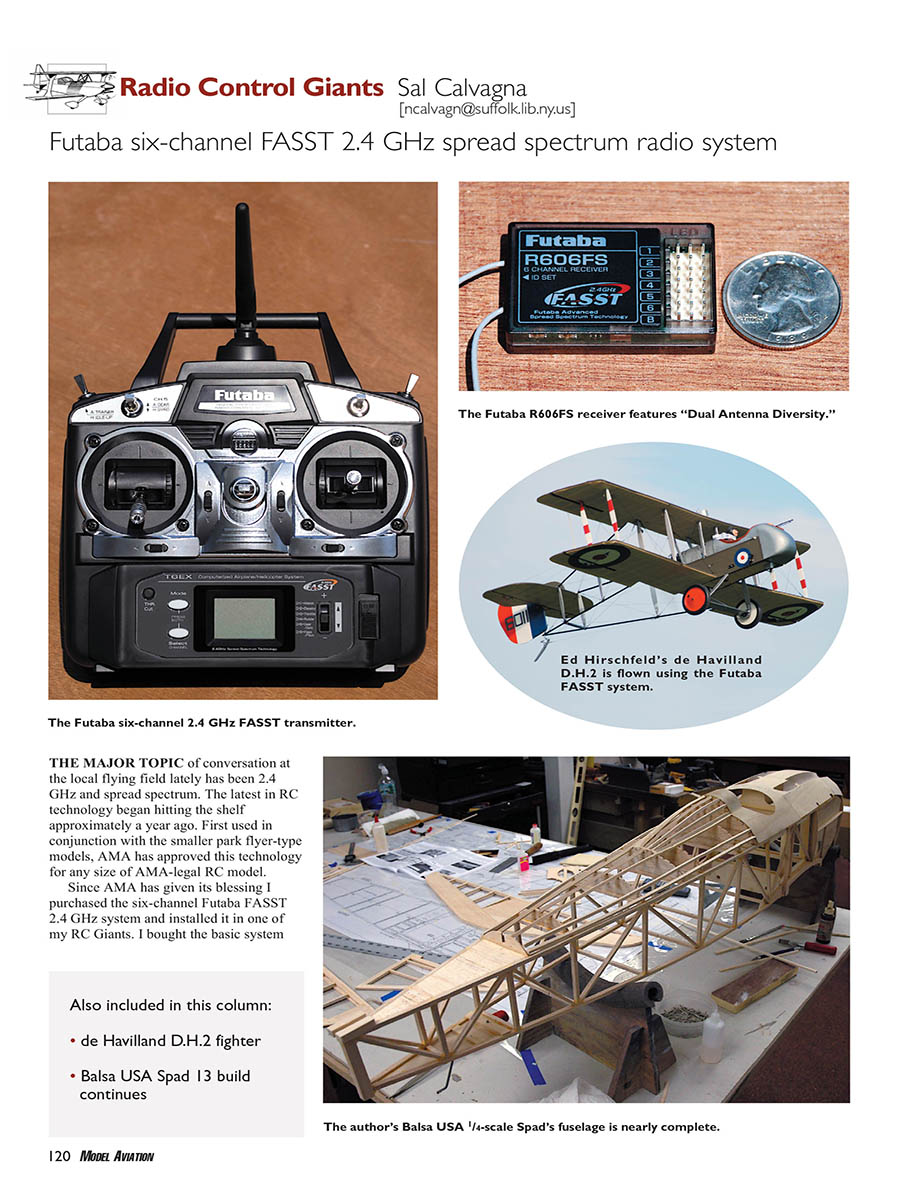
The major topic of conversation at the local flying field lately has been 2.4 GHz and spread spectrum. The latest in RC technology began hitting the shelves approximately a year ago. First used with smaller park-flyer type models, the AMA has approved this technology for any size of AMA-legal RC model. Since the AMA has given its blessing, I purchased the six-channel Futaba FASST 2.4 GHz system and installed it in one of my RC Giants. I bought the basic system that includes the transmitter, receiver, charger, and switch harness.
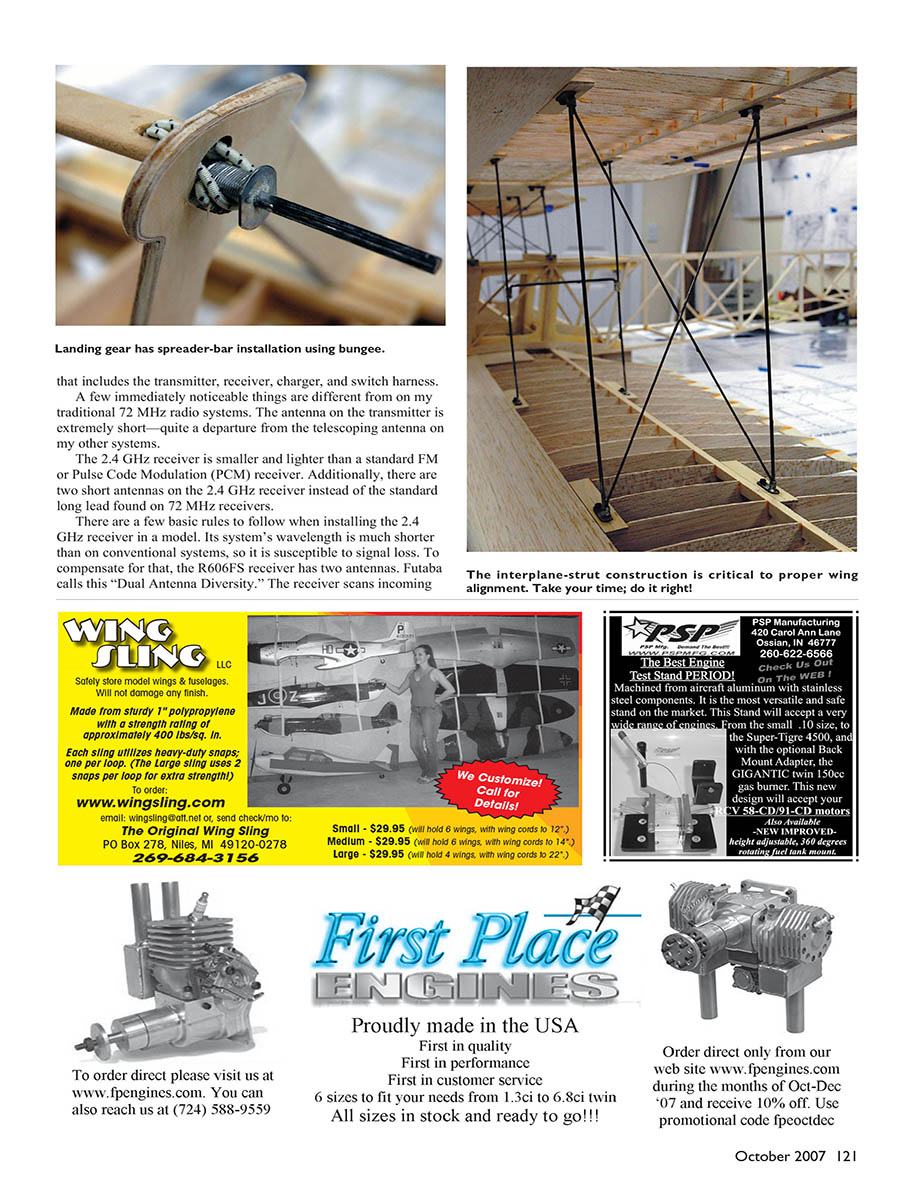
A few immediately noticeable things are different from my traditional 72 MHz radio systems. The antenna on the transmitter is extremely short—quite a departure from the telescoping antenna on my other systems. The 2.4 GHz receiver is smaller and lighter than a standard FM or Pulse Code Modulation (PCM) receiver. Additionally, there are two short antennas on the 2.4 GHz receiver instead of the standard long lead found on 72 MHz receivers.
There are a few basic rules to follow when installing the 2.4 GHz receiver in a model:
- The system's wavelength is much shorter than on conventional systems, so it is more susceptible to signal loss.
- To compensate for that, the R606FS receiver has two antennas. Futaba calls this "Dual Antenna Diversity."
- The receiver scans incoming frequency every 2 milliseconds, so there is no need for a frequency pin.
- On the back of the transmitter is an LED that shows when the transmitter is in a power-down mode or when an RF signal is being transmitted. An LED on the receiver glows green when fully linked to the transmitter.
- As with 72 MHz systems, a range check is critical to confirm proper system operation before flight. The Futaba 2.4 GHz system has a power-down mode that reduces RF power and reduces the system's range. In that mode a proper range distance is 30–50 paces. This range check should be performed with the engine/motor off and again with the engine/motor on.
I was anxious to install my new system on one of my RC Giants. I chose the Fokker Eindecker because of all the flying/landing wires, pull-pull cables, and aluminum tape. The Eindecker flew with a PCM receiver because of the poor reception using an FM receiver. No matter how I placed the FM receiver, I could not get a satisfactory range test, so I figured that model would be an excellent trial for the spread-spectrum system. I installed the new 2.4 GHz receiver and was pleased with the range-test results. Test flights with this system were flawless. Spread spectrum is here to stay, and these systems will continue to mature and offer more functionality to the RC modeler. I'm happy with my system's operation. Give it a try in your RC Giant.
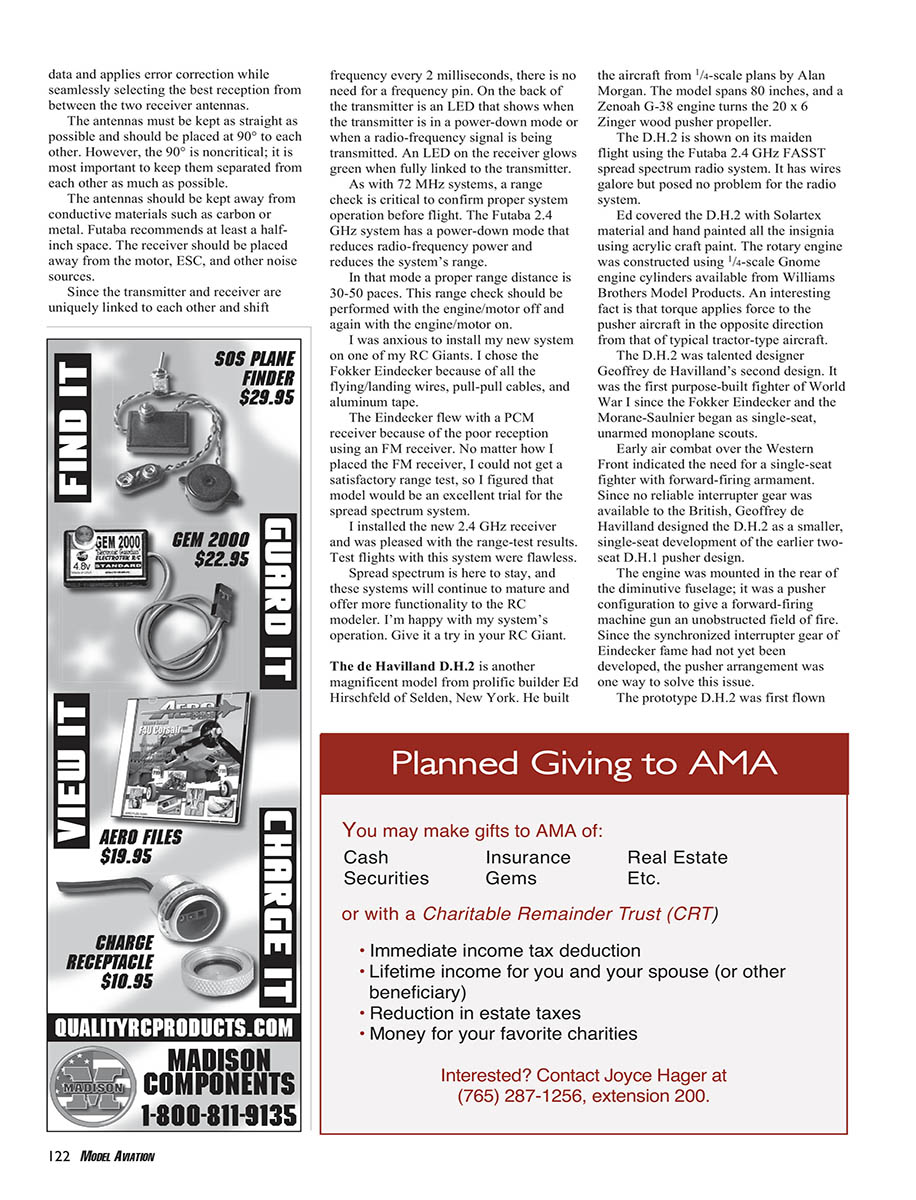
The de Havilland D.H.2 is another magnificent model from prolific builder Ed Hirschfeld of Selden, New York. He built the aircraft from 1/4-scale plans by Alan Morgan. The model spans 80 inches, and a Zenoah G-38 engine turns the 20 x 6 Zinger wood pusher propeller. The D.H.2 is shown on its maiden flight using the Futaba 2.4 GHz FASST spread spectrum radio system. It has wires galore but posed no problem for the radio system. Ed covered the D.H.2 with Solartex material and hand-painted all the insignia using acrylic craft paint. The rotary engine was constructed using 1/4-scale Gnome engine cylinders available from Williams Brothers Model Products. An interesting fact is that torque applies force to the pusher aircraft in the opposite direction from that of typical tractor-type aircraft.
The D.H.2 was the talented designer Geoffrey de Havilland's second design. It was the first purpose-built fighter of World War I since the Fokker Eindecker and the Morane-Saulnier began as single-seat, unarmed monoplane scouts.
Early air combat over the Western Front indicated the need for a single-seat fighter with forward-firing armament. Since no reliable interrupter gear was available to the British, Geoffrey de Havilland designed the D.H.2 as a smaller, single-seat development of the earlier two-seat D.H.1 pusher design.
The engine was mounted in the rear of the diminutive fuselage; it was a pusher configuration to give a forward-firing machine gun an unobstructed field of fire. Since the synchronized interrupter gear of Eindecker fame had not yet been developed, the pusher arrangement was one way to solve this issue.
The prototype D.H.2 was first flown from Hendon Field in June 1915. It possessed good maneuverability and an excellent rate of climb. The aircraft was armed with a single Lewis machine gun and five drums of ammunition, which could be positioned on one of three flexible mountings in the cockpit.
Pilots quickly learned that the best method to achieve a kill was to aim the aircraft rather than the gun, so the gun was fixed in the forward-firing center mount. Higher authorities banned this configuration until a clip was approved that fixed the gun in place but could be released if required.
The D.H.2’s top speed was roughly 93 mph. As development continued, more power was sought from the Gnome Monosoupape rotary engine. It was rebored to increase power and would occasionally shed its cylinders in flight and sever tailbooms with fatal consequences.
Newly built engines were installed in all the D.H.2s flown to France by 24 Squadron RFC—the world’s first fighter squadron—in late 1915. Although it was unpopular because of limited speed and range and a tendency to spin, the D.H.2 helped end the “Fokker Scourge” when the Eindecker had ruled the skies. Airco built roughly 400 D.H.2s.
The Spad Build Continues
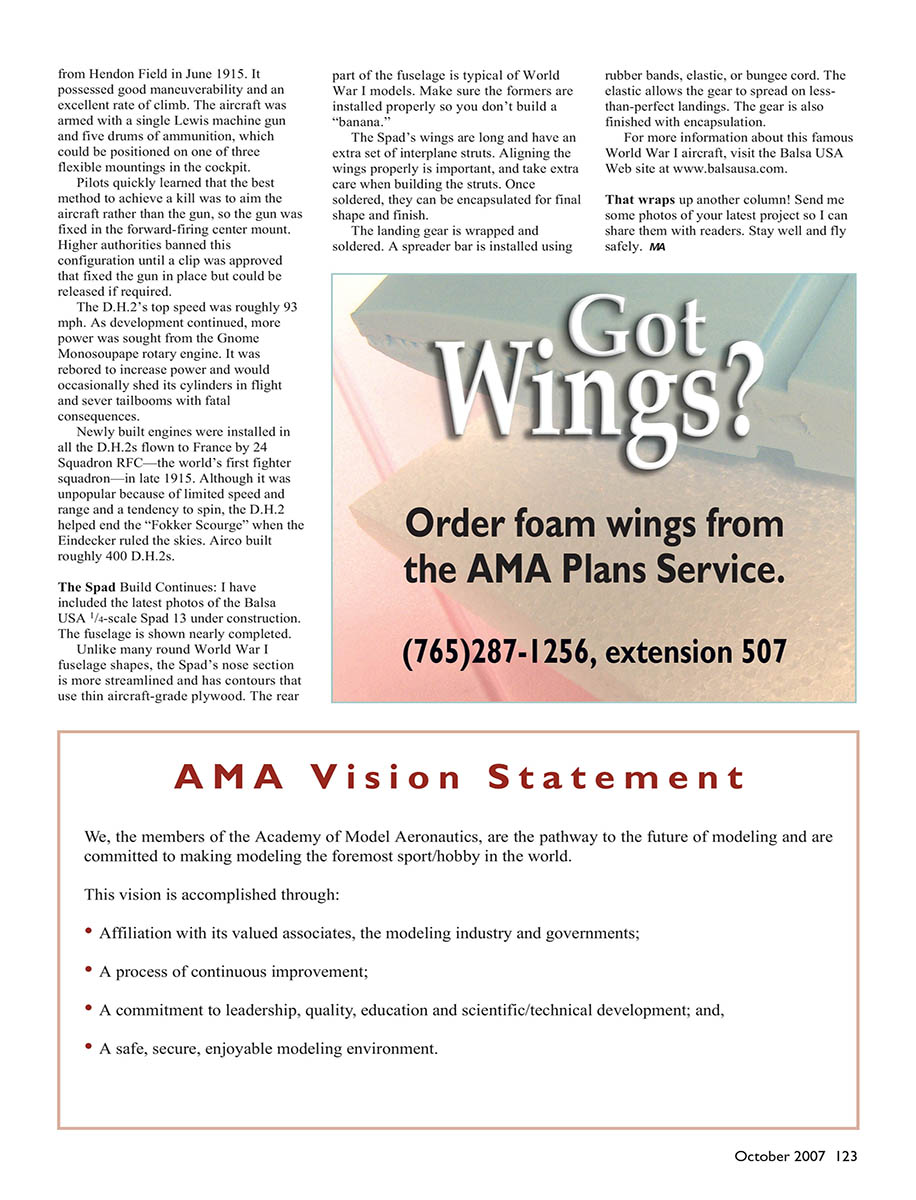
I have included the latest photos of the Balsa USA 1/4-scale Spad 13 under construction. The fuselage is shown nearly completed.
Unlike many round World War I fuselage shapes, the Spad’s nose section is more streamlined and has contours that use thin aircraft-grade plywood. The rear part of the fuselage is typical of World War I models. Make sure the formers are installed properly so you don’t build a “banana.”
The Spad’s wings are long and have an extra set of interplane struts. Aligning the wings properly is important, and take extra care when building the struts. Once soldered, they can be encapsulated for final shape and finish.
The landing gear is wrapped and soldered. A spreader bar is installed using rubber bands, elastic, or bungee cord. The elastic allows the gear to spread on less-than-perfect landings. The gear is also finished with encapsulation.
For more information about this famous World War I aircraft, visit the Balsa USA Web site at www.balsausa.com.
That wraps up another column! Send me some photos of your latest project so I can share them with readers. Stay well and fly safely. MA
Transcribed from original scans by AI. Minor OCR errors may remain.

