
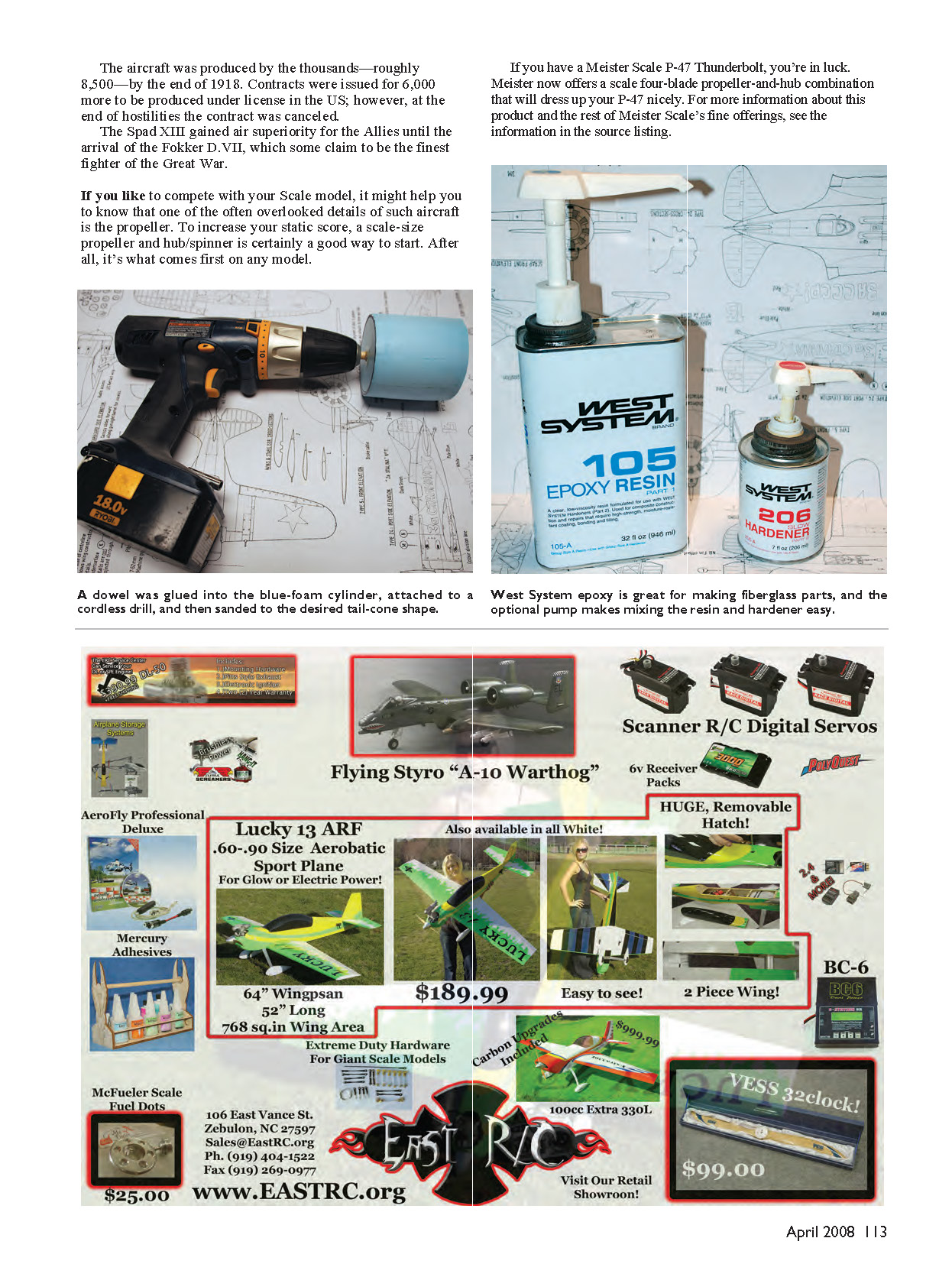
RADIO CONTROL GIANTS 2008/04
Spad XIII and Production Notes
The aircraft was produced by the thousands—roughly 8,500—by the end of 1918. Contracts were issued for 6,000 more to be produced under license in the US; however, at the end of hostilities the contract was canceled.
The Spad XIII gained air superiority for the Allies until the arrival of the Fokker D.VII, which some claim to be the finest fighter of the Great War.
Scale Propellers and Competition Tips
If you like to compete with your scale model, one often-overlooked detail is the propeller. To increase your static score, a scale-size propeller and hub/spinner is certainly a good way to start. After all, it's what comes first on any model.
If you have a Meister Scale P-47 Thunderbolt, you're in luck. Meister now offers a scale four-blade propeller-and-hub combination that will dress up your P-47 nicely. For more information about this product and the rest of Meister Scale's offerings, see the information in the source listing.
Fabricating Fiberglass Parts for a 1/4-Scale Polikarpov I-16 (Rata)
My latest project required fiberglass parts that were not available anywhere, so I had to fabricate them myself. The project is a 1/4-scale Russian Polikarpov I-16 called the "Rata" (Russian for "rat"). The two fiberglass parts I fabricated are the engine cowling and a tail cone.
The tail cone is similar in shape to a .40–.60 glow-size spinner. The I-16 has a round fuselage that comes to a point in the rear. This tail cone is located under the rudder and between the halves of the elevators.
The two main reasons I wanted to make this part from fiberglass were:
- so I could remove it to access the elevator control-horn assembly, and
- to keep the tail end of the model as light as possible.
The I-16 has an extremely short nose moment, so the choice and amount of building material used aft of the CG is critical for balance. My intention was to add as little weight to the model's nose as possible.
Materials and Tools
- Blue foam (extruded, closed-cell foam; available in densities up to 4 lb/ft³)
- Band saw
- Wood dowel and epoxy glue
- Cordless drill
- Sanding block and fine-grit sandpaper
- 3M 77 adhesive spray
- 1-ounce fiberglass cloth
- West System epoxy
- Credit card (for squeegeeing)
- Microballoons mixed with finishing resin (for filling)
- Small flat-head screwdriver
Fabrication Steps
- Cut a 3-inch blue-foam cylinder using a band saw.
- Drill a hole in the center of the cylinder and install a wood dowel with epoxy glue.
- Mount the dowel in a cordless drill and shape the tail cone by holding a sanding block to the spinning foam. Wear eye protection.
- Remove the cone periodically to check its contour against the fuselage until the correct shape and size are achieved.
- Smooth the formed foam cone using fine-grit paper cupped in the hand.
- Spray the blue foam with 3M 77 adhesive so the first layer of fiberglass cloth will adhere smoothly.
- Cut pieces of 1-ounce fiberglass cloth and gently apply them to the cone until it is completely covered.
- Mix West System epoxy and completely coat the tail cone.
- Because the 1-ounce cloth is thin, wrap the cone a second time with additional pieces and use a credit card to squeegee the surface smooth. Do not worry about making the surface perfectly flat.
- Let the assembly dry overnight.
- Sand the surface smooth by spinning the assembly in the cordless drill; most imperfections will be removed during sanding.
- If uneven or rough spots remain, mix microballoons with finishing resin, coat the areas, let dry, and sand again while spinning the part in the drill.
- When the exterior surface is smooth, use a small flat-head screwdriver to remove the blue foam core, leaving a hollow, nicely finished fiberglass tail cone.
Too bad I couldn't find a spinner with the exact shape I needed—it would have saved time. However, making one from scratch added to my modeling skills.
About West System Epoxy
I used West System epoxy, a high-quality, two-part adhesive formulated and manufactured by Gougeon Brothers, Inc. It bonds to fiberglass, wood, metal, fabrics, and other composite materials. It can be easily modified for a wide range of coating and adhesive applications.
West System epoxy is used for construction and repairs requiring superior moisture resistance and high strength, and is especially popular in marine applications. It is an excellent choice for model work where epoxy is typically used and is wonderful for making fiberglass parts. Because it is not a 50/50 mixture, the optional pump set makes mixing the resin and hardener simple—one pump of resin to one pump of hardener.
See the source listing to find where you can get more information about West System and epoxy.
Closing
That's all for this month. Stay tuned for more about the Polikarpov I-16 Russian Rata and some flight shots of the Spad 13 when the weather warms here in New York.
MA
Sources
- Balsa USA
(906) 863-6421 www.balsausa.com
- Meister Scale
(772) 621-9692 www.meister-scale.com
- West System
(866) 937-8797 www.westsystem.com
Transcribed from original scans by AI. Minor OCR errors may remain.

