

The Polikarpov I-16 wing-construction project
Sal Calvagna [[email protected]]
Project progress (April)
In the two previous columns I wrote about working with foam on my models. I described the lost-foam process using blue foam to make components from fiberglass parts, and I used this method to make a tail cone, spinner, and cowl for my latest project.
I also described how to make wing skins from balsa sheets and how to strengthen foam wing cores by installing full-height plywood spars. In the course of those articles I briefly mentioned that the subject I was working on is a 1/4-scale Polikarpov I-16. I received a number of inquiries about the I-16 from readers interested in this rarely modeled subject.
As of early April, the foam-core wing has been sheeted, the leading edge (LE) has been installed, wingtips have been added, and the ailerons have been completed. I have included a number of photos of the project as it looked in early April.
Wing skin attachment
I glued on the wing skins using West System epoxy. I applied the glue directly to the balsa skins because if applied directly to the foam it would absorb most of the epoxy. I placed the wing skins and foam cores back into their foam cradles and weighted them down evenly with heavy books and magazines. I repeated the process the following day to attach the lower set of wing skins.
Leading edge and wingtips
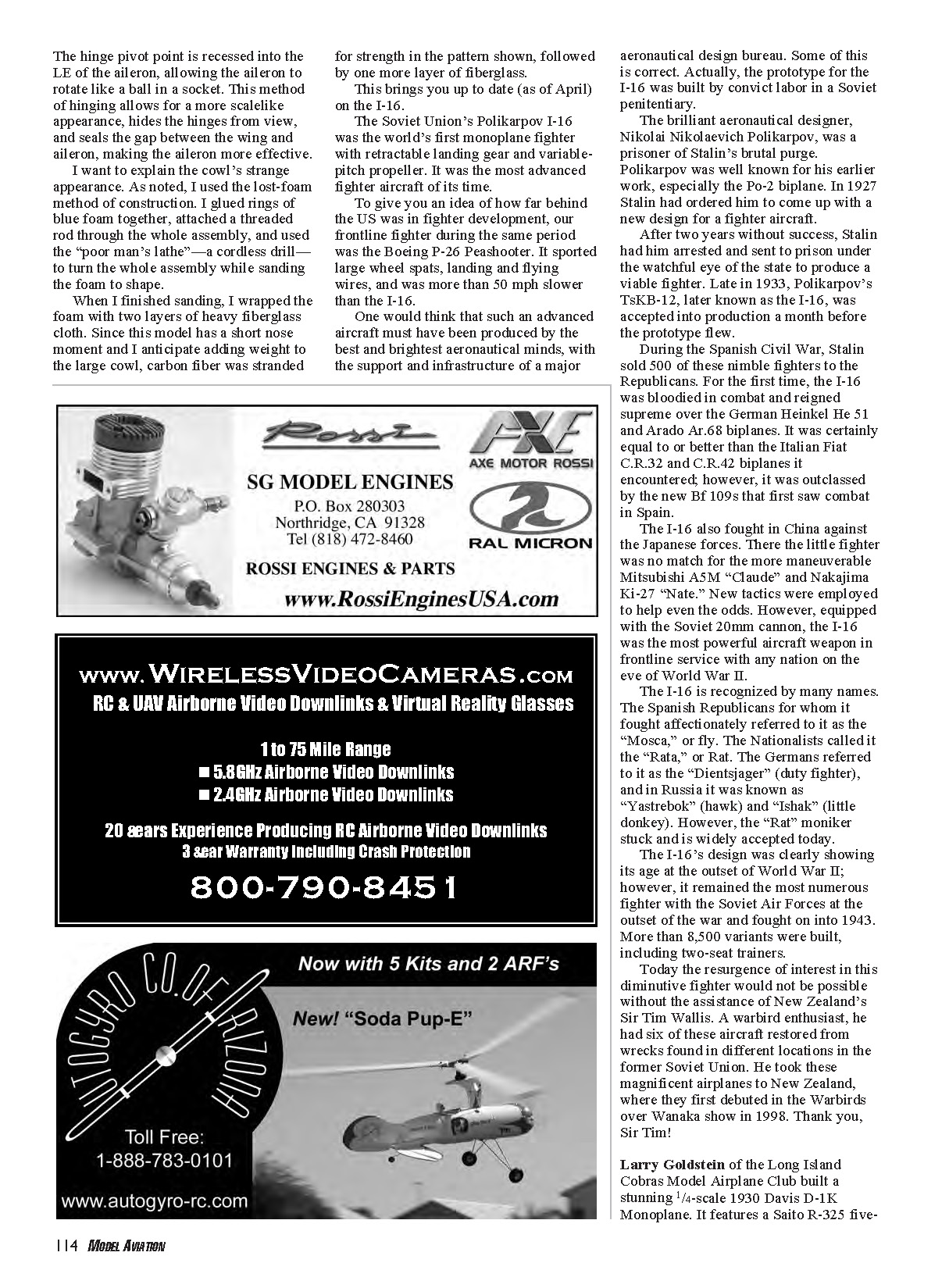
My next step was to add the LE. This time I used 12-minute epoxy. The LE was followed by the wingtips. Since the tip rib was roughly 1 inch thick, I used four pieces of 1/4" balsa. A thin layer of 1/32" aircraft-grade plywood was sandwiched between the balsa in the center. This helps make the wingtip ding-proof because it protects the soft balsa around its circumference.
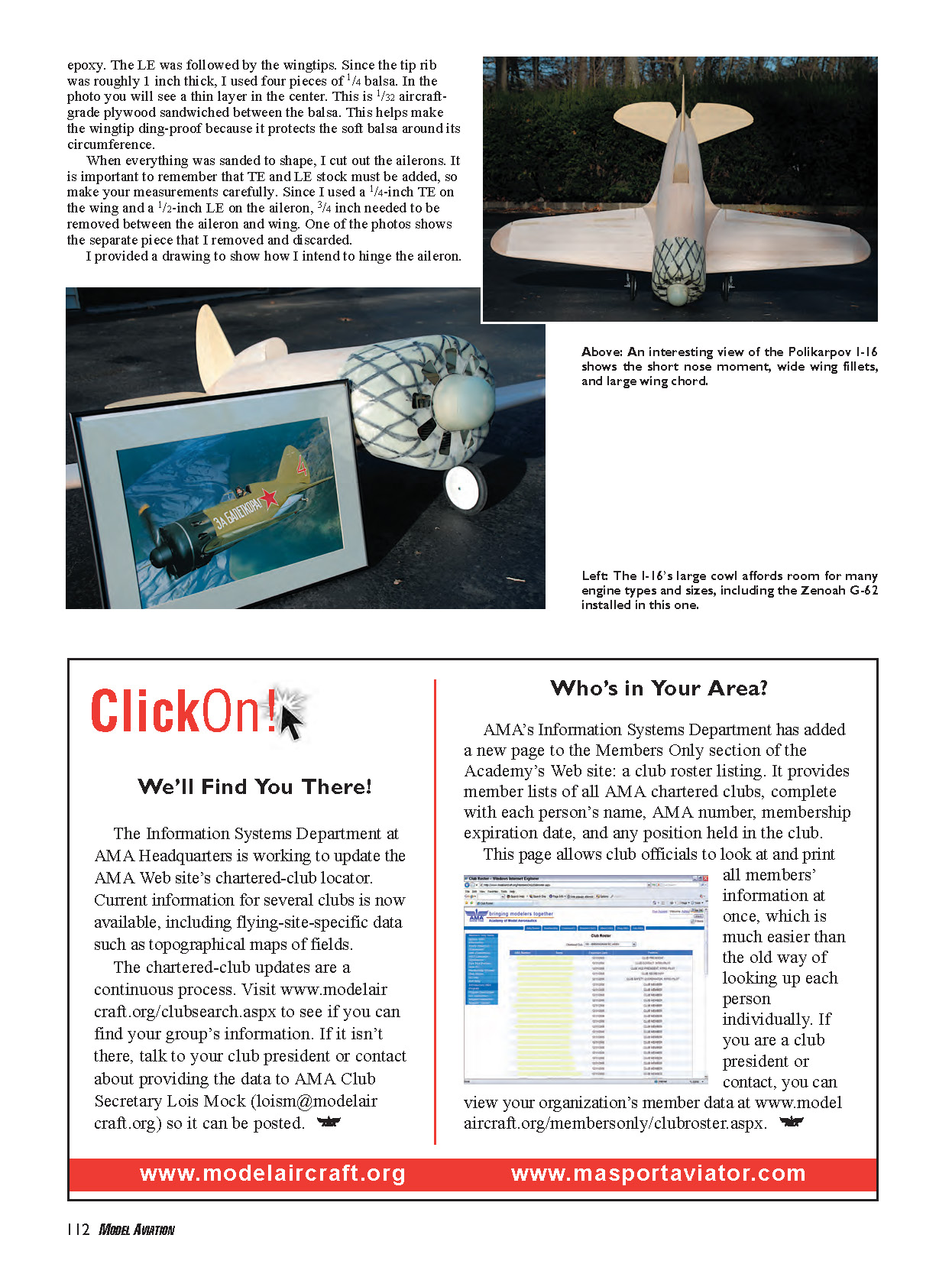
When everything was sanded to shape, I cut out the ailerons. It is important to remember that trailing-edge (TE) and leading-edge (LE) stock must be added, so make your measurements carefully. Since I used a 1/4" TE on the wing and a 1/2" LE on the aileron, 3/4" needed to be removed between the aileron and wing. One of the photos shows the separate piece that I removed and discarded.
Ailerons and hinging
I provided a drawing to show how I intend to hinge the aileron. The hinge pivot point is recessed into the LE of the aileron, allowing the aileron to rotate like a ball in a socket. This method of hinging allows for a more scale-like appearance, hides the hinges from view, and seals the gap between the wing and aileron, making the control surface more effective.
Cowl construction
I want to explain the cowl’s unusual appearance. As noted, I used the lost-foam method of construction. I glued rings of blue foam together, attached a threaded rod through the whole assembly, and used a “poor man’s lathe”—a cordless drill—to turn the assembly while sanding the foam to shape. When I finished sanding, I wrapped the foam with two layers of heavy fiberglass cloth.
Since this model has a short nose moment and I anticipate adding weight to the large cowl, carbon fiber was stranded for strength in the pattern shown, followed by one more layer of fiberglass.
This brings you up to date (as of April) on the I-16.
Historical background
The Soviet Union’s Polikarpov I-16 was the world’s first monoplane fighter with retractable landing gear and a variable-pitch propeller. It was one of the most advanced fighter aircraft of its time.
To give you an idea of how far behind the U.S. was in fighter development, our frontline fighter during the same period was the Boeing P-26 Peashooter. It sported large wheel spats, landing and flying wires, and was more than 50 mph slower than the I-16.
One might assume such an advanced aircraft was the product of a major aeronautical design bureau, but the prototype for the I-16 was built by convict labor in a Soviet penitentiary. The brilliant designer Nikolai Nikolaevich Polikarpov was imprisoned during Stalin’s purge. Polikarpov, well known for earlier work such as the Po-2 biplane, was ordered by Stalin in 1927 to come up with a new fighter design. After two years without success, he was arrested and sent to prison to produce a viable fighter. Late in 1933, Polikarpov’s TsKB-12, later known as the I-16, was accepted into production a month before the prototype flew.
Combat history and nicknames
During the Spanish Civil War, Stalin sold 500 I-16s to the Republicans. In Spain the I-16 first saw combat and proved superior to the German Heinkel He 51 and Arado Ar 68 biplanes, and at least equal to the Italian Fiat C.R.32 and C.R.42. However, it was outclassed by the new Bf 109s that first saw combat there.
The I-16 also fought in China against Japanese forces, where it faced the Mitsubishi A5M “Claude” and Nakajima Ki-27 “Nate.” New tactics were employed to help even the odds. Equipped with the Soviet 20 mm cannon, the I-16 was the most powerful fighter in frontline service on the eve of World War II.
The I-16 is known by many names:
- Spanish Republicans: “Mosca” (fly)
- Spanish Nationalists: “Rata” (rat)
- Germans: “Dienstjäger” (duty fighter)
- Russian nicknames: “Yastrebok” (hawk) and “Ishak” (little donkey)
The “Rat” moniker stuck and is widely used today.
The I-16’s design showed its age by the outset of World War II, but it remained the most numerous fighter with the Soviet Air Forces at the war’s start and continued to see combat into 1943. More than 8,500 variants were built, including two-seat trainers.
Warbird restoration
Today’s resurgence of interest in the I-16 would not have been possible without the efforts of New Zealand’s Sir Tim Wallis. A warbird enthusiast, he had six I-16s restored from wrecks found in remote locations in the former Soviet Union. He brought these aircraft to New Zealand, where they debuted at the Warbirds Over Wanaka show in 1998.
Events
Come visit with me at the annual Warbirds Over Delaware event, held at Lums Pond State Park in Kirkwood, Delaware, July 10–13, 2008. Warbirds Over Delaware is an AMA and International Miniature Aircraft Association Scale event hosted by the Delaware R/C Club. These people do a wonderful job of welcoming participants and guests. Barring unforeseen problems, I intend to have the Rata at this gathering.
For more information about this event, please visit the Delaware R/C Club web site (see sources).
Sources
- Scale Model Research Spain — www.smr-spain.com
- Delaware R/C Club — www.delawarerc.org/warbirds.htm
Transcribed from original scans by AI. Minor OCR errors may remain.

