
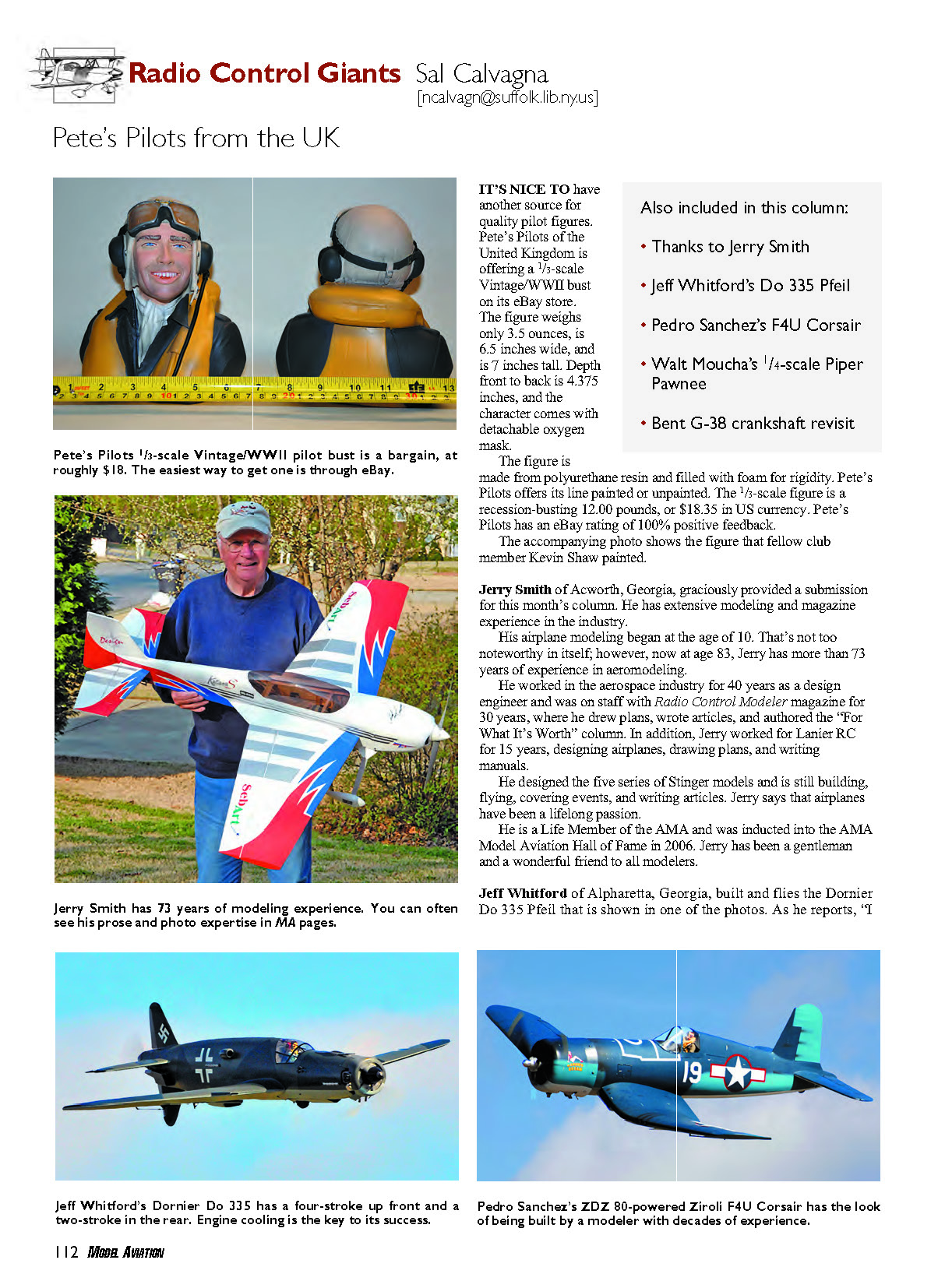
Radio Control Giants
Sal Calvagna [[email protected]]
Pete's Pilots from the UK
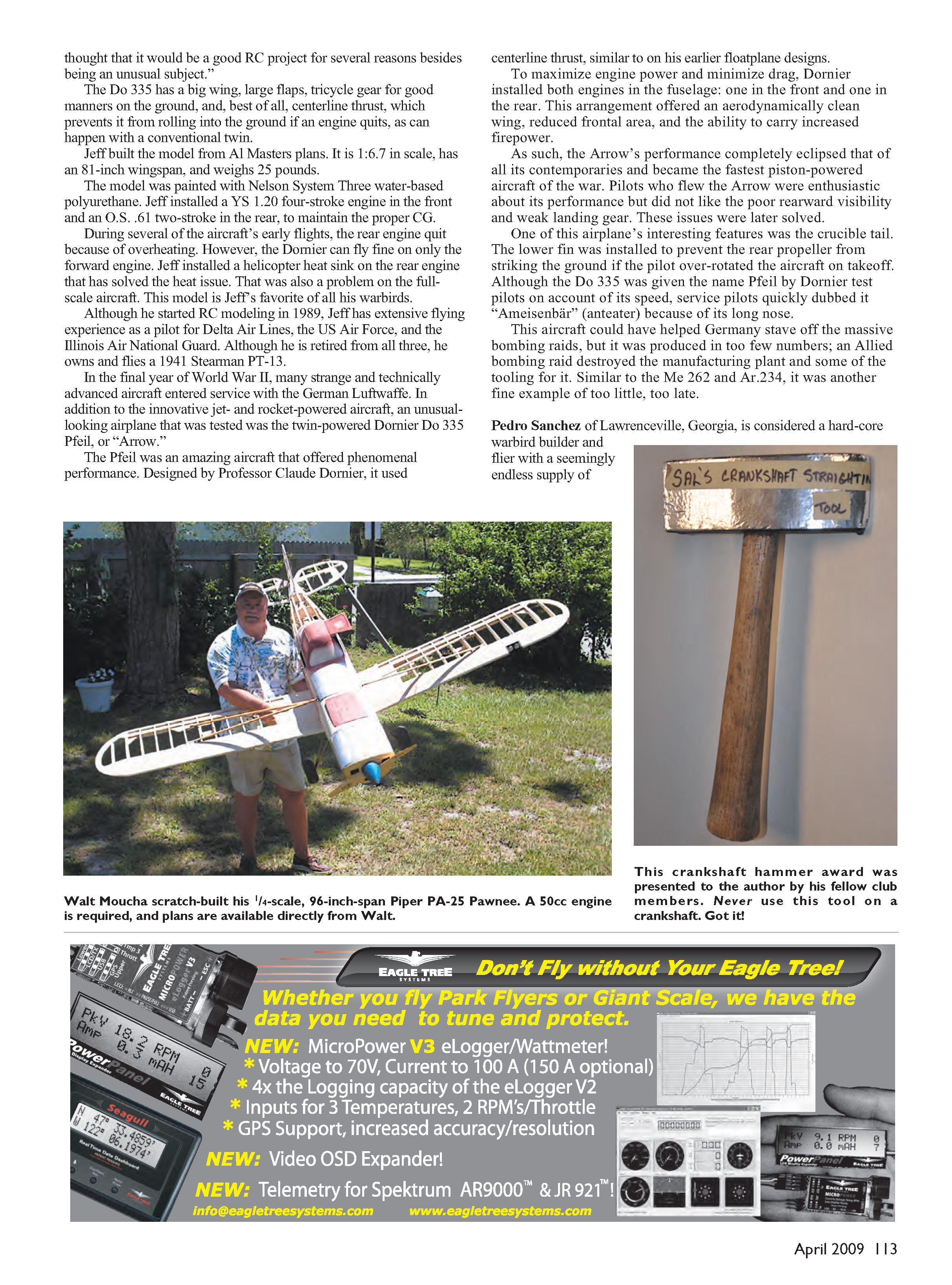
It's nice to have another source for quality pilot figures. Pete's Pilots of the United Kingdom is offering a 1/3-scale Vintage/WWII bust in its eBay store. The figure weighs only 3.5 ounces, is 6.5 inches wide, and is 7 inches tall. Depth front to back is 4.375 inches, and the character comes with a detachable oxygen mask.
The figure is made from polyurethane resin and filled with foam for rigidity. Pete's Pilots offers its line painted or unpainted. The 1/3-scale figure is a recession-busting 12.00 pounds, or $18.35 in U.S. currency. Pete's Pilots has an eBay rating of 100% positive feedback.
The accompanying photo shows the figure that fellow club member Kevin Shaw painted.
Jerry Smith — a modeling lifetime
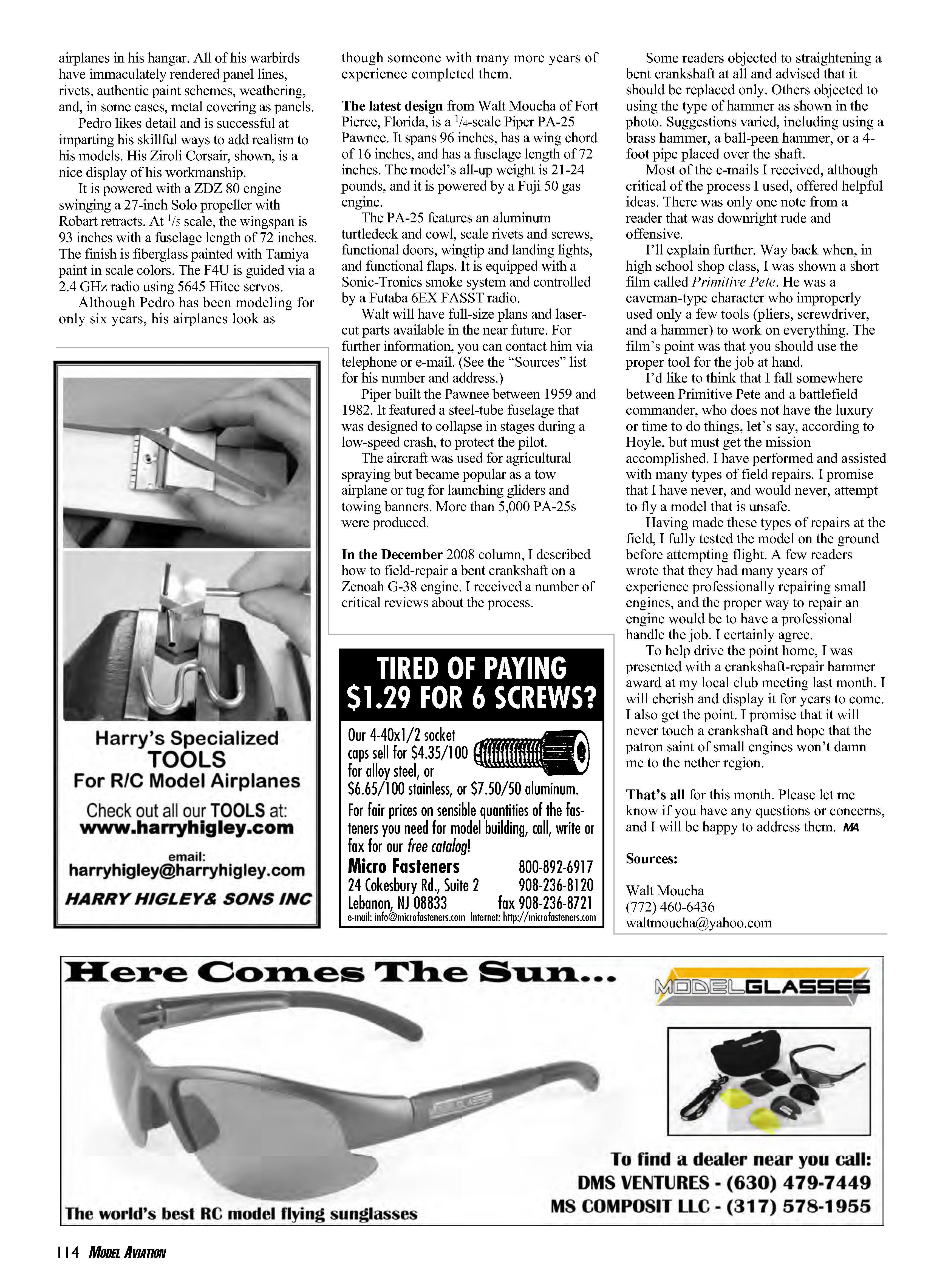
Jerry Smith of Acworth, Georgia, graciously provided a submission for this month's column. He has extensive modeling and magazine experience in the industry.
His airplane modeling began at the age of 10. That's not too noteworthy in itself; however, now at age 83, Jerry has more than 73 years of experience in aeromodeling.
He worked in the aerospace industry for 40 years as a design engineer and was on staff with Radio Control Modeler magazine for 30 years, where he drew plans, wrote articles, and authored the "For What It's Worth" column. In addition, Jerry worked for Lanier RC for 15 years, designing airplanes, drawing plans, and writing manuals.
He designed the five series of Stinger models and is still building, flying, covering events, and writing articles. Jerry says that airplanes have been a lifelong passion.
He is a Life Member of the AMA and was inducted into the AMA Model Aviation Hall of Fame in 2006. Jerry has been a gentleman and a wonderful friend to all modelers.
Jeff Whitford — Dornier Do 335 Pfeil (model)
Jeff Whitford of Alpharetta, Georgia, built and flies the Dornier Do 335 Pfeil shown in one of the photos. As he reports, "I thought that it would be a good RC project for several reasons besides being an unusual subject." The Do 335 has a big wing, large flaps, tricycle gear for good manners on the ground, and, best of all, centerline thrust, which prevents it from rolling into the ground if an engine quits, as can happen with a conventional twin.
Jeff built the model from Al Masters plans. It is 1:6.7 in scale, has an 81-inch wingspan, and weighs 25 pounds. The model was painted with Nelson System Three water-based polyurethane. Jeff installed a YS 1.20 four-stroke engine in the front and an O.S. .61 two-stroke in the rear to maintain the proper CG.
During several of the aircraft's early flights, the rear engine quit because of overheating. However, the Dornier can fly fine on only the forward engine. Jeff installed a helicopter heat sink on the rear engine, which solved the heat issue. That was also a problem on the full-scale aircraft. This model is Jeff's favorite of all his warbirds. Although he started RC modeling in 1989, Jeff has extensive flying experience as a pilot for Delta Air Lines, the U.S. Air Force, and the Illinois Air National Guard. Although he is retired from all three, he owns and flies a 1941 Stearman PT-13.
The Dornier Do 335 Pfeil — brief history
In the final year of World War II, many strange and technically advanced aircraft entered service with the German Luftwaffe. In addition to the innovative jet- and rocket-powered aircraft, an unusual-looking airplane that was tested was the twin-powered Dornier Do 335 Pfeil, or "Arrow."
The Pfeil was an amazing aircraft that offered phenomenal performance. Designed by Professor Claude Dornier, it used centerline thrust, similar to his earlier floatplane designs.
To maximize engine power and minimize drag, Dornier installed both engines in the fuselage: one in the front and one in the rear. This arrangement offered an aerodynamically clean wing, reduced frontal area, and the ability to carry increased firepower.
As such, the Arrow's performance completely eclipsed that of all its contemporaries and became the fastest piston-powered aircraft of the war. Pilots who flew the Arrow were enthusiastic about its performance but did not like the poor rearward visibility and weak landing gear. These issues were later addressed.
One of this airplane's interesting features was the cruciform tail. The lower fin was installed to prevent the rear propeller from striking the ground if the pilot over-rotated the aircraft on takeoff. Although the Do 335 was given the name Pfeil by Dornier test pilots on account of its speed, service pilots quickly dubbed it "Ameisenbär" (anteater) because of its long nose.
This aircraft could have helped Germany stave off the massive bombing raids, but it was produced in too few numbers; an Allied bombing raid destroyed the manufacturing plant and some of the tooling for it. Similar to the Me 262 and Arado Ar 234, it was another fine example of too little, too late.
Pedro Sanchez — Ziroli Corsair
Pedro Sanchez of Lawrenceville, Georgia, is considered a hard-core warbird builder and flier with a seemingly endless supply of airplanes in his hangar. All of his warbirds have immaculately rendered panel lines, rivets, authentic paint schemes, weathering, and, in some cases, metal covering as panels.
Pedro likes detail and is successful at imparting his skillful ways to add realism to his models. His Ziroli Corsair is a nice display of his workmanship.
It is powered with a ZDZ 80 engine swinging a 27-inch Solo propeller with Robart retracts. At 1/5 scale, the wingspan is 93 inches with a fuselage length of 72 inches. The finish is fiberglass painted with Tamiya paint in scale colors. The F4U is guided via a 2.4 GHz radio using 5645 Hitec servos.
Although Pedro has been modeling for only six years, his airplanes look as though someone with many more years of experience completed them.
Walt Moucha — 1/4-scale Piper PA-25 Pawnee
The latest design from Walt Moucha of Fort Pierce, Florida, is a 1/4-scale Piper PA-25 Pawnee. It spans 96 inches, has a wing chord of 16 inches, and has a fuselage length of 72 inches. The model's all-up weight is 21–24 pounds, and it is powered by a Fuji 50 gas engine.
The PA-25 features an aluminum turtledeck and cowl, scale rivets and screws, functional doors, wingtip and landing lights, and functional flaps. It is equipped with a Sonic-Tronics smoke system and controlled by a Futaba 6EX FASST radio.
Walt will have full-size plans and laser-cut parts available in the near future. For further information, you can contact him via telephone or e-mail. (See the "Sources" list for his number and address.)
Piper built the Pawnee between 1959 and 1982. It featured a steel-tube fuselage that was designed to collapse in stages during a low-speed crash to protect the pilot.
The aircraft was used for agricultural spraying but became popular as a tow airplane or tug for launching gliders and towing banners. More than 5,000 PA-25s were produced.
Crankshaft repair — reader feedback and response
In the December 2008 column, I described how to field-repair a bent crankshaft on a Zenoah G-38 engine. I received a number of critical reviews about the process.
Some readers objected to straightening a bent crankshaft at all and advised that it should be replaced only. Others objected to using the type of hammer shown in the photo. Suggestions varied, including using a brass hammer, a ball-peen hammer, or a 4-foot pipe placed over the shaft.
Most of the e-mails I received, although critical of the process I used, offered helpful ideas. There was only one note from a reader that was downright rude and offensive.
I'll explain further. Way back when, in high school shop class, I was shown a short film called Primitive Pete. He was a caveman-type character who improperly used only a few tools (pliers, screwdriver, and a hammer) to work on everything. The film's point was that you should use the proper tool for the job at hand.
I'd like to think that I fall somewhere between Primitive Pete and a battlefield commander, who does not have the luxury or time to do things, let's say, according to Hoyle, but must get the mission accomplished. I have performed and assisted with many types of field repairs. I promise that I have never, and would never, attempt to fly a model that is unsafe.
Having made these types of repairs at the field, I fully tested the model on the ground before attempting flight. A few readers wrote that they had many years of experience professionally repairing small engines, and the proper way to repair an engine would be to have a professional handle the job. I certainly agree.
To help drive the point home, I was presented with a crankshaft-repair hammer award at my local club meeting last month. I will cherish and display it for years to come. I also get the point. I promise that it will never touch a crankshaft and hope that the patron saint of small engines won't damn me to the nether region.
That's all for this month. Please let me know if you have any questions or concerns, and I will be happy to address them.
MA
Sources
- Walt Moucha
(772) 460-6436 [email protected]
Transcribed from original scans by AI. Minor OCR errors may remain.

