


Radio Control Giants
Sal Calvagna [email protected]
Questions about blended fuel
WELCOME BACK to the RC Giants column. In recent issues I have written about ethanol-blended fuels that we have been using in our gasoline-powered models. This must be a popular subject, because other publications have addressed the issue too. Small-engine repair shops point a finger at ethanol as the cause of fuel-system-related problems.
In an e-mail I received, a reader wrote that although his Quadra .35-powered Dr.I triplane has experienced no issues with blended fuels, both his leaf blower and his weed trimmer have required repair from dissolved plastic and gummed-up carburetors. Could it be that garden-equipment manufacturers use materials that are sensitive to ethanol that we modelers are not?
I don’t have the answer right now; however, I do know that some of the popular fuel lines we use become hard and brittle in time with blended fuel use. In our application, the most important piece of fuel line to check and replace as needed is the pickup line inside the tank — you know, the one with the clunk.
If anyone knows of a fuel line (appropriate for our models) that remains flexible in ethanol-blended fuels, please notify me so I can share the good news. Thanks!
Bill Fuori’s Douglas AC-47D gunship
Bill Fuori of The Villages, Florida, who splits his time between Florida and New York, built an incredible Douglas AC-47D gunship from Ziroli plans. Bill claims that he went the extra mile in improving the scale outline so he could compete in this year’s Top Gun Scale event.
Bill made all the molds for the 140-inch-span aircraft, including the nose cone, engine cowlings, and the smaller parts you can see on the model. Power is provided by two Zenoah G-38 engines. The AC-47D is covered with 1-ounce fiberglass cloth and is finished with automotive lacquer. More than 150 paint maskings were used to create the camouflage scheme. In addition to landing lights, Bill installed a sound system and special lighting to emulate the sight and noise of the three miniguns firing. He also applied more than 30,000 simulated rivets by hand to create an authentic-looking finish.
Bill will enter the model in the Top Gun Team class, and at the controls will be Dino DiGiorgio, a frequent Top Gun competitor. Excellent work, Bill, and best of luck to both of you!
AC-47D — background
In the 1960s, the Air Force tested aircraft with side-firing weapons for possible use in Vietnam. A Douglas C-47 cargo aircraft was converted to the AC-47D (attack/cargo) designation. This was a fixed-wing, side-firing gunship that could provide close air support of ground troops or planned strikes against known targets. In late 1964, the first AC-47D, call sign “Spooky,” was used in combat and became an instant success in halting enemy attacks on hamlets and defensive positions. After that, a substantial number of converted C-47s were put into action throughout Southeast Asia in a relatively short time period.
The converted transports/cargo airplanes were equipped with three 7.62 mm Gatling miniguns mounted in the fifth and sixth windows and the cargo-door area of the aircraft's port side. Roughly 16,500 rounds were carried on a typical mission.
During attack maneuvers, the gunship traveled at nearly 120 knots indicated airspeed. At a firing rate of 6,000 rounds per minute, the area covered was approximately 52 yards in diameter, placing a round within every 2.4 yards during a three-second burst.
No outpost or village under gunship protection was ever lost to the enemy. However, the AC-47Ds were easy targets; 15 of the 53 made were shot down between 1965 and 1969.
When these aircraft fired at night, it looked as though a sheet of flame poured from them. They soon became known as “Dragonships” and “Puff the Magic Dragon,” after the popular song of the time.
Fred Angel’s Boeing P-26A “Peashooter”
Fred Angel of Lunenburg, Massachusetts, built a nice Boeing P-26A “Peashooter.” The photograph was taken at the 2009 WRAM Show in Westchester, New York.
The model is 1/4 scale, spans 84 inches, and is powered by a Saito 1.70 three-cylinder, four-stroke glow engine. It weighs 23 pounds and is covered with Coverite fabric. The painted finish is aircraft dope. Very nice, Fred!
Boeing P-26A — background
The full-scale Boeing P-26 was the first all-metal production fighter and the first pursuit monoplane to serve the US Army Air Corps. The prototype was flown in 1932.
Although this was the US's first all-metal monoplane in service, it still had externally braced wings and fixed landing gear of earlier biplane design. But the P-26A did sport newly introduced flaps to reduce landing speed.
The aircraft was easy to fly, as its pilots reported, but it was soon outclassed by European contemporaries. Philippine Army Air Corps P-26s flew in combat against the Japanese early in World War II, but they were soon overwhelmed by the new Zero fighters.
The P-26 was the last Boeing fighter to enter service until the company acquired McDonnell Douglas in 1997. Boeing went on to build bombers and cargo aircraft for the military and became a household name with its line of civilian jetliners.
Lou Zackman Jr.’s Grumman F3F (work in progress)
Lou Zackman Jr. of Middle Island, New York, has a work in progress: his Grumman F3F fighter. The full-scale aircraft was the last American biplane fighter delivered to the US Navy in 1936, and it was retired from frontline squadrons at the end of 1941.
The model is 1/3 scale with a span of 110 inches. According to Lou, he is going to use a Desert Aircraft DA-150 twin-cylinder gas engine for power. Louis Pentecost of Seattle, Washington, designed the F3F's plans.
The fuselage will be covered with fiberglass cloth, and the wings will be covered with Solartex. Lou likes to use Rust-Oleum paint for the finish.
Keep up the good work!
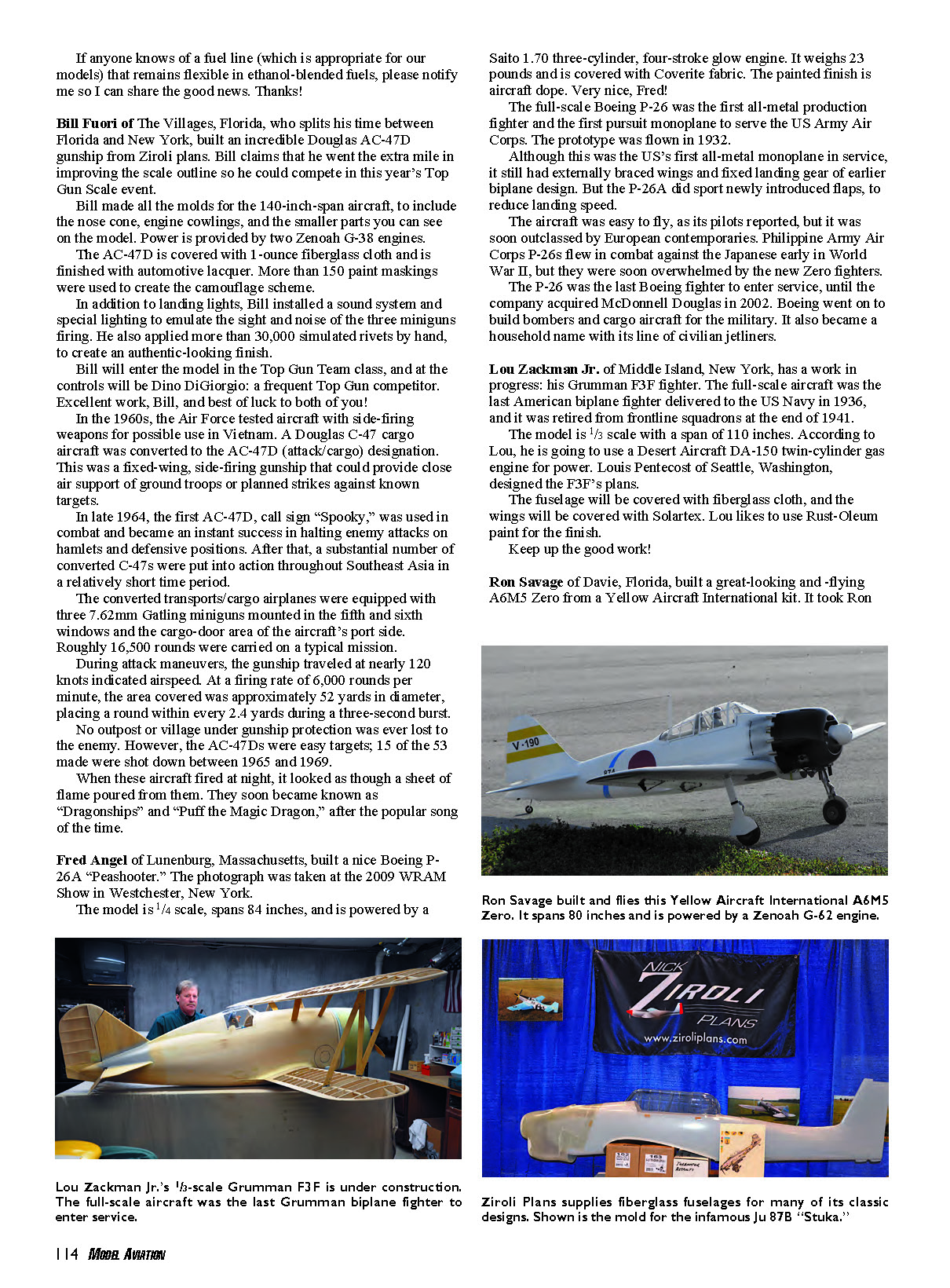
Ron Savage’s A6M5 Zero
Ron Savage of Davie, Florida, built a great-looking and -flying A6M5 Zero from a Yellow Aircraft International kit. It took Ron only two months to complete and had close to 10 flights on it as this column was being written. The model is finished in PPG paints, and power is provided by a Zenoah G-62 gas engine.
Ron wrote: "I started building and flying RC planes when I was in my early twenties, with limited success. After a particularly bad crash of a plane that I built from a plan in a magazine, I switched to RC boats. From there I moved on to full-size boats. I built several in-board runabouts and ended up building a 33-foot yawl.
"At the age of 60, I happened to see a neighbor with an RC airplane and went down the street to check it out. I was hooked and started building RC planes again. I started with trainers and worked my way up.
"I am now 71 and currently have seven 1/5-scale planes, mostly warbirds from Top Flite and Great Planes, including an F4U Corsair, P-47, two P-51 Mustangs, and an OV-10 Bronco from a Rich Uravitch kit. I fly at Markham Park in Ft. Lauderdale, Florida approximately three to four times a week.
"I think building RC planes is a great hobby, and is much more rewarding than assembling an ARF, if you have the time and the skill."
I couldn't agree more, Ron. Congratulations on such fine workmanship; I wish you well with all your modeling projects.
Ziroli fiberglass fuselages
Building a Ziroli-plans model is now easier because of newly offered fiberglass fuselages for many of the company's designs. Shown is the structure for the Ju 87B “Stuka” kit at the 2009 WRAM Show.
If you've wanted to build a Ziroli model but needed a head start, look at the list of models you can choose from that offer a fiberglass fuselage. Contact Nick Ziroli Plans and start building!
That's all for this month. I know that the majority of winter flying exists only in the warmer southern climates. However, since summer is upon us, we should be enjoying premium flying weather from sea to shining sea.
Get off your duff, take the model and a camera to your local field, and send me some nice photos of models flying. Let's see how good of a photographer you are!
MA
Sources:
- Top Gun — (863) 607-6611 — www.franktiano.com
- Nick Ziroli Plans — (631) 467-4765 — www.ziroliplans.com
Transcribed from original scans by AI. Minor OCR errors may remain.

