
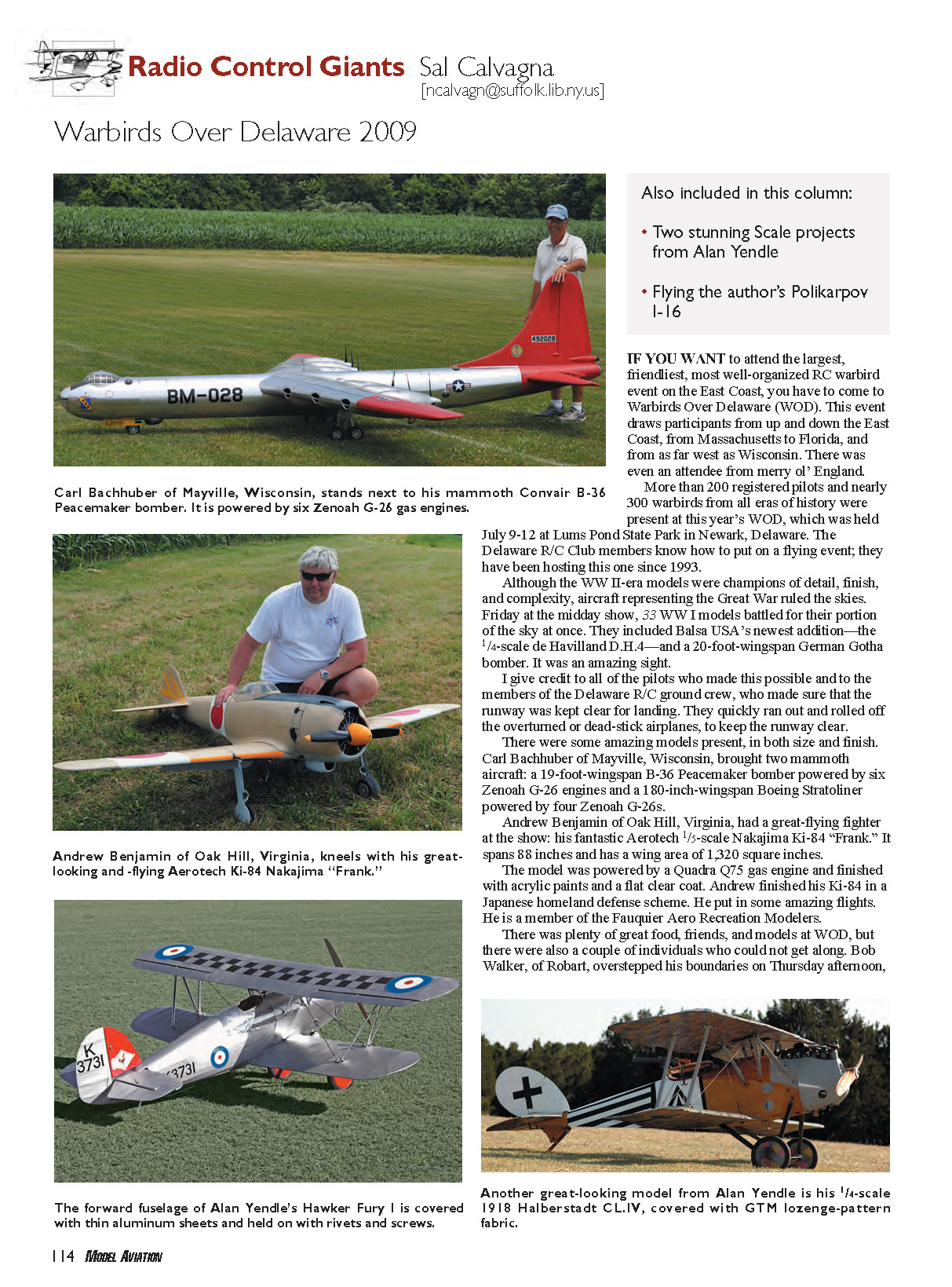
Warbirds Over Delaware 2009
By Sal Calvagna ([email protected])
Event overview
If you want to attend the largest, friendliest, most well-organized RC warbird event on the East Coast, you have to come to Warbirds Over Delaware (WOD). This event draws participants from up and down the East Coast, from Massachusetts to Florida, and from as far west as Wisconsin. There was even an attendee from merry ol' England.
More than 200 registered pilots and nearly 300 warbirds from all eras of history were present at this year's WOD, held July 9–12 at Lums Pond State Park in Newark, Delaware. The Delaware R/C Club members know how to put on a flying event; they have been hosting this one since 1993.
Although WWII-era models were champions of detail, finish, and complexity, aircraft representing the Great War ruled the skies. At the Friday midday show, 33 WWI models battled in the air at once. They included Balsa USA's newest addition — the 1/4-scale de Havilland D.H.4 — and a 20-foot-wingspan German Gotha bomber. It was an amazing sight.
I give credit to all of the pilots who made this possible and to the members of the Delaware R/C ground crew, who made sure the runway was kept clear for landing. They quickly ran out and rolled off overturned or dead-stick airplanes to keep the runway clear.
Notable aircraft and pilots
There were some amazing models present, in both size and finish.
- Carl Bachhuber of Mayville, Wisconsin, brought two mammoth aircraft: a 19-foot-wingspan B-36 Peacemaker bomber powered by six Zenoah G-26 engines and a 180-inch-wingspan Boeing Stratoliner powered by four Zenoah G-26s.
- Andrew Benjamin of Oak Hill, Virginia, flew a fantastic Aerotech 1/5-scale Nakajima Ki-84 "Frank." The fighter spans 88 inches and has a wing area of 1,320 square inches. The model was powered by a Quadra Q75 gas engine and finished with acrylic paints and a flat clear coat. Andrew finished his Ki-84 in a Japanese homeland defense scheme and put in some amazing flights. He is a member of the Fauquier Aero Recreation Modelers.
There was plenty of great food, friends, and models at WOD, but there were also a couple of individuals who could not get along. Bob Walker, of Robart, overstepped boundaries on Thursday afternoon by flying and landing near a residence; a local promptly chased him off the field. Bob argued his point, which made the other guy so angry that he broke through a protective fence and attacked one of the parked models. There is a video of the whole event; see the Sources list for a link.
The Delaware R/C Club works hard to accommodate many modelers for this great event. From impound to flightline safety, plenty of members are always on hand to ensure the fly-in goes smoothly and safely. The club even provides a huge tent in which to store and protect models overnight. On the topic of tents, if CDs Dave and Pete Malchione try to sell you a used one, don't go for the deal — the last one they sold me had more holes in it than the Titanic. Thanks, Dave and Pete.
See you all in 2010!
Alan Yendle's models
Alan Yendle, a prolific scale modeler formerly of Atlanta, Georgia, who has moved to Austin, Texas, built two beautiful models after getting his shop back together.
- Hawker Fury I
- Built at 27.5% scale to accommodate a Quadra 75 in the pointed nose; a smaller scale would not have accommodated the engine.
- Wingspan: 99 inches; weight: 39 pounds.
- Forward fuselage covered with thin aluminum sheet, riveted and screwed into the framework.
- Tunnel built from the rear of the engine exits into a large radiator under the lower wing to assist engine cooling.
- Sydney Camm, who later designed the Hawker Hurricane, Typhoon, and Tempest, designed the full-scale Hawker Fury I in 1942. Alan thinks it's one of the best-looking biplanes of that era.
- Halberstadt CL.IV
- Scale: 1/4; wingspan: 105 inches.
- Power: Air Hobbies Sachs Dolmar 3.2 ignition gas engine.
- Weight: 38 pounds.
- Covered with GTM Lozenge Fabric from Glenn Torrance Models.
- Built from Windsock Datafile No. 43 and photos taken at the Air Force Museum at Wright-Patterson AFB in Dayton, Ohio.
Both the Fury I and the CL.IV are beautifully constructed, as are all of Alan's models. It's great to see this quality on seldom-modeled subjects. Great going, Alan.
My 1/4-scale Polikarpov I-16 project
The 1/4-scale Polikarpov I-16 project took me two years of sporadic building to finally complete. As with all models, some parts were straightforward — the tail feathers, foam-core wing, and cowling were fairly easy. Installing the Zenoah G-62 engine was simple because of the huge, round cowl. There was so much room that I was able to use the stock "can" muffler that came with the power plant.
Some aspects were taxing, such as the fuselage with many curves and large fillets. Making the spinner was also a pain. I caught a break when my friend Mike at Nick Ziroli Plans showed me a spinner backplate available for the Ziroli P-38 Lightning. It was the correct diameter and shape for my I-16; I used it and some blue foam to fabricate the spinner.
The landing gear installation was by far the most difficult aspect. To somewhat replicate the full-scale aircraft, I needed three struts on each main gear, and the gear had to retract nearly 20° rearward into the wing. Since there was nothing closely related I could purchase off the shelf, I had to fabricate something. I used a set of Robart Heavy Duty 635 Series low-profile retracts as the basis and added two faux struts made from telescoping brass tubes. The fake struts are cosmetic only; the Robart gear and main strut do all the work.
After two years of building, I was ready for that first, nerve-racking flight. Please understand that had this been a more commonly modeled subject, such as the Mustang, P-47, or Zero, I would have been less hesitant. I didn't know what to expect as my Polikarpov I-16 left the ground.
Since my airplane is short-coupled and has large elevators, I programmed some exponential into the elevator and ailerons. I read that the full-scale aircraft had a phenomenal roll rate.
I taxied the model onto our beautiful 700-foot manicured grass runway and decided to try a gentle test hop first. I powered up and used a bit of rudder to guide the airplane straight. The tail came up nicely, and the airplane headed down the runway on the mains. With no further radio input, the I-16 lifted off gently and proceeded to climb out on its own. So much for the test hop.
The model climbed to a safe altitude. I put the gear up and turned the aircraft downwind to trim it for level flight. All it needed was a few clicks of down elevator (I guess that's why it flew off the ground without elevator input). At that point, I felt my heart would no longer burst through my chest, and I happily flew a couple of racetrack patterns as I calmed down. To my surprise, the aircraft was extremely stable.
I made some high-speed passes, a bit lower, and then practiced banking more sharply to see if it would drop off in a turn. It was rock-solid and extremely predictable. So far, so good — time to attempt a landing.
I slowed the model, put the gear down, and lined up on approach. The airplane was extraordinarily stable and started to lose altitude as I reduced throttle, arriving at an excellent glide angle to our field. One of the main wheels dropped off at approximately 50 feet of altitude. The I-16 was still approaching nicely, but it had one peg leg and I was frozen in horror.
As the model came closer, fellow club members yelled, "Put the gear up!" I hit the retract switch, the gear rose, and I proceeded to belly in the aircraft ever so softly. All was fine; there was not a scratch on the airplane, thanks to the gentle grass.
I now have roughly a dozen flights on the I-16 and feel much more comfortable with its performance. The exponential helps smooth the flight; in fact, I increased the exponential on the elevator since it was still a bit sensitive. I could not be happier, and this Polikarpov should be a welcomed addition to all those Mustangs, Spitfires, Fw 190s, and Zeros on the model warbird circuit. If you have any questions about the I-16, drop me a line and I will be happy to respond.
Sources
- WOD video: www.youtube.com/watch?v=bElbdcz74aM
- International Miniature Aircraft Association: www.fly-imaa.org
Transcribed from original scans by AI. Minor OCR errors may remain.

