
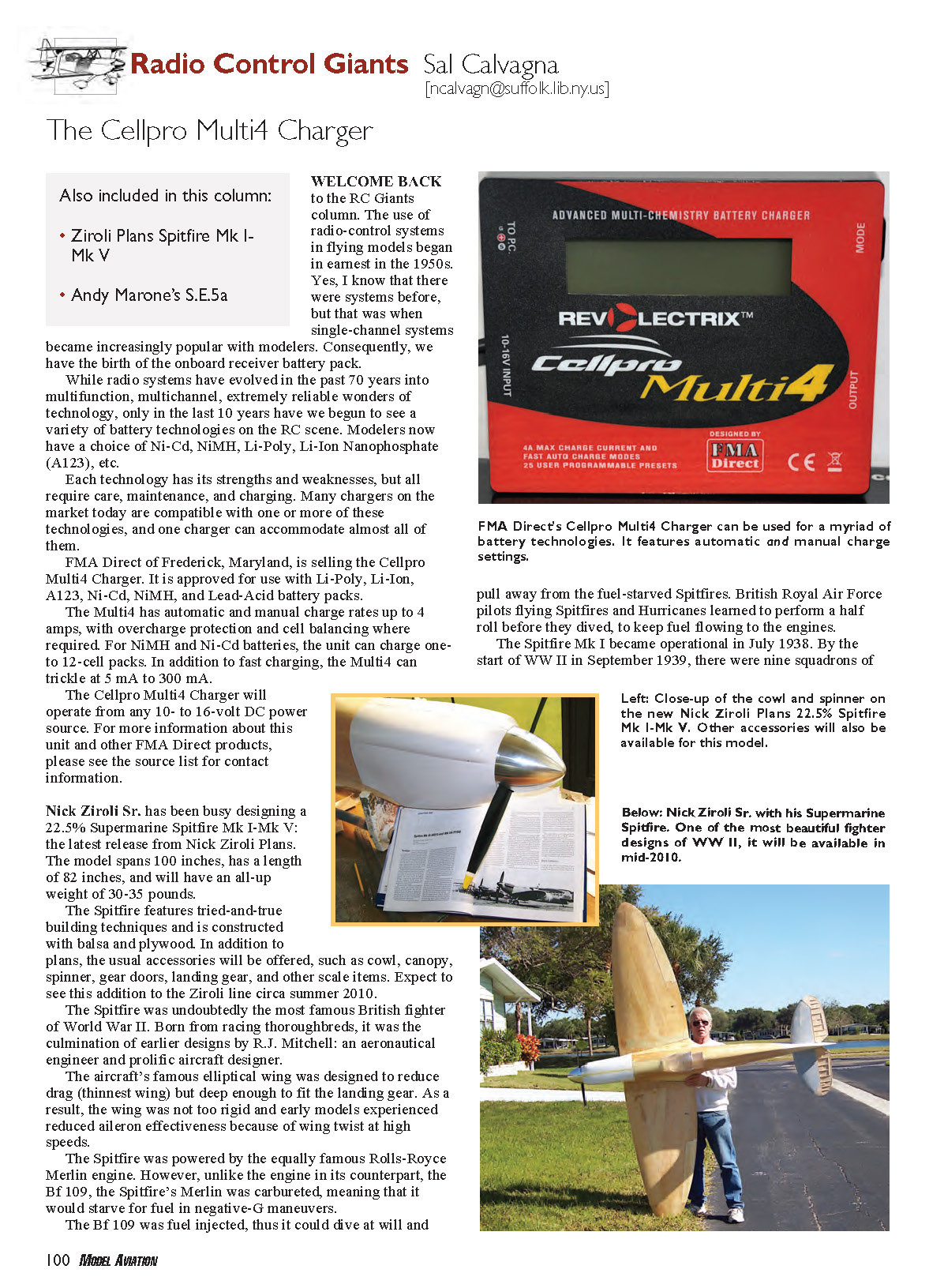
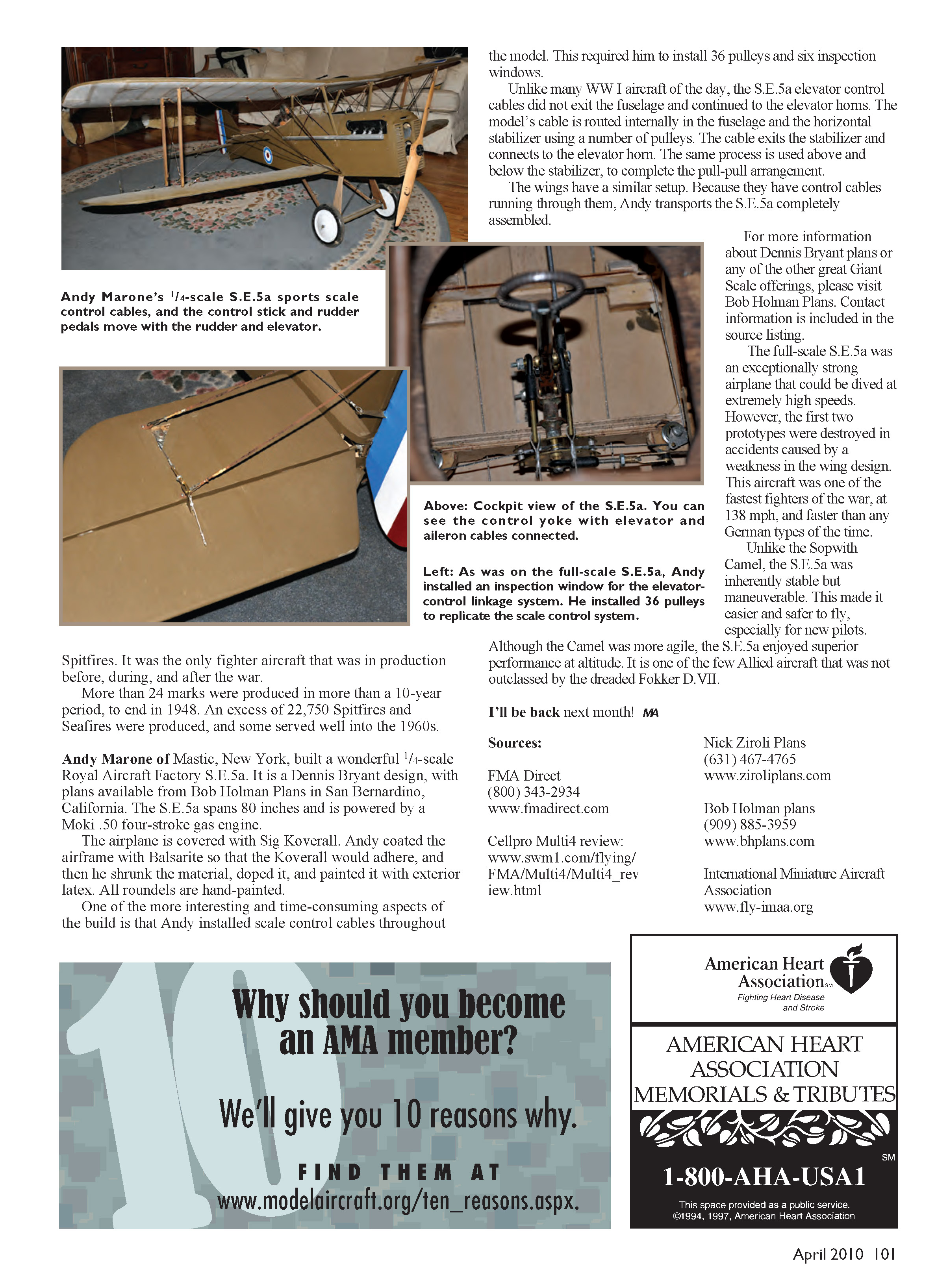
Radio Control Giants
Sal Calvagna [[email protected]]
The Cellpro Multi4 Charger
Welcome back to the RC Giants column. The use of radio-control systems in flying models began in earnest in the 1950s. Yes, there were systems before then, but that era marked when single-channel systems became increasingly popular with modelers and the birth of the onboard receiver battery pack.
Radio systems have evolved over the past 70 years into multifunction, multichannel, extremely reliable wonders of technology. Only in the last 10 years have we seen a variety of battery technologies enter the RC scene. Modelers now have a choice of Ni-Cd, NiMH, Li-Poly, Li-Ion Nanophosphate (A123), and more. Each technology has strengths and weaknesses, but all require care, maintenance, and proper charging. Many modern chargers are compatible with one or more technologies, and one charger can often accommodate almost all of them.
FMA Direct of Frederick, Maryland, sells the Cellpro Multi4 Charger. It is approved for use with Li-Poly, Li-Ion, A123, Ni-Cd, NiMH, and lead-acid battery packs.
Features
- Automatic and manual charge rates up to 4 A
- Overcharge protection and cell balancing where required
- Can charge 1- to 12-cell NiMH and Ni-Cd packs
- Fast charging plus trickle charging from 5 mA to 300 mA
- Operates from any 10- to 16-volt DC power source
For more information about this unit and other FMA Direct products, see the source list.
Nick Ziroli 22.5% Supermarine Spitfire Mk I–Mk V
Nick Ziroli Sr. has been busy designing a 22.5% Supermarine Spitfire Mk I–Mk V—the latest release from Nick Ziroli Plans. The model spans 100 inches, has a length of 82 inches, and will have an all-up weight of 30–35 pounds.
The Spitfire will use tried-and-true building techniques and is constructed with balsa and plywood. In addition to plans, the usual accessories will be offered, such as cowl, canopy, spinner, gear doors, landing gear, and other scale items. Expect this addition to the Ziroli line circa summer 2010.
Historical notes
The Spitfire was undoubtedly the most famous British fighter of World War II. Born from racing-thoroughbred design principles, it was the culmination of earlier work by R.J. Mitchell, a prolific aeronautical engineer and aircraft designer.
- The aircraft’s famous elliptical wing reduced drag while remaining deep enough to fit the landing gear. Early examples experienced reduced aileron effectiveness at high speeds due to wing twist.
- The Spitfire was powered by the Rolls-Royce Merlin engine. Unlike the Bf 109’s fuel-injected engine, the Merlin was carbureted and could starve for fuel in negative-G maneuvers. German Bf 109s, being fuel injected, could dive aggressively and gain advantage; RAF pilots learned to perform a half roll before diving to keep fuel flowing.
- The Spitfire Mk I became operational in July 1938. By the start of WWII in September 1939 there were nine squadrons of Spitfires. It was the only fighter aircraft in production before, during, and after the war.
- More than 24 marks were produced over a roughly 10-year period ending in 1948. More than 22,750 Spitfires and Seafires were built, and some served into the 1960s.
1/4-Scale Royal Aircraft Factory S.E.5a (Dennis Bryant design)
Andy Marone of Mastic, New York, built a fine 1/4-scale Royal Aircraft Factory S.E.5a. It is a Dennis Bryant design, with plans available from Bob Holman Plans. The model spans 80 inches and is powered by a Moki .50 four-stroke gas engine.
Construction and finish
- The airplane is covered with Sig Koverall. Andy coated the airframe with Balsarite so that the Koverall would adhere, then shrunk the material, doped it, and painted it with exterior latex.
- All roundels are hand-painted.
Scale control cable installation
One of the more interesting and time-consuming aspects of the build was installing scale control cables throughout the model. This required the installation of 36 pulleys and six inspection windows.
Unlike many WWI aircraft, the S.E.5a elevator control cables did not exit the fuselage and continue directly to the elevator horns. Andy routed the model’s elevator cables internally through the fuselage and horizontal stabilizer using multiple pulleys. The cable exits the stabilizer and connects to the elevator horn. The same arrangement is used above and below the stabilizer to complete the pull-pull setup. The wings have a similar internal control-cable layout. Because of this complete internal routing, Andy transports the S.E.5a fully assembled.
For more information about Dennis Bryant plans or other Giant Scale offerings, see the source listing.
Full-scale S.E.5a notes
The full-scale S.E.5a was an exceptionally strong airplane capable of very high-speed dives. The first two prototypes were lost in accidents caused by a wing-design weakness, but the type went on to become one of the fastest fighters of the war—about 138 mph—and faster than any contemporary German types at the time. Unlike the Sopwith Camel, the S.E.5a was inherently stable but still maneuverable, making it easier and safer to fly, especially for new pilots. Although the Camel was more agile, the S.E.5a enjoyed superior high-altitude performance and was one of the few Allied aircraft not outclassed by the Fokker D.VII.
I'll be back next month! —Sal Calvagna
Sources
- FMA Direct, (800) 343-2934, www.fmadirect.com
- Cellpro Multi4 review: www.swm1.com/flying/FMA/Multi4/Multi4_review.html
- Nick Ziroli Plans, (631) 467-4765, www.ziroliplans.com
- Bob Holman Plans, (909) 885-3959, www.bhplans.com
- International Miniature Aircraft Association, www.fly-imaa.org
Transcribed from original scans by AI. Minor OCR errors may remain.

