
Radio Control Giants
Sal Calvagna [[email protected]]
The BH Models Chipmunk ARF
Welcome to the July RC Giants column.
ARFs have been around for quite some time. Heck, I bought my first one, an EZ Super Chipmunk, in, of all unlikely places, a hobby store in Kuala Lumpur, Malaysia, in 1985 while serving with the State Department. If I remember correctly, it had a wingspan of 63 inches and called for a .40–.60 glow engine. The model looked great finished in the scheme of Art Scholl, a well-known aerobatics pilot.
The Chipmunk was constructed using minimal wood—balsa and light plywood—but it was mainly held together with a funky 1/8-inch foam covering that had the color and graphics embedded. The covering was nearly impossible to repair if you dinged it up.
ARFs took off, and for the next two decades they flourished in the .25–.60 size range. However, it took a little longer for them to gravitate toward Giant Scale. At first, ARFs were mostly scale aerobatics models such as the Laser and Extra, and there were Golden Age and civil designs. There were also military types of Giant Scale models, but not as many as are available today.
Giant ARF military aircraft have exploded onto the modeling scene in the last couple of years. They come in different sizes, types, and varying degrees of quality. A general rule is that the model's degree of quality or scale fidelity can be determined by its sticker price. Following are some options.
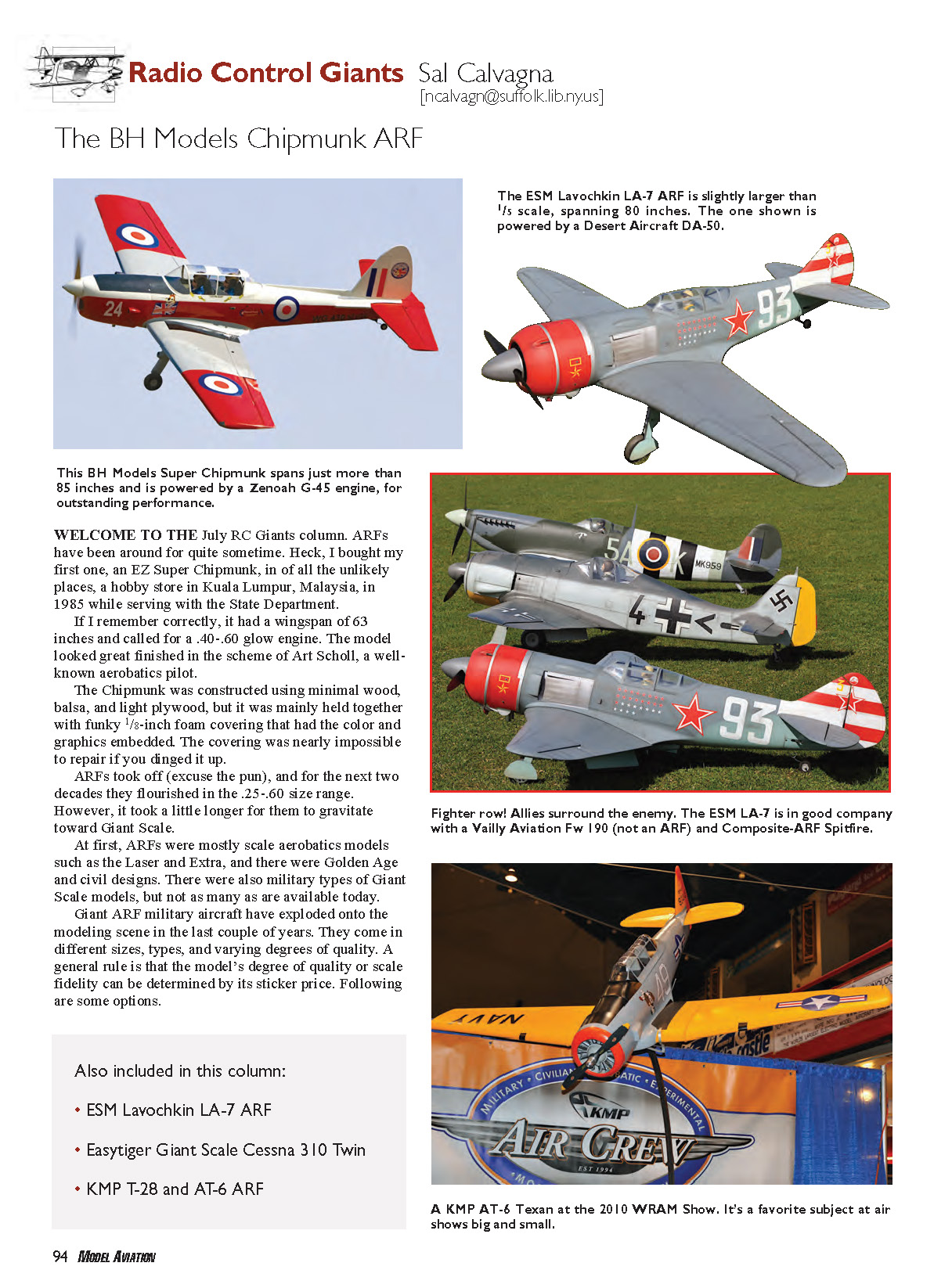
The BH Models Giant Scale Chipmunk ARF is available from Hobby People. It spans 85.5 inches, has a fuselage length of 69 inches, and has an all-up weight of nearly 14 pounds. This airplane was designed for an approximately 45cc power plant.
The main landing gear features sprung oleo struts. The Chipmunk is constructed from light plywood and balsa, and the covering is Oracover. A large, removable upper hatch offers access for battery packs if you want to convert the model to electric power. The Chipmunk requires a six-channel radio and seven high-torque servos.
My friend Gerry Yarrish owns one of these fine ARFs, and it has been featured in an issue of Model Airplane News. It is powered with a Zenoah G-45 gas engine and is an outstanding performer at 14 pounds.
For more information about the Chipmunk and other BH ARFs, please visit the Hobby People website.
Ever Soaring Models La-7
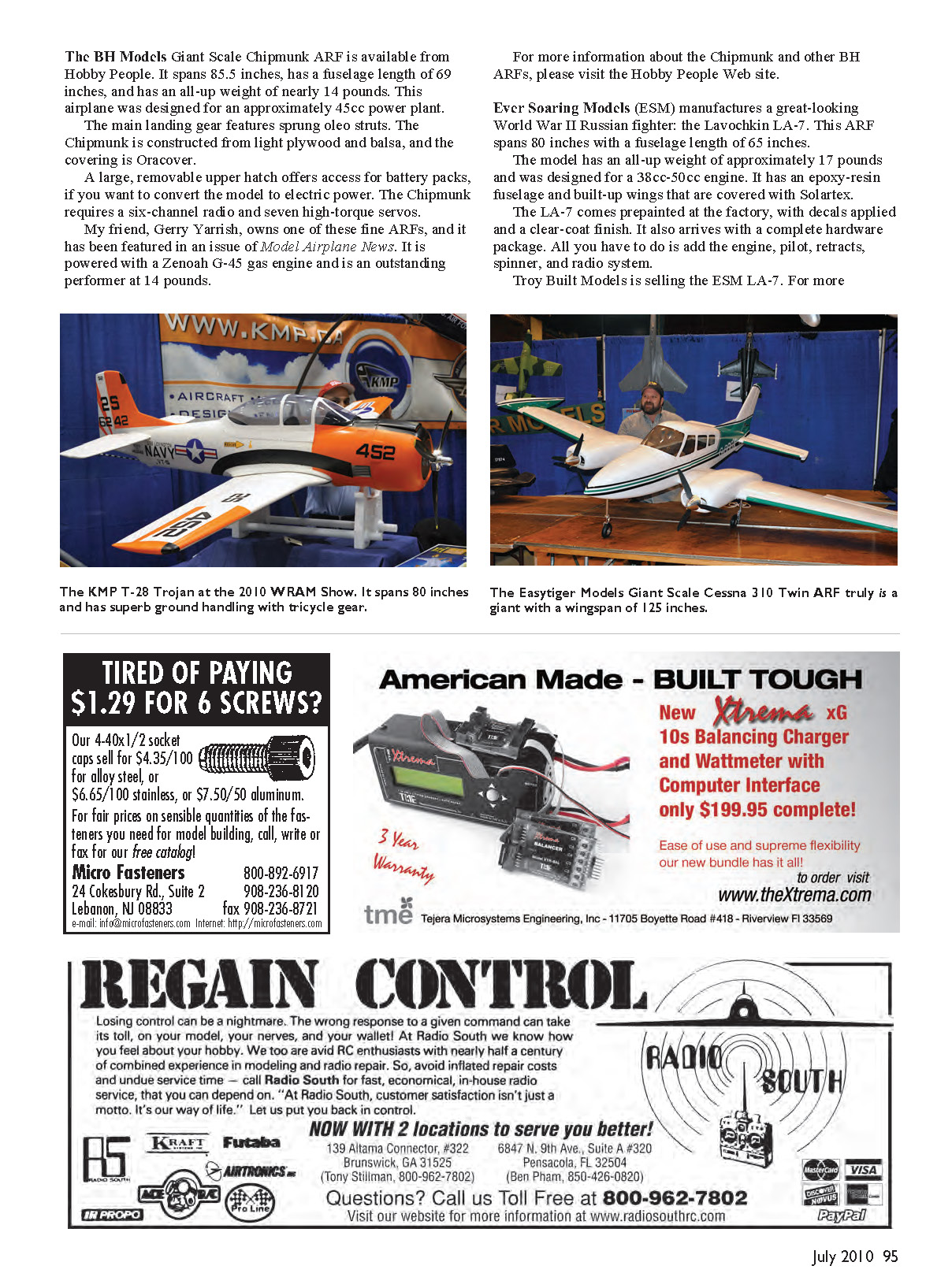
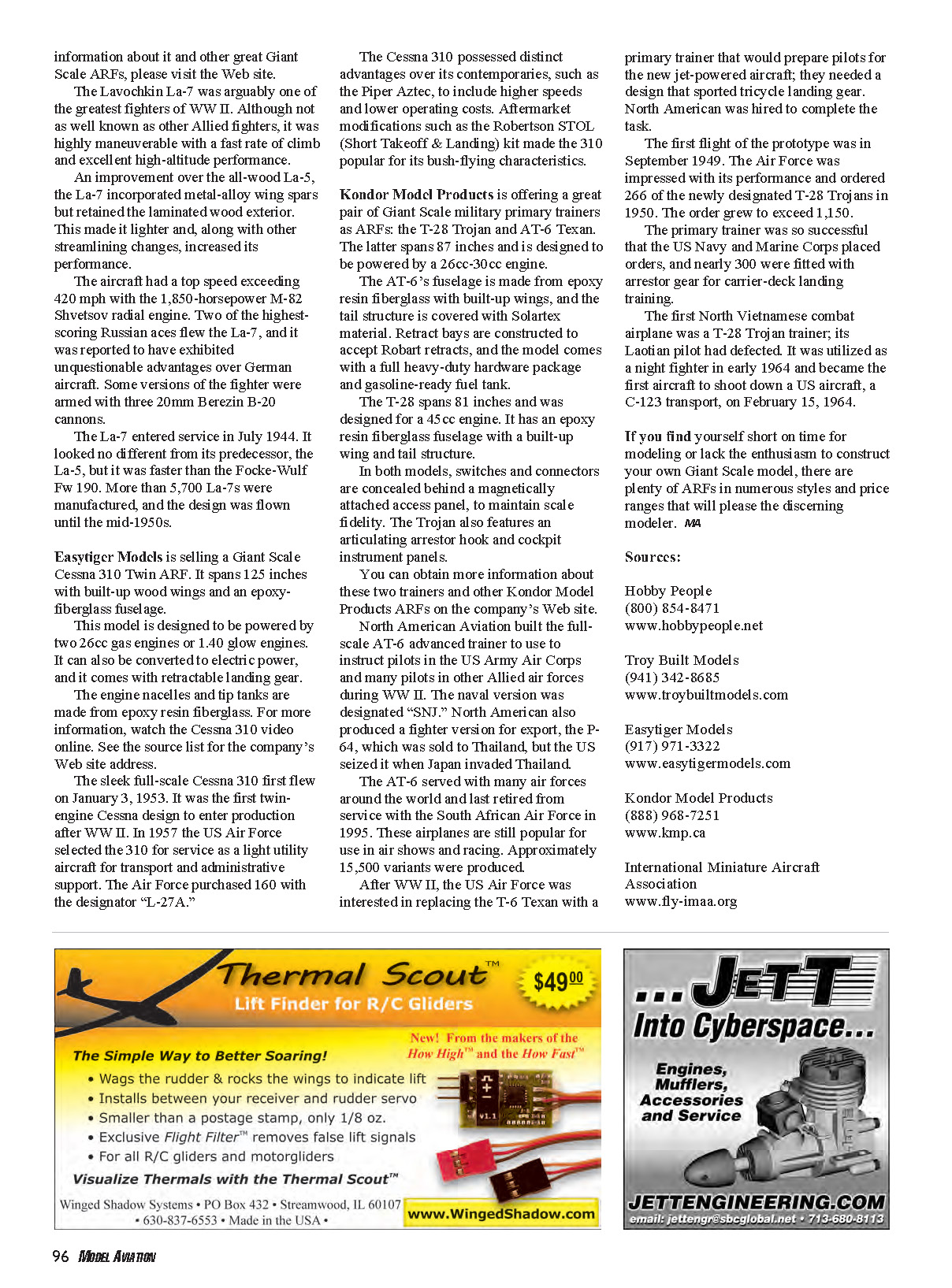
Ever Soaring Models (ESM) manufactures a great-looking World War II Russian fighter: the Lavochkin La-7. This ARF spans 80 inches with a fuselage length of 65 inches.
The model has an all-up weight of approximately 17 pounds and was designed for a 38cc–50cc engine. It has an epoxy-resin fuselage and built-up wings that are covered with Solartex. The La-7 comes prepainted at the factory, with decals applied and a clear-coat finish. It also arrives with a complete hardware package. All you have to do is add the engine, pilot, retracts, spinner, and radio system.
Troy Built Models is selling the ESM La-7. For more information about it and other great Giant Scale ARFs, please visit their website.
The Lavochkin La-7 was arguably one of the greatest fighters of WWII. Although not as well known as other Allied fighters, it was highly maneuverable with a fast rate of climb and excellent high-altitude performance. An improvement over the all-wood La-5, the La-7 incorporated metal-alloy wing spars but retained the laminated wood exterior. This made it lighter and, along with other streamlining changes, increased its performance.
The aircraft had a top speed exceeding 420 mph with the 1,850-horsepower M-82 Shvetsov radial engine. Two of the highest-scoring Russian aces flew the La-7, and it was reported to have exhibited unquestionable advantages over German aircraft. Some versions of the fighter were armed with three 20 mm Berezin B-20 cannons.
The La-7 entered service in July 1944. It looked no different from its predecessor, the La-5, but it was faster than the Focke-Wulf Fw 190. More than 5,700 La-7s were manufactured, and the design was flown until the mid-1950s.
Easytiger Models Cessna 310 Twin ARF
Easytiger Models is selling a Giant Scale Cessna 310 Twin ARF. It spans 125 inches with built-up wood wings and an epoxy-fiberglass fuselage.
This model is designed to be powered by two 26cc gas engines or two .40 glow engines. It can also be converted to electric power, and it comes with retractable landing gear. The engine nacelles and tip tanks are made from epoxy resin fiberglass. For more information, watch the Cessna 310 video online or visit the company website.
The sleek full-scale Cessna 310 first flew on January 3, 1953. It was the first twin-engine Cessna design to enter production after WWII. In 1957 the U.S. Air Force selected the 310 for service as a light utility aircraft for transport and administrative support, purchasing 160 with the designator L-27A.
The Cessna 310 possessed distinct advantages over its contemporaries, such as the Piper Aztec, including higher speeds and lower operating costs. Aftermarket modifications such as the Robertson STOL (Short Takeoff & Landing) kit made the 310 popular for its bush-flying characteristics.
Kondor Model Products T-28 Trojan and AT-6 Texan
Kondor Model Products is offering a great pair of Giant Scale military primary trainers as ARFs: the T-28 Trojan and the AT-6 Texan.
- AT-6 Texan
- Span: 87 inches
- Designed for: 26cc–30cc engine
- Fuselage: epoxy resin fiberglass with built-up wings
- Tail: covered with Solartex
- Features: retract bays constructed to accept Robart retracts, full heavy-duty hardware package, gasoline-ready fuel tank
- T-28 Trojan
- Span: 81 inches
- Designed for: 45cc engine
- Fuselage: epoxy resin fiberglass with built-up wing and tail
- Features: articulating arrestor hook, cockpit instrument panels
In both models, switches and connectors are concealed behind a magnetically attached access panel to maintain scale fidelity. You can obtain more information about these two trainers and other Kondor Model Products ARFs on the company's website.
North American Aviation built the full-scale AT-6 advanced trainer to use to instruct pilots in the U.S. Army Air Corps and many Allied air forces during WWII. The naval version was designated SNJ. North American also produced a fighter version for export, the P-64, which was sold to Thailand, but the U.S. seized it when Japan invaded Thailand.
The AT-6 served with many air forces around the world and last retired from service with the South African Air Force in 1995. These airplanes are still popular for use in air shows and racing. Approximately 15,500 variants were produced.
After WWII, the U.S. Air Force was interested in replacing the T-6 Texan with a primary trainer that would prepare pilots for the new jet-powered aircraft; they needed a design that sported tricycle landing gear. North American was hired to complete the task. The prototype's first flight was in September 1949. The Air Force was impressed with its performance and ordered 266 of the newly designated T-28 Trojans in 1950. The order grew to exceed 1,150.
The primary trainer was so successful that the U.S. Navy and Marine Corps placed orders, and nearly 300 were fitted with arrestor gear for carrier-deck landing training. The first North Vietnamese combat airplane was a T-28 Trojan trainer flown by a defected Laotian pilot; it was utilized as a night fighter in early 1964 and became the first aircraft to shoot down a U.S. aircraft, a C-123 transport, on February 15, 1964.
If you find yourself short on time for modeling or lack the enthusiasm to construct your own Giant Scale model, there are plenty of ARFs in numerous styles and price ranges that will please the discerning modeler.
Sources:
- Hobby People — (800) 854-8471 — www.hobbypeople.net
- Troy Built Models — (941) 342-8685 — www.troybuiltmodels.com
- Easytiger Models — (917) 971-3322 — www.easytigermodels.com
- Kondor Model Products — (888) 968-7251 — www.kmp.ca
- International Miniature Aircraft Association — www.fly-imaa.org
Transcribed from original scans by AI. Minor OCR errors may remain.

