
Follow-up on Andy Marone’s Sopwith
Sal Calvagna <[email protected]>
WELCOME BACK. Why does it seem as though summer passes so quickly, while the winter lingers for an eternity? Talk about time flying — September is already here and fall is on the way. Don’t fret; there’s still plenty of good flying weather to enjoy this season.
In the April issue, Andy Marone of Manorville, New York, was busy scratchbuilding a 1/3-scale Sopwith Triplane. I have some photos of the completed model to share.
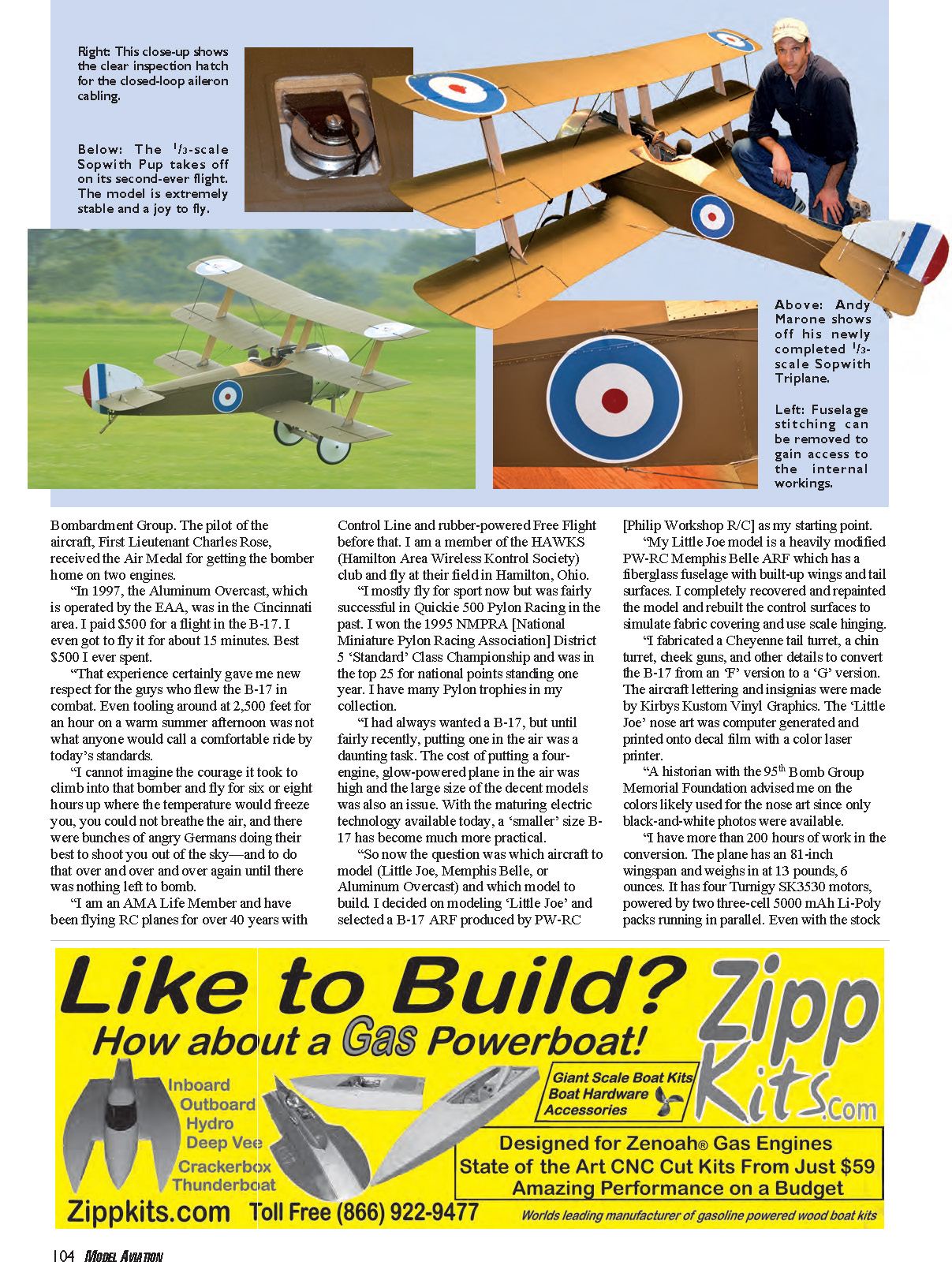
Andy Marone recently completed a 1/3-scale Sopwith Triplane built from his own plans based on Replicraft drawings. This build was first featured in the April 2011 “RC Giants” column. Andy has completed the model and I had an opportunity to photograph it before its first flight.
He built the model with scale fidelity in mind — from the precise placement of the wing ribs to the scale control cabling that operates the ailerons, elevators, and rudder. Even the covering on the fuselage has scale stitching that can be removed to access the internal workings.
Because the three wings contain the scale aileron cables, he cannot easily take the model apart for transportation, so Andy transports the fully assembled model in a large trailer he purchased. The model is powered by a Rotomotor Roto 85cc two-cylinder, four-stroke gas engine.
The Sopwith Triplane was designed by Herbert Smith in 1916 with three narrow-chord wings and a fuselage and tailplane similar to that of the Sopwith Pup. Although it had one more wing than the Pup, the new aircraft allowed the pilot a greatly improved field of view.
The prototype first flew in May 1916 and it became an instant success. More importantly, the triplane could out-climb and out-turn the German Albatros of the same period. The Germans were so impressed with the triplane’s performance that they made it a priority to secure a downed triplane for evaluation, which led to the existence of the Fokker triplane.
Andy has flown the model and reports that it exceeds his expectations in flight. Nice work, Andy!
Also included in this column:
- Todd Bailey’s PW-RC B-17
- ViperJet by Skymaster RC
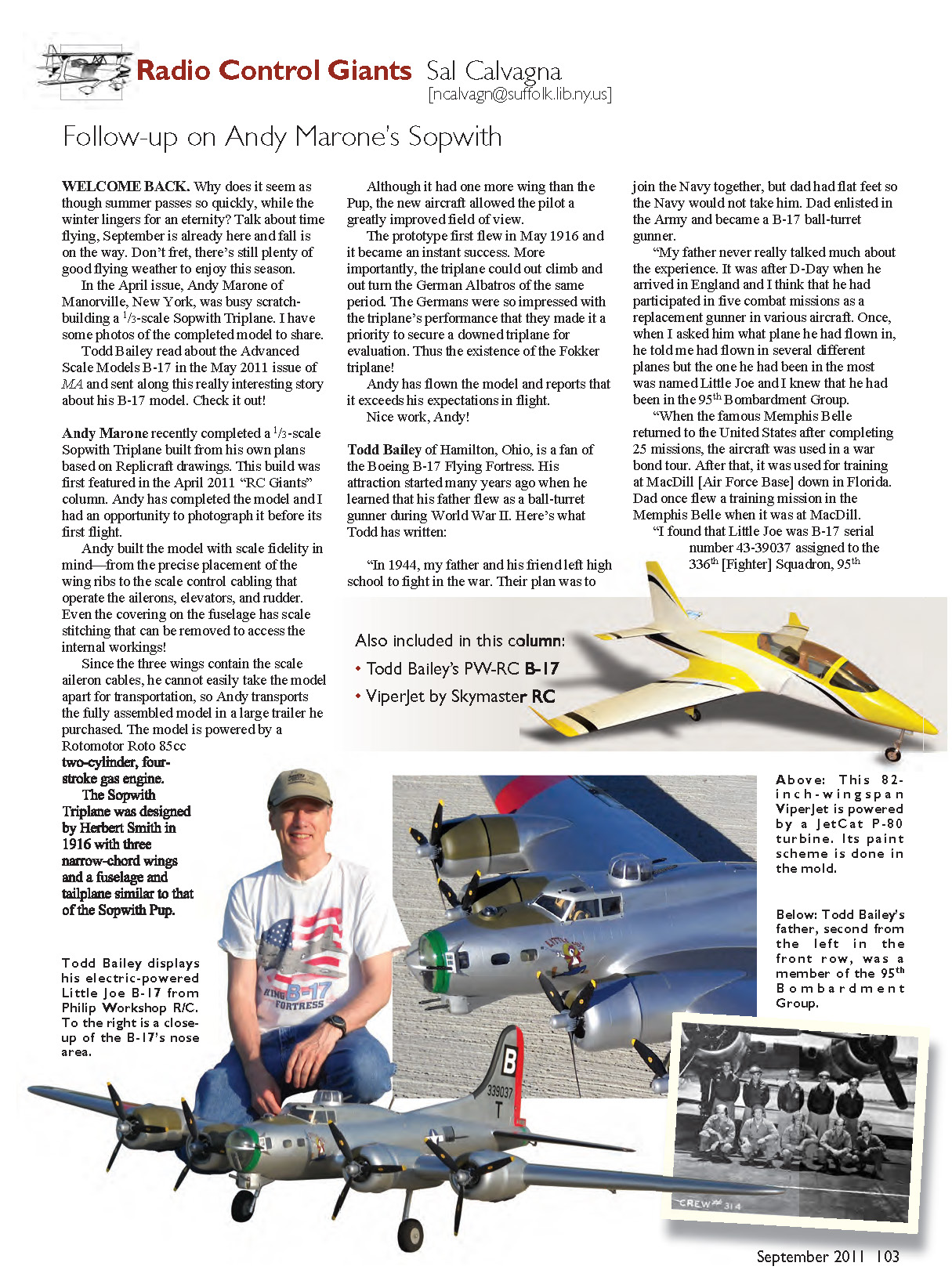
Todd Bailey’s PW-RC B-17
Todd Bailey of Hamilton, Ohio, is a fan of the Boeing B-17 Flying Fortress. His attraction started many years ago when he learned that his father flew as a ball-turret gunner during World War II. Here’s what Todd has written:
“In 1944, my father and his friend left high school to fight in the war. Their plan was to join the Navy together, but dad had flat feet so the Navy would not take him. Dad enlisted in the Army and became a B-17 ball-turret gunner.
“My father never really talked much about the experience. It was after D-Day when he arrived in England and I think that he had participated in five combat missions as a replacement gunner in various aircraft. Once, when I asked him what plane he had flown in, he told me he had flown in several different planes but the one he had been in the most was named Little Joe and I knew that he had been in the 95th Bombardment Group.
“When the famous Memphis Belle returned to the United States after completing 25 missions, the aircraft was used in a war bond tour. After that, it was used for training at MacDill Air Force Base down in Florida. Dad once flew a training mission in the Memphis Belle when it was at MacDill.
“I found that Little Joe was B-17 serial number 43-39037 assigned to the 336th Squadron, 95th Bombardment Group. The pilot of the aircraft, First Lieutenant Charles Rose, received the Air Medal for getting the bomber home on two engines.
“In 1997, the Aluminum Overcast, which is operated by the EAA, was in the Cincinnati area. I paid $500 for a flight in the B-17. I even got to fly it for about 15 minutes. Best $500 I ever spent.
“That experience certainly gave me new respect for the guys who flew the B-17 in combat. Even tooling around at 2,500 feet for an hour on a warm summer afternoon was not what anyone would call a comfortable ride by today’s standards.
“I cannot imagine the courage it took to climb into that bomber and fly for six or eight hours up where the temperature would freeze you, you could not breathe the air, and there were bunches of angry Germans doing their best to shoot you out of the sky — and to do that over and over and over again until there was nothing left to bomb.
“I am an AMA Life Member and have been flying RC planes for over 40 years with Control Line and rubber-powered Free Flight before that. I am a member of the HAWKS (Hamilton Area Wireless Kontrol Society) club and fly at their field in Hamilton, Ohio.
“I mostly fly for sport now but was fairly successful in Quickie 500 Pylon Racing in the past. I won the 1995 NMPRA (National Miniature Pylon Racing Association) District 5 ‘Standard’ Class Championship and was in the top 25 for national points standing one year. I have many Pylon trophies in my collection.
“I had always wanted a B-17, but until fairly recently, putting one in the air was a daunting task. The cost of putting a four-engine, glow-powered plane in the air was high and the large size of the decent models was also an issue. With the maturing electric technology available today, a ‘smaller’ size B-17 has become much more practical.
“So now the question was which aircraft to model (Little Joe, Memphis Belle, or Aluminum Overcast) and which model to build. I decided on modeling ‘Little Joe’ and selected a B-17 ARF produced by PW-RC (Philip Workshop R/C) as my starting point.
“My Little Joe model is a heavily modified PW-RC Memphis Belle ARF which has a fiberglass fuselage with built-up wings and tail surfaces. I completely recovered and repainted the model and rebuilt the control surfaces to simulate fabric covering and use scale hinging.
“I fabricated a Cheyenne tail turret, a chin turret, cheek guns, and other details to convert the B-17 from an ‘F’ version to a ‘G’ version. The aircraft lettering and insignias were made by Kirby’s Kustom Vinyl Graphics. The ‘Little Joe’ nose art was computer generated and printed onto decal film with a color laser printer.
“A historian with the 95th Bomb Group Memorial Foundation advised me on the colors likely used for the nose art since only black-and-white photos were available.
“I have more than 200 hours of work in the conversion. The plane has an 81-inch wingspan and weighs in at 13 pounds, 6 ounces. It has four Turnigy SK3530 motors, powered by two three-cell 5000 mAh Li-Poly packs running in parallel. Even with the stock scale three-blade props, I have 1,330 watts with over 8 pounds of static thrust, so I have plenty of power and it flies like a big trainer.
“Control is provided by a Spektrum DX7 with the AR7000 receiver. The plane has air-driven retracts and scale split flaps. First flight was on August 22, 2010, and I currently have a total of 18 ‘missions’ on the model.”
For more information about the PW-RC B-17, please visit the company's website listed in "Sources."
Thanks, Todd, for the great model and wonderful story. Your B-17 aircraft will always be a historical reminder — in your case, a personal reminder — of how our young airmen were sent in harm's way.
ViperJet by Skymaster RC
The availability and diversity of quality jet kits is on the rise. Add a miniature turbine and watch the thrill meter go off the scale. Skymaster RC offers an excellent variety of scale jet models in various stages of completion. One of its latest is the ViperJet.
This scale model is available in two sizes: an 82-inch and a 102-inch wingspan version. The one pictured is the 82-inch ViperJet. The model can be purchased with or without a paint scheme, with the gear installed, or with various other options. For more information please visit the Skymaster or BVM Jets websites listed in "Sources."
The ViperJet is a scale model of the aircraft produced by the Viper Aircraft Corporation as a kit for home building. The construction utilizes composite materials throughout and can reach speeds of close to 500 mph.
The aircraft was conceived and designed by Scott and Dan Hanchette. Although originally designed to be powered by a piston engine using a multibladed pusher propeller, because of problems and poor performance it was redesigned and the first jet prototype (MKII) flew in 2005 using a General Electric T58 turboshaft engine for power.
That's all for this month. Send me some photos of a recent Giant Scale event you attended and I will be happy to include them in an upcoming column.
MA
Sources
- Philip Workshop R/C — www.pw-rc.com
- Kirby’s Kustom Vinyl Graphics — (513) 932-2422, www.kirbysgraphics.com
- Skymaster Jet Models — [email protected], www.skymasterjet.com
- BVM Jets — (407) 327-6333, www.bvmjets.com
- International Miniature Aircraft Association — www.fly-imaa.org
Transcribed from original scans by AI. Minor OCR errors may remain.

