
Radio Control Giants
Sal Calvagna [[email protected]]
Finding the appropriate pilot figure for your model
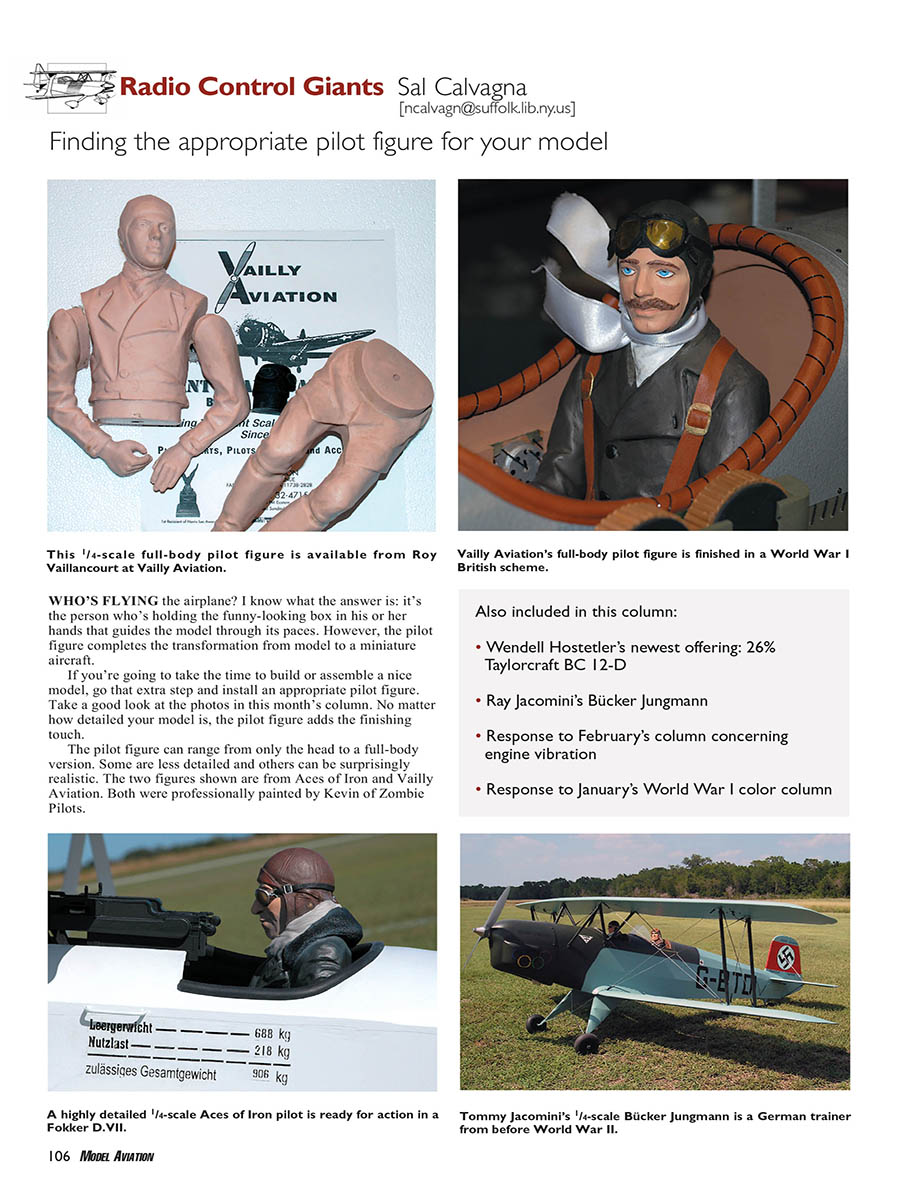
WHO'S FLYING the airplane? I know what the answer is: it's the person who's holding the funny-looking box in his or her hands that guides the model through its paces. However, the pilot figure completes the transformation from model to a miniature aircraft.
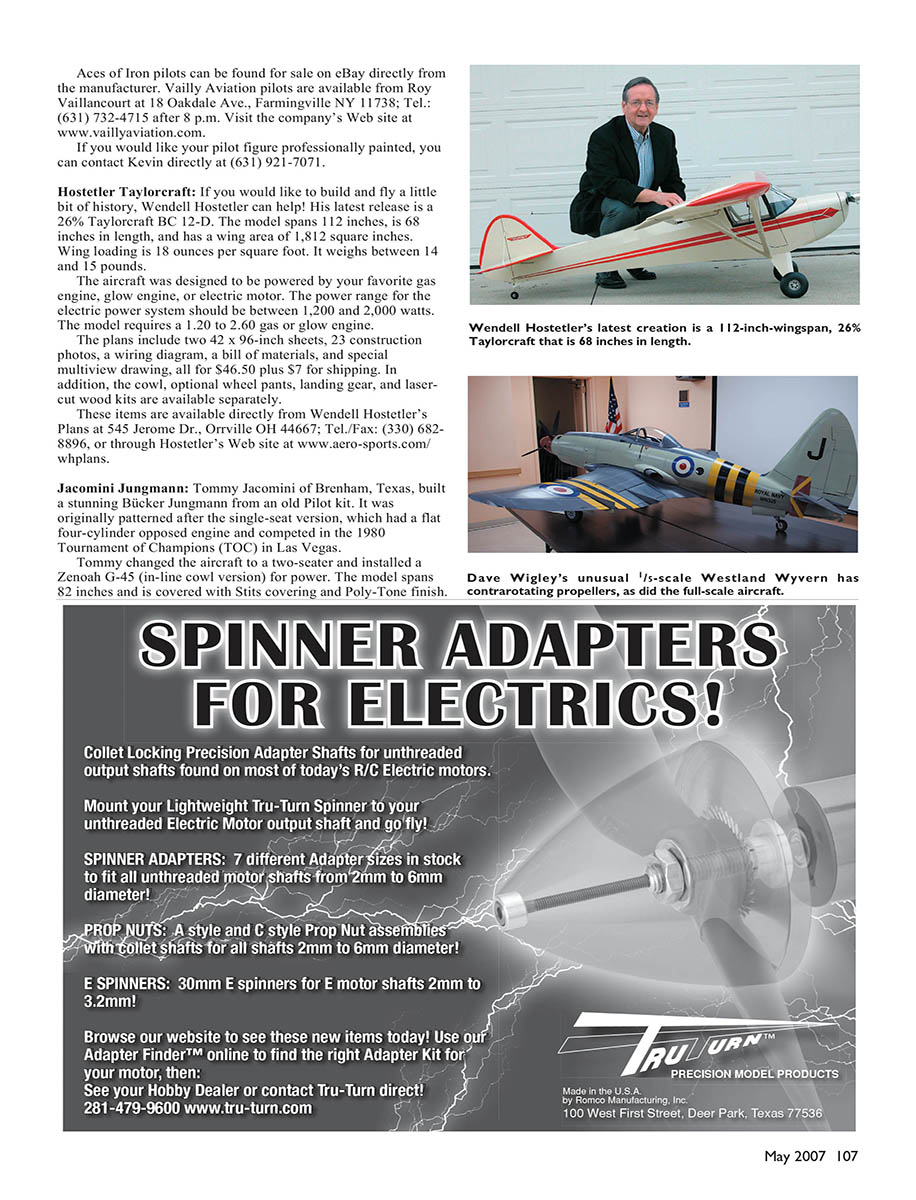
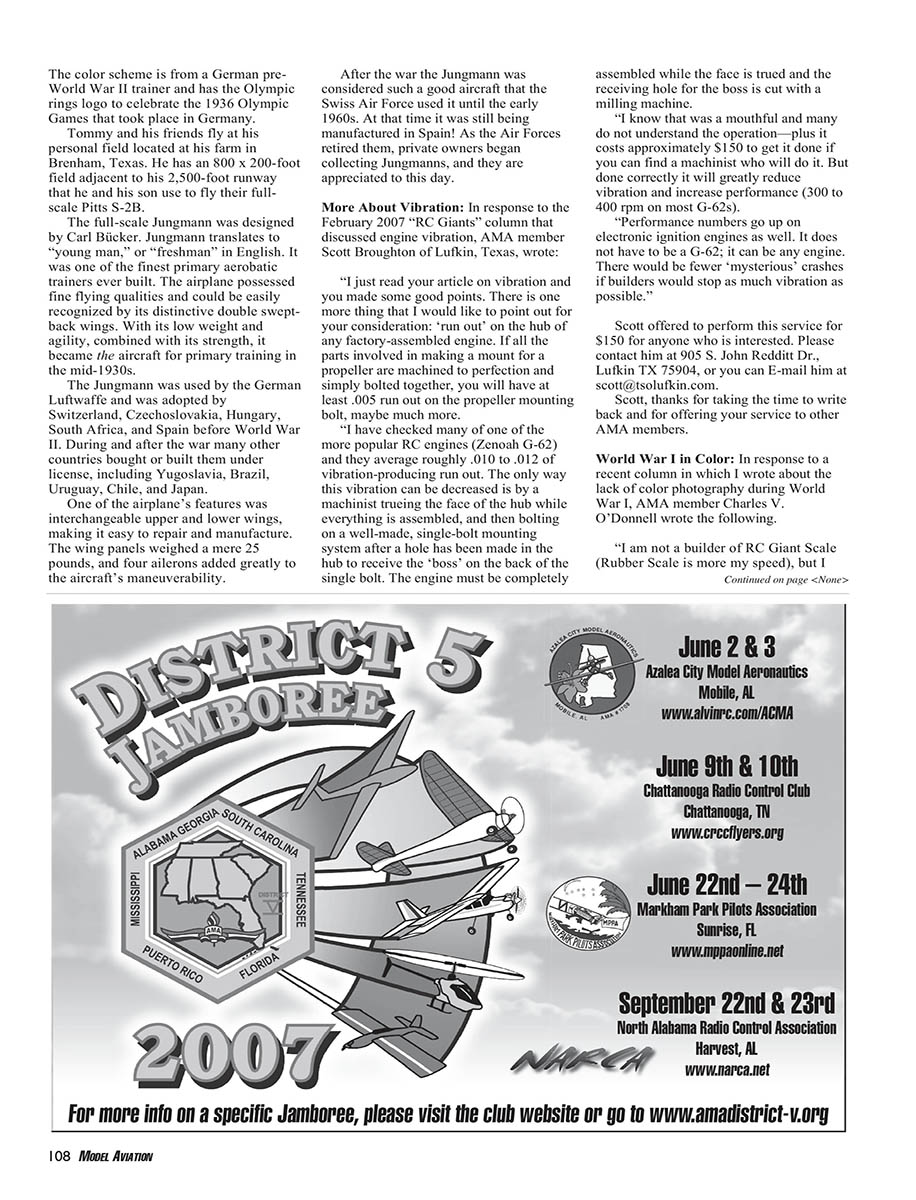
If you're going to take the time to build or assemble a nice model, go that extra step and install an appropriate pilot figure. Take a good look at the photos in this month's column. No matter how detailed your model is, the pilot figure adds the finishing touch.
The pilot figure can range from only the head to a full-body version. Some are less detailed and others can be surprisingly realistic. The two figures shown are from Aces of Iron and Vailly Aviation. Both were professionally painted by Kevin of Zombie Pilots.
Pilot figures — availability and painting
- Aces of Iron pilots can be found for sale on eBay directly from the manufacturer.
- Vailly Aviation pilots are available from Roy Vaillancourt at 18 Oakdale Ave., Farmingville NY 11738; Tel.: (631) 732-4715 (after 8 p.m.). Visit the company’s Web site at www.vaillyaviation.com.
- If you would like your pilot figure professionally painted, contact Kevin of Zombie Pilots at (631) 921-7071.
Also included in this column:
- Wendell Hostetler’s newest offering: 26% Taylorcraft BC 12-D
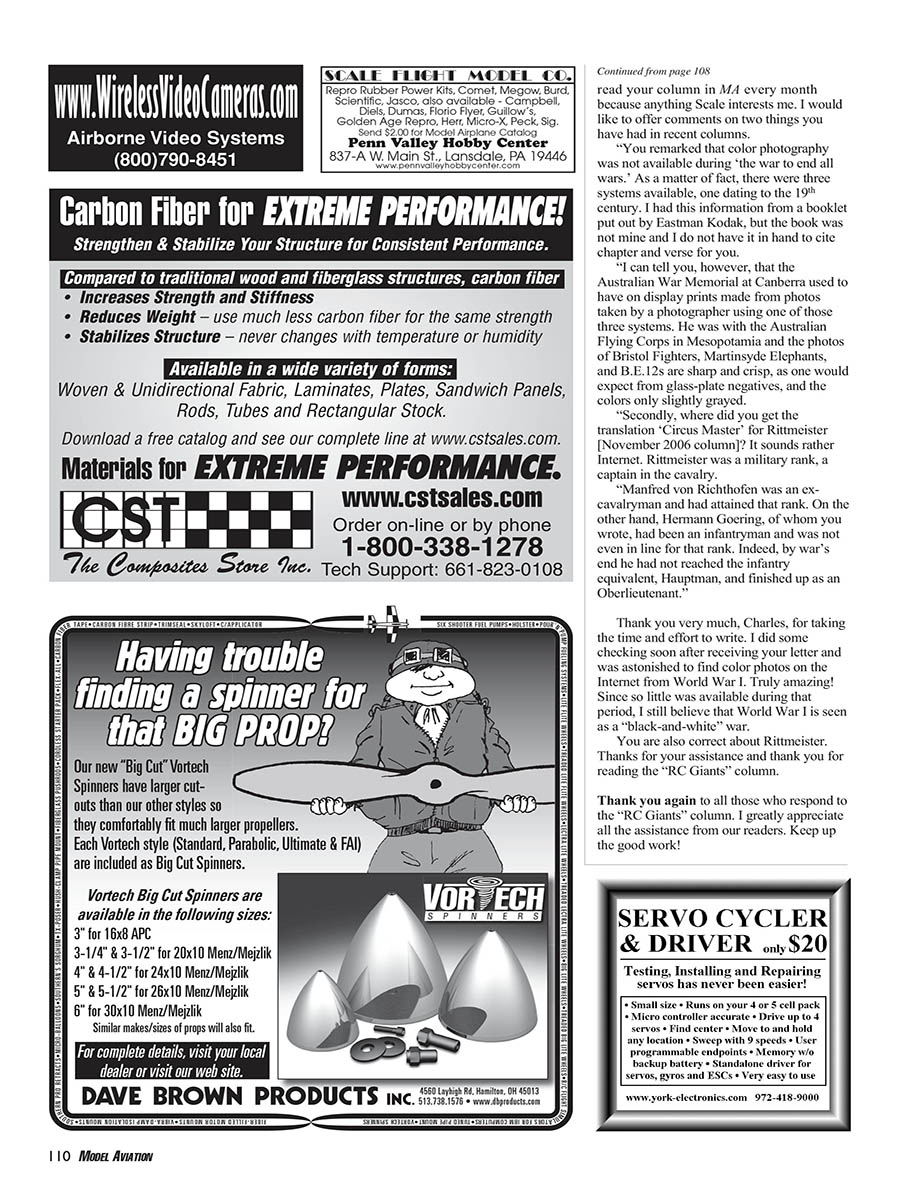
- Ray Jacomini’s Bücker Jungmann
- Response to February’s column concerning engine vibration
- Response to January’s World War I color column
Hostetler Taylorcraft
If you would like to build and fly a little bit of history, Wendell Hostetler can help. His latest release is a 26% Taylorcraft BC 12-D. The model spans 112 inches, is 68 inches in length, and has a wing area of 1,812 square inches. Wing loading is 18 ounces per square foot. It weighs between 14 and 15 pounds.
The aircraft was designed to be powered by your favorite gas engine, glow engine, or electric motor. The power range for the electric power system should be between 1,200 and 2,000 watts. The model requires a 1.20 to 2.60 gas or glow engine.
The plans include two 42 x 96-inch sheets, 23 construction photos, a wiring diagram, a bill of materials, and a special multiview drawing, all for $46.50 plus $7 for shipping. In addition, the cowl, optional wheel pants, landing gear, and laser-cut wood kits are available separately.
These items are available directly from Wendell Hostetler’s Plans at 545 Jerome Dr., Orrville OH 44667; Tel./Fax: (330) 682-8896, or through Hostetler’s Web site at www.aero-sports.com/whplans.
Jacomini Jungmann
Tommy Jacomini of Brenham, Texas, built a stunning Bücker Jungmann from an old Pilot kit. It was originally patterned after the single-seat version, which had a flat four-cylinder opposed engine and competed in the 1980 Tournament of Champions (TOC) in Las Vegas. Tommy changed the aircraft to a two-seater and installed a Zenoah G-45 (in-line cowl version) for power.
The model spans 82 inches and is covered with Stits covering and Poly-Tone finish. The color scheme is from a German pre-World War II trainer and includes the Olympic rings logo to celebrate the 1936 Olympic Games that took place in Germany.
Tommy and his friends fly at his personal field on his farm in Brenham, Texas. He has an 800 x 200-foot field adjacent to his 2,500-foot runway that he and his son use to fly their full-scale Pitts S-2B.
The full-scale Jungmann was designed by Carl Bücker. Jungmann translates to "young man," or "freshman" in English. It was one of the finest primary aerobatic trainers ever built. The airplane possessed fine flying qualities and could be easily recognized by its distinctive double swept-back wings. With its low weight and agility, combined with its strength, it became the aircraft for primary training in the mid-1930s.
The Jungmann was used by the German Luftwaffe and was adopted by Switzerland, Czechoslovakia, Hungary, South Africa, and Spain before World War II. During and after the war many other countries bought or built them under license, including Yugoslavia, Brazil, Uruguay, Chile, and Japan.
One of the airplane's features was interchangeable upper and lower wings, making it easy to repair and manufacture. The wing panels weighed a mere 25 pounds, and four ailerons added greatly to the aircraft's maneuverability.
After the war the Jungmann was considered such a good aircraft that the Swiss Air Force used it until the early 1960s. At that time it was still being manufactured in Spain. As the air forces retired them, private owners began collecting Jungmanns, and they are appreciated to this day.
More About Vibration
In response to the February "RC Giants" column that discussed engine vibration, AMA member Scott Broughton of Lufkin, Texas, wrote:
"I just read your article on vibration and you made some good points. There is one more thing that I would like to point out for your consideration: 'run out' on the hub of any factory-assembled engine. If all the parts involved in making a mount for a propeller are machined and bolted together, you will have at least .005 run out on the propeller mounting hub, maybe much more.
"I have checked many of one of the more popular RC engines (Zenoah G-62) and they average roughly .010 to .012 of vibration-producing run out. The only way this vibration can be decreased is by a machinist truing the face of the hub while everything is assembled, and then bolting on a well-made, single-bolt mounting system after a hole has been made in the hub to receive the 'boss' on the back of the single bolt. The engine must be completely assembled while the face is trued and the receiving hole for the boss is cut with a milling machine.
"I know that was a mouthful and many do not understand the operation—plus it costs approximately $150 to get it done if you can find a machinist who will do it. But done correctly it will greatly reduce vibration and increase performance (300 to 400 rpm on most G-62s).
"Performance numbers go up on electronic ignition engines as well. It does not have to be a G-62; it can be any engine. There would be fewer 'mysterious' crashes if builders would stop as much vibration as possible."
Scott offered to perform this service for $150 for anyone who is interested. Please contact him at 905 S. John Redditt Dr., Lufkin TX 75904, or E-mail him at [email protected].
Scott, thanks for taking the time to write back and for offering your service to other AMA members.
World War I in Color
In response to a recent column in which I wrote about the lack of color photography during World War I, AMA member Charles V. O'Donnell wrote the following.
"I am not a builder of RC Giant Scale (Rubber Scale is more my speed), but I read your column in MA every month because anything Scale interests me. I would like to offer comments on two things you have had in recent columns.
"You remarked that color photography was not available during 'the war to end all wars.' As a matter of fact, there were three systems available, one dating to the 19th century. I had this information from a booklet put out by Eastman Kodak, but the book was not mine and I do not have it in hand to cite chapter and verse for you.
"I can tell you, however, that the Australian War Memorial at Canberra used to have on display prints made from photos taken by a photographer using one of those three systems. He was with the Australian Flying Corps in Mesopotamia and the photos of Bristol Fighters, Martinsyde Elephants, and B.E.12s are sharp and crisp, as one would expect from glass-plate negatives, and the colors only slightly grayed.
"Secondly, where did you get the translation 'Circus Master' for Rittmeister (November 2006 column)? It sounds rather Internet. Rittmeister was a military rank, a captain in the cavalry.
"Manfred von Richthofen was an ex-cavalryman and had attained that rank. On the other hand, Hermann Goering, of whom you wrote, had been an infantryman and was not even in line for that rank. Indeed, by war's end he had not reached the infantry equivalent, Hauptmann, and finished up as an Oberleutnant."
Thank you very much, Charles, for taking the time and effort to write. I did some checking soon after receiving your letter and was astonished to find color photos on the Internet from World War I. Truly amazing! Since so little was available during that period, I still believe that World War I is seen as a "black-and-white" war.
You are also correct about Rittmeister. Thanks for your assistance and thank you for reading the "RC Giants" column.
Thank you again to all those who respond to the "RC Giants" column. I greatly appreciate all the assistance from our readers. Keep up the good work!
Transcribed from original scans by AI. Minor OCR errors may remain.

