
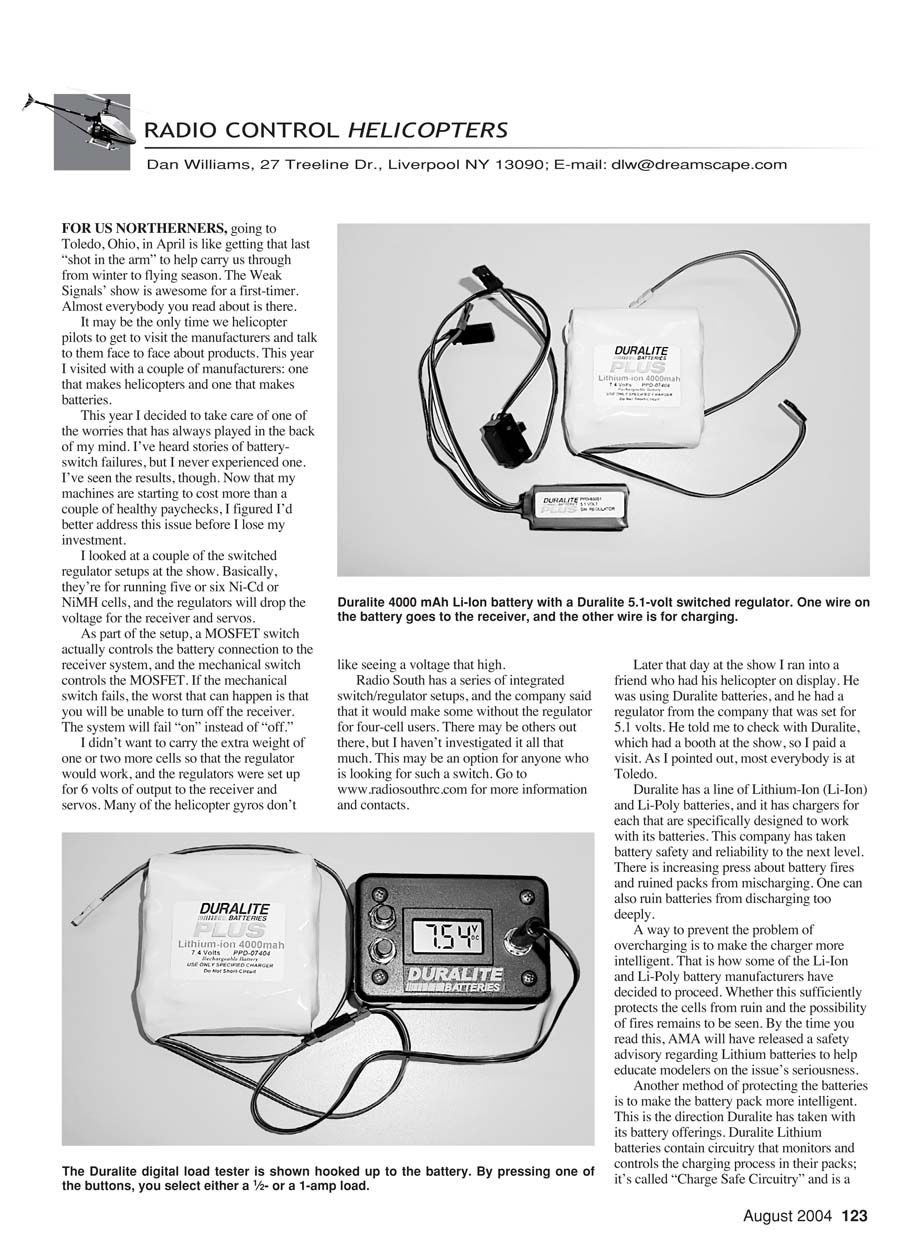
RADIO CONTROL HELICOPTERS
Dan Williams
27 Treeline Dr., Liverpool NY 13090 E-mail: [email protected]
Toledo show and visiting manufacturers
For us northerners, going to Toledo, Ohio, in April is like getting that last "shot in the arm" to help carry us through from winter to flying season. The Weak Signals show is awesome for a first-timer — almost everybody you read about is there.
It may be the only time we helicopter pilots get to visit the manufacturers and talk to them face to face about products. This year I visited with a couple of manufacturers: one that makes helicopters and one that makes batteries.
This year I decided to take care of one of the worries that has always played in the back of my mind. I'd heard stories of battery-switch failures, but I never experienced one. I'd seen the results, though. Now that my machines are starting to cost more than a couple of healthy paychecks, I figured I'd better address this issue before I lose my investment.
Switched regulators and MOSFETs
I looked at a couple of the switched-regulator setups at the show. Basically, they're for running five or six Ni-Cd or NiMH cells, and the regulators will drop the voltage for the receiver and servos.
As part of the setup, a MOSFET switch actually controls the battery connection to the receiver system, and the mechanical switch controls the MOSFET. If the mechanical switch fails, the worst that can happen is that you will be unable to turn off the receiver — the system will fail "on" instead of "off."
I didn't want to carry the extra weight of one or two more cells so that the regulator would work, and the regulators I looked at were set up for 6 volts of output to the receiver and servos. Many helicopter gyros don't like seeing a voltage that high.
Radio South option
Radio South has a series of integrated switch/regulator setups, and the company said it would make some without the regulator for four-cell users. There may be others out there, but I haven't investigated it all that much. This may be an option for anyone looking for such a switch. Visit www.radiosouthrc.com for more information and contacts.
Duralite — batteries, charging, and safety
Later that day at the show I ran into a friend who had his helicopter on display. He was using Duralite batteries, and he had a regulator from the company that was set for 5.1 volts. He told me to check with Duralite, which had a booth at the show, so I paid a visit.
Duralite has a line of Lithium-Ion (Li-Ion) and Li-Poly batteries, and it has chargers specifically designed to work with its batteries. This company has taken battery safety and reliability to the next level. There is increasing press about battery fires and ruined packs from mischarging. One can also ruin batteries from discharging them too deeply.
A way to prevent overcharging is to make the charger more intelligent. That is how some Li-Ion and Li-Poly battery manufacturers have proceeded. Whether this sufficiently protects the cells from ruin and the possibility of fires remains to be seen. By the time you read this, AMA will have released a safety advisory regarding lithium batteries to help educate modelers on the issue's seriousness.
Another method of protecting batteries is to make the battery pack more intelligent. This is the direction Duralite has taken with its offerings. Duralite Lithium batteries contain circuitry that monitors and controls the charging process in their packs; it's called "Charge Safe Circuitry" (a trademarked name for the system).
Each lithium cell has a nominal voltage of 3.7 volts. Two cells in series give about 7.4 volts; putting another identical series pair in parallel increases capacity while keeping the 7.4-volt nominal pack voltage. Duralite's internal circuitry monitors each cell's voltage and the total pack voltage for any overcharge condition and will shut down the charging process if necessary.
Charging is done through a separate charge plug on the pack and is completed using a Duralite Plus charger. It is a complete and safe system for charging lithium cells.
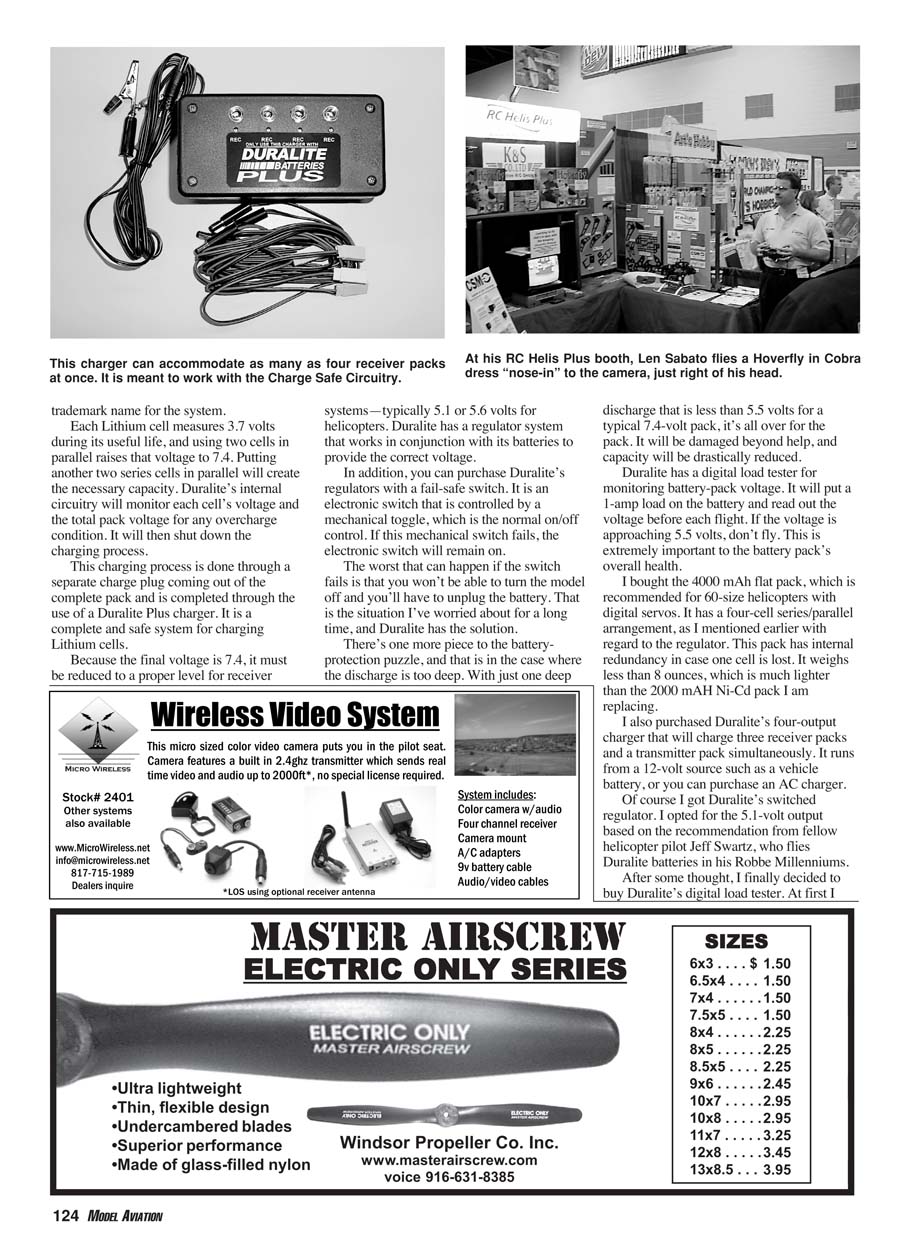
Because the final pack voltage is about 7.4 volts, it must be reduced to a proper level for receiver systems — typically 5.1 or 5.6 volts for helicopters. Duralite has a regulator system that works in conjunction with its batteries to provide the correct voltage.
In addition, you can purchase Duralite's regulators with a fail-safe switch. It is an electronic switch that is controlled by a mechanical toggle, which is the normal on/off control. If the mechanical switch fails, the electronic switch will remain on. The worst that can happen if the switch fails is that you won't be able to turn the model off and you'll have to unplug the battery — the situation I've worried about for a long time, and Duralite has a solution.
Protecting against deep discharge
There's one more piece to the battery-protection puzzle: deep discharge. With just one deep discharge below roughly 5.5 volts for a typical 7.4-volt pack, the pack can be permanently damaged and its capacity drastically reduced.
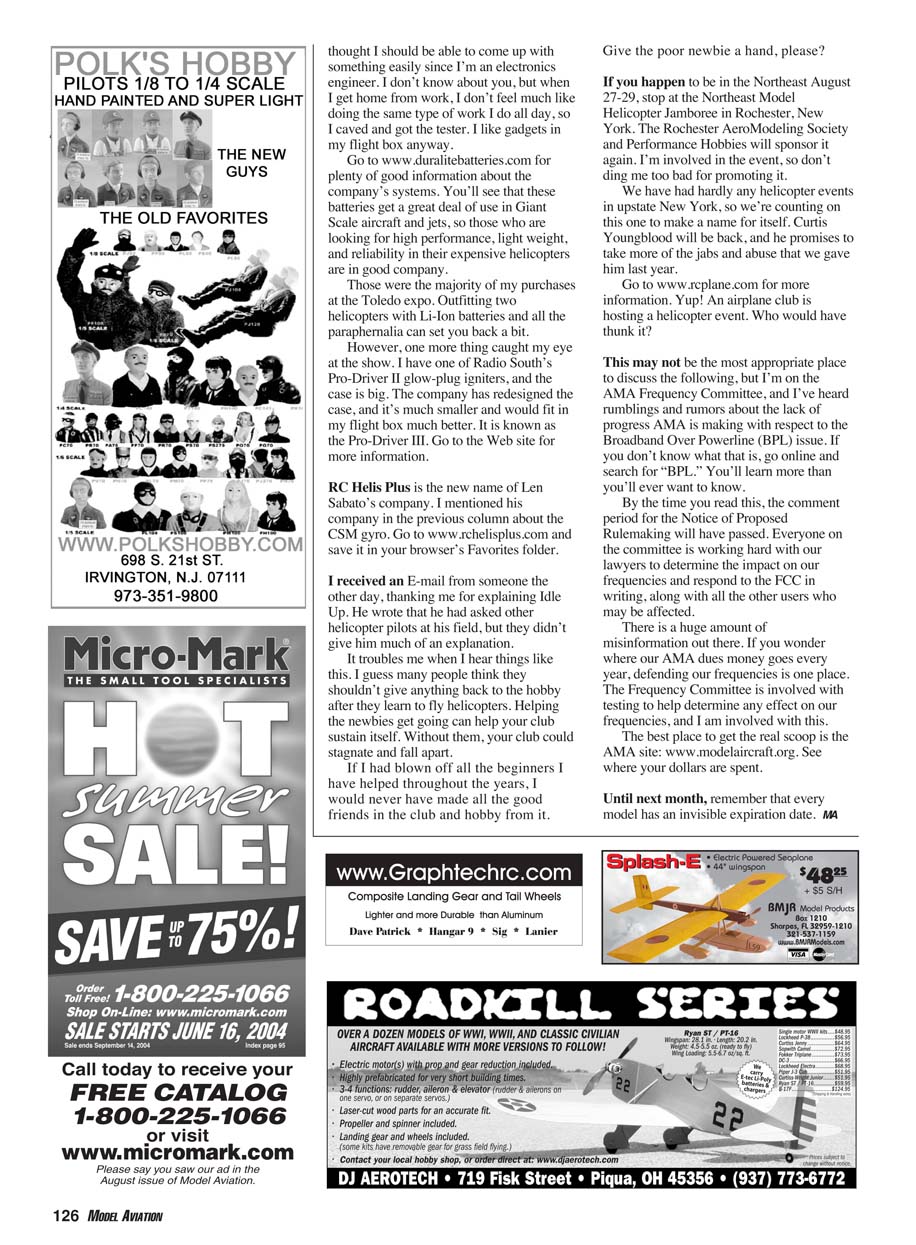
Duralite has a digital load tester for monitoring battery-pack voltage. It will put a 1-amp load on the battery and read out the voltage before each flight. If the voltage is approaching 5.5 volts, don't fly. This is extremely important to the battery pack's overall health.
Duralite products I purchased
I outfitted my helicopters with Duralite gear. My purchases included:
- 4000 mAh flat pack (recommended for 60-size helicopters with digital servos). This pack uses a four-cell series/parallel arrangement that provides internal redundancy in case one cell is lost. It weighs less than 8 ounces, much lighter than the 2000 mAh Ni-Cd pack I replaced.
- Duralite four-output charger (charges three receiver packs and a transmitter pack simultaneously). It runs from a 12-volt source (such as a vehicle battery), or you can purchase an AC charger.
- Duralite switched regulator (I opted for the 5.1-volt output based on recommendation from fellow helicopter pilot Jeff Swartz, who flies Duralite batteries in his Robbe Millenniums).
- Duralite digital load tester — I decided to buy this rather than invent something on my own. After work I don't feel much like doing the same type of work I do all day, so I caved and got the tester. I like gadgets in my flight box anyway.
For more information about Duralite systems, go to www.duralitebatteries.com. These batteries get a great deal of use in Giant Scale aircraft and jets, so those looking for high performance, light weight, and reliability in their expensive helicopters are in good company.
Outfitting two helicopters with Li-Ion batteries and all the paraphernalia can set you back a bit, but I felt it was worth the investment.
Other finds at the show
One more thing caught my eye at the show. I have one of Radio South's Pro-Driver II glow-plug igniters, and the case is big. The company has redesigned the case, and it's much smaller and would fit in my flight box much better. It is known as the Pro-Driver III. See the Web site for more information.
RC Helis Plus is the new name of Len Sabato's company. I mentioned the company in the previous column about the CSM gyro. Go to www.rchelisplus.com and save it in your browser's Favorites folder.
Helping new pilots
I received an e-mail from someone the other day thanking me for explaining Idle Up. He wrote that he had asked other helicopter pilots at his field, but they didn't give him much of an explanation.
It troubles me when I hear things like this. I guess many people think they shouldn't give anything back to the hobby after they learn to fly helicopters. Helping the newbies get going can help your club sustain itself. Without them, your club could stagnate and fall apart.
If I had blown off all the beginners I have helped throughout the years, I would never have made all the good friends in the club and hobby from it.
Give the poor newbie a hand, please.
Northeast Model Helicopter Jamboree
If you happen to be in the Northeast August 27–29, stop at the Northeast Model Helicopter Jamboree in Rochester, New York. The Rochester AeroModeling Society and Performance Hobbies will sponsor it again. I'm involved in the event, so don't ding me too bad for promoting it.
We have had hardly any helicopter events in upstate New York, so we're counting on this one to make a name for itself. Curtis Youngblood will be back, and he promises to take more of the jabs and abuse that we gave him last year.
Go to www.rcplane.com for more information. Yup — an airplane club is hosting a helicopter event. Who would have thunk it?
AMA Frequency Committee and BPL
This may not be the most appropriate place to discuss the following, but I'm on the AMA Frequency Committee, and I've heard rumblings and rumors about the lack of progress AMA is making with respect to the Broadband Over Powerline (BPL) issue. If you don't know what that is, go online and search for "BPL." You'll learn more than you'll ever want to know.
By the time you read this, the comment period for the Notice of Proposed Rulemaking will have passed. Everyone on the committee is working hard with our lawyers to determine the impact on our frequencies and respond to the FCC in writing, along with all the other users who may be affected.
There is a huge amount of misinformation out there. If you wonder where your AMA dues money goes every year, defending our frequencies is one place. The Frequency Committee is involved with testing to help determine any effect on our frequencies, and I am involved with this.
The best place to get the real scoop is the AMA site: www.modelaircraft.org. See where your dollars are spent.
Closing
Until next month, remember that every model has an invisible expiration date.
MA
Transcribed from original scans by AI. Minor OCR errors may remain.

