
RADIO CONTROL HELICOPTERS
Dan Williams, 27 Treeline Dr., Liverpool NY 13090; E-mail: [email protected]
Introduction
Hello again! This month marks my one-year anniversary for writing this column. It's been fun for the most part. I've met some great people along the way and received many e-mails from readers. Many more people take the time to write to me than I ever would have guessed, and I thank them for that. It makes me feel better about what I'm writing.
I've also learned how difficult it is to write a monthly column. Gathering information suitable for a column month after month can be daunting. I try to mix coverage of new products, pass along techniques that can help newbies, and report on events I've attended. From the responses I've received, the consensus is that it's a good assortment.
The Internet and magazines
The Internet has become an almost “real time” source of information about new products and immediately offers reports on whether they are good or bad. It has also become a place where many hide behind keyboards and write almost anything about anything or anyone. Nothing is going to come out of the screen and give someone a bloody lip; sometimes I wish it could.
If you can sift through the garbage, timely and valuable information can be found online. That has helped me because I can use it as a source for the column. On the other hand, reporting that information with the lead times associated with magazine printing can be a problem. There's something about a magazine article that carries more oomph than typical Web posts. For that reason, I think magazines will continue to have their place.
Trip to Atlanta — Heli Smackdown
I just returned from my annual trek to Atlanta, Georgia. I usually bring my helicopter, but this time I shipped it instead of checking it as baggage because of the hassle with the size of the case. The golf-case method of bringing models on an airplane works well. Last year Curtis Youngblood checked his helicopters as baggage, and AMA President Dave Brown wrote about shipping models in one of his columns. I bought a case from CJ Youngblood Enterprises that holds two helicopters nicely and comes with instructions for creating internal supports. See www.curtisyoungblood.com for more information.
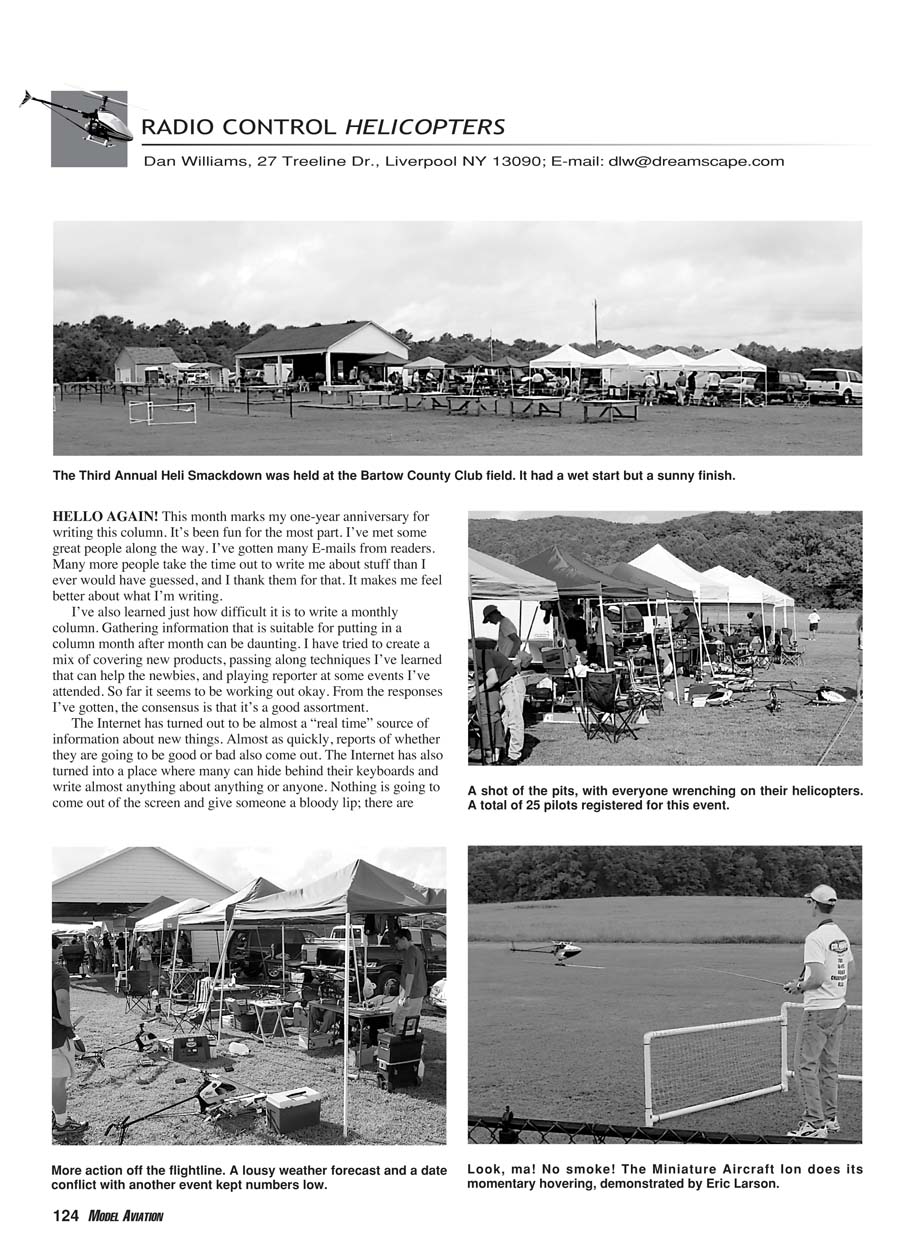
This year was the Third Annual Heli Smackdown, held outside Atlanta in Bartow County and hosted by the Bartow Model Aviation Club. The club is a combined airplane and helicopter group and made an agreement with another club so fixed-wing modelers could use a different field for the weekend—great cooperation between helicopter and fixed-wing fliers. All clubs should aspire to that level of cooperation.
Saturday's weather was a bit dicey to start: drizzly and overcast, with ceilings not conducive to auto-duration events. As the morning went on, though, the skies brightened and there was plenty of flying and sunburns. I always get my first sunburn of the season in the South.
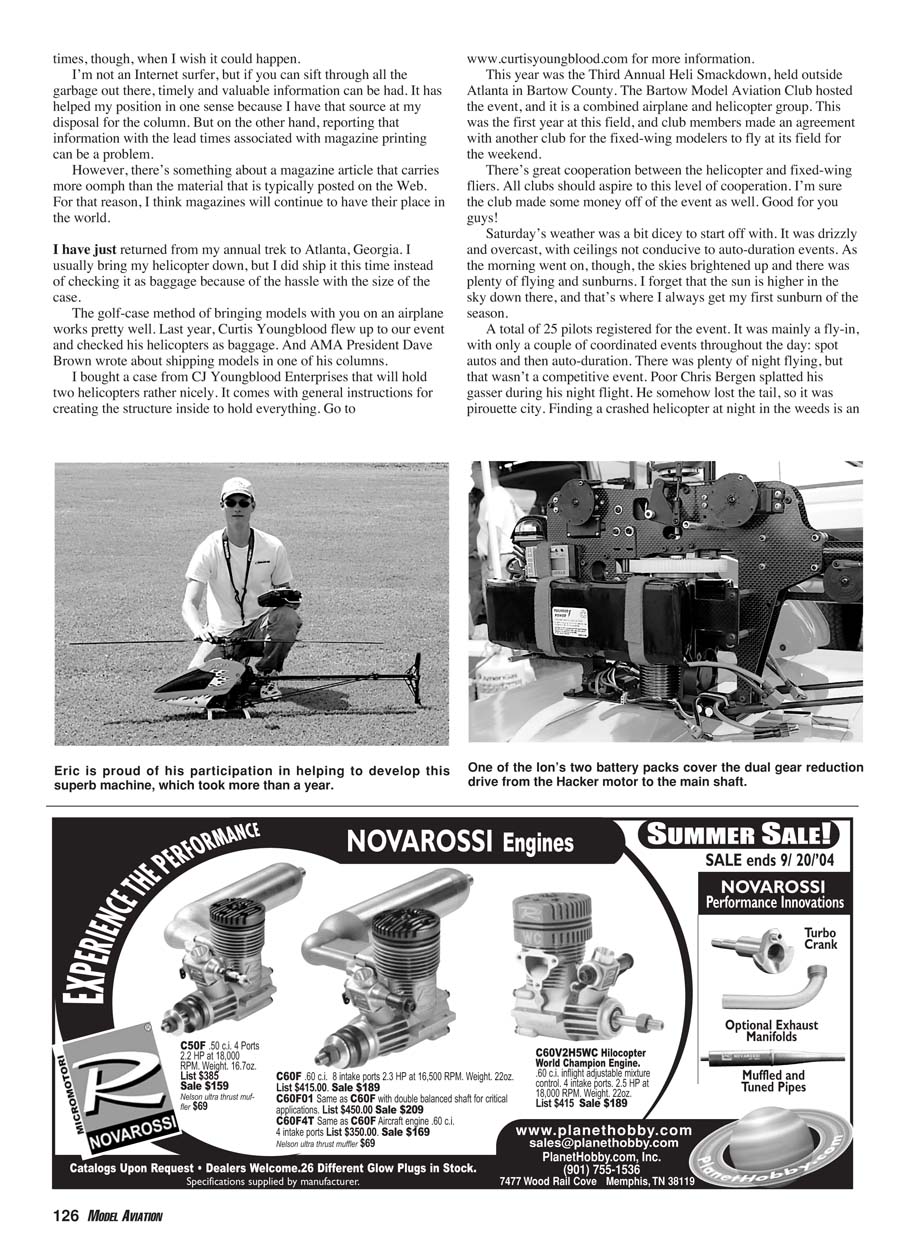
A total of 25 pilots registered for the event. It was mainly a fly-in, with only a couple of coordinated events throughout the day: spot autos and auto-duration. There was plenty of night flying, though that wasn't a competitive event. Poor Chris Bergen splatted his gasser during a night flight; he somehow lost the tail, so it was pirouette city. Finding a crashed helicopter at night in the weeds is an interesting proposition—the club had a search crew with flashlights and we found it eventually.
Event highlights:
- Spot-auto: timed event; hover and land on a 6-foot circle painted on the runway—closest to center gets the most points. Most pilots liked it.
- Auto-duration: timed engine run at idle to maximize time aloft using fuel.
- Mini-classes: separated into two classes (30-inch blades and 36-inch blades) and were competitive.
- Night flying, scale demos, and combat.
- Vendors and swap tables—good for picking up parts and bargains.
I got a chance to see some of the new Miniature Aircraft products, including the Ion. The Ion hovered briefly for me; it's an unusual machine and very quiet.
Rotorhead setups and tracking
I've been getting quite a few e-mails about rotorhead setups and tracking. Start with the basics:
- Make sure your blades are balanced.
- Ensure tracking is within a blade width.
- Verify head bearings are free and smooth.
- If you have excessive vibration, check the frame for cracks and the tailboom support.
- When converting from glow to electric, remember the CG can shift; re-balance with the installed power system.
If you have questions, send me an e-mail. I'm still learning and appreciate hearing from readers.
3-D flying: style and safety
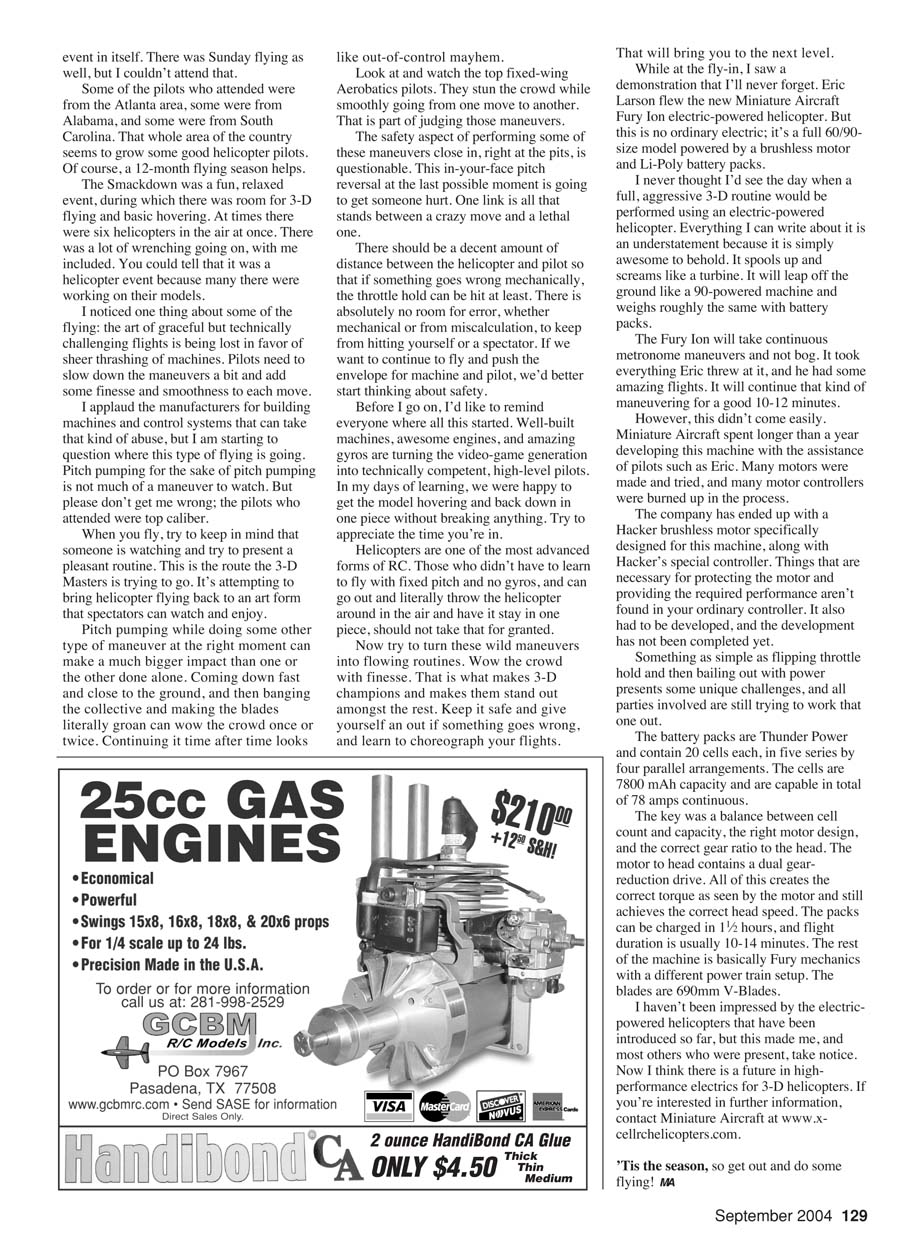
The Smackdown was a fun, relaxed event with room for 3-D flying and basic hovering. At times there were six helicopters in the air at once. There was a lot of wrenching going on, and you could tell it was a helicopter event because many people were working on their models.
I noticed a trend: the art of graceful but technically challenging flying is being lost in favor of sheer thrashing. Pilots need to slow down maneuvers and add finesse and smoothness. I applaud manufacturers for building machines and control systems that take abuse, but I question where this style is going. Pitch pumping for the sake of pitch pumping is not much of a maneuver to watch.
When you fly, remember someone is watching—try to present a pleasant routine. The 3-D Masters are attempting to bring helicopter flying back to an art form spectators can enjoy. Pitch pumping timed with another maneuver can make a big impact; repeating the same violent move over and over looks like out-of-control mayhem.
Safety concerns:
- Performing aggressive maneuvers close to the pits or spectators is risky. One link is all that can separate a crazy move from a lethal one.
- Maintain a decent distance between helicopter and pilot so if something goes wrong you have time to hit throttle hold.
- There is no room for mechanical error or miscalculation; give yourself an out.
Remember where this all started: well-built machines, powerful engines, and amazing gyros have turned the video-game generation into technically competent, high-level pilots. Those who didn't have to learn on fixed-pitch machines with no gyros should not take that for granted. Learn to choreograph flights and turn wild maneuvers into flowing routines—wow the crowd with finesse. That will bring you to the next level.
Miniature Aircraft Fury Ion — electric 3-D helicopter
While at the fly-in I saw a demonstration I'll never forget. Eric Larson flew the new Miniature Aircraft Fury Ion electric-powered helicopter. This is no ordinary electric—it's a full 60/90-size model powered by a brushless motor and Li-Poly battery packs.
I never thought I'd see a full, aggressive 3-D routine performed with an electric-powered helicopter. It spools up and screams like a turbine, will leap off the ground like a 90-powered machine, and weighs roughly the same with battery packs. The Fury Ion handled continuous metronome maneuvers without bogging and took everything Eric threw at it—amazing flights of 10–14 minutes.
Development notes and specs:
- Miniature Aircraft spent more than a year developing the machine with test pilots such as Eric.
- Many motors and motor controllers were tried, and many controllers were burned up during development.
- The final setup uses a Hacker brushless motor designed for this machine and Hacker's special controller. Protecting the motor and providing the required performance required controller features not found in ordinary units.
- Flipping throttle hold and bailing out with power presents unique challenges that are still being worked on.
- Battery packs: Thunder Power, 20 cells per pack arranged 5s x 4p. Cells are 7800 mAh; packs are capable of about 78 A continuous (total).
- Key design choices: balance between cell count and capacity, correct motor design, and correct gear ratio to the head.
- Drive: dual gear-reduction to achieve correct torque and head speed.
- Charge time: about 1.5 hours. Flight duration: typically 10–14 minutes.
- Blades: 690 mm V-blades.
- The rest of the airframe uses Fury mechanics with a different powertrain.
I hadn't been impressed by previous electric-powered helicopters, but this one made most of us take notice. I think there is a future in high-performance electrics for 3-D helicopters. For more information contact Miniature Aircraft at www.x-cellhelicopters.com.
Closing
Next month I'll try to cover a few of the new gyros and micro servos that are making waves in the hobby. Until then, keep your head in the game and fly safe.
MA
Transcribed from original scans by AI. Minor OCR errors may remain.

