
RADIO CONTROL HELICOPTERS
Dan Williams 27 Treeline Dr., Liverpool NY 13090 E-mail: [email protected]
I HAVE AN apology to make. Several errors were printed in the August 2004 column, and Duralite Batteries pointed them out to me. The corrections did not make it into the column. For a 7.4-volt pack, the finish-charge voltage is 8.4 V, the "Stop Fly" voltage is 6.9 V, and running the battery down past 5.5 V may damage the pack. I apologize to Duralite Batteries and anyone I may have confused by the error.
We've been having a rather rough stretch of weather during the past couple of weeks. We've gotten more rain and more thunderstorms in a shorter time than I can recall. The flying sites are rather soggy. I really feel for the fixed-wing pilots who are having a tough time with this stuff. The grass is growing like crazy, and it's too wet for mowing. At least we can fly helicopters under those conditions!
In the past season or so, a new device called the Throttle Jockey has come onto the scene. It is basically similar in concept to the Futaba Throttle Governor, but the similarity ends quickly. The Throttle Jockey is less expensive, doesn't seem prone to some of the failures we've experienced in the past, and seems to be catching on! I've been working with Ray Stacy of Performance Hobbies, who is my good flying friend, to evaluate this device for the column. I worked with him a bit on the write-up, but he did the work so I'll let him take over here.
Throttle Jockey (overview and installation)
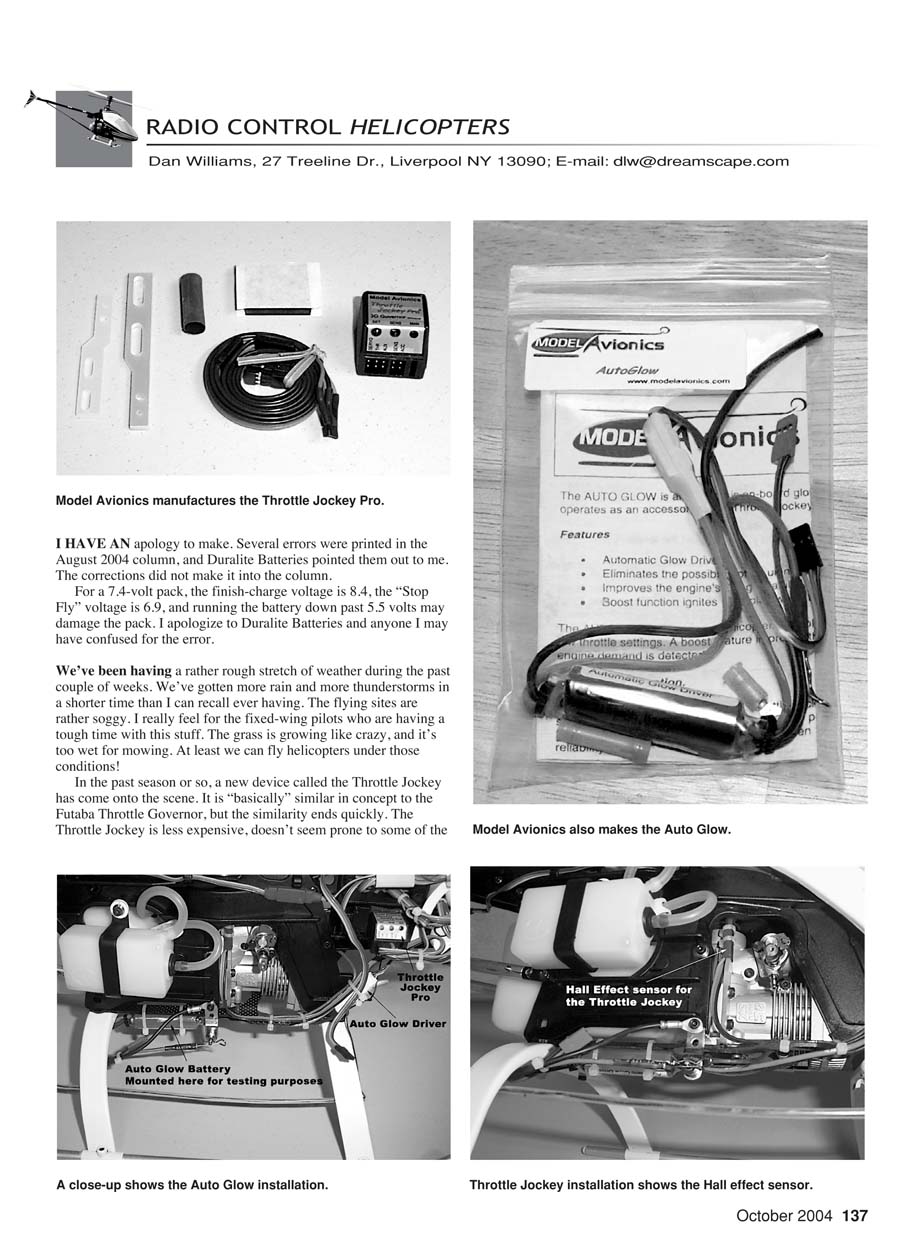
Paul Beard, owner of Model Avionics, has developed a neat little box that installs between your throttle servo and receiver. This little 1-inch-square black box monitors your engine rpm and compensates for the additional load of climbouts and aerobatics by increasing throttle when needed to maintain engine rpm. It also decreases the throttle when the load is light.
This has worked out very well for my 8-year-old son Kyle. His hands are too small to reach the idle-up switch. In the past, he would overspeed the head when coming out of the air because he couldn't reach the flight-mode switch. The Throttle Jockey has solved that problem. With the Throttle Jockey, once he takes off I switch him into idle-up and he can complete his 3-D flight without ever worrying about the head speed.
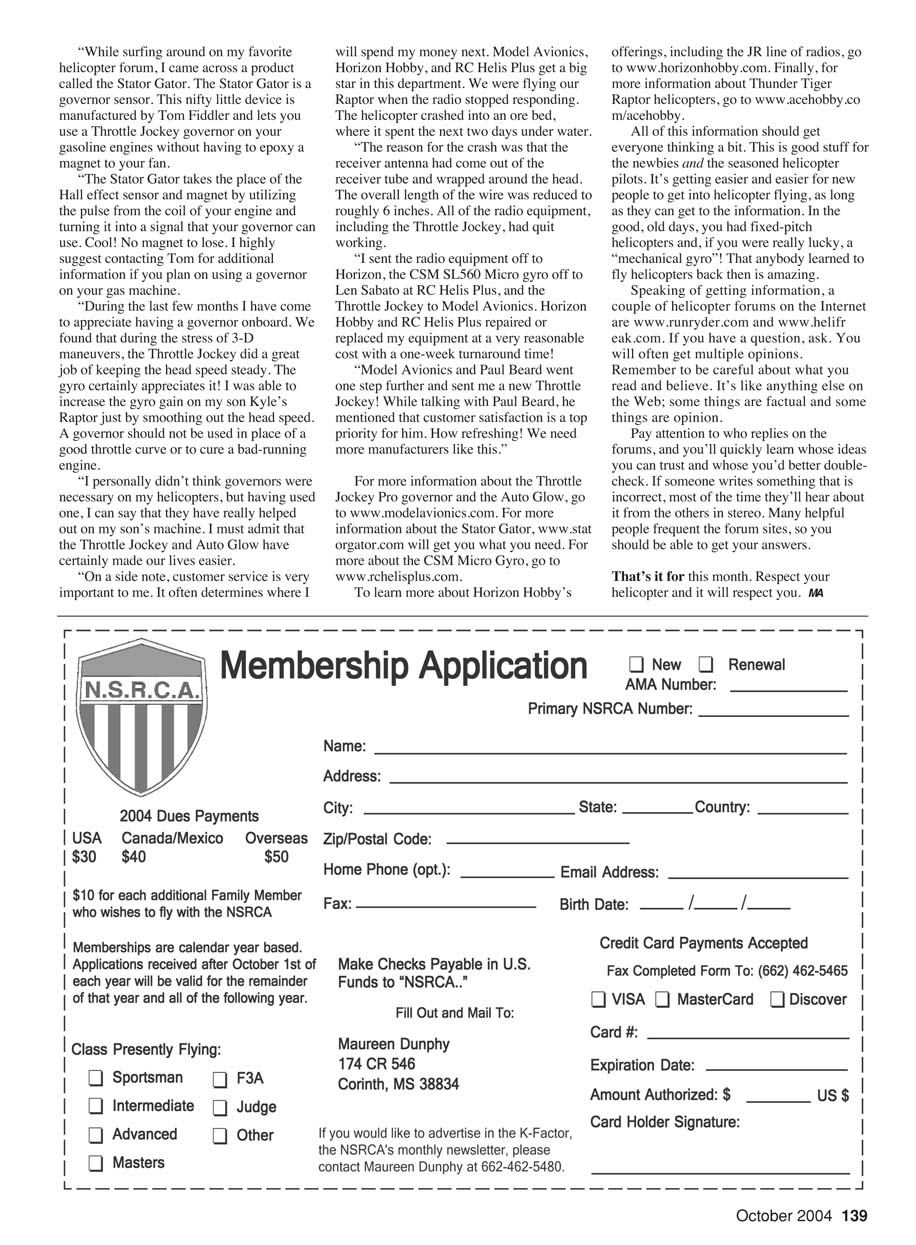
The Throttle Jockey monitors engine rpm by using a Hall-effect sensor to detect a magnet that has been attached to the fan of your engine. Raptor fans have a nice little recessed area on the fan to facilitate magnet installation. A second magnet is included for four-stroke and gasoline engines that run at a much slower rpm. The Throttle Jockey with one magnet on the fan has an rpm range of 9,000–22,000. With two magnets installed, the rpm range drops to 4,500–11,000.
Once the Throttle Jockey is installed, you need to calibrate it via the instructions so that the governor understands the servo's range of motion. A second lead is connected to a spare channel in your receiver. This channel is used as a reference to determine what your head speed will be. Raising or lowering your endpoint on the reference channel will raise or lower your head speed.
On my installation, I used AUX 4, which lets me adjust the head speed by turning the potentiometer on the transmitter. Model Avionics has a nice calculator on its web page for calculating the initial setting of the reference endpoint number. For our Raptor 50, the correct endpoint setting is 84. This gives us a head speed of 1,800 rpm.
There is no problem if you do not have a spare auxiliary channel. The Throttle Jockey has a mechanical potentiometer adjustment as well. For setup purposes, the Throttle Jockey has an LED indicator to let you know when the sensor detects the magnet passing by. There is also an LED to let you know when the Throttle Jockey is engaged.
During setup, have your throttle as close to 100% travel as you possibly can. I have found that the Throttle Jockey may not calibrate properly if your throttle ATVs are set too high. I mentioned it to Paul Beard and he is looking into it. Once the calibration is complete, verify that the activation LED is on when the throttle stick is higher than 25% throttle and the LED is off when the throttle stick is lower than 25%.
The Throttle Jockey kicks in at 25% of your throttle position. It would be a good idea to make sure that your throttle curves for your idle-up settings are all more than 25%. When spooling up in the normal flight mode, once you are above 25% throttle, you can hear the governor kick in and smoothly take your machine to the designated engine rpm. It will stay there until your throttle curve falls below 25% or your reference setting is set to 50% or less.
Auto Glow (add-on)
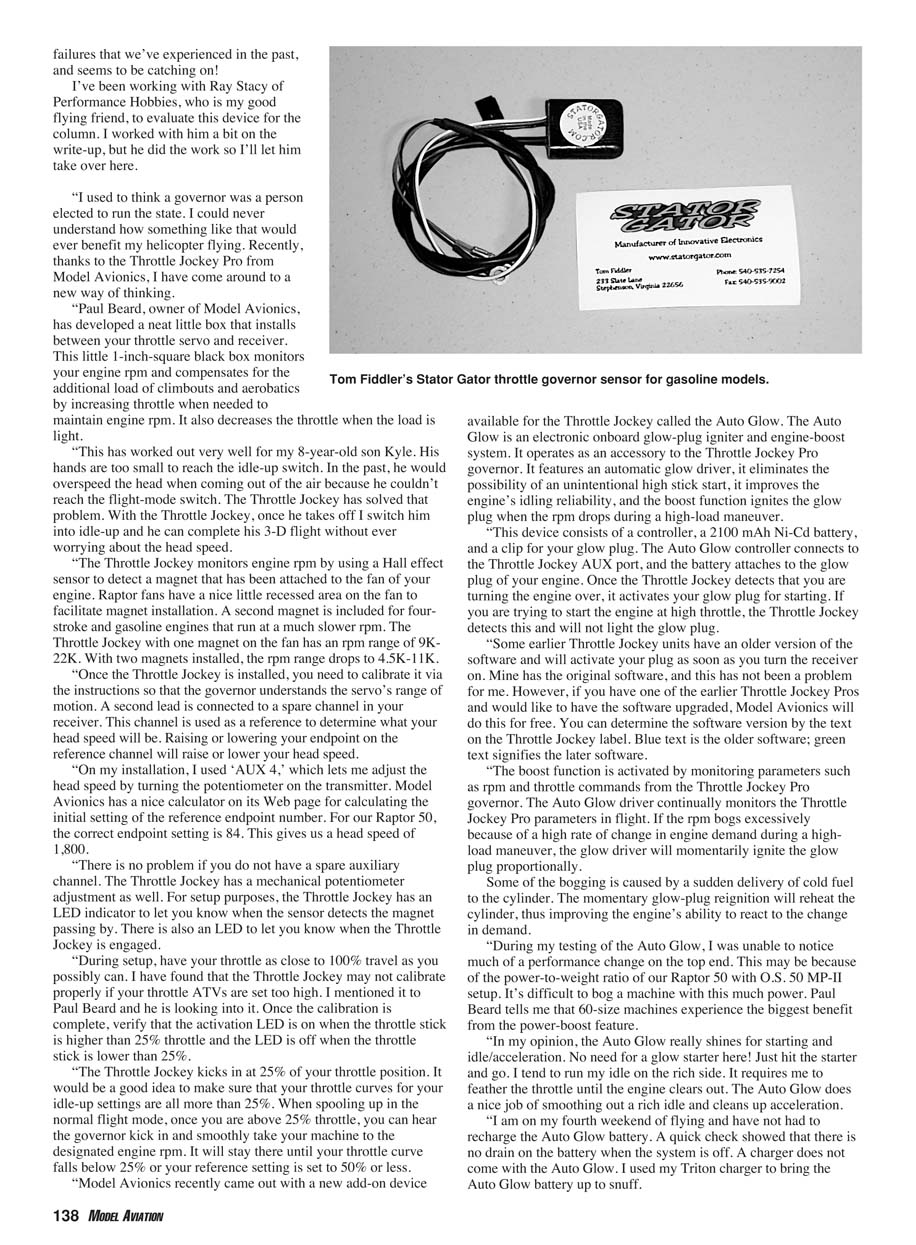
Model Avionics recently came out with a new add-on device for the Throttle Jockey called the Auto Glow. The Auto Glow is an electronic onboard glow-plug igniter and engine-boost system. It operates as an accessory to the Throttle Jockey Pro governor.
Features and benefits:
- Automatic glow driver for starting.
- Eliminates the possibility of an unintentional high-stick start.
- Improves engine idling reliability.
- Boost function ignites the glow plug when rpm drops during a high-load maneuver.
This device consists of a controller, a 2100 mAh Ni-Cd battery, and a clip for your glow plug. The Auto Glow controller connects to the Throttle Jockey AUX port, and the battery attaches to the glow plug of your engine. Once the Throttle Jockey detects that you are turning the engine over, it activates your glow plug for starting. If you are trying to start the engine at high throttle, the Throttle Jockey detects this and will not light the glow plug.
Some earlier Throttle Jockeys have an older version of the software that will activate your plug as soon as you turn the receiver on. Mine has the original software, and this has not been a problem for me. If you have one of the earlier Throttle Jockey Pros and would like to have the software upgraded, Model Avionics will do this for free. You can determine the software version by the text on the Throttle Jockey label: blue text is the older software; green text signifies the later software.
The boost function is activated by monitoring parameters such as rpm and throttle commands from the Throttle Jockey Pro governor. The Auto Glow driver continually monitors these parameters in flight. If the rpm bogs excessively because of a high rate of change in engine demand during a high-load maneuver, the glow driver will momentarily ignite the glow plug proportionally.
Some of the bogging is caused by a sudden delivery of cold fuel to the cylinder. The momentary glow-plug reignition will reheat the cylinder, thus improving the engine’s ability to react to the change in demand.
During my testing of the Auto Glow, I was unable to notice much of a performance change on the top end. This may be because of the power-to-weight ratio of our Raptor 50 with O.S. .50 MP-II setup — it's difficult to get a machine with this much power. Paul Beard tells me that 60-size machines experience the biggest benefit from the power-boost feature.
In my opinion, the Auto Glow really shines for starting and idle/acceleration. No need for a glow starter here! Just hit the starter and go. I tend to run my idle on the rich side; it requires me to feather the throttle until the engine clears out. The Auto Glow does a nice job of smoothing out a rich idle and cleaning up acceleration.
I'm on my fourth weekend of flying and have not had to recharge the Auto Glow battery. A quick check showed that there is no draw on the battery when the system is off. A charger does not come with the Auto Glow; I used my Triton charger to bring the Auto Glow battery up to snuff.
Stator Gator (gas-engine rpm sensing)
While surfing on my favorite helicopter forum, I came across a product called the Stator Gator. The Stator Gator is a governor sensor manufactured by Tom Fiddler that lets you use a Throttle Jockey governor on your gasoline engines without having to epoxy a magnet to your fan.
The Stator Gator takes the place of the Hall-effect sensor and magnet by utilizing the pulse from the coil of your engine and turning it into a signal that your governor can use. No magnet to lose. I highly suggest contacting Tom for additional information if you plan on using a governor on your gas machine.
Why use a governor?
During the last few months I have come to appreciate having a governor onboard. We found that during the stress of 3-D maneuvers, the Throttle Jockey did a great job of keeping the head speed steady. The gyro certainly appreciates it! I was able to increase the gyro gain on my son Kyle's Raptor just by smoothing out the head speed. A governor should not be used in place of a good throttle curve or to cure a bad-running engine.
I personally didn't think governors were necessary on my helicopters, but having used one, I can say that they have really helped out on my son's machine. I must admit that the Throttle Jockey and Auto Glow have certainly made our lives easier.
Customer service (anecdote)
Customer service is very important to me. It often determines where I will spend my money next. Model Avionics, Horizon Hobby, and RC Helis Plus get a big star in this department.
We were flying our Raptor when the radio stopped responding. The helicopter crashed into a tree and then spent the next two days under water. The reason for the crash was that the receiver antenna had come out of the receiver tube and wrapped around the head. The overall length of the wire was reduced to roughly 6 inches. All of the radio equipment, including the Throttle Jockey, had quit working.
I sent the radio equipment off to Horizon, the CSM SL560 Micro gyro off to Len Sabato at RC Helis Plus, and the Throttle Jockey to Model Avionics. Horizon Hobby and RC Helis Plus repaired or replaced my equipment at a very reasonable cost with a one-week turnaround time. Model Avionics and Paul Beard went one step further and sent me a new Throttle Jockey. While talking with Paul Beard, he mentioned that customer satisfaction is a top priority for him. How refreshing! We need more manufacturers like this.
Resources
- Model Avionics (Throttle Jockey Pro, Auto Glow): www.modelavionics.com
- Stator Gator: www.statorgator.com
- CSM Micro Gyro / RC Helis Plus: www.rchelisplus.com
- Horizon Hobby (including JR radios): www.horizonhobby.com
- Thunder Tiger Raptor helicopters: www.acehobby.com/acehobby
- Helicopter forums: www.runryder.com and www.helifreak.com
All of this information should get everyone thinking a bit. This is good stuff for newbies and seasoned helicopter pilots. It's getting easier and easier for new people to get into helicopter flying, as long as they can get to the information. In the good old days, you had fixed-pitch helicopters and, if you were really lucky, a "mechanical gyro"! That anybody learned to fly helicopters back then is amazing.
Pay attention to who replies on the forums, and you'll quickly learn whose ideas you can trust and whose you'd better double-check. If someone writes something that is incorrect, most of the time they'll hear about it from the others in stereo. Many helpful people frequent the forum sites, so you should be able to get your answers.
That's it for this month. Respect your helicopter and it will respect you.
MA
Transcribed from original scans by AI. Minor OCR errors may remain.

