
RADIO CONTROL HELICOPTERS
Dan Williams, 27 Treeline Dr., Liverpool NY 13090; E-mail: [email protected]
The Northeast Model Helicopter Jamboree
What an experience—again! I just got back to reality from four great days of flying helicopters with some great pilots and the master himself: Curtis Youngblood.
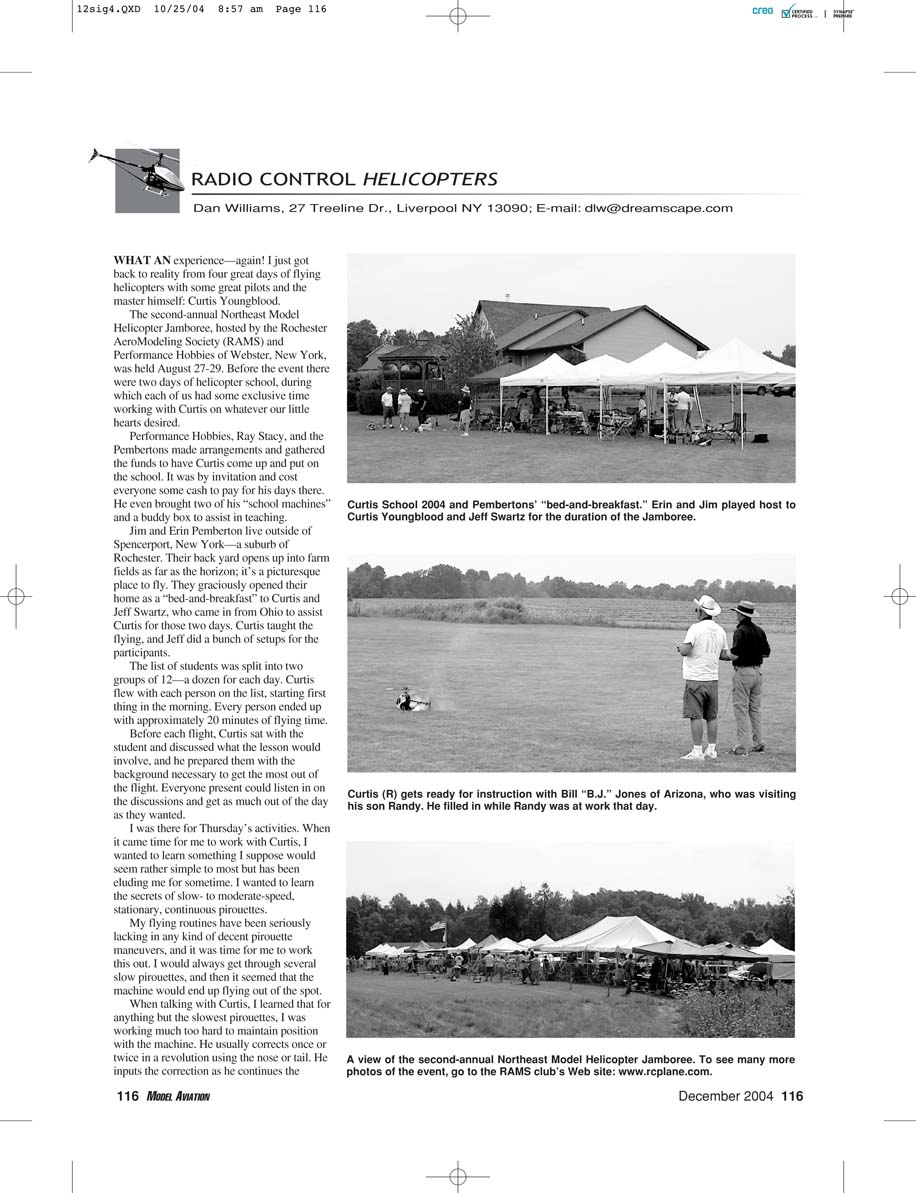
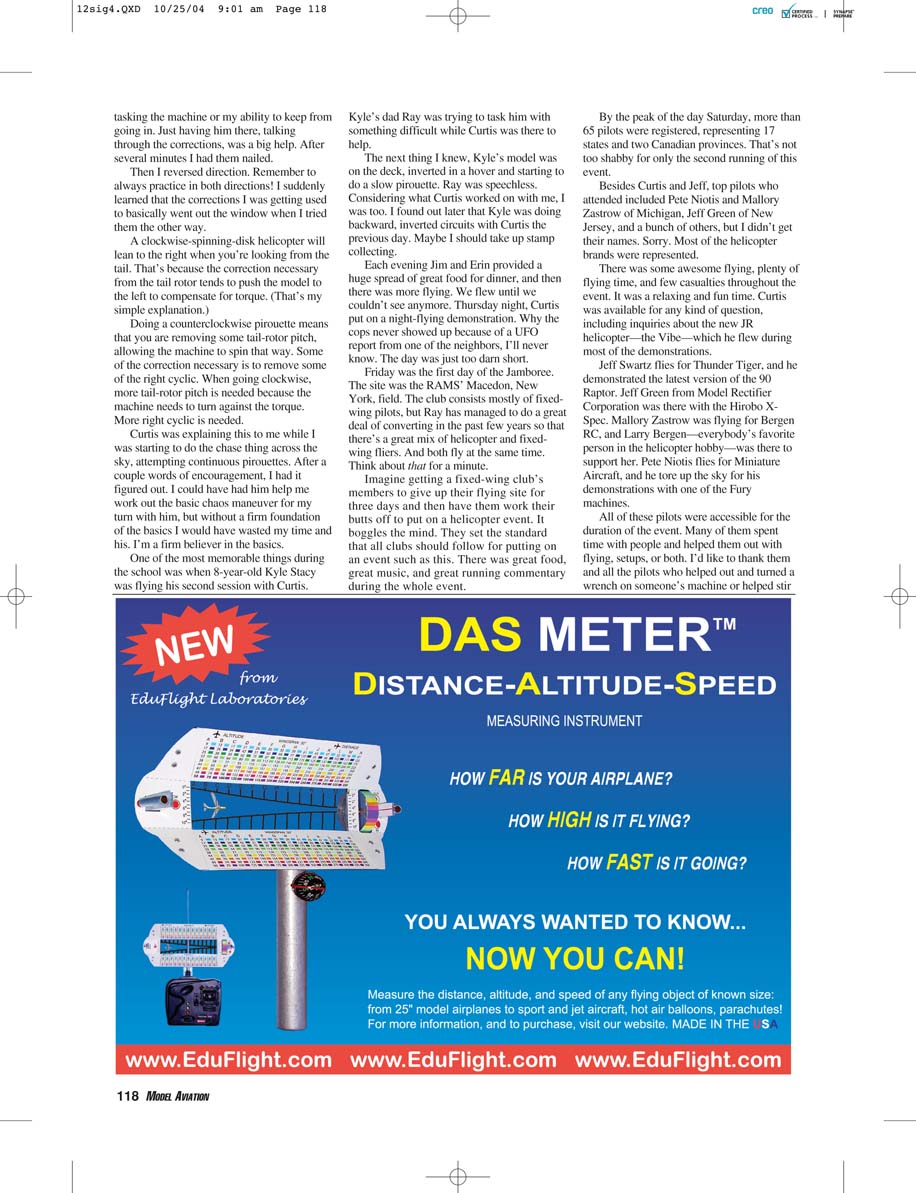
The second-annual Northeast Model Helicopter Jamboree, hosted by the Rochester AeroModeling Society (RAMS) and Performance Hobbies of Webster, New York, was held August 27–29. Before the event there were two days of helicopter school, during which each of us had some exclusive time working with Curtis on whatever our little hearts desired.
Performance Hobbies, Ray Stacy, and the Pembertons made arrangements and gathered the funds to have Curtis come up and put on the school. It was by invitation and cost everyone some cash to pay for his days there. He even brought two of his "school machines" and a buddy box to assist in teaching.
Jim and Erin Pemberton live outside of Spencerport, New York—a suburb of Rochester. Their backyard opens up into farm fields as far as the horizon; it's a picturesque place to fly. They graciously opened their home as a "bed-and-breakfast" to Curtis and Jeff Swartz, who came in from Ohio to assist Curtis for those two days. Curtis taught the flying, and Jeff did a bunch of setups for the participants.
The list of students was split into two groups of 12—a dozen for each day. Curtis flew with each person on the list, starting first thing in the morning. Every person ended up with approximately 20 minutes of flying time.
Before each flight, Curtis sat with the student and discussed what the lesson would involve, and he prepared them with the background necessary to get the most out of the flight. Everyone present could listen in on the discussions and get as much out of the day as they wanted.
Helicopter school — lessons learned
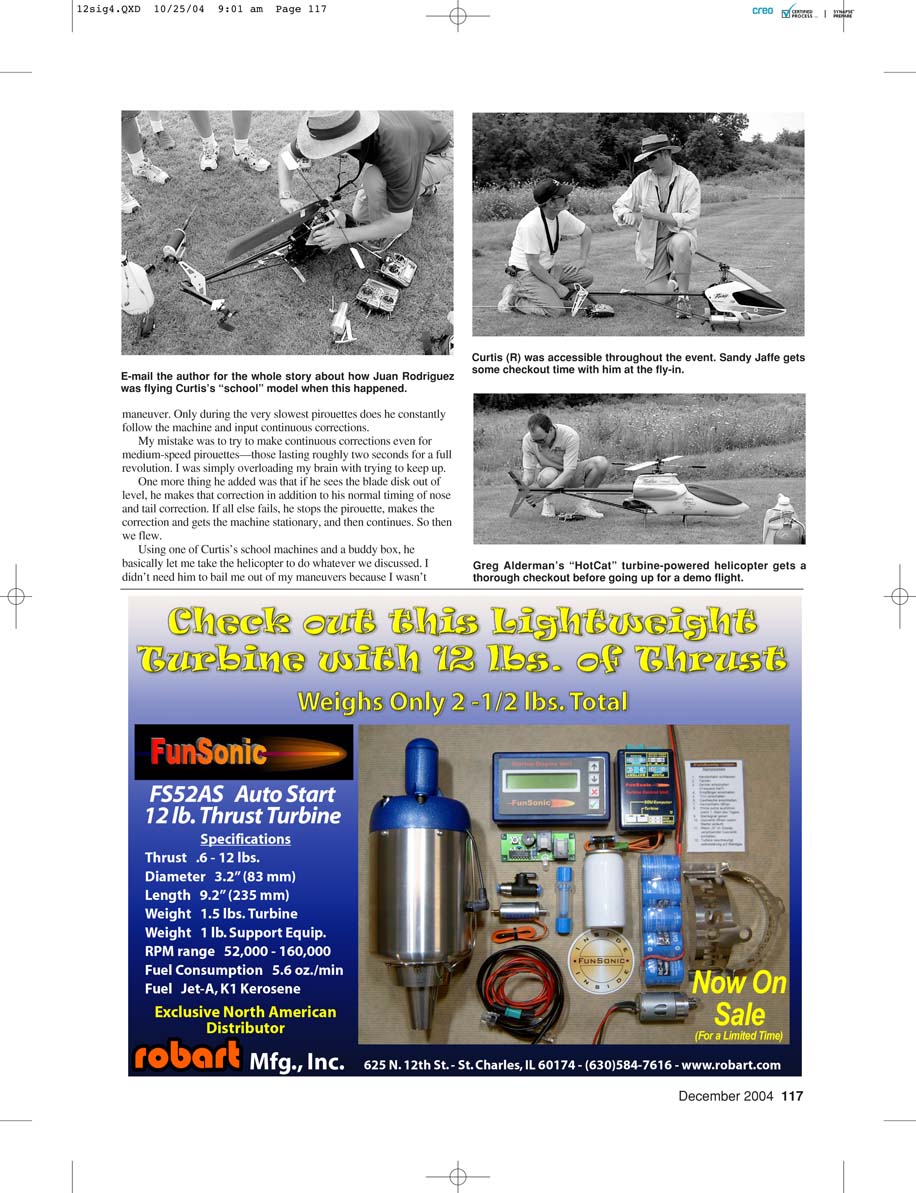
I was there for Thursday's activities. When it came time for me to work with Curtis, I wanted to learn something I suppose would seem rather simple to most but has been eluding me for some time. I wanted to learn the secrets of slow- to moderate-speed, stationary, continuous pirouettes. My flying routines have been seriously lacking in any kind of decent pirouette maneuvers, and it was time for me to work this out. I would always get through several slow pirouettes, and then it seemed that the machine would end up flying out of the spot.
When talking with Curtis, I learned that for anything but the slowest pirouettes, I was working much too hard to maintain position with the machine. He usually corrects once or twice in a revolution using the nose or tail. He inputs the correction as he continues the maneuver. Only during the very slowest pirouettes does he constantly follow the machine and input continuous corrections. My mistake was to try to make continuous corrections even for medium-speed pirouettes—those lasting roughly two seconds for a full revolution. I was simply overloading my brain with trying to keep up.
One more thing he added was that if he sees the blade disk out of level, he makes that correction in addition to his normal timing of nose and tail correction. If all else fails, he stops the pirouette, makes the correction and gets the machine stationary, and then continues.
So then we flew. Using one of Curtis's school machines and a buddy box, he basically let me take the helicopter to do whatever we discussed. I didn't need him to bail me out of my maneuvers because I wasn't taxing the machine or my ability to keep from going in. Just having him there, talking through the corrections, was a big help. After several minutes I had them nailed. Then I reversed direction. Remember to always practice in both directions! I suddenly learned that the corrections I was getting used to basically went out the window when I tried them the other way.
A clockwise-spinning-disk helicopter will lean to the right when you're looking from the tail. That's because the correction necessary from the tail rotor tends to push the model to the left to compensate for torque. Doing a counterclockwise pirouette means that you are removing some tail-rotor pitch, allowing the machine to spin that way. Some of the correction necessary is to remove some of the right cyclic. When going clockwise, more tail-rotor pitch is needed because the machine needs to turn against the torque. More right cyclic is needed.
Curtis was explaining this to me while I was starting to do the chase thing across the sky, attempting continuous pirouettes. After a couple words of encouragement, I had it figured out. I could have had him help me work out the basic chaos maneuver for my part within him, but without a firm foundation of the basics I would have wasted my time and his. I'm a firm believer in the basics.
One of the most memorable things during the school was when 8-year-old Kyle Stacy was flying his second session with Curtis. Kyle's dad Ray was trying to task him with something difficult while Curtis was there to help. The next thing I knew, Kyle's model was on the deck, inverted in a hover and starting to do a slow pirouette. Ray was speechless. Considering what Curtis worked on with me, I was too. I found out later that Kyle was doing backward, inverted circuits with Curtis the previous day. Maybe I should take up stamp collecting.
Each evening Jim and Erin provided a huge spread of great food for dinner, and then there was more flying. We flew until we couldn't see anymore. Thursday night, Curtis put on a night-flying demonstration. Why the cops never showed up because of a UFO report from one of the neighbors, I'll never know. The day was just too darn short.
The Jamboree event
Friday was the first day of the Jamboree. The site was the RAMS' Macedon, New York, field. The club consists mostly of fixed-wing pilots, but Ray has managed to do a great deal of converting in the past few years so that there's a great mix of helicopter and fixed-wing fliers. And both fly at the same time. Think about that for a minute.
Imagine getting a fixed-wing club's members to give up their flying site for three days and then have them work their butts off to put on a helicopter event. It boggles the mind. They set the standard that all clubs should follow for putting on an event such as this. There was great food, great music, and great running commentary during the whole event.
By the peak of the day Saturday, more than 65 pilots were registered, representing 17 states and two Canadian provinces. That's not too shabby for only the second running of this event.
Demonstrations and notable pilots
Besides Curtis and Jeff, top pilots who attended included:
- Pete Niotis and Mallory Zastrow of Michigan
- Jeff Green of New Jersey
- Jeff Swartz (assisting Curtis)
- Mallory Zastrow (flying for Bergen RC) and Larry Berger supporting her
- Pete Niotis (flying Miniature Aircraft)
- Greg Alderman (turbine-powered demonstrations)
Most of the helicopter brands were represented. There was some awesome flying, plenty of flying time, and few casualties throughout the event. It was a relaxing and fun time. Curtis was available for any kind of question, including inquiries about the new JR helicopter—the Vibe—which he flew during most of the demonstration.
Jeff Swartz flies for Thunder Tiger, and he demonstrated the latest version of the 90 Raptor. Jeff Green from Model Rectifier Corporation was there with the Hirobo X-Spec. Mallory Zastrow was flying for Bergen RC, and Larry Berger—everybody's favorite person in the helicopter hobby—was there to support her. Pete Niotis tore up the sky for his demonstrations. They were all great pilots and accessible for the duration of the event. Many of them spent time with people and helped them with flying, setups, or both.
I'd like to thank all the pilots who helped out, turned a wrench on someone's machine, or helped move transmitter sticks to test a setup. In many cases, this is the only access many fliers have to professional help. These pilots realize what it takes to keep this great hobby moving forward.
Turbine-powered helicopters
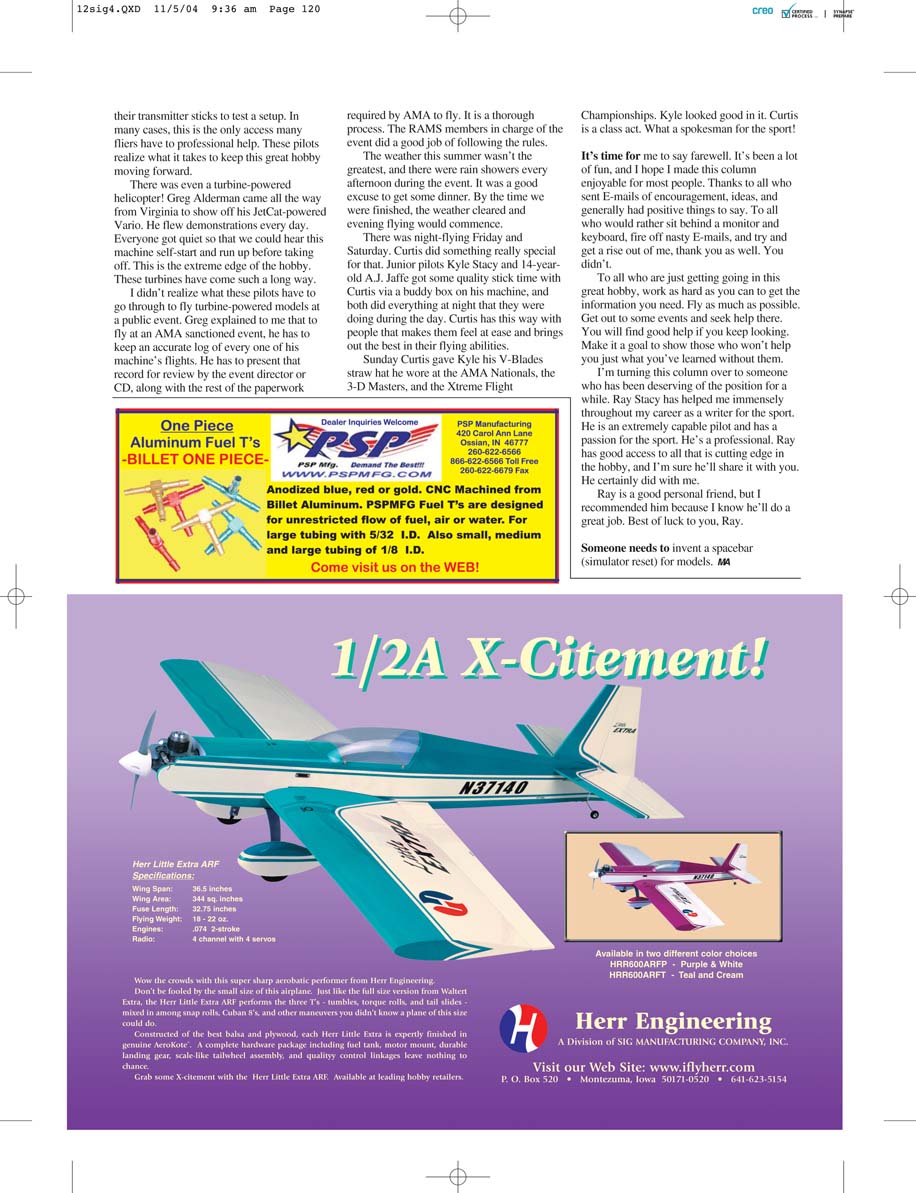
There was even a turbine-powered helicopter! Greg Alderman came all the way from Virginia to show off his JetCat-powered Vario. He flew demonstrations every day. Everyone got quiet so that we could hear this machine self-start and run up before taking off. This is the extreme edge of the hobby. These turbines have come such a long way.
I didn't realize what these pilots have to go through to fly turbine-powered models at a public event. Greg explained to me that to fly at an AMA-sanctioned event, he has to keep an accurate log of every one of his machine's flights. He has to present that record for review by the event director or contest director, along with the rest of the paperwork required by AMA to fly. It is a thorough process. The RAMS members in charge of the event did a good job of following the rules.
Night flying and junior pilots
The weather this summer wasn't the greatest, and there were rain showers every afternoon during the event. It was a good excuse to get some dinner. By the time we were finished, the weather cleared and evening flying would commence.
There was night flying Friday and Saturday. Curtis did something really special for that. Junior pilots Kyle Stacy and 14-year-old A.J. Jaffe got some quality stick time with Curtis via a buddy box on his machine, and both did everything at night that they were doing during the day. Curtis has this way with people that makes them feel at ease and brings out the best in their flying abilities.
Sunday Curtis gave Kyle his V-Blades straw hat he wore at the AMA Nationals, the 3-D Masters, and the Xtreme Flight Championships. Kyle looked good in it. Curtis is a class act. What a spokesman for the sport!
Thanks and farewell
It's time for me to say farewell. It's been a lot of fun, and I hope I made this column enjoyable for most people. Thanks to all who sent e-mails of encouragement, ideas, and generally had positive things to say. To all who would rather sit behind a monitor and keyboard, fire off nasty e-mails, and try and get a rise out of me, thank you as well. You didn't.
To all who are just getting going in this great hobby, work as hard as you can to get the information you need. Fly as much as possible. Get out to some events and seek help there. You will find good help if you keep looking. Make it a goal to show those who won't help you just what you've learned without them.
I'm turning this column over to someone who has been deserving of the position for a while. Ray Stacy has helped me immensely throughout my career as a writer for the sport. He is an extremely capable pilot and has a passion for the sport. He's a professional. Ray has good access to all that is cutting edge in the hobby, and I'm sure he'll share it with you. He certainly did with me.
Ray is a good personal friend, but I recommended him because I know he'll do a great job. Best of luck to you, Ray.
Someone needs to invent a spacebar (simulator reset) for models. MA
Transcribed from original scans by AI. Minor OCR errors may remain.

