
Radio Control Helicopters
Ray Stacy [[email protected]]
Part two of the Stratus review by guest columnist Gordie Meade
The Stratus kit comes with the twin-boom struts with the plastic ball ends, familiar to all the Fury fliers, which are very easy to build and install. To maximize the rigidity of the tailboom, I chose to use the boom struts used on the XL Pro IIK, which have machined aluminum ends. Since they are not designed for use on this model, I had to "persuade" the machined ends to provide a little more angle than stock for the Pro.
After J.B. welding the ends on and allowing time for them to cure completely, I placed the machined end in a vise and carefully increased the angle so that they aligned correctly with the bottom plate of the Stratus and the bottom of the boom clamp — not the side. By moving the mounting to the bottom of the clamp we maximize the angle of the strut and minimize the flex of the clamp, making the most rigid but lightest-weight tailboom we can.
If you decide to do this, be very careful, as it is easy to break the struts right outside the aluminum ends, thus ruining the strut. For most applications, the plastic end struts would work fine and may actually be a little lighter — a consideration if the model is going to be tail-heavy.
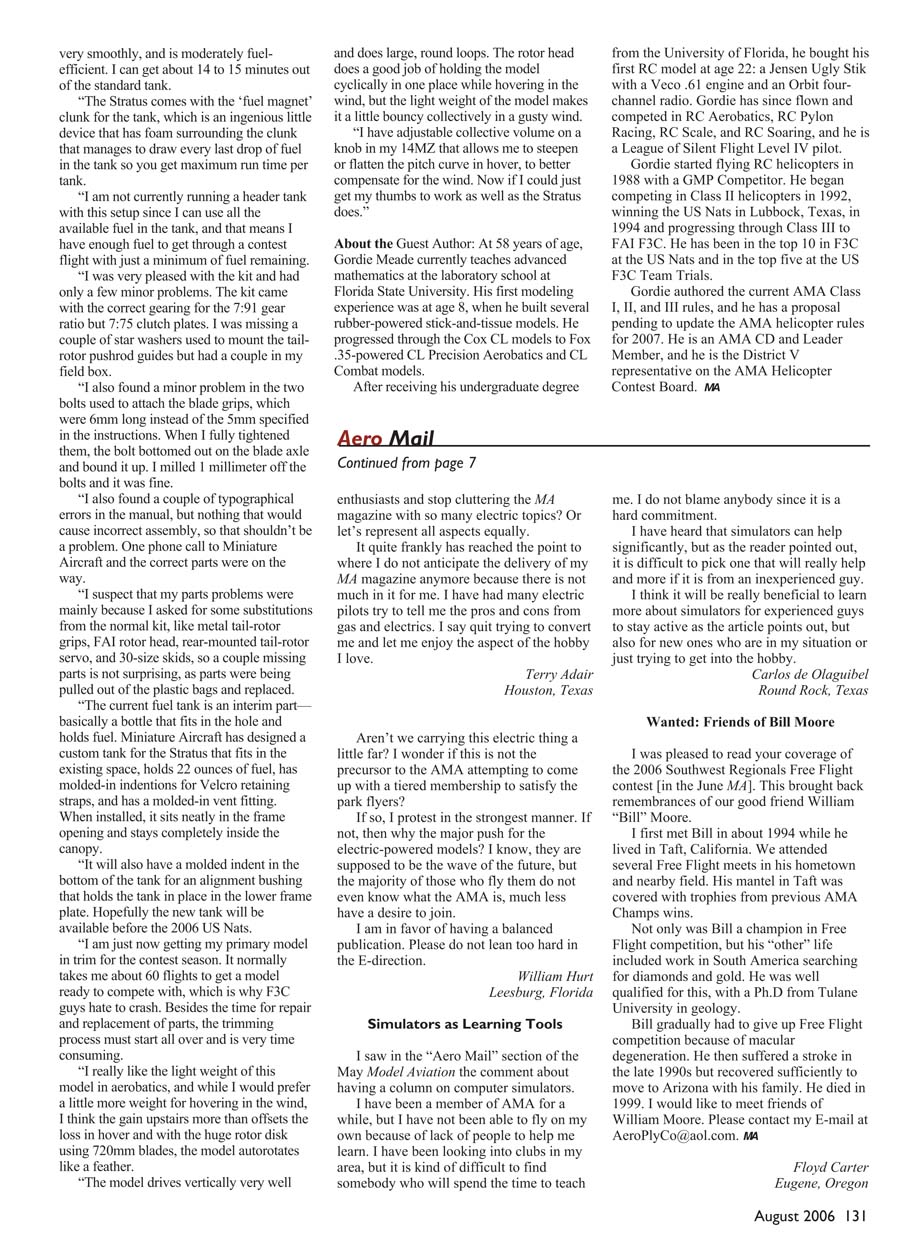
I have flown the Tempest FAI rotor head, designed by World Champion Cliff Hiatt, on all my contest models for the last few years and really have grown to love it. It has adjustable flybar mixing ratios from 0.6:1 all the way to 0.9:1, which is my choice.
Miniature Aircraft offers O-ring dampeners from 50 durometer (very soft) to 90 durometer (very hard) to adjust the feel of the head to suit each pilot. For FAI I require the softer ones.
Depending on the season and ambient temperature, I use either 50 durometer or a combination of 50–60. This allows the use of a low head speed for hovering, around 1,450 rpm if we choose, without any bumping, and using quite a bit of noncorrecting delta.
Delta is a term we use for an offset blade pitch arm input. If the link connects to the pitch arm at exactly the center of the head block, it would have no delta at all. If you move the link ahead or behind the center of the head, when the solid axle experiences an input, that will very slightly increase or decrease the pitch in the blade.
If the blade flaps up and the delta causes the pitch in the blade to decrease, we call it correcting or positive delta. If the blade pitches up and the delta causes the blade pitch to increase, we call it noncorrecting or negative delta.
The combination that I use has been pretty well explored over the last couple of years. I am very comfortable with it, so it was a no-brainer for me to install it on the Stratus.
One change on this Stratus from all my other models with this head is that the block is now machined as one piece, not the two pieces I was familiar with. I checked the runout on this head block and found it to be spot on, better than any of my other heads, so this is a plus.
I have been using 720 mm symmetrical blades weighing about 195 grams for the last two or three years. Curtis Youngblood has introduced a new line of rotor blades, the Radix, and I prevailed upon him for a set to use for testing.
Since they have been designed for heavy 3-D, the weight is only 185 grams, which is very light for my style of FAI flying but heavy enough to determine the characteristics of the blades. When production gets caught up with the demand for the new blades, he has plans on doing some F3C-weight blades — 195–205 grams.
I completed the actual mechanical construction of the model and sat down with the radio to begin setup. I am using the Futaba 14MZ which has 2048 resolution and a really good CCPM program that is very adjustable to keep the swashplate both tracking smoothly through all positions of collective and still through all cyclic movements.
When you get all this dialed in, it makes an amazing difference in how the model performs. It takes some time to get it all right, but it is certainly worth the effort in the performance of the model.
Take the time now to get as many CCPM interactions out of the model as you can. There are two types of interactions that can occur: pitch to cyclic and cyclic to pitch. The trick is to make the swashplate sit level through all collective applications and to make the swashplate not move vertically in cyclic applications.
The 14MZ has a built-in program to do that. Other radios require program mixes to accomplish the same thing.
The Stratus’s control geometry is pretty good as far as minimizing interaction mechanically, but taking the time to remove as much control interaction as you possibly can electronically is time well spent, as there is a significant performance gain to be had.
Trimming the model for F3C flight is a very time-consuming and labor-intensive process. I balance the model roughly by hanging the model from the flybar and having it settle just a touch nose-down, but final trim is done by checking the model in hover.
With the swashplate absolutely level I hover the model and see what trim it needs. If it wants to back up, I add nose weight. If it requires back trim, I either remove nose weight (ideal) or add tail weight.
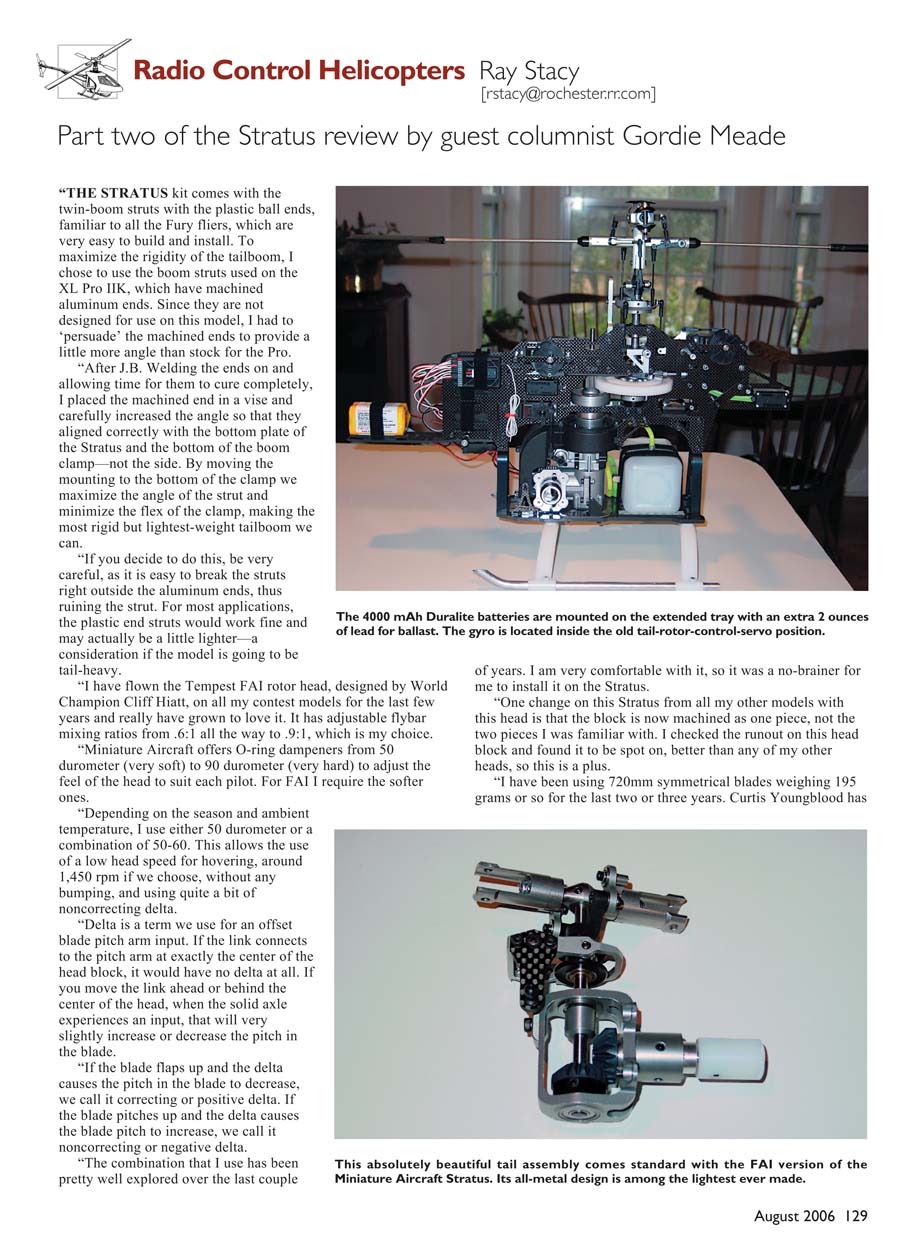
My Stratus with the rear-mounted tail-rotor servo tends to be very neutral or even a bit tail-heavy. Miniature Aircraft makes a longer battery tongue (part 0000L) that allows you to move the battery (the heaviest piece of radio gear) forward for balance. I use the Duralite 4000 mAh Li-Ion batteries, which are comparatively lightweight, so I need about 2 ounces of additional weight to get the model to balance correctly.
Keeping the back end of the model light is important, so I use the lightest, but still rigid, fins I can find. Saving an ounce in the back of the model removes 4 ounces or more in the front, which keeps the model light. When the model, with three-quarters of a tank of fuel, picks up and hovers with zero fore-aft trim, I am satisfied and move on to forward flight.
The FAI schedules require that the model roll well and pitch smoothly, and I have found that the swashplate needs to be as level as possible in all flight conditions for that to happen. The Stratus FAI tends to want to nose over at high speed, so we normally use a slightly larger than standard horizontal fin, which helps hold the tail down.
The particular fins on my models are prototype fins that have slots milled in and we can add or remove area by covering or uncovering the slots. By varying the area of the horizontal fin we can adjust how much the model climbs or noses over at high speed.
By keeping the swashplate as level as we can, performance at higher and inverted flight is similar and the model is very neutral. With just the normal default servo throws, I can get over 22° of collective, from −10° to +12°, with no difficulty and still have available throw for maximum cyclic deflection.
Even with the relatively heavy flybar paddles I use, the cyclic rates are pretty quick and do not require excessive control deflection. I am using only ±5° of cyclic in forward flight and only ±2½° in hover.
Since the Stratus has more weight lower in the main frames, the vertical CG of the model is fairly high compared to the Tempest and Fury, which makes the model very neutral on the roll axis so it is very easy to get an axial roll in either direction with very little collective change.
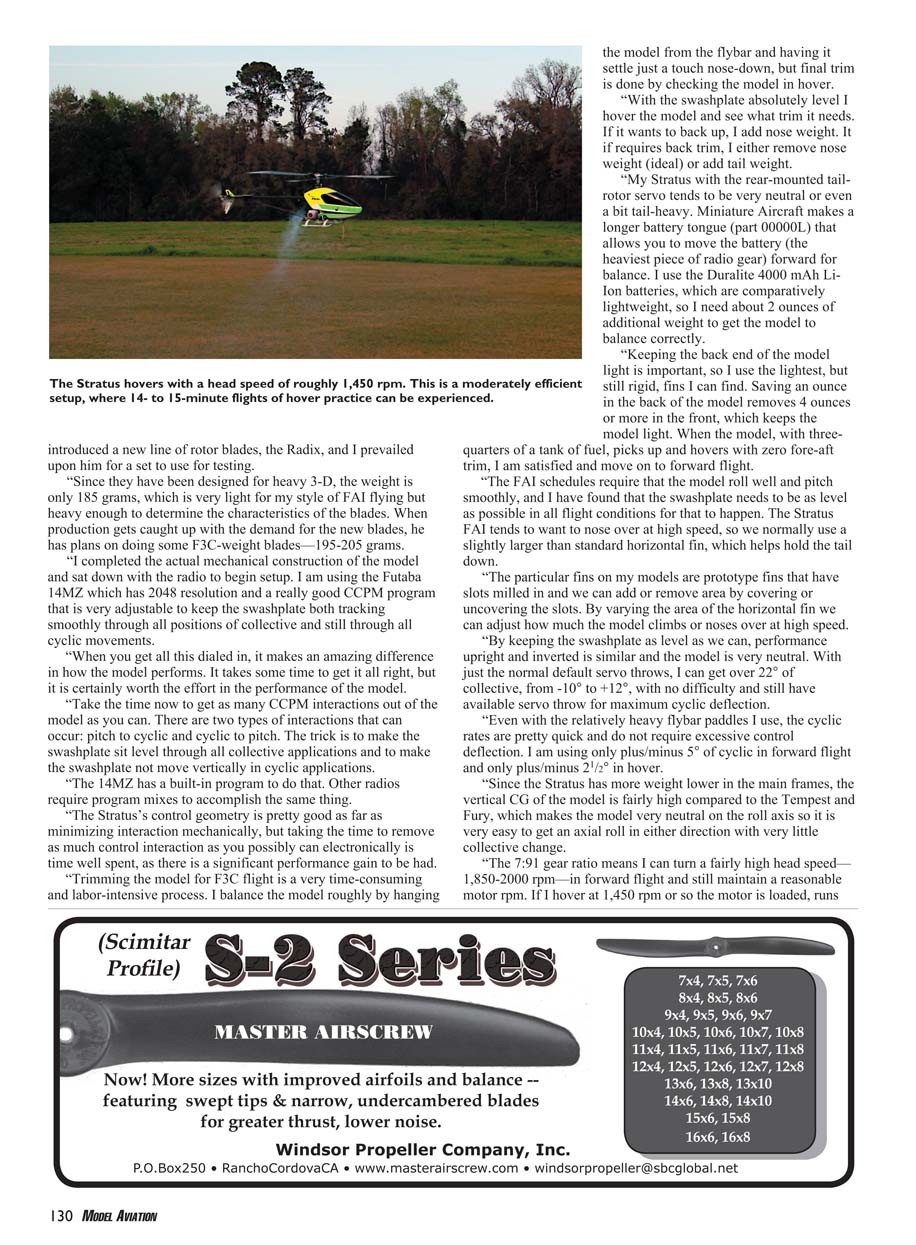
The 7.9:1 gear ratio means I can turn a fairly high head speed — 1,850–2,000 rpm — in forward flight and still maintain a reasonable motor rpm. If I hover at 1,450 rpm or so the motor is loaded, runs very smoothly, and is moderately fuel-efficient. I can get about 14 to 15 minutes out of the standard tank.
The Stratus comes with the "fuel magnet" clunk for the tank, which is an ingenious little device that has foam surrounding the clunk that manages to draw every last drop of fuel in the tank so you get maximum run time per tank.
I am not currently running a header tank with this setup since I can use all the available fuel in the tank, and that means I have enough fuel to get through a contest flight with just a minimum of fuel remaining.
I was very pleased with the kit and had only a few minor problems. The kit came with the correct gearing for the 7.9:1 gear ratio but 7.75 clutch plates. I was missing a couple of star washers used to mount the tail-rotor pushrod guides but had a couple in my field box.
I also found a minor problem in the two bolts used to attach the blade grips, which were 6 mm long instead of the 5 mm specified in the instructions. When I fully tightened them, the bolt bottomed out on the blade axle and bound it up. I milled 1 mm off the bolts and it was fine.
I also found a couple of typographical errors in the manual, but nothing that would cause incorrect assembly, so that shouldn't be a problem. One phone call to Miniature Aircraft and the correct parts were on the way.
I suspect that my parts problems were mainly because I asked for some substitutions from the normal kit, like metal tail-rotor grips, FAI rotor head, rear-mounted tail-rotor servo, and 30-size skids, so a couple missing parts is not surprising, as parts were being pulled out of the plastic bags and replaced.
The current fuel tank is an interim part — basically a bottle that fits in the hole and holds fuel. Miniature Aircraft has designed a custom tank for the Stratus that fits in the existing space, holds 22 ounces of fuel, has molded-in indentations for Velcro retaining straps, and has a molded-in vent fitting. When installed, it sits neatly in the frame opening and stays completely inside the canopy.
It will also have a molded indent in the bottom of the tank for an alignment bushing that holds the tank in place in the lower frame plate. Hopefully the new tank will be available before the 2006 US Nats.
I am just now getting my primary model in trim for the contest season. It normally takes me about 60 flights to get a model ready to compete with, which is why F3C guys hate to crash. Besides the time for repair and replacement of parts, the trimming process must start all over and is very time consuming.
I really like the light weight of this model in aerobatics, and while I would prefer a little more weight for hovering in the wind, I think the gain upstairs more than offsets the loss in hover and with the huge rotor disk using 720 mm blades, the model autorotates like a feather.
The model drives vertically very well and does large, round loops. The rotor head does a good job of holding the model cyclically in one place while hovering in the wind, but the light weight of the model makes it a little bouncy collectively in a gusty wind.
I have adjustable collective volume on a knob in my 14MZ that allows me to steepen or flatten the pitch curve in hover, to better compensate for the wind. Now if I could just get my thumbs to work as well as the Stratus does.
About the Guest Author:
At 58 years of age, Gordie Meade currently teaches advanced mathematics at the laboratory school at Florida State University. His first modeling experience was at age 8, when he built several rubber-powered stick-and-tissue models. He progressed through the Cox CL models to Fox .35-powered CL Precision Aerobatics and CL Combat models.
After receiving his undergraduate degree from the University of Florida, he bought his first RC model at age 22: a Jensen Ugly Stik with a Veco .61 engine and an Orbit four-channel radio. Gordie has since flown and competed in RC Aerobatics, RC Pylon Racing, RC Scale, and RC Soaring, and he is a League of Silent Flight Level IV pilot.
Gordie started flying RC helicopters in 1988 with a GMP Competitor. He began competing in Class II helicopters in 1992, winning the US Nats in Lubbock, Texas, in 1994 and progressing through Class III to FAI F3C. He has been in the top 10 in F3C at the US Nats and in the top five at the US F3C Team Trials.
Gordie authored the current AMA Class I, II, and III rules, and he has a proposal pending to update the AMA helicopter rules for 2007. He is an AMA CD and Leader Member, and he is the District V representative on the AMA Helicopter Contest Board. MA
Transcribed from original scans by AI. Minor OCR errors may remain.

