
Radio Control Helicopters
Mark Fadely [email protected]
Often-asked helicopter questions and some straightforward answers
Now that winter is upon us, it's a good time to reflect on the past year and focus on what we want from our hobby in the upcoming year. Everyone dives into the hobby in a different way. Some people who are new to the RC world get really excited and let it become an obsession. Others have been flying helicopters for decades and tend to balance their time with other activities. Many pilots fall somewhere in between. One thing that all of them have in common is enthusiasm.
I mentioned last month that more people than ever are giving RC helicopters a try, and why not? It's never been easier or more affordable to get started.
I was curious to find out more about the RC helicopter market, so I paid a visit to my local hobby shop. The shop is a HobbyTown and Bill Scott owns it. He opened the shop here in Indianapolis, Indiana, in 1995 and has expanded it to a 15,000-square-foot megastore. He also has a satellite store on the south side of Indy.
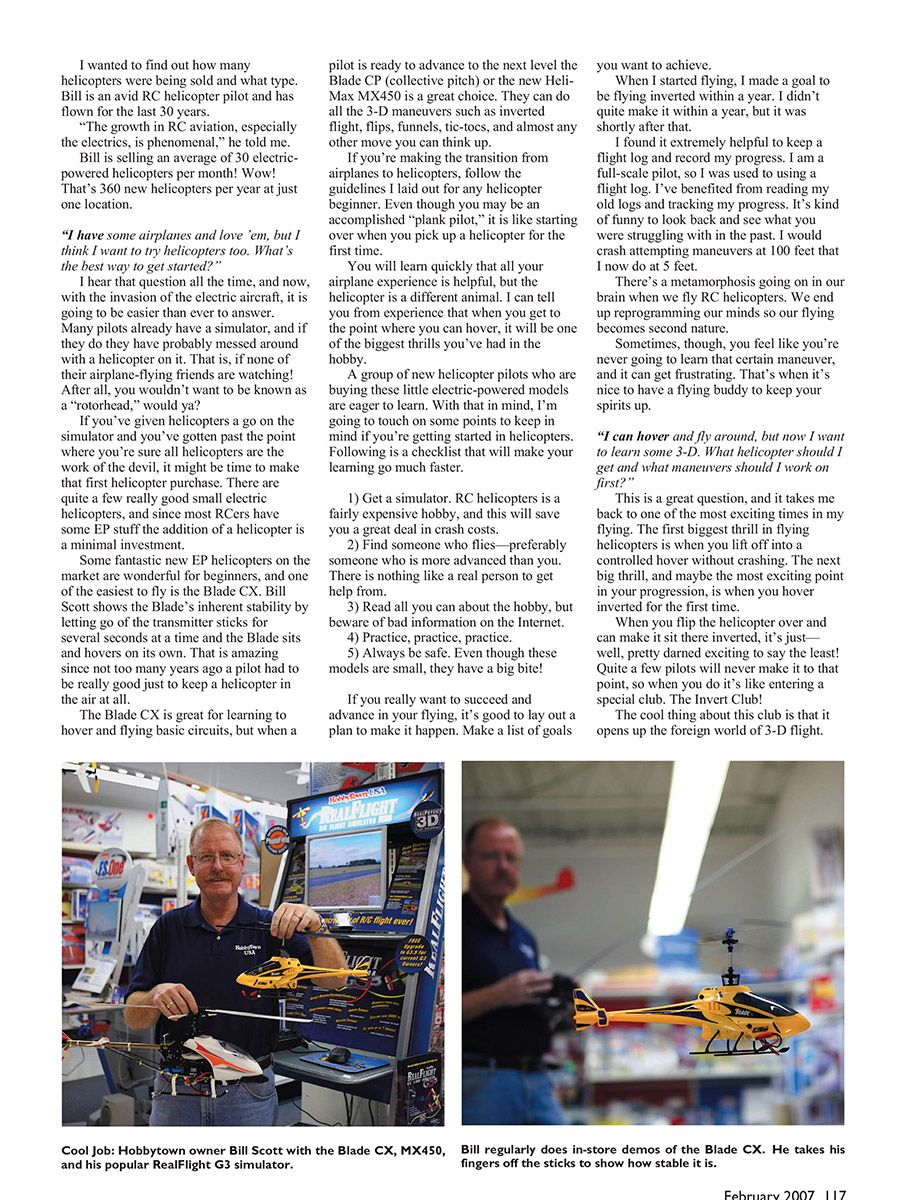
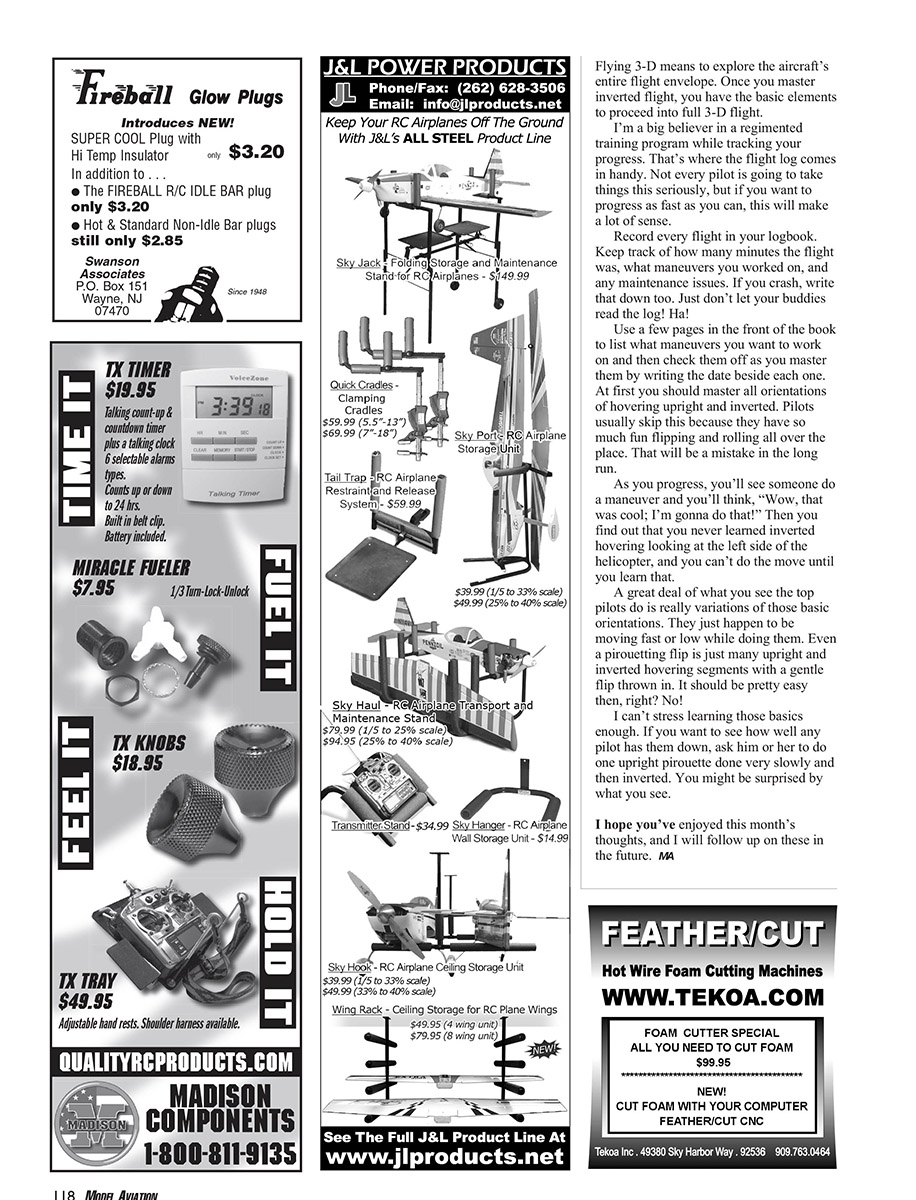
When I walked into the RC air department I saw two operating flight simulators. One was the RealFlight G3 and the other was the new FS One from Hangar 9. It was midday on a Wednesday and both of the simulators were in use. It's nice that shoppers can just walk up and start flying on these units.
I wanted to find out how many helicopters were being sold and what type. Bill is an avid RC helicopter pilot and has flown for the last 30 years. "The growth in RC aviation, especially the electrics, is phenomenal," he told me. Bill is selling an average of 30 electric-powered helicopters per month — wow! That's 360 new helicopters per year at just one location.
"I have some airplanes and love 'em, but I think I want to try helicopters too. What's the best way to get started?" I hear that question all the time, and now, with the invasion of the electric aircraft, it is going to be easier than ever to answer.
Many pilots already have a simulator, and if they do they have probably messed around with a helicopter on it. That is, if none of their airplane-flying friends are watching! After all, you wouldn't want to be known as a "rotorhead," would ya? If you've given helicopters a go on the simulator and you've gotten past the point where you're sure all helicopters are the work of the devil, it might be time to make that first helicopter purchase.
There are quite a few really good small electric helicopters, and since most RCers have some electric-powered (EP) equipment the addition of a helicopter is a minimal investment. Some fantastic new EP helicopters on the market are wonderful for beginners, and one of the easiest to fly is the Blade CX. Bill Scott shows the Blade's inherent stability by letting go of the transmitter sticks for several seconds at a time and the Blade sits and hovers on its own. That is amazing since not too many years ago a pilot had to be really good just to keep a helicopter in the air at all.
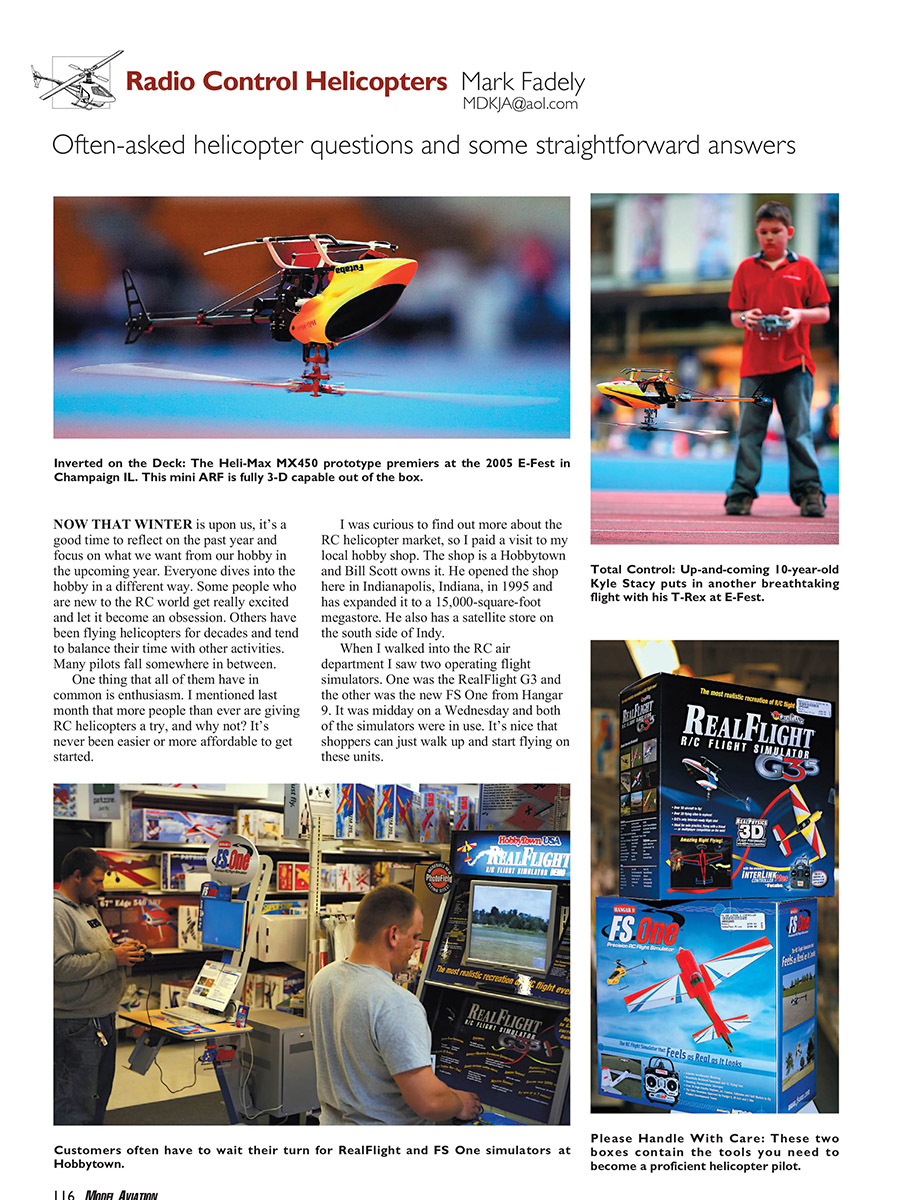
The Blade CX is great for learning to hover and for flying basic circuits, but when a pilot is ready to advance to the next level the Blade CP (collective pitch) or the new Heli-Max MX450 is a great choice. They can do all the 3-D maneuvers such as inverted flight, flips, funnels, tic-tocs, and almost any other move you can think up.
If you're making the transition from airplanes to helicopters, follow the guidelines I laid out for any helicopter beginner. Even though you may be an accomplished "plank pilot," it is like starting over when you pick up a helicopter for the first time.
You will learn quickly that all your airplane experience is helpful, but the helicopter is a different animal. I can tell from my experience that when you get to the point where you can hover, it will be one of the biggest thrills you've had in the hobby.
A group of new helicopter pilots who are buying these little electric-powered models are eager to learn. With that in mind, I'm going to touch on some points to keep in mind if you're getting started in helicopters. Following is a checklist that will make your learning go much faster.
- Get a simulator. RC helicopters are a fairly expensive hobby, and this will save you a great deal in crash costs.
- Find someone who flies—preferably someone who is more advanced than you. There is nothing like a real person to get help from.
- Read all you can about the hobby, but beware of bad information on the Internet.
- Practice, practice, practice.
- Always be safe. Even though models are small, they have a big bite!
If you really want to succeed and advance in your flying, it's good to lay out a plan to make it happen. Make a list of goals you want to achieve.
When I started flying, I made a goal to be flying inverted within a year. I didn't quite make it within a year, but it was shortly after that.
I found it extremely helpful to keep a flight log and record my progress. I am a full-scale pilot, so I was used to using a flight log. I've benefited from reading my old logs and tracking my progress. It's kind of funny to look back and see what you were struggling with in the past. I would crash attempting maneuvers at 100 feet that I now do at 5 feet.
There's a metamorphosis going on in our brain when we fly RC helicopters. We end up reprogramming our minds so our flying becomes second nature.
Sometimes, though, you feel like you're never going to learn that certain maneuver, and it can get frustrating. That's when it's nice to have a flying buddy to keep your spirits up.
"I can hover and fly around, but now I want to learn some 3-D. What helicopter should I get and what maneuvers should I work on first?"
This is a great question, and it takes me back to one of the most exciting times in my flying. The first biggest thrill in flying helicopters is when you lift off into a controlled hover without crashing. The next big thrill, and maybe the most exciting point in your progression, is when you hover inverted for the first time.
When you flip the helicopter over and can make it sit there inverted, it's just — well, pretty darned exciting to say the least! Quite a few pilots will never make it to that point, so when you do it's like entering a special club. The Invert Club!
The cool thing about this club is that it opens up the foreign world of 3-D flight. Flying 3-D means to explore the aircraft's entire flight envelope. Once you master inverted flight, you have the basic elements to proceed into full 3-D flight.
I'm a big believer in a regimented training program while tracking your progress. That's where the flight log comes in handy. Not every pilot is going to take things this seriously, but if you want to progress as fast as you can, this will make a lot of sense.
Record every flight in your logbook. Keep track of how many minutes the flight was, what maneuvers you worked on, and any maintenance issues. If you crash, write that down too. Just don't let your buddies read the log! Ha!
Use a few pages in the front of the book to list what maneuvers you want to work on and then check them off as you master them by writing the date beside each one. At first you should master all orientations of hovering upright and inverted. Pilots usually skip this because they have so much fun flipping and rolling all over the place. That will be a mistake in the long run.
As you progress, you'll see someone do a maneuver and you'll think, "Wow, that was cool; I'm gonna do that!" Then you find out that you never learned inverted hovering looking at the left side of the helicopter, and you can't do the move until you learn that.
A great deal of what you see the top pilots do is really variations of those basic orientations. They just happen to be moving fast or low while doing them. Even a pirouetting flip is just many upright and inverted hovering segments with a gentle flip thrown in. It should be pretty easy then, right? No!
I can't stress learning those basics enough. If you want to see how well any pilot has them down, ask him or her to do one upright pirouette done very slowly and then inverted. You might be surprised by what you see.
I hope you've enjoyed this month's thoughts, and I will follow up on these in the future.
Transcribed from original scans by AI. Minor OCR errors may remain.

