
Radio Control Helicopters
Mark Fadely [email protected]
An enthusiastic review of the Blade CP Pro
WELCOME BACK to the madness! I trust you have all been busy beating the air into submission since our last meeting. Since you're probably reading this in mid-winter, there's surely not much outdoor flying going on in most areas. This is the time of year I dream about being somewhere besides cold Indiana. Those of you who get to fly outside year-round have it made.
Blade CP Pro: I thought this would be a good time to delve a bit deeper into the indoor helicopter scene. I received a new little helicopter in the mail the other day: an E-flite Blade CP Pro RTF from Horizon Hobby (www.horizonhobby.com). These mini mechanical marvels are selling extremely well. Mini and micro EP models are the most exciting things to ever happen in the helicopter world. It's no wonder everyone wants one.
I love getting big boxes in the mail, and the Blade CP Pro arrived in a colorful package decorated with nice photos on all sides. It even had a picture of the model flying inverted! Now that's enough to get an aspiring 3-D pilot excited. There was a disclaimer below the invert picture that read, "Intended for experienced helicopter pilots over age 14." I carried the box down to the basement and passed my wife along the way. She shrugged and said, "Another one?" I'm glad she's so understanding—sort of. I opened the box and there it was. I mean all of it. There was the model, transmitter, batteries, charger, and it was all assembled. You just take this thing out of the box and fly it? Yep, that's what it said. "3D out of the box" was written right on it.
I was thinking, "Sure; this is not going to be that easy. I guess this review is going to have a rather limited write-up for the building section, like none!" I've been in the RC hobby for 35 years, and this was not making sense to me. After all, even ARFs have to be assembled and prepared for flight. How can all the adjustments and pushrods be set properly? I didn't get it.
The hardest part about getting this little helicopter ready to go was getting it out of its comfy Styrofoam packing. I plugged in the included Li-Poly balancing charger and let it get its first-flight charge started. My wife reminded me of a couple unfinished items on my honey-do list, so I took care of those and came back a bit later to check out the model. I had already installed the AA batteries in the transmitter, so it was time to plug up the Li-Poly pack and see what would happen.
It's always a thrill to put a new helicopter in the air for the first time. I spooled up cautiously and got it light on the skids. I'll be honest; I was a bit apprehensive about the tail rotor being driven by a motor. I've never flown one with that setup, and I can't believe it works all that well. With a little more collective it lifted off, and with a little aileron trim I had it hovering nicely. This was breaking all the rules I learned in "Helicopters 101." You're supposed to spend weeks building a model helicopter, tweak the parts, visit a machine shop a couple times, and then maybe think about firing it up. I pulled this model out of the box and flew it. Wow! What a concept. What's not to like?
I pushed the nose down and took off into forward flight. The little machine flew and tracked excellently. It was time to see if it could really fly inverted. At approximately 30 feet of altitude I pulled it up into a half loop, stopped it on its back, and held it there. It did fantastic, so I let it come down to eye level and then pushed out of it, back into upright flight.
The tail control was great with the motor-driven tail rotor, and all the other mechanical parts such as the servos, receiver, and gyro operated nicely. This small model behaved much like other good micro and mini helicopters I've flown. I have to hand it to this model's designers. This is just what the EP helicopter market needs: a plug-and-play 3-D machine.
My conclusion is that this is an excellent micro 3-D electric for experienced pilots. It has the capabilities to fly full 3-D, including inverted, backward, and sideways flight. I had a blast flying the Blade and have to give credit to the people who brought it to the market. Many people who are new to the hobby have no idea what a feat it is to have an RTF RC helicopter with these abilities.
Indoor Fun-Fly
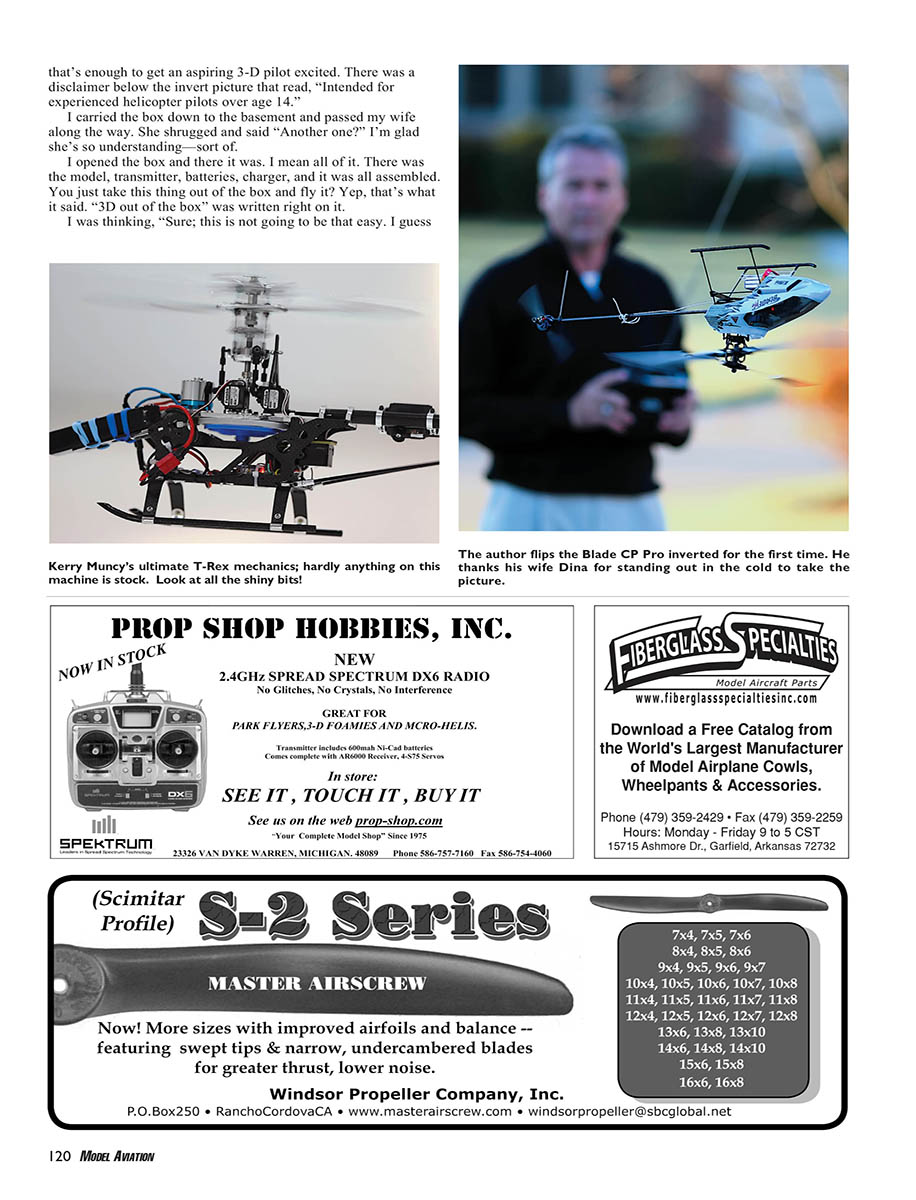
I recently attended a fun-fly and swap meet that was held in a heated hangar at the Anderson Municipal Airport. Anderson is a small town between Indianapolis and Muncie. This was my first time there, and it was a treat. The event was open to small electric-powered airplanes and helicopters.
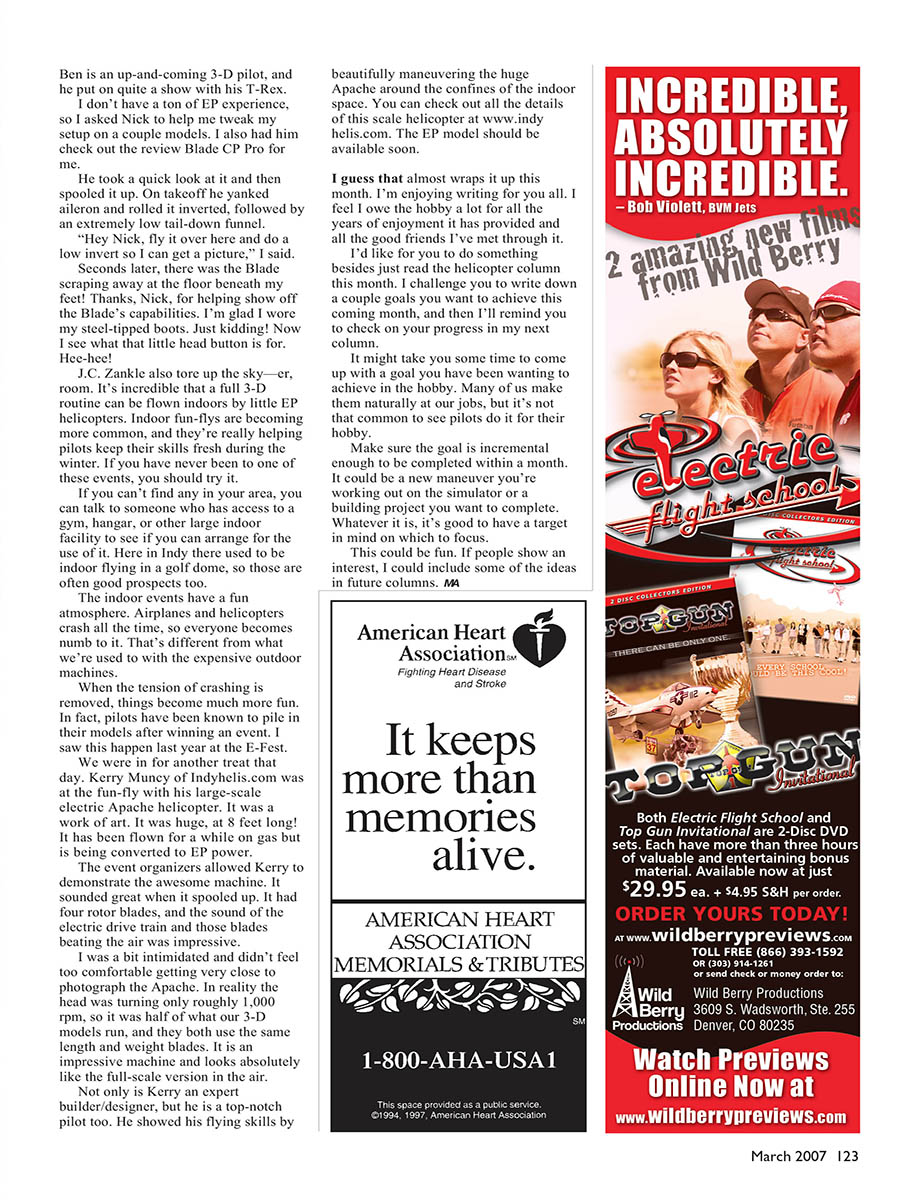
I pulled into the parking lot and went inside. This hangar looked new and was big—large enough for 3-D pilot extraordinaire Nick Maxwell to fly his full routine. Other notable pilots in attendance included:
- Nick Maxwell
- J.C. Zankle
- Kerry Muncy
- Ben Parrot
Ben is an up-and-coming 3-D pilot, and he put on quite a show with his T-Rex. I don't have a ton of EP experience, so I asked Nick to help me tweak my setup on a couple models. I also had him check out the review Blade CP Pro for me. He took a quick look at it and then spooled it up. On takeoff he yanked aileron and rolled it inverted, followed by an extremely low tail-down funnel.
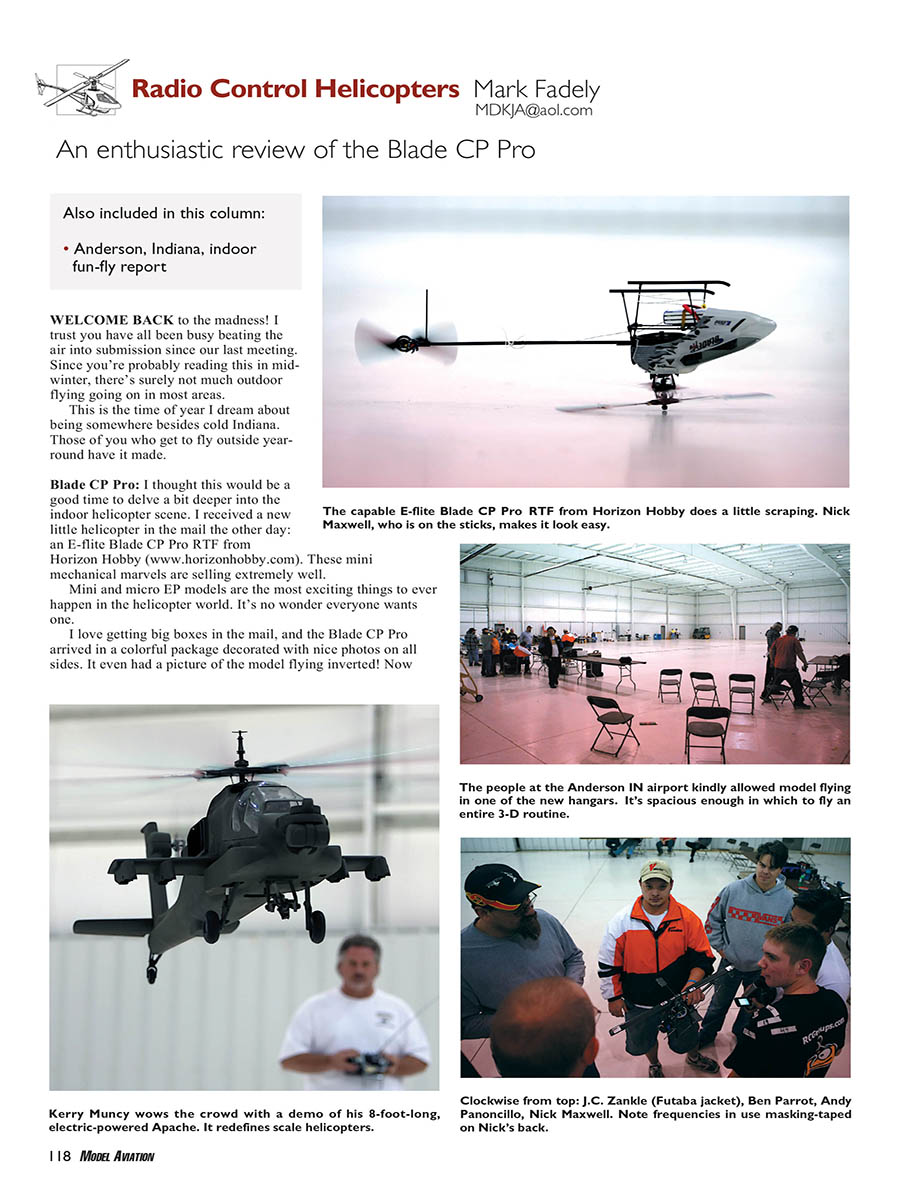
"Hey Nick, fly it over here and do a low invert so I can get a picture," I said. Seconds later, there was the Blade scraping away at the floor beneath my feet! Thanks, Nick, for helping show off the Blade's capabilities. I'm glad I wore my steel-tipped boots. Just kidding!
J.C. Zankle also tore up the sky—er, room. It's incredible that a full 3-D routine can be flown indoors by little EP helicopters. Indoor fun-flys are becoming more common, and they're really helping pilots keep their skills fresh during the winter. If you have never been to one of these events, you should try it.
If you can't find any in your area, you can talk to someone who has access to a gym, hangar, or other large indoor facility to see if you can arrange for the use of it. Here in Indy there used to be indoor flying in a golf dome, so those are often good prospects too.
The indoor events have a fun atmosphere. Airplanes and helicopters crash all the time, so everyone becomes numb to it. That's different from what we're used to with the expensive outdoor machines. When the tension of crashing is removed, things become much more fun. In fact, pilots have been known to pile in their models after winning an event. I saw this happen last year at the E-Fest.
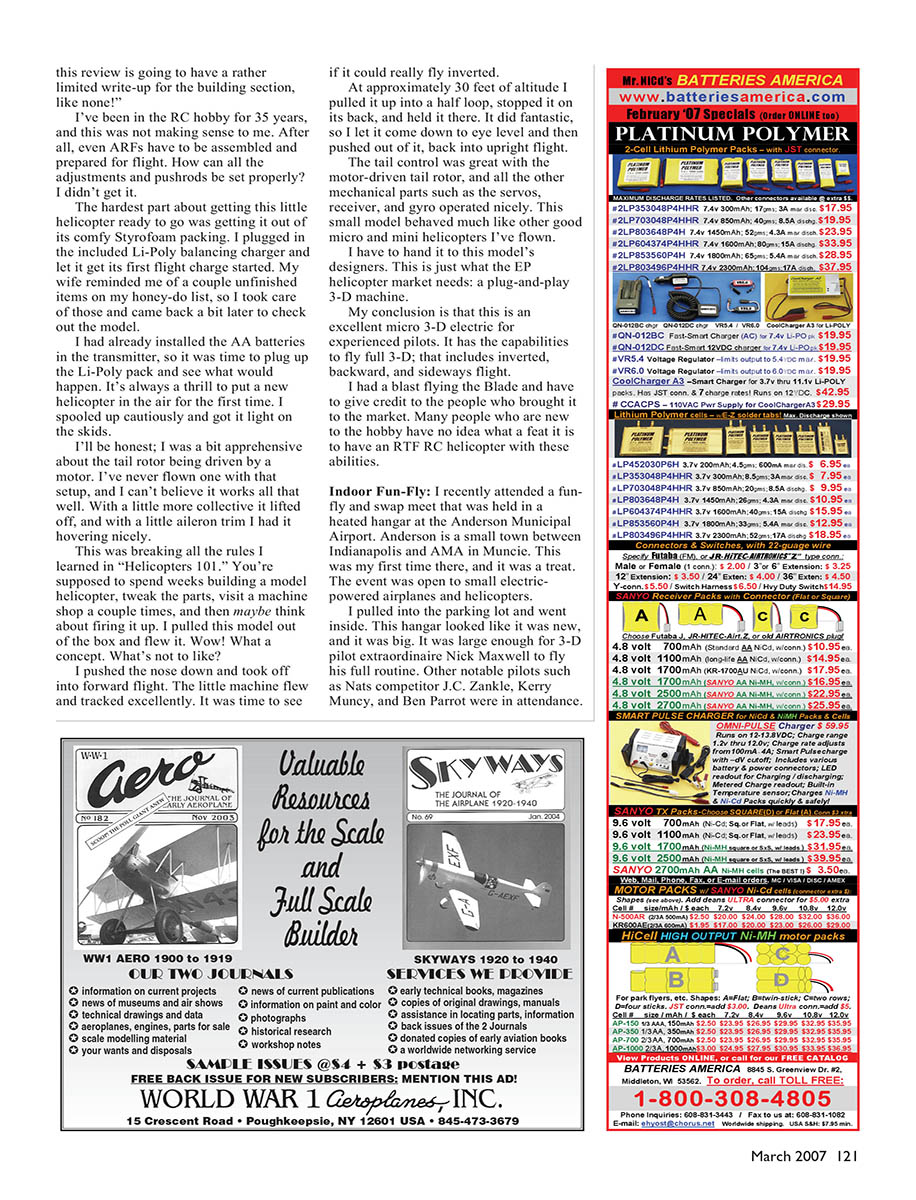
We were in for another treat that day. Kerry Muncy of indyhelis.com was at the fun-fly with his large-scale electric Apache helicopter. It was a work of art—huge at 8 feet long. It has been flown for a while on gas but is being converted to EP power. The event organizers allowed Kerry to demonstrate the awesome machine. It sounded great when it spooled up. It had four rotor blades, and the sound of the electric drive train and those blades beating the air was impressive.
I was a bit intimidated and didn't feel too comfortable getting very close to photograph the Apache. In reality the head was turning only roughly 1,000 rpm, so it was half of what our 3-D models run, and they both use the same length and weight blades. It is an impressive machine and looks absolutely like the full-scale version in the air. Not only is Kerry an expert builder/designer, but he is a top-notch pilot too. He showed his flying skills by beautifully maneuvering the huge Apache around the confines of the indoor space. You can check out all the details of this scale helicopter at www.indyhelis.com. The EP model should be available soon.
I guess that almost wraps it up this month. I'm enjoying writing for you all. I feel I owe the hobby a lot for all the years of enjoyment it has provided and all the good friends I've met through it.
I'd like for you to do something besides just read the helicopter column this month. I challenge you to write down a couple goals you want to achieve this coming month, and then I'll remind you to check on your progress in my next column.
It might take you some time to come up with a goal you have been wanting to achieve in the hobby. Many of us make goals at our jobs, but it's not that common to see pilots do it for their hobby. Make sure the goal is incremental enough to be completed within a month. Examples might include:
- A new maneuver you're working out on the simulator
- A building project you want to complete
Whatever it is, it's good to have a target in mind on which to focus. This could be fun. If people show an interest, I could include some of the ideas in future columns.
Transcribed from original scans by AI. Minor OCR errors may remain.

