
Radio Control Helicopters
Mark Fadely [[email protected]]
Thoughts about learning to fly helicopters
Hello, everyone. I hope all of you in the North are starting to get some flying in to shake off the winter rust.
It seems that no matter how much you practice on the simulator, it can never replace the real experience. The simulator is great for keeping your fingers going in the right directions, but real-world conditions always change things a bit. It usually takes a few days of real flying to get back into the groove after some time off.
This month I will cover some learning techniques and write about stick inputs for the most popular advanced maneuver. Then we will visit a fun-fly in Lexington, Kentucky.
The numbers are in, and our local hobby shop sold more RC helicopters than ever before. This enthusiastic crop of new pilots needs some good resources to get started right.
If you're serious about learning to fly helicopters, there is a mountain of information available to help guide you. The tricky part is determining what information is good and what is not.
"I got this micro helicopter for Christmas and I've broken four sets of blades trying to fly it! What do I do now?"
The late Ernie Huber ran a flight school for years, and he had some good insights into the hobby. He used to tell a story about how the RC-helicopter manufacturers would brag about the thousands of models they had sold. He would ask, "Well, where are they?" If so many helicopters had been sold, why weren't they seen at the flying fields? He knew the answer. Those helicopters were broken and sitting in a closet somewhere, never to be flown again. That is a common scenario. A new pilot gets a helicopter and tries to fly it with no help, crashes, and then gives up on the hobby.
This was the type of experience Ernie wanted to help eliminate. He was a super guy, and he started his flight school to help pilots get off on the right foot. This is a difficult hobby, so it's rewarding when you are successful. Ernie wanted to help people share the passion he had for aeromodeling.
If you are having problems learning with your new machine, the best thing you can do is find someone who flies and ask for help.
When the RC helicopter hobby was getting started it was common for pilots to drive several hours just to meet someone with which to fly. Now that we have the Internet, a vast amount of information is available instantly. It's good to read all you can and ask questions in online forums, but there is no substitute for flying in person with another pilot. There are flight schools still in operation, and they cater to beginners all the way up to expert pilots.
Even the most advanced fliers get stuck in a rut and need someone to help get them over a hurdle in their training sometimes. Some of the best pilots have flying buddies to help them advance. It's easy to get down on yourself and give up. As Chuck Yeager said, "There are no born pilots." It takes a lot of work for anyone to learn. When you see top pilots flying unbelievable maneuvers, it looks easy, but they had to go through the same gradual learning process you do. It might seem as though they have progressed faster, but it usually means they have put in more hours of practice. If you can't find anyone in your area to fly with, check with the nearest hobby shop that deals in helicopters. Someone there will probably know of pilots in the area.
I have seen people learn to fly on their own, but it is a tough road to follow. Most expert pilots will tell you that someone was instrumental in helping them learn.
Please don't give up. If you were interested enough to try it, I believe you will have a lifetime of fun in this hobby.
"I'm getting pretty advanced in my flying, but now I'm trying pirouetting flips and I'm pulling my hair out trying to learn them. Any advice?"
That's a great question about one of the most popular maneuvers. I went through the same frustration.
I would take the helicopter up to approximately 150 feet and give it a go. Many times it would be falling while I kept pushing the sticks in all the wrong directions. I can't tell you how many times I almost crashed after starting that high.
That was a difficult time for me. I hope you can avoid a little bit of my pain with the following suggestions.
- Set your rudder to maintain a slow to medium pirouette rate at full deflection.
- Have someone else do the maneuver with your helicopter first (if possible). It is important for the student to know that his or her machine will actually perform the move.
- Practice on the simulator until you have it down (if you own one).
- Bring an extra pair of underwear to the field for your first attempts. Just kidding on that one! (Sort of.)
The importance of having the rudder stick at full deflection is to eliminate one of the pilot inputs your brain would have to process. Anything that can free up a little brainpower is good.
If you've gotten good at doing the maneuver on the simulator, you are going to be ahead of the game for sure. Don't get disappointed if you do it perfectly on the simulator and can't pull one off for real.
There are so many factors that make your real-world experience much different from when you use the simulator. Wind, visual perspective, timing, and flying characteristics will change when you are flying a model.
The most difficult thing about the pirouetting flip is synchronizing the cyclic inputs to the helicopter's rotation. You have to stir the cyclic stick in a circle that is opposite from the yaw rotation to provide the constant elevator and aileron inputs that maintain the flipping motion.
Most pilots pirouette using left rudder (with the torque on a clockwise rotor). You can pirouette either direction, but going against the torque will rob the machine of power.
It's a good idea to get a small toy helicopter to help visualize the inputs as you move it around. Full-scale aerobatic pilots use small models all the time to plan out their routines.
Take the helicopter up to a comfortable altitude where you can still see it clearly; 100–150 feet works well for me. Decide where your sync point is going to be, meaning that you will be cueing off the nose or tail to time your cyclic inputs. I use nose-in as my sync point on normal pirouetting flips.
Do a half flip to get started, and don't worry about collective input for now. Pull the rudder stick to the left and let the helicopter start pirouetting upright. As the nose passes by, pull back on the cyclic and start a clockwise circular motion with the cyclic stick for a revolution or two and then continue.
Practice stopping the tail and bailing out of the maneuver in all orientations. Knowing your bailout procedure is important, and if you don't practice this step you will crash! Ask me how I know that! Keep doing this until you can confidently flip the helicopter over on its back and stop it in an inverted pirouetting hover.
As you get comfortable, ease in some collective to keep the model from falling during the flip. A little bump of positive collective will do the trick. Too much collective will make the model climb during the flip; conversely, too much negative collective can cause problems. It's easy to mess things up by overcontrolling the collective at first.
Keep in mind that this could take days, weeks, or months to master! One day it will all click and you will wonder why it was so hard. I never thought I would master this maneuver.
If some of you more advanced fliers get that part down, don't stop. Do successive consecutive pirouetting flips in sequence. When you conquer the full pirouetting flips, you're still not finished. Yep, there's more; there are two more variations of pirouetting flips.
You can vary how many rotations the helicopter performs by changing the size of your cyclic stirring circle. Small circles mean less flipping input, thus more pirouettes per flip. Pirouetting flips with many fast pirouettes are generally more pleasing to watch than one flip per pirouette, but they are much more difficult. The smaller-input pirouetting flips require considerably less power from the machine too.
Last, you can learn to do pirouetting flips and change your sync point to a full 360° of a circle. That's the true definition of a Chaos.
Once you have mastered that, you need to e-mail the Extreme Flight Championships and 3D Masters because you'll be a contender.
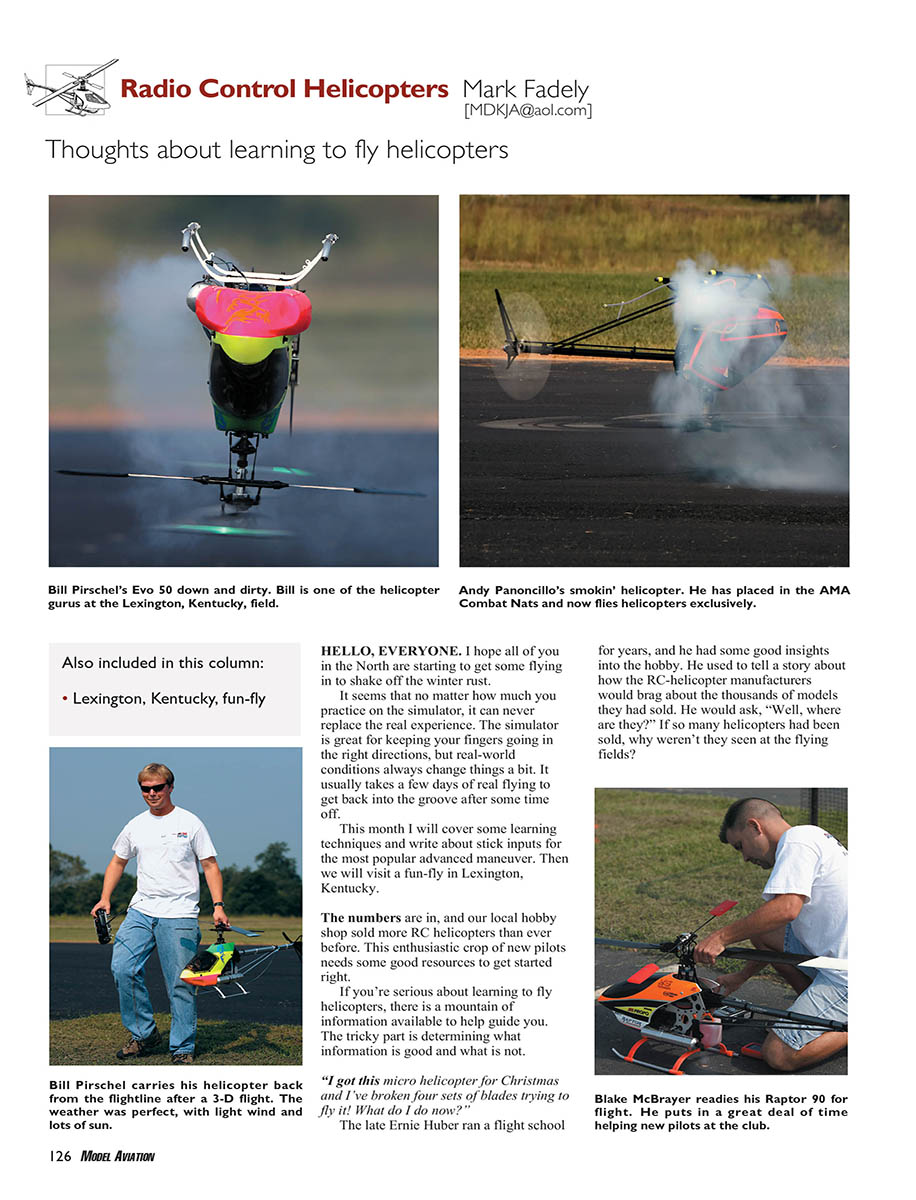
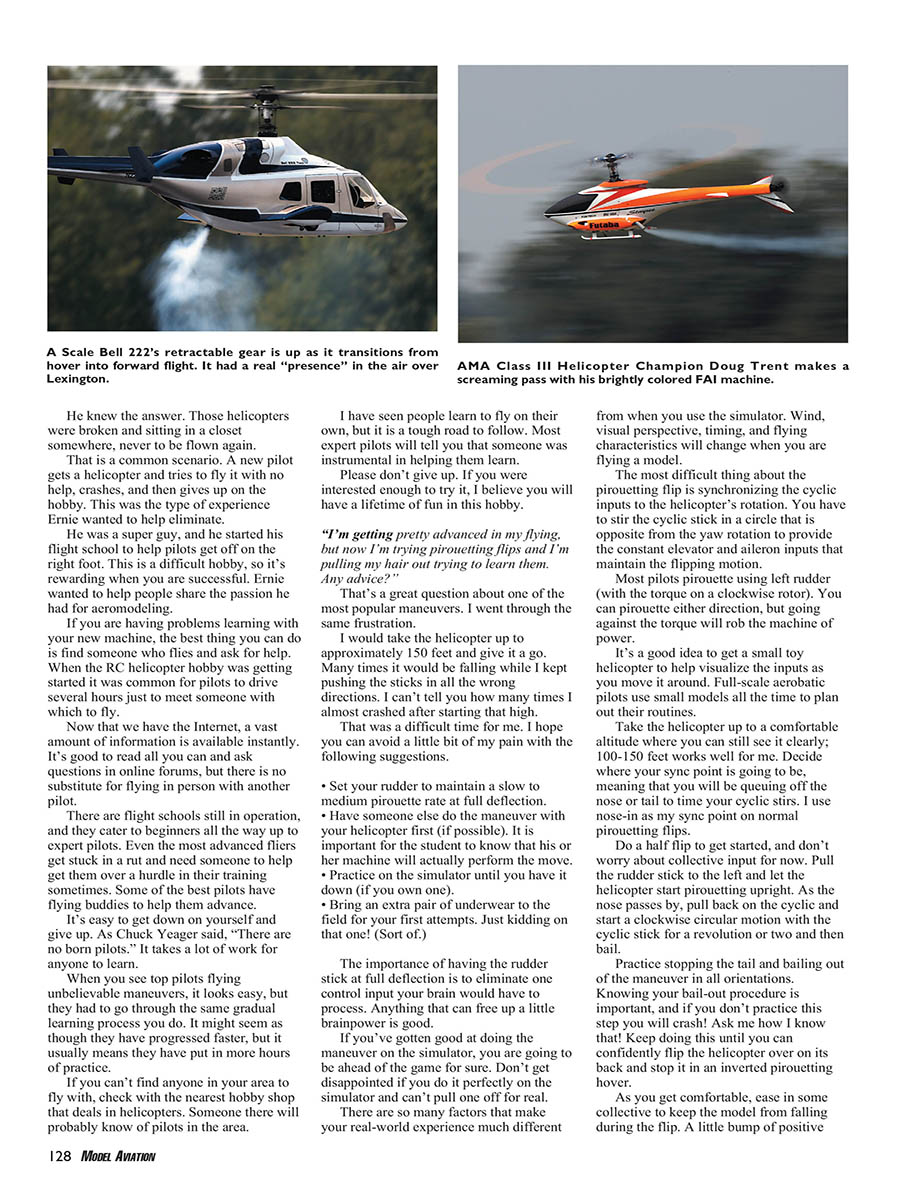
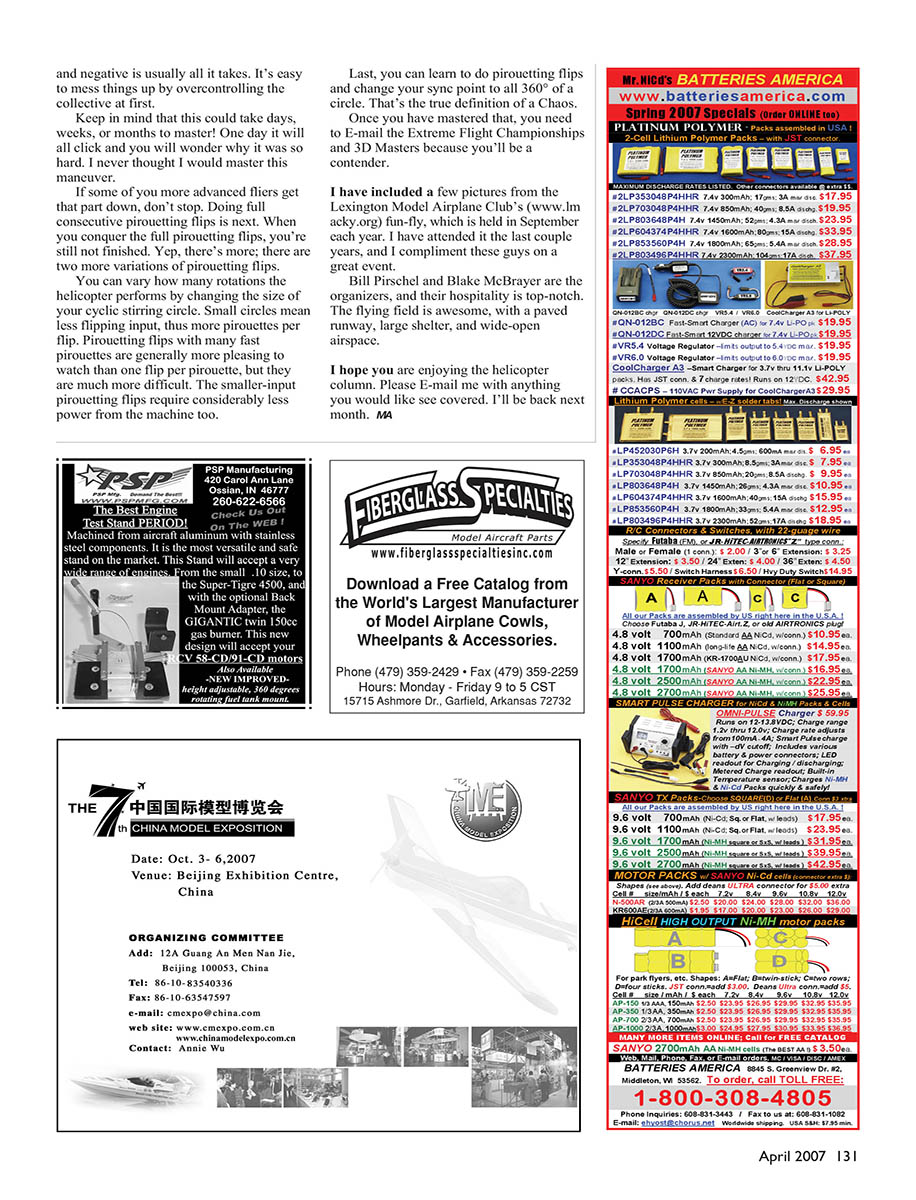
I have included a few pictures from the Lexington Model Airplane Club's (www.lmacky.org) fun-fly, which is held in September each year. I have attended the last couple of years, and I compliment these guys on a great event.
Bill Pirschel and Blake McBrayer are the organizers, and their hospitality is top-notch. The flying field is awesome, with a paved runway, large shelter, and wide-open airspace.
I hope you are enjoying the helicopter column. Please e-mail me with anything you would like to see covered. I'll be back next month.
Mark Fadely
Transcribed from original scans by AI. Minor OCR errors may remain.

