
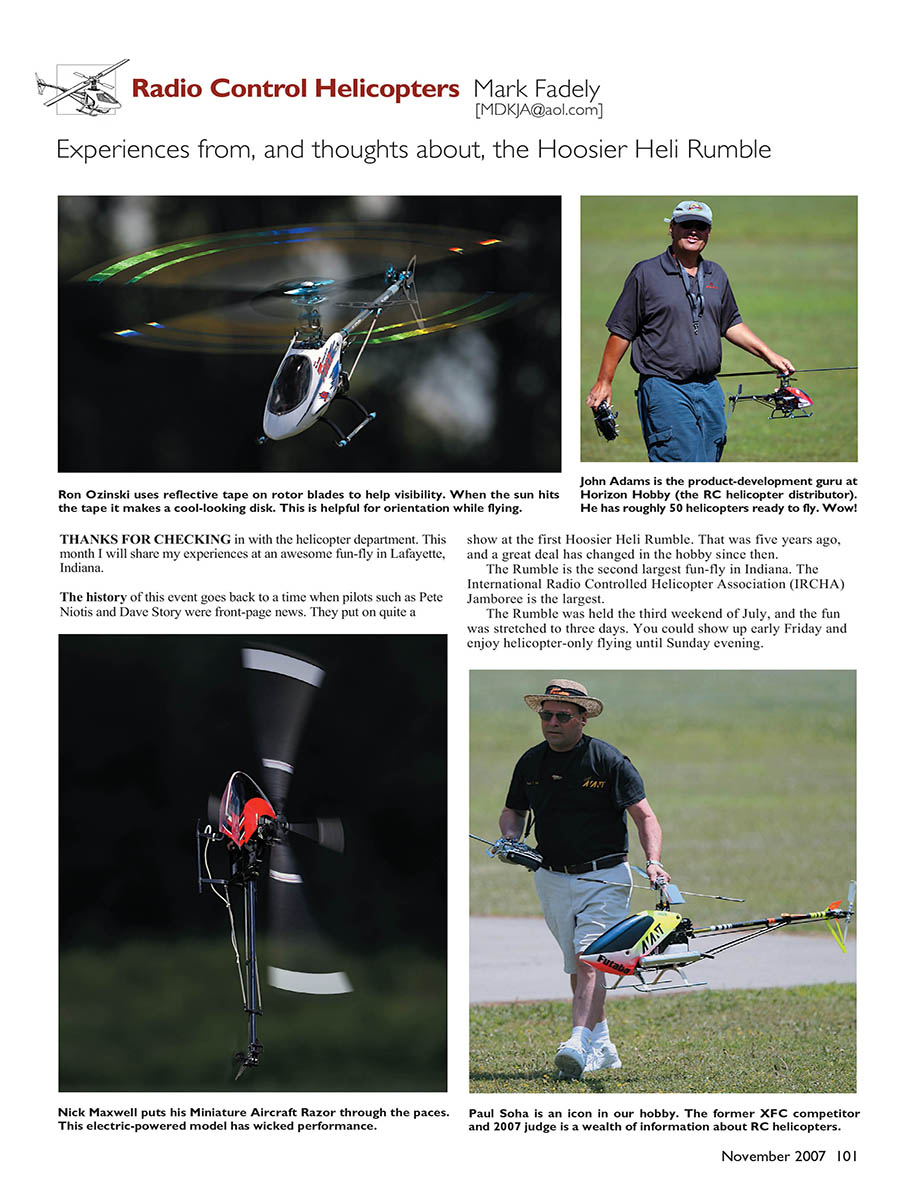
Radio Control Helicopters
Mark Fadely [[email protected]]
Experiences from, and thoughts about, the Hoosier Heli Rumble
Thanks for checking in with the helicopter department. This month I will share my experiences at an awesome fun-fly in Lafayette, Indiana.
The history of this event goes back to a time when pilots such as Pete Niotis and Dave Story were front-page news. They put on quite a show at the first Hoosier Heli Rumble. That was five years ago, and a great deal has changed in the hobby since then.
The Rumble is the second largest fun-fly in Indiana. The International Radio Controlled Helicopter Association (IRCHA) Jamboree is the largest.
The Rumble was held the third weekend of July, and the fun was stretched to three days. You could show up early Friday and enjoy helicopter-only flying until Sunday evening.
Origins of the Hoosier Heli Rumble — Erik Anderson
Following is how Erik describes the origins of the Hoosier Heli Rumble:
"The fun fly began about 6 years ago. The IRCHA Jamboree had not moved to Indiana yet and we thought that the pilots from Indiana, Illinois, Michigan, Ohio and Kentucky would appreciate having a good large-scale heli event. The Lafayette Cloud Jockeys had a great site for the event so we decided to go for it.
"The first year we had Curtis Youngblood as a guest pilot. Seventy-five pilots showed up that year and everyone had a great time.
"Unfortunately the next year I got called away with the military. The fun fly was run one more time but then on the third year there was a lot of flooding and the event had to be canceled. It kind of died out after that.
"I was away for about 5 years and then I came back to Lafayette. When I returned everyone was asking about the Rumble and when would it start up again. So I thought, why not? Let's get it going again. We decided to run it just the same way we had before.
"The focus of this fun fly is just on fun. We have a few impromptu contests during the weekend but nothing too formal. There was a night fly with a cash prize.
"There is a lot of work involved in putting on a fun fly. It is worth it though to see how much the pilots enjoy coming. There is a lot of camaraderie in this hobby and I like to see everyone enjoy themselves."
When I asked Erik how much he had been practicing, he replied:
"My available practice time was cut short when I was in the military but since returning to Lafayette I have been flying for Team JR and Horizon. That has helped a bunch. I have a lot more free time now and with this nice field so close to home it makes it very convenient."
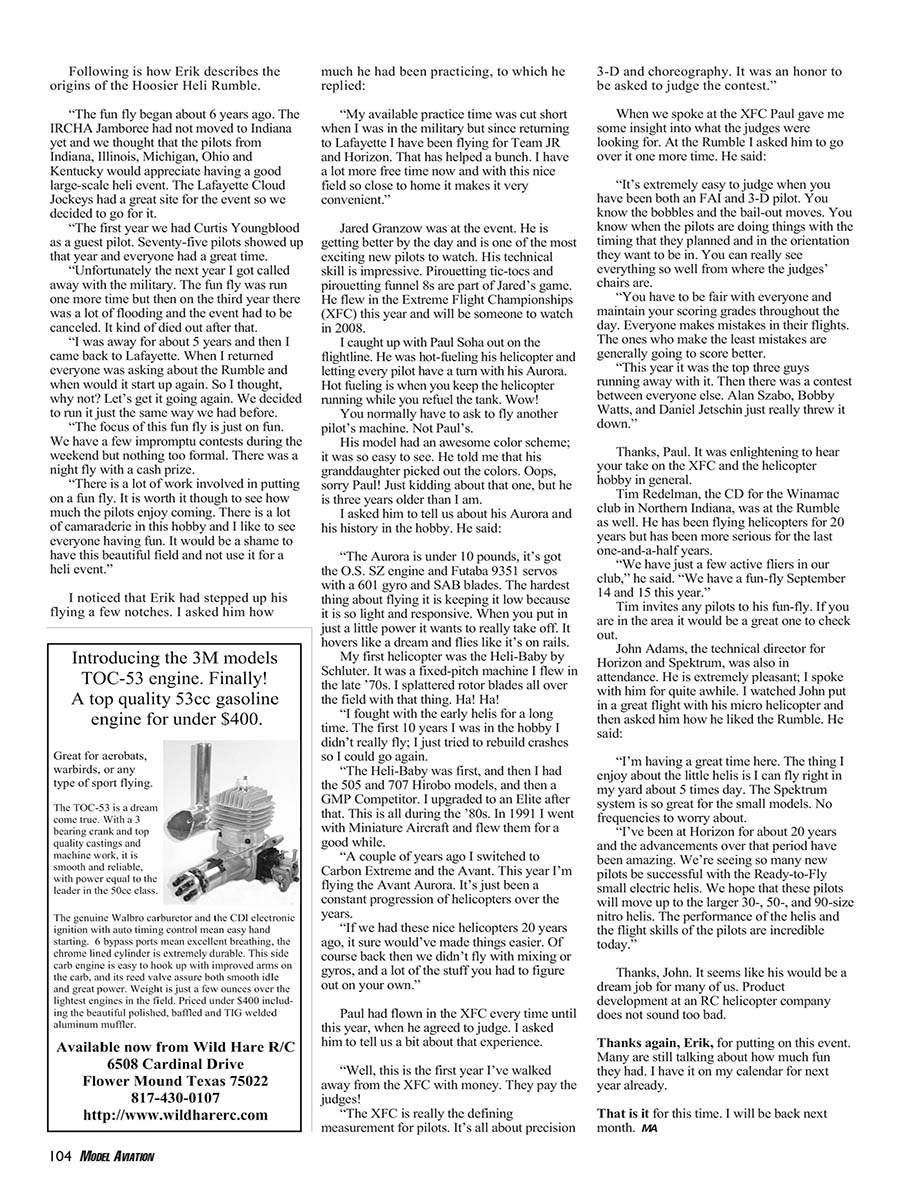
Erik Anderson organizes the event. Ron Kovach, Rob McGuire, and many other members of the hosting Lafayette Cloud Jockeys club help make it happen. Organizers and helpers included:
- Erik Anderson
- Ron Kovach
- Rob McGuire
- Members of the Lafayette Cloud Jockeys club
They have a beautiful facility. You enter the field by driving past a golf course. Lush grass and woods line the road as it winds down and around, finally opening up to a vast RC dream field with no distractions. The site is located along the banks of the Wabash River in Lafayette, Indiana.
The weather this year was beautiful, with blue skies, light winds, and temps in the 80s. Erik rented a killer sound system to play music while everyone flew. Any pilot could bring up his or her own CD or MP3 player and then go fly.
There was a full-course barbecue dinner for all registered pilots. All the food was fantastic.
Put this event on your calendar for next year if you can. It puts the "fun" back in "fun-fly." Way to go, Erik! The music was a big hit.
Pilots and highlights
Jared Granzow was at the event. He is getting better by the day and is one of the most exciting new pilots to watch. His technical skill is impressive. Pirouetting tic-tocs and pirouetting funnel 8s are part of Jared's game. He flew in the Extreme Flight Championships (XFC) this year and will be someone to watch in 2008.
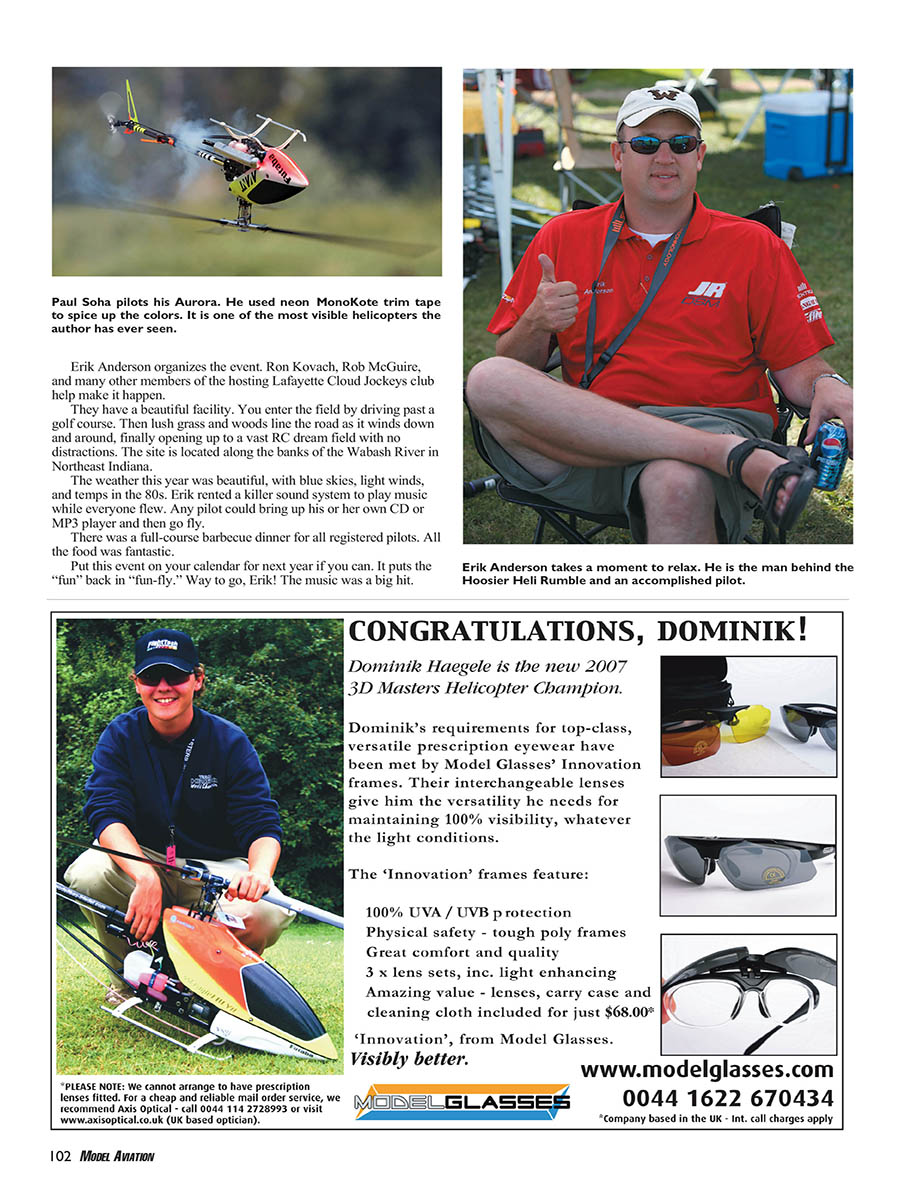
I caught up with Paul Soha out on the flightline. He was hot-fueling his helicopter and letting every pilot have a turn with his Aurora. Hot fueling is when you keep the helicopter running while you refuel the tank. Wow! You normally have to ask to fly another pilot's machine. Not Paul's.
His model had an awesome color scheme; it was so easy to see. He told me that his granddaughter picked out the colors. Oops, sorry Paul! Just kidding about that one, but he is three years older than I am.
I asked him to tell us about his Aurora and his history in the hobby. He said:
"The Aurora is under 10 pounds, it's got the O.S. 52 engine and Futaba 9351 servos with a 600 gyro and SAB blades. The hardest thing about flying it is keeping it low because it is so light and responsive. When you put in just a little power it wants to really take off. It hovers like a dream and flies like it's on rails.
"My first helicopter was the Heli-Baby by Schluter. It was a fixed-pitch machine I flew in the late '70s. I splattered rotor blades all over the field with that thing. Ha ha!
"I fought with the early helis for a long time. The first 10 years I was in the hobby I didn't really fly; I just tried to rebuild crashes so I could go out again.
"The Heli-Baby was first, and then I had the 505 and 707 Hirobo models, and then a GMP Competitor. I upgraded to an Elite after that. This is all during the '80s. In 1991 I went with Miniature Aircraft and flew them for a good while.
"A couple of years ago I switched to Carbon Extreme and then Avant. This year I'm flying the Avant Aurora. It's just been a constant progression of helicopters over the years.
"If we had these nice helicopters 20 years ago, it would have made things easier. Of course back then we didn't fly with mixing or gyros, and a lot of the stuff you had to figure out on your own."
Paul had flown in the XFC every time until this year, when he agreed to judge. I asked him to tell us a bit about that experience.
"Well, this is the first year I've walked away from the XFC with money. They pay the judges!
"The XFC is really the defining measurement for pilots. It's all about precision 3-D and choreography. It was an honor to be asked to judge the contest."
When we spoke at the XFC Paul gave me some insight into what the judges were looking for. At the Rumble I asked him to go over it one more time. He said:
"It's extremely easy to judge when you know the bobs and the bail-out moves. You know when the pilots are doing things with the timing that they planned and the orientation they want to be in. You can really see everything so well from where the judges' chairs are.
"You have to be fair with everyone and maintain your scoring grades throughout the day. Everyone makes mistakes in their flights. The ones who make the least mistakes are generally going to score better.
"This year it was the top three guys running away with it. Then there was a comb between everyone else. Allan Szabo, Bobby Watts, and Daniel Jetschin just really threw it down."
Thanks, Paul. It was enlightening to hear your take on the XFC and the helicopter hobby in general.
Tim Redelman, the CD for the Winamac club in Northern Indiana, was at the Rumble as well. He has been flying helicopters for 20 years but has been more serious for the last one-and-a-half years.
"We have just a few active fliers in our club," he said. "We have a fun-fly September 14 and 15 this year."
Tim invites any pilots to his fun-fly. If you are in the area it would be a great one to check out.
John Adams, the technical director for Horizon and Spektrum, was also in attendance. He is extremely pleasant; I spoke with him for quite a while. I watched John put in a great flight with his micro helicopter and then asked him how he liked the Rumble. He said:
"I'm having a great time here. The thing I enjoy about the little helis is I can fly right in my yard about 5 times a day. The Spektrum system is so great for the small models. No frequencies to worry about.
"I've been at Horizon for about 20 years and the advancements over that period have been amazing. We're seeing so many new pilots be successful with the Ready-to-Fly small electric helis. We hope that these pilots will move up later to the larger 30-, 50-, and 90-size nitro helis. The performance of the helis and the flight skills of the pilots are incredible today."
Thanks, John. It seems like his would be a dream job for many of us. Product development at an RC helicopter company does not sound too bad.
Thanks again, Erik, for putting on this event. Many are still talking about how much fun they had. I have it on my calendar for next year already.
That is it for this time. I will be back next month.
MA
Transcribed from original scans by AI. Minor OCR errors may remain.

