
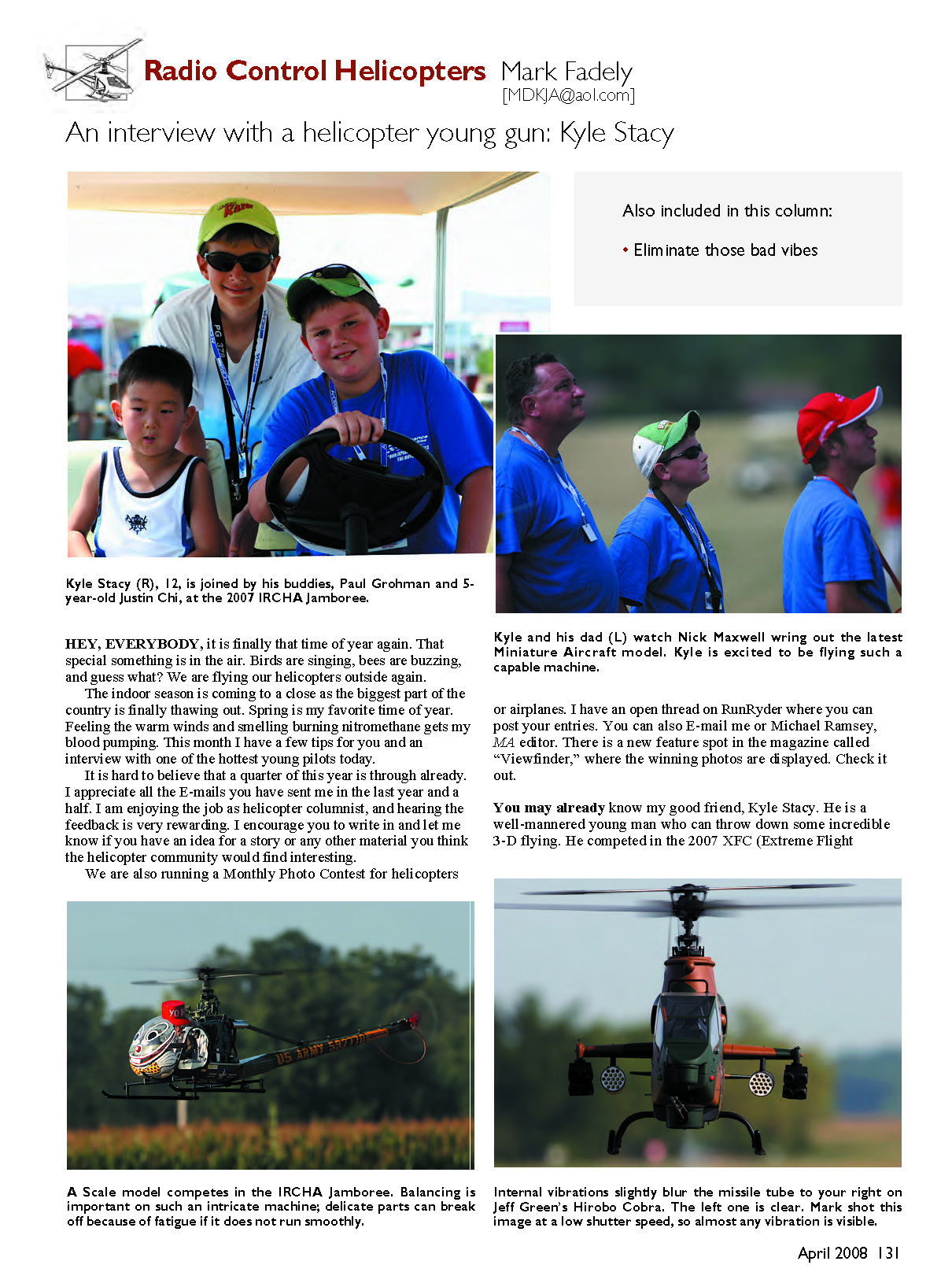
Radio Control Helicopters
Mark Fadely [[email protected]]
An interview with a helicopter young gun: Kyle Stacy
Hey, everybody, it is finally that time of year again. That special something is in the air. Birds are singing, bees are buzzing, and guess what? We are flying our helicopters outside again.
The indoor season is coming to a close as the biggest part of the country is finally thawing out. Spring is my favorite time of year. Feeling the warm winds and smelling burning nitromethane gets my blood pumping. This month I have a few tips for you and an interview with one of the hottest young pilots today.
It is hard to believe that a quarter of this year is through already. I appreciate all the e-mails you have sent me in the last year and a half. I am enjoying the job as helicopter columnist, and hearing the feedback is very rewarding. I encourage you to write in and let me know if you have an idea for a story or any other material you think the helicopter community would find interesting.
We are also running a monthly photo contest for helicopters or airplanes. I have an open thread on RunRyder where you can post your entries. You can also e-mail me or Michael Ramsey, MA editor. There is a new feature spot in the magazine called "Viewfinder," where the winning photos are displayed. Check it out.
You may already know my good friend Kyle Stacy. He is a well-mannered young man who can throw down some incredible 3-D flying. He competed in the 2007 XFC (Extreme Flight Championships). Watch out for Kyle; he has a new helicopter and will be quite a force this year.
Kyle’s father, Ray, is also a helicopter pilot and a longtime modeler. They make a great team. They reside in Rochester, New York, and each year Ray holds a nice fun-fly at the Rochester field.
Following is part of an interview I did with Kyle.
MF: How old are you now and what grade are you in school? KS: I am 12 and in the seventh grade.
MF: How long have you flown helicopters? KS: I first flew a simulator when I was 5. I flew my first helicopters — a Corona 120, Venture 30, and Raptor 50 — when I was 6.
MF: Do you have other hobbies too? KS: I am learning to play guitar. I also like flying RealFlight online with my friend Paul Grohman.
MF: What helicopter do you fly and who are your sponsors? KS: I fly the Miniature Aircraft Stratus mainly. I am hoping to fly the Bandit and Razor this year as part of Team Miniature Aircraft. My radio is the Futaba 12FGH 2.4 GHz. Empire Hobby/Hyperion was my first sponsor. Miniature Aircraft and Team Futaba signed me on this year. I am also sponsored by Youngblood Enterprises, Powermaster Fuel, and Scott Gray Products.
MF: What keeps you motivated to continue flying? KS: I like doing it with my dad and I like hanging out with my friends at the flying field. I want to keep improving. I like how my friend David Playfair pushes me to fly harder at my home field. Mostly I just love to fly.
MF: What is your main goal in the hobby? KS: To have fun, make new friends, and hopefully become one of the top pilots.
MF: Do you like competition? KS: I like the competitions to see how I do against other pilots. Competing makes me fly better and it's always fun to see my friends there.
MF: What advice would you give to beginning pilots? KS: When I was 7 Curtis Youngblood told me to keep it fun and I have. Don't fly if you aren't having fun. Be focused and practice. Set your goals and do it. I practice on the simulator every day. Don't just hang the sticks around, but try to learn something new. My dad always tells me to make good decisions and to respect people.
MF: Do you have any idea what you think your future career might be? KS: I don't know exactly what yet, but I would like to do something in aviation.
MF: What are your favorite maneuvers? KS: Reversing piroueting flips, and doing my dad's favorite takeoff — one I got from Curtis Youngblood — where you take off, push forward cyclic to nose down, do a half pirouette, and then fly out backwards inverted. I also like doing anything low.
Kyle, I want to thank you for taking time away from your busy Xbox schedule to talk with me. I am just kidding you, little buddy. I look forward to seeing you and your dad at the events this year. Take care.
Tail section vibrations and balancing
I am shifting gears now to resume the discussion about the trials and tribulations of helicopter vibrations. I have been writing about vibrations and balancing.
Having a smooth-running helicopter is extremely important. It will stay together longer and fly more efficiently, but did you ever consider what all that shaking is doing to your machine?
The long-term effects of vibrations can have dire consequences on the model, and possibly even you. When parts are subjected to continuing vibration, fatigue is inevitable. Then parts break in flight, which is not a good thing.
Anyone who has been hit by flying debris from a model airplane or helicopter knows it is something you want to avoid. Keeping our machines in top mechanical condition goes a long way to promote safety.
Last time I wrote about the main rotor and its profound effect in relation to visible vibrations. Now I'll peer into the much-misunderstood aft section of our helicopters.
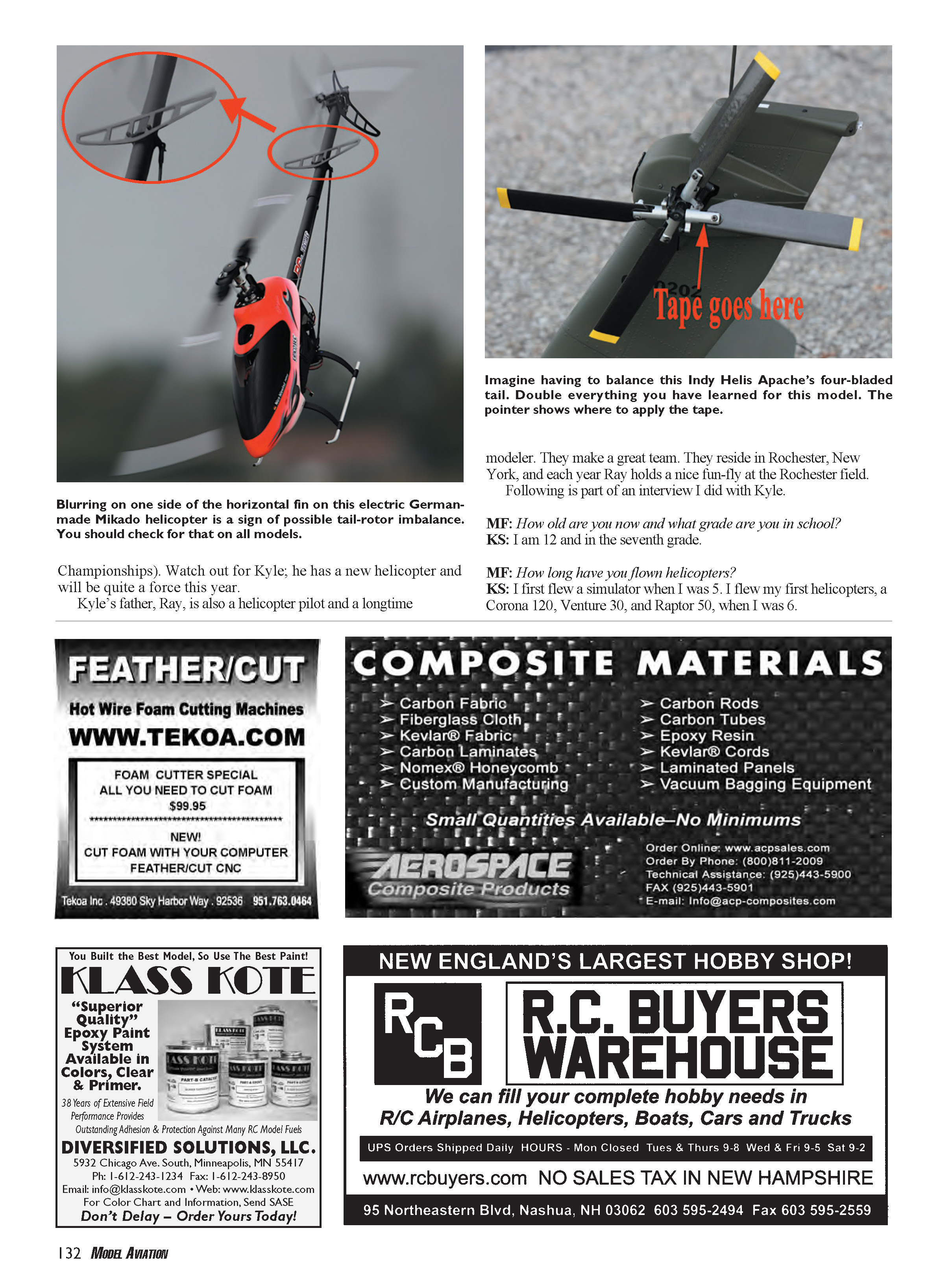
Think of the machine's entire tail section as one big tuning fork; that is how it behaves. There are so many things going on in the tail that it is tough to diagnose vibrations there. Knowledge is key, so I'll teach you what vibrations show up in the tail section and how you can fix them.
You should definitely balance the tail rotor. I have seen various methods of doing this, but I think there is only one good way: dynamic balancing. Does that sound familiar? It is the same method I used for balancing the main rotor head in the last discussion.
An AMA member who was a helicopter pilot in Vietnam e-mailed me after that column to let me know he balanced full-scale rotor blades the same way. He would spool up his Bell 47 and check for vibrations while hovering. Then he would land and put more or less masking tape on the blades until he got the aircraft running as smoothly as possible.
Wow — who would have thought you could balance a full-scale helicopter the same way?
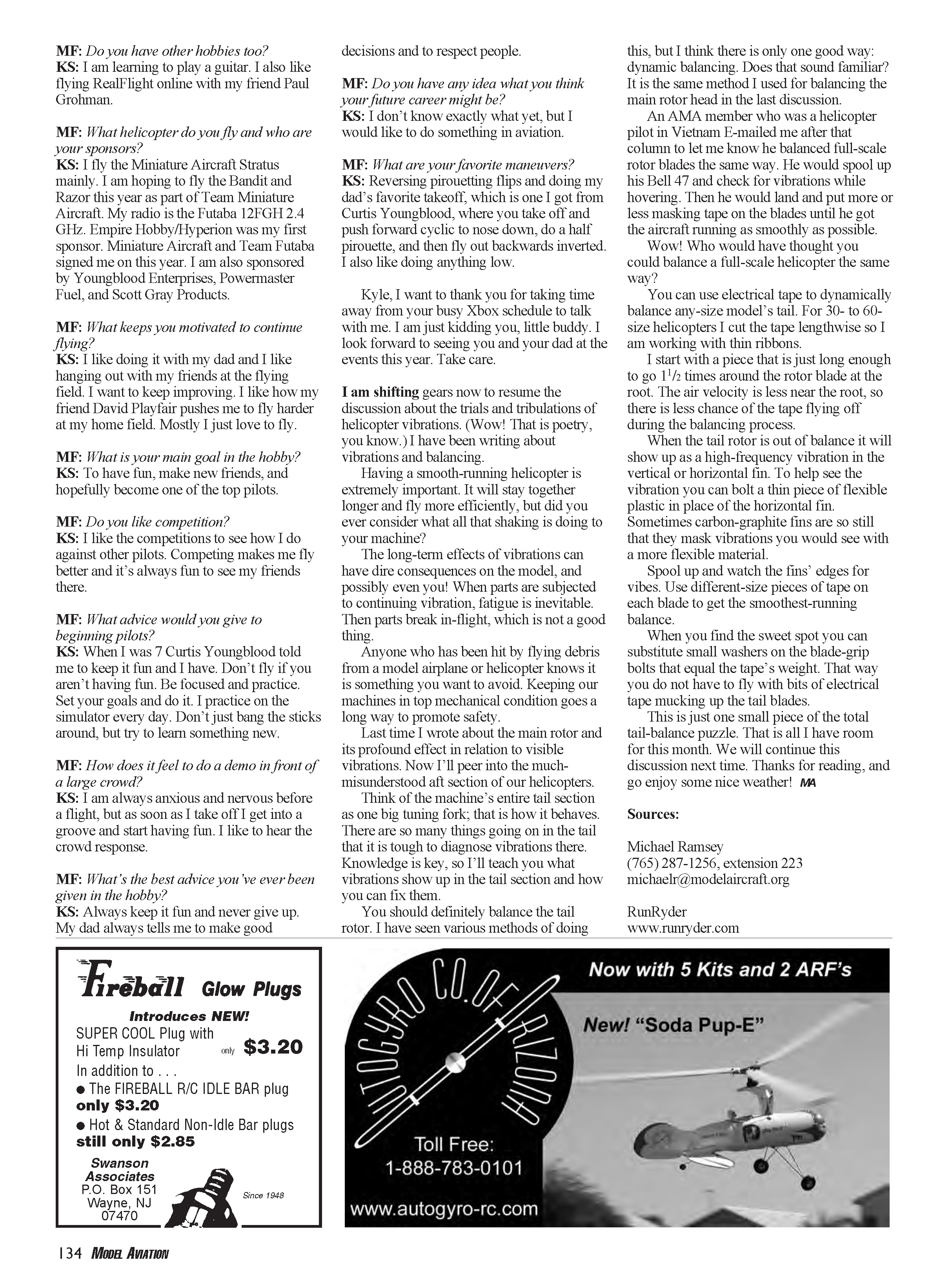
You can use electrical tape to dynamically balance any-size model's tail. For 30- to 60-size helicopters I cut the tape lengthwise so I am working with thin ribbons.
- Start with a piece just long enough to go one and a half times around the rotor blade at the root. The air velocity is less near the root, so there is less chance of the tape flying off during the balancing process.
- Use thin ribbons of tape (cut lengthwise) for 30–60 size blades.
- Replace the horizontal fin with a thin piece of flexible plastic to help see vibration; sometimes carbon-graphite fins are so stiff they mask vibrations.
- Spool up and watch the fin edges for high-frequency vibration showing in the vertical or horizontal fin.
- Add or remove different-size pieces of tape on each blade until the tail runs as smoothly as possible.
- Once you find the sweet spot, substitute small washers on the blade-grip bolts equal to the tape's weight so you don't have to fly with tape on the blades.
This is just one small piece of the total tail-balance puzzle. That is all I have room for this month. We will continue this discussion next time. Thanks for reading, and go enjoy some nice weather!
MA
Sources
- Michael Ramsey — (765) 287-1256, extension 223 — [email protected]
- RunRyder — www.runryder.com
Transcribed from original scans by AI. Minor OCR errors may remain.

